Semester 2
The New South:
When reconstruction began in 1877, the South became more stagnant. New changes to the area don’t begin to occur until the 1940s. Jim Crow reigned supreme.
The goal was to make the South a copy of the economically diverse and successful North.
Success?: To a limited extent. North owns factories, railroads, and banks, leaving the South stuck with what it has. factory jobs go to the whites, the South is still stuck to cash crops, and the African Americans stay in their roles in sharecropping.
The West:
These “cowboy” towns are far from permanent. They are built to create a center around a new railroad or a newly discovered resource, and they are gone in a decent amount of time. Those who pursue the West are also pursuing economic benefits in the East.
Soon enough, Native Americans were pushed to the edge. They have nowhere to go because of the frontier. The settlers have changed their lives, and there’s fear on both sides. Nothing in the government clearly states how to deal with the Natives, leading to confusing and broken treaties by both parties.
Railroads needed the tribes and the buffalo to move. So, the rail companies would hire people, like Buffalo Bill, to kill off the buffalo for food and to make way for the trains. The railroads showed no concern for the animals or the tribes, and federal troops began to intervene. They tried to enforce treaties that forced Natives onto reservations so they were out of the way of the whites.
Native Americans in the West
Indian Wars (1860s - 1880s)
Sand Creek Massacre (1864) — Sand Creek, Colorado. John Evans led a group of men to slaughter a group of Native Americans to make room for settlers.
Little Bighorn (1876) — George Armstrong leads a battalion and loses to a tribe of Native Americans. It renewed efforts to eliminate tribes in the West because of the perceived threat they posed to westward expansion and the gold rush.
The Reservation System: The concept was to place Native Americans on land not wanted by white settlers. Treaties are made promising land to move natives to, without explaining how horrible this land really was. As a result, natives end up in poverty and in a dependent relationship with the whites as they lose their traditional means of livelihood and are forced to assimilate into a culture that often disregards their values and ways of life.
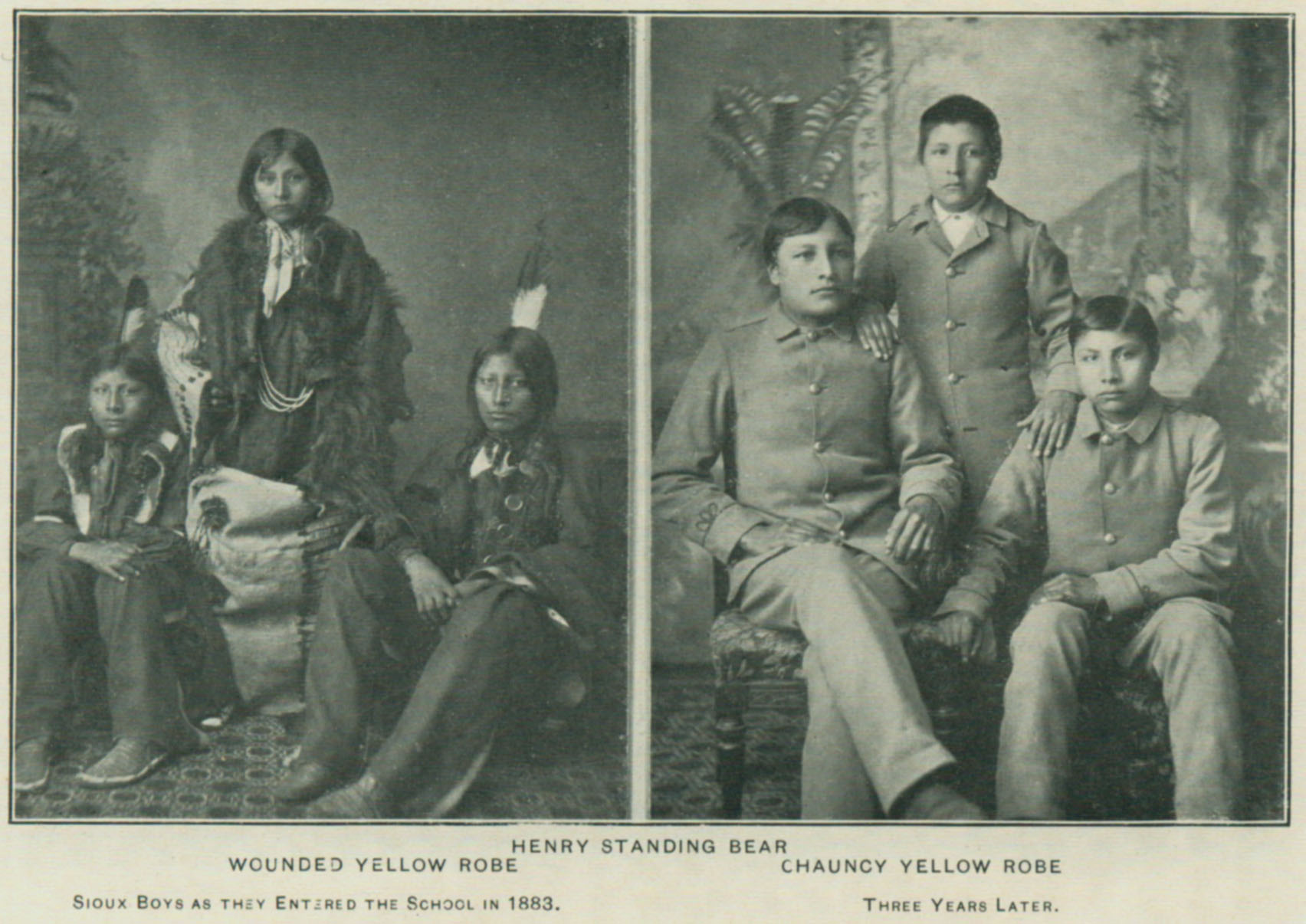
The Reform for Natives: Dawes Severaity Act (1887): “Kill the Indian and save the man”. The goal was to assimilate Natives into the white culture, often by promoting education programs that would enforce English language acquisition and vocational training, while erasing traditional practices and beliefs called Carlisle Schools. The chunks of land that were once set aside for Reservations were chipped away to be given elsewhere, leading to further loss of resources and autonomy for Native tribes. This trend continued over the decades, resulting in significant legal and cultural ramifications.
Oklahoma Land Rush (1889): The Federal Government gave away the last significant chunk of western land thanks to the Dawes Severalty Act. To try and make it fair, they literally held a race where thousands of settlers lined up and took off to claim their land parcels, often resulting in chaos and conflict over territories. Sooners, people who ignored the race and claimed land before anyone else, took advantage of opportunities to establish settlements illegally, further complicating land ownership and creating tensions among legitimate claimants.
Mining:
New strikes: In 1859, Colorado had a major gold discovery at Pikes Peak, sparking a massive influx of prospectors and miners hoping to strike it rich and leading to the establishment of new towns and economic opportunities across the region.
Boomtowns: Quick towns that are thrown up to try and create a spot for young, single men looking to start their lives. These towns create this “Wild West” concept.
Sherman Silver Purchase Act: Demanded by Silver Barons to increase the government's purchase of silver, leading to a significant expansion in silver mining and impacting the economy by increasing the money supply.
Boomtowns end up as ghost towns. Independent miners fall into corporations with hydraulic mining and huge environmental costs.
Cattle:
Cattle Drives: Meat needed for cities as new technology, like refrigerator cars, allows new food sources to be transported over long distances, facilitating the growth of the cattle industry and increasing profits for ranchers.
Slaughterhouses and meat plants emerge as crucial facilities to process the vast amounts of livestock, further boosting the economy and providing numerous jobs in both urban and rural areas, such as Chicago and KC.
Due to things like the Land Rush, Range Wars start. Fences and wires are thrown up to keep animals off the new land. Open ranges of cows and sheep end, railroads expand, and feedlots are invented.
Farmers:
Homestead Act (1862): The government aims to encourage people to settle in the West. So, they grant free land (160 acres) in the west to anyone who settles there for at least five years. Problems with this act included price increases, insufficient land, and interference with the railroad.
The Populist Party: Formed in the 1890s, the Populist Party emerged to represent the interests of farmers and laborers, advocating for policies such as the regulation of railroad rates, the establishment of a graduated income tax, and the direct election of senators.
They decided to have the coinage of silver, believing it would increase the money supply and provide relief from debt pressure, especially for farmers, thus benefiting the agrarian economy. Besides the support for farmers, the populists also gained the support of miners, as they were the ones collecting that silver and gold. Bankers, however, didn’t agree with this party because they wanted money to remain worth as much as it was.
Initiative: The populists also supported direct communication between the people and the government through things such as petitions
They also wanted multiple rights for workers, like 8-hour workdays and income taxesf or equitable wages, as well as the establishment of labor unions to advocate for better working conditions. Additionally, the party pushed for the implementation of government ownership of railroads and telegraph lines, which they believed would help to eliminate monopolies and return control to the people.
Tying the National Economy Together:
Communication:
The Pony Express: A mail service that operated between Missouri and California, providing quick delivery via horses that stopped from station to station.
The Transcontinental Telegraph: A Morse code operation system that allows people to communicate quickly across large expanses.
The Transatlantic cable: An undersea cable that greatly improved communication between North America and Europe, enabling near-instantaneous transmission of messages across the ocean.
The New York Stock Exchange: A marketplace for buying and selling stocks, where transactions are conducted on the trading floor and facilitated through a system of brokers, revolutionizing the way investors engage in the economy. It took advantage of its opportunities using technology like the stock ticker.
Alexander Graham Bell: The Telephone
The Government promotes the railroad: federal loans and land grants help push the railroad to become more important and widely used nationally, as it’s viewed as the country's most valuable asset at the time.
The Transcontinental Railroad: Immigrated workers from around the world put their lives on the line to help build the road from California to Oklahoma, and the awful working conditions earned the name “Hell on Wheels”.
Impacts: It allows for new resources to grow, new markets to bounce up, and bigger businesses to spawn. Immigration increased during its building and after, as people sought jobs and opportunities in the expanding economy fostered by the railroad. It also increased urbanization thanks to the sudden new need for labor forces in cities that sprang up along the railroad, transforming how people lived and worked across the nation.
Innovations and industrialization of the Gilded Age:
New industries and new jobs force economic growth.
The introduction of the refrigerated railcars, typewriters, and cash registers is an example of this.
These innovations allowed for the growth of leisure time, which consequently led to an increased demand for consumer goods and services, further fueling the economy during this transformative period.
Thomas Edison: He created the first Research and Development factory, holding over 1500 patents in his life, and helped found AT&T. He also invented the gramophone and a vitascope (early projector).
New Financial and Management Systems:
New ways to consolidate control of an industry. The goal was to create a monopoly in an industry by destroying competition.
Strategies: Cutting prices, having secret rebates to shippers, forming a “pool” to create a shared pricing system and have a stronger force to eliminate competition, “watering the stock,” or aka, lying to the shareholders.
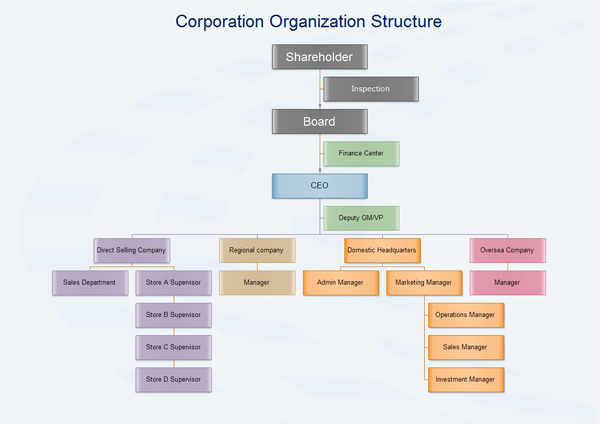
A new corporate structure is formed to make more money and push power around. Shareholders —> BODs —> CEOs —> Middle Class Managers —> workers
Marketing to a larger audience: Marketing increases demand and immigration due to its strong influence. This new immigration also allows for cheap labor and more customers, causing more marketing, and so on.
New marketing methods: Marketing became a science. Advertising firms boomed, department stores emerged, the hobby of browsing, chain stores exploded, and mail order catalogs were pushed to the public as the “modern” thing to do.
John D. Rockefeller: Creates a significant oil company. He’s a pioneer of horizontal integration, which allowed him to eliminate competition by acquiring not rival companies, but those above them on the chain, then higher, thereby controlling the market and maximizing profits.
Andrew Carnegie: An influential industrialist who led the expansion of the American steel industry, and eventually controlled 2/3s of the US market. He starts the process of vertical integration. He buys out each rank and step of processes so he can control the whole production chain, from raw materials to finished goods, resulting in reduced costs and increased efficiency in operations.
J.P. Morgan: He’s an investment banker who moves money around to the most efficient ability. He starts the idea of interlocking directorates. The concept that once you have enough, you should just buy basically anything you can, no matter the industry.
The Free Market:
Government role in the economy: Should they control or regulate? Should they do either? Or should they allow the market to operate freely without intervention, promoting competition and innovation among businesses?
Laissez-faire: an economic philosophy that advocates minimal government intervention in the marketplace, allowing supply and demand to dictate pricing and production.
Views on wealth:
The Social Gospel: Walter Rauschanbasch and Washington Gladden created the concept that, as a wealthy person, you have a responsibility to help those who have fallen by creating an example to follow, while also providing them with the ways and means for those who are poor to climb their way up.
Literary critiques of wealth: Various authors have examined the moral implications of wealth, suggesting that it can lead to isolation, corruption, and a disconnection from the values of community and empathy. These critiques often explore the tension between personal success and social responsibility, highlighting other possibilities such as socialism and communism.
Immigration:
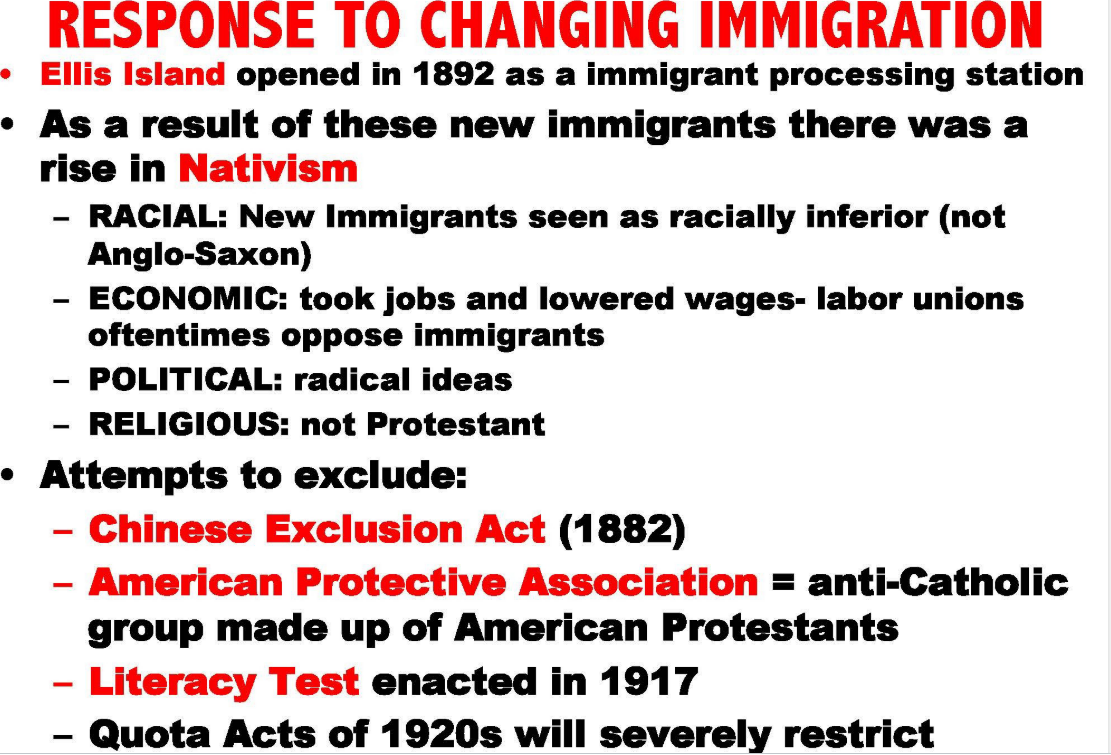
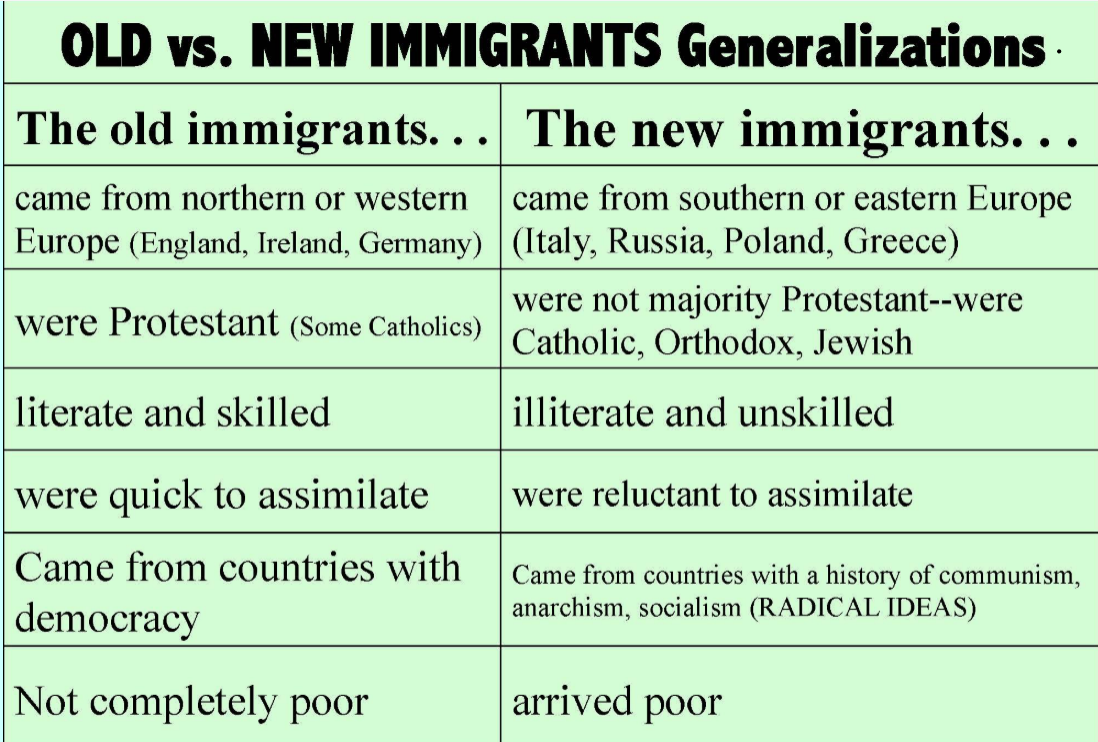
Nativism: The concept to blame immigrants for corruption in government, crime, radicalism (unions), violence, cheap labor, and labor competition.
Anti-Immigration Legislation: Restrict criminals, the insane, the infectious, alcoholics, and illiterates. Along with this, they passed the Chinese Exclusion Act and started the American Protective Association.
Urbanization:
Rapid post-war growth causes the population to triple. 40% of Americans will live in cities.
Reasons for growth: Industrialization produces more jobs, skyscrapers produce more space, and tenements are developed. Along with this, mass transportation grows and allows for easier access to these cities.
Urban problems: Overcrowding, sanitation, poverty/slums, crime, and pollution.
Period 7
Progressivism and TR:
The Progressives want to improve society. The problems that arose from industrialization, immigration, and urbanization needed to be fixed, and fast.
Led by many women and journalists. These people, especially the journalists, were called Muckrakers. They investigated and exposed issues and social problems, raking up the “muck” of society.
Progressive reforms:
Improving life in the big cities (housing, sanitation, health)
Government regulation of business and work conditions
Efforts to protect consumers
People are being more involved in government
Conservation: Protect America’s natural resources
4 new amendments were added to the Constitution:
16th: Allows the federal government to impose an income tax on individuals and businesses.
17th: Allows for the direct election of U.S. senators by popular vote rather than being chosen by state legislatures.
18th: Prohibits the manufacture, sale, and transportation of alcoholic beverages in the United States.
19th: Grants women the right to vote, prohibiting any U.S. citizen from being denied the right to vote based on sex.
Muckrakers: Journalists who write exposés on the evils of an industrial society.
Goals: They wanted to shock people into caring about an issue. But… they didn’t offer a change plan. They simply hoped that if people got involved, change would occur.
Political corruption: Increase middle-class control of government through reforms that attack political machines
The Secret Ballot: Nobody knows how you vote besides you and the counter.
Direct Primaries: These allow voters to directly select their party's nominees for the general election, promoting greater voter engagement and reducing the influence of party elites.
Direct Election of Senators: 17th Amendment
City Commissioners / City managers: Efficeincyin local governance is enhanced through the direct election of city commissioners and managers, as it allows citizens to hold their leaders accountable and ensures that elected officials prioritize the needs of their constituents.
The Initiative: Forces politicians to vote on a bill they don’t want to bring up
The Referendum: The public makes laws directly, without the politicians in the government
The Recall: This process enables voters to remove elected officials from office before the end of their term, fostering greater accountability and responsiveness among elected representatives.
Women's Suffrage:
Doubles middle class vote
Given in 1919 by the 19th Amendment
16th Amendment: Federal Income tax (1913)
18th Amendment: Prohibition. No more alcohol. (1919)
Progressivism and Labor:
Women and Children First: Keating Owens Act (1916), which prohibits child labor.
Improving the workplace: Building codes, sanitation codes, maxium 10 hour day
Teddy Roosevelt: 26th President of the United States, known for his progressive policies and trust-busting efforts.
The Square Deal: All men are not equal, however… the government can help protect anyone who isn’t on second base from the start.
The anthracite coal strike: PA miners want a 9-hour day and 20% more pay. The owners say no, but TR intervenes. He poses on the worker’s side instead.
TR creates the Department of Labor and Commerce: Mediate labor issues and investigate “improper trusts”.
Railroads: The Elkins Act (1903) imposed heavy fines for secret rebates. Hepburn Act (1906) makes it so the ICC can nullify and set maximum r.r rates
The Meat Inspection Act (1906): Ensures food safety by mandating federal inspection of meat products and setting sanitation standards for slaughterhouses.
Conservation/preservation: Gifford Pinchot becomes the first Chief Forester. Multiple Land use resource management starts. John Muir started the Sierra Club.
Wilson and Progressivism:
He strengthens antitrust laws —> Clayton Anti-trust Act. He adds lists of unfair business practices, exempts unions from sherman anti-trust act, and makes picketing and strikes legal.
Limits: WW has limits— He doesn’t aid AAs. He allows for the segregation of the federal government. He’s also very pro-business and helps conservative businessmen become appointed to the Federal Reserve Board and commissions.
WW1
War in Europe (1914):
The conflict begins with the assassination of Archduke Franz Ferdinand, which triggers a series of alliances and declarations of war among the major powers. The United States initially maintains a stance of neutrality, but tensions rise due to German submarine warfare and economic ties with the Allies.
US Neutrality:
Pro British: We share common.. everything.
Pro-German: 2nd most dominant ethnic group in the U.S
Wilson claims neutrality due to split
US German Dilemma:
U.S. will sell guns and food to both areas to gain cash
Election of 1916:
Wilson wins again, securing his second term as president due to a campaign focused on neutrality and the promise of keeping the nation out of the war… doesn’t happen. The Sussex Pledge fails quickly after his win.
Germany announces unrestricted submarine warfare.
MAIN: M= Militarism. A= Alliances. I= Imperialism. N= Nationalism.
The Zimmerman note: The main cause for the U.S. to jump into action. Germany calls for Germany to declare war on America with the promise of gaining land.
We declare war on 4/2/17
Wilson’s goals for the war:
The 14 points:
1. No more secret treaties
2. Freedom of the seas for all nations
3. Reduction of armaments (weapons)
4. Ethnic self-determination of colonies
5. Creation of the League of Nations
The ultimate peaceful crusade
Opposition to the war:
Socialists/Progressives: They don’t want social progress to pause. We can’t afford it.
Labor Unions: They argue that war efforts detract from workers' rights, wages, and job security, leading to a decline in labor standards while the economy rises.
Farmers: We need the cash cow of trading with Europe.
German Immigrants: Uh, don’t fight us?
Wilson tries to get people to support the war:
George Creel: Propaganda! Get people to enlist, donate with bonds, and support the war effort through various campaigns and through anti-German propaganda.
Hysteria:
Mobs spawn in cities and target Germans
Rename German words to hide names or to rebel
Espionage Act of 1917 and the Sedition Act of 1918: Illegal to criticize the government, and mail suspension was allowed.
Supreme Court case of Schenck vs. the U.S. of 1919:
No, you do not have full free speech. It ends if you cause a clear and present danger with your words.
Organizing for the war:
War Industries Board: Allocate raw materials, tell manufacturers what to produce, fix prices, and standardize production.
Big Businesses benefit, smalls fall.
Volunteerism: Ask, don’t make.
Victory gardens to save food for troops
Labor:
National Was Labor Board:
Encourages businesses to keep labor happy with 8-hour days and higher wages.
Unions that protest are put down fast. We don’t have time.
Paying for the war:
1/3 revenue act (graduated up to 65% of income)
No substitutes: Selective Service Act (drafting)
1920s
Central Question: What is the function of government?
SECOND BILL OF RIGHTS
Every American has the right to:
A job, ensuring that every citizen is provided with an opportunity to earn a livelihood.
An adequate wage and decent living, emphasizing the importance of fair compensation for labor that enables individuals to meet their essential needs.
A decent home, recognizing housing as a fundamental human right, fostering stability and security.
Medical care, aiming to provide universal healthcare access and reduce financial barriers to receiving medical treatment.
Economic protection during sickness, accident, old age, or unemployment, highlighting the need for social safety nets and support systems.
A good education, asserting that quality education is essential for personal and societal advancement.
Discussion: How does this change FDR? The introduction of the Second Bill of Rights represents a significant shift in Franklin D. Roosevelt's vision for the role of the government, moving from a focus merely on economic recovery to ensuring a more equitable and just society.
I. The Twenties
Historical Context: The era known for praise of big business, reflecting a general societal belief in the free market and the potential of American capitalism to foster growth and prosperity.
A. Immediate Post-War Period
Isolationism
Disillusionment with war as the 14 points were not attained, leading to skepticism about international involvement and reliance on global cooperation.
Shift in focus: Stop trying to save the world and focus on the U.S., resulting in a withdrawal into domestic issues and a reluctance to engage in foreign conflicts.
The Death of Progressivism
General sentiment: People become tired of crusades and reforms, resulting in a cultural desire for stability and normalcy.
Embracing fun and making money becomes the norm, promoting consumerism and leisure activities.
Economic Recession
Causes:
Factories shut down or adapted to making consumer goods, leading to job cuts and economic instability.
Returning veterans increase job competition, resulting in lower-paying jobs that contribute to discontent.
Labor strikes and inflation rise due to scarcity of consumer goods and high demand for products, leading to social unrest.
Example: Seattle faced a strike involving 60,000 longshoremen, demonstrating widespread labor dissatisfaction.
Quote: “There is no right to strike against the public by anybody, anywhere, anytime.” – Gov. Calvin Coolidge.
Response: Coolidge mobilizes the National Guard and dismisses police, showcasing governmental resistance to labor movements and tensions between workers and authorities.
The Red Scare
Major Fear: Concern that Bolshevik immigrants would instill radical ideas in the U.S., inciting social and political paranoia across the nation.
Actions Taken: Over 40 mail bombs delivered, including one to the Attorney General's house, illustrating the perceived threat of radicalism.
The Red Scare Continued
Led by Attorney General A. Mitchell Palmer, raids target suspected radicals, often without substantial evidence, marking a dark period for civil liberties.
J. Edgar Hoover appointed as head of the Bureau of Investigation, setting a precedent for federal involvement in domestic surveillance.
Consequences: 6,000 arrests, with 249 “suspected” radicals deported to the USSR on the “Russian Ark,” instigating fear and eroding trust in immigrant communities.
Legislative Action: New York legislature expels five Socialist Party representatives, demonstrating the systemic suppression of political dissent.
Quote by Guy Empey: “I believe we should place them [the Reds] all on a ship of stone, with sails of lead, and that their first stopping place should be hell,” illustrating public sentiment towards radicals.
Palmer’s Warnings and Actions
Notable Event: Wall Street bombing (1920) heightens tensions and exemplifies fears of rampant anarchism and terrorism.
Palmer warns of possible May Day riots (1920), but no uprising occurs, leading to reduced hysteria and shifting public focus.
Rhetoric: Palmer’s statements advocate for extreme measures against radicals: “Stand them up before the firing squad and save space on our ships” and “S.O.S.—ship or shoot,” revealing the radicalization of law enforcement narratives.
Notorious Legal Cases
Sacco & Vanzetti Case: Italian immigrants executed for armed robbery and murder without solid evidence, symbolizing the biases in the American justice system.
The judge referred to them derogatorily as “those anarchist bastards,” highlighting the pervasive xenophobia and intolerance of the time.
B. Industry and Invention
Shift from Production to Consumption
Spending augmented by pent-up war savings, accessibility to easy credit, and increases in real wages following transitions, leading to consumer-driven economic growth.
Importance of understanding these economic dynamics illustrated by accompanying graphs that detail the relationship between consumer behavior and economic health.
The Second Industrial Revolution (1922-1929)
Features:
Another industrial boom focused on consumer durable goods, such as appliances, cars, radios, furniture, and clothing, reflecting changing lifestyle needs.
Electricity supersedes steam power, enhancing efficiency, reducing costs, and producing more affordable goods for the masses.
Growth in national brand awareness connects Americans nationwide, overshadowing local goods and promoting a standardized consumer experience.
Advertising’s Role
Advertising thrives, stimulating economic growth by:
Convincing consumers to buy more due to peer pressure and sex appeal, creating a culture centered around consumption.
Involvement of celebrity spokespeople and campaigns originating from Madison Avenue, reflecting the growing intersection of commerce and entertainment.
Advancements in Production
Lower prices achieved through technological improvements, such as:
Henry Ford's enhancements to the assembly line, revolutionizing the speed and efficiency of production.
Frederick W. Taylor's efficiency studies leading to Taylorism, emphasizing maximizing productivity in the workplace.
Transition to a consumer economy through welfare capitalism:
Business owners provide employees with stock options and wages high enough for them to buy products they help create, fostering a sense of investment in the company’s success.
Growth of the Auto Industry
Henry Ford's “Tin Lizzie” revolutionizes transportation, making vehicles attainable for average Americans at a price of $260, leading to a surge in automobile ownership.
Detroit emerges as the industrial hub, spurring growth in related sectors (glass, rubber, roads, oil), creating numerous job opportunities and transforming American landscapes.
Impact on families:
Enables freedom for youth through personal transport, reshaping social dynamics as teenagers gain mobility.
Family road trips promote social connections and tourism, fostering a new appreciation for leisure travel.
Airplane Development
Contributions of Orville and Wilbur Wright, particularly their first successful flight in Kitty Hawk, NC, in 1903, sparking interest in aviation.
The barnstorming era and the influence of Charles Lindbergh’s 1927 transatlantic flight popularize commercial aviation and set the stage for future innovations in air travel.
Radio’s Transformation
Birth of popular culture through radio broadcasting, as it becomes a primary source of entertainment and news.X
Example: The 1920 broadcast of Harding's election marks a turning point in political engagement and media influence.
Key programs included: Amos and Andy, Harold Gray's Little Orphan Annie, and other popular shows engaging diverse audiences.
Significance: Radio became a medium that unified families and the nation, reshaping communal experiences through collective listening.
Film Industry Evolution
Early cinema, pioneered by Thomas Edison in the 1890s: Nickelodeons and notable films such as "The Great Train Robbery" and "The Birth of a Nation" lay the foundation for the motion picture industry.
Hollywood as a burgeoning center of film, exemplified by "The Jazz Singer" (1927), represents the cultural apex of cinema during this era.
Social Impact: Films reshape societal norms around womanhood, promote gender roles, and create shared national experiences, reflecting and influencing public attitudes.
C. A Quickly Changing Society
Gangster Culture and Prohibition
Prohibition led to profits from bootlegging; Al Capone became emblematic of organized crime and gangland violence, personifying the era's lawlessness.
Notable incidents: The St. Valentine’s Day Massacre and Alcatraz's notoriety as a federal prison highlight the criminal network’s reach and public fascination with gangsters.
Prohibition Dynamics
Enforced by the Volstead Act:
Strong support among Midwestern farmers and Southern groups, yet weak in immigrant-held Northeastern cities, cultivating a divide in public opinion.
Obstacles regarding enforcement:
Public disillusionment with reform, ease of illegal production, and changing moral attitudes toward alcohol consumption creating challenges to legality and authority.
Impacts of Prohibition
Resulted in:
A rise of organized crime and significant corruption within law enforcement as officials compromised their integrity.
Increased consumption of hard liquor as bootlegging flourished, paradoxically leading to harder drinking habits nationwide.
A notable, if partial, decline in overall drinking habits and improved work attendance rates, demonstrating society's complex relationship with alcohol.
Despite being inforced, prohibition was kind of a joke law, as many who tried to enforce it were the ones drinking the next night.
Rise of Sports as Big Business
The 1920s saw the intersection of technology, advertising, and celebrity culture:
Creation of prominent athletes, illustrated by figures like Jack Dempsey and Babe Ruth, who become cultural icons transcending sport.
Notre Dame's football team, notably featuring the Four Horsemen, illustrate the rise of college athletics in the national consciousness.
Urbanization Trends
Shift in demographic representation as urban centers like Chicago and New York rise in prominence:
Implications for self-perception in American society, creating a dichotomy between urban and rural identities.
Women’s Changing Roles
Young women challenge traditional views of domesticity, driven by economic and political independence alongside urbanization and feminist movements.
The 19th Amendment grants voting rights to women, yet turnout remains low, prompting discussions about empowerment versus societal constraints.
Flappers as Cultural Icons
Definition: Young, urban, single, working women who symbolize a lifestyle rebellion against traditional female roles and societal expectations.
General societal perspective: Many question the morality and implications of the flapper culture stemming from the 19th Amendment, reflecting broader anxieties about women's liberation.
Margaret Sanger and Birth Control Advocacy
Faced suppression on birth control discussions due to Comstock laws, which criminalized contraceptive dissemination.
Establishes the American Birth Control League (later known as Planned Parenthood), advocating for reproductive rights and health education.
The National Women’s Party pushes for the Equal Rights Amendment, which fails to pass, illustrating the struggles within the women’s rights movement during this period.
Divided opinions among women regarding evolving social expectations highlight the varied experiences within the female population.
Influence of Sigmund Freud
Promotes the idea of unconscious drives (notably sexual) influencing human behavior, validating a Bohemian lifestyle with a philosophy of “Do what you think,” challenging Victorian norms on sexuality and morality.
Cultural Significance of Jazz
Popularized during the Great Migration, with figures like Louis Armstrong leading the movement northward to cities like Harlem, contributing to a cultural renaissance.
Adoption among white audiences promotes a shared cultural experience that defies traditional values and fosters racial integration through music.
Harlem Renaissance and African American Culture
Emergence of a vibrant cultural scene in northern cities:
Notable figures: Langston Hughes whose poems such as "The Negro Speaks of Rivers" explore deep historical connections to African heritage and collective struggles.
Hughes’s poem “Dream Deferred” discusses the consequences of unrealized aspirations symbolically, reflecting the frustrations of African Americans.
Marcus Garvey and the movement for Black Nationalism:
Promoted cultural pride and the establishment of organizations like the United Negro Improvement Association and the Black Star Line to celebrate and uplift African American heritage.
Literature of the “Lost Generation”
Notable Authors: H.L. Mencken, identified as the father of this movement, critiques middle-class values of marriage, patriotism, and democracy, embodying the disillusionment of post-war society.
Other authors like e.e. cummings display a similar disillusionment, using experimental forms to express their discontent and search for meaning.
D. Social Conservatism
Response to Change
Cultural and demographic shifts provoke conservative reactions across various facets of society, leading to a resurgence of traditional values.
Nativism Trends
Resulting from new immigration patterns primarily from Poland and Italy:
Association with Isolationism, leading to the Emergency Quota Act of 1921, which limits immigration to 3% of the ethnic population in 1890.
Intended to impose restrictions on newer immigrant groups, aiming to preserve a perceived American identity.
Nativism Continued
Immigration Act of 1924 further restricts by lowering the limit to 2%, marking a stark tightening of immigration policy.
Explicit exclusions target Japanese immigrants, reflecting a continued nativist sentiment and racial discrimination.
KKK Rises Again
Revitalization of the Ku Klux Klan during the mid-1920s:
Financing and influence extend to various forms of anti-immigrant, anti-Semitic, and anti-Communist sentiment, showcasing the Klan's resurgence in national politics.
Initially strong in the South and West, but began to decline after internal conflicts, revealing the fragility of nativist coalitions.
Historical Local Influence
Example: Mayor Ben Franklin Stapleton of Denver (1923-31), who promoted anti-Jewish and anti-Catholic laws, illustrating broader nativist impacts on governance and community attitudes.
Fundamentalism’s Resurgence
Reaction from Christian leaders worried about societal changes promoting a return to literal biblical interpretations.
Exemplified by the Scopes Monkey Trial (1925), reflecting tensions between modernism and traditionalist views, emblematic of the culture wars shaping American identity.
The Great Depression:
ww2
Ethnic Groups:
Germans: Little Discrimination
Lack of Immigration
Little propaganda
Japanese:
Pearl Harbor hysteria
History of anti-Japanese racism
Holding camps, loss of property
Horematsu V. US
Propaganda:
Pearl Harbor: Little need to showcase the drama… it was all real.
Smoky the Bear
Production:
Mass War production with ships, types of them, huge amounts (1 per hour) of them, and the quality of them.
Women:
War: Demand for labor, no matter the gender. We’re distressed. Gender doesn’t matter right now.
Young, unmarried women join to serve as nurses in the military
Many women, after the war, returned home with newfound confidence and skills, creating families.
Migration:
Urbanization increases as people shift into the Sunbelt, aka the region in the southern United States that has seen rapid population growth and economic development due to the military draw of the region.
African Americans:
Another great Migration: North and west, and into service
They’re pushed by racism, but pulled by industrial jobs
Race riots bloom in the north
Fair employment practices commission
no more discrimination
Mexican Americans:
The 1942 agreement with Mexico allowed Mexican farmers to enter the US without going through immigration
300,000 will enter during the war, and most will stay
DRamatically impacts the racial makeup
Race Riots bloom in 1943
Europe 1941-1943:
England wanted to attack Italy from Northern Africa
The soviet union launched a significant counteroffensive, turning the tide in the Eastern Front and marking a critical phase in the war
The USSR “freed” Poland, Hungary, and Romania
Tehran Conference, 1943:
In 1943, FDR, Churchill, and Stalin met in Tehran, Iran, for the first of three wartime conferences.
The USA, Britain, and USSR coordinated their war strategy
FDR and Churchill finally committed to Stalin’s demands to open a western front (D-Day)
Discussed plans to create a “general international organization” to promote peace
Election of 1944:
GOP
Thomas Dewey
Platform
Finish war, promote peace
Democrats:
FDR - 4th term
FDR’s health is failing
Harry S Truman, the new VP candidate
Returns:
FDR wins and becomes the only four-time president in U.S. history, which raises expectations for his next term despite his deteriorating health.
War in Europe Ends:
Battle of the Bulge:
The last attempt by the Nazis to attack and gain something — they used the last tanks, gas, and materials — in hopes to cause enough destruction to force America into starting peace
The Race for Germany:
The US advances from the West, and the USSR advances from the East. It’s a race to occupy as much of the country as possible before anyone else can.
Yalta (1945):
Discuss Russia declaring war on Japan
FDR agrees to let the USSR remain “temporarily” in Eastern Europe
Stalin agrees to free elections in Eastern Europe (never happens)= Russia wins the negotiation
The Death of Leaders:
FDR dies in his sleep in April 1945
Hitler committed suicide in April 1945
V-E Day:
May 18th, 1945
The Pacific Front
The USA:
They plan and execute a bombing on Tokyo to intimidate, which eventually leads to one of the biggest Naval fights in history, known as the Battle of Midway, which they win.
Island Hopping: This strategy allowed the allies to win strategic islands without investing precious time, resources, and others.
The Japanese:
They refused to follow, or even recognize, the “rules” of war that were laid out in the Geneva Convention.
The Death March: POW American soldiers are dragged across the Philippines and killed
The End:
The Japanese don’t let down easily, deploying tactics like Kamikaze pilots to keep the war going.
The Manhattan Project:
Oppenheimer- in charge: many scientists from Germany collaborated, leading to groundbreaking advancements in nuclear physics.
The Project itself is caught by Russian spies, heightening future tensions
Beyond bombs, new technologies like jet engines, sonar, and penicillin were created… then the internet.
Potsdam (July 1945):
This conference confirms the USSR's entry into the Pacific
Pacific casualties mounting for the US
Russia enters the Pacific Theatre
Hiroshima:
Whilst Japan is trying to surrender, it is invaded. The American public demands unconditional surrender, and Truman wants to avoid USSR activity in Japan.
In the end, Truman, hoping to save American lives, decides the bomb is the best option.
VJ-Day: 1945
The 50s
America’s economic boom:
Undamaged by the war, the country doesn’t have a ton of repairs to make.
Increased factories still stand from the war, and they need a purpose, so we start to produce like crazy
Continued government spending on defense, with VA loans/ the GI bill
Pent-up consumer demand finally bursts
Oil is discovered, leading to cheap energy, which the economy runs on
Rising Standard of Living:
The Middle Class is over 60% of the population
New labor-saving devices are efficient but cheap
The US becomes the wealthiest nation in the history of the world
The Baby Boom:
Americans produced a “baby boom” in the 1950s, leading to the largest generation in US history
The return of soldiers from war led to an increase in marriage and birthrate
The baby boom led to a growing demand for schools, housing, daycare, and infastructure
Employment also rises thanks to this
Suburbanization:
The demand for a safe place to raise a family results in government-funded road construction —> higheays are born
VA loans: These government-backed loans provide access to affordable housing for veterans
The “White Flight”: Most whites can afford to move to suburban areas, often leaving behind urban neighborhoods and contributing to socioeconomic divides. Those left behind in the cities can spread out, and ethnic communities may begin to form
Automania:
Cars are more common, and that development leads to new ideas like fast food, traveling across the country by car, drive-ins, and more amusement parks
The election of 1952:
Democrats:
Adlai Stevenson (IL)
The party is hurt by the three C’s
Communism
Corruption
Korea
GOP:
General Dwight D. Esienhpwer (Ike)
He ended the Korean war
His vice president… Nixon.
Civil Rights
1940s:
Desegregation: The beginning of the movement. The military, sports, and other activities become mixed rather than separated.
1950s:
Brown V Board of Education:
By overturning Plessy V Ferguson, this case votes that segregation is unconstitutional and that everyone should desegregate with all deliberate speed.
Ike refuses to risk popularity to enforce decision, but he’s eventually forced to act through a bunch of events:
Rosa Parks and the Montgomery Bus Boycott (1955)
MLK and others pose non-violent non-coorperation
Little Rock 9
The current governor of Arkansas at the time used a national guard to try and keep colored high schoolers out of schools and hold back integration
Ike responds at last, stopping the guard from hurting the students and instead telling them to walk the students to the school and keep them safe
This marks the time when the government starts to become responsible for social affairs and change
Dynamic Conservatism:
The idea was the balance the budget but continue some government programs— Cons. W/ $ but not w/ people
Conservative:
Refuse government money to pay for vaccines
Reduce TVA
Reduce defense spending
More Bang for the Buck— Reduce costs by reducing actual soldiers and replace them with weaponry
Brinkmanship: The use of possible conflict to achieve FP goals. Playing chicken with bombs
Strategic Air Command: Nuclear Weapons Division
Liberal:
Continue social security
Continue farm subsides
Interstate Highway Act for defense and evacuation
The Middle East
The US gains interest in the region after oil is discovered and could be extracted for cheaply to produce revenue
US engineers overthrow the government, aka the Shah, in 1953, after plans aren’t followed
Truman + Oil = Eisenhower Doctorine
The 60s
JFK Domestic Events
Civil rights: JFK promises but does not deliver
The Freedom Riders: An interracial group of Northerners goes south in silent protest. The federal law says no more segregation, but southern states say it’s legal.
The bus is attacked by mobs, arrests, bombs, and more… JFK eventually sends marshals to give these buses a safe escort through the south
MLK and Birmingham:
It’s a bombing of a black church at night, expecting shock… but four young black girls were actually within the church and were killed in the bomb
This tragic event leads to a march, which is televised everywhere. It portrayed the southern racist powers and cops in a negative light, sending sympathy and support from the nation and lighting the North in a positive light.
MLK marched on Washington, causing Kennedy to start Congress on a bill
In 1963, JFK was assassinated by Lee Harvey Oswald. This assassination ended his era of being both a world leader and a pop culture star… and made his presidency an empty one. Jack Ruby then assassinates Lee Harvey Oswald on his way to questioning.
Lyndon Johnson:
After JFK’s assassination, Johnson was sworn in. As a new deal democrat, he created the program “The Great Society”, which would increase the size and scope of the federal government.
This new program expands civil rights, immigration, education funding, and medical help for the elderly.
The Great Society:
This program helps the following:
Medicare— healthcare for those over 65
Medicaid— healthcare for the poor and disabled
Food stamps and money for the arts
Reduction of pesticide use and increase access to clean water
Critics say it’s too expensive, idealistic, inefficient, and creates dependency
LBJ finishes JFK’s term:
He vows to Kennedy’s legislation
Civil Rights Act of 1964:
No discrimination in public facilities
EEOC— no discrimination in hiring
No discrimination by gender
Ends Segregation
Affirmative action order— places must hire more minorities
Freedom Summer (1964)— Frannie Lou Hamer leads a program to register all African American voters— especially black women
Johnson ran in 1964 with a clear liberal agenda
Republicans turned to the conservative senator Barry Goldwater of Arizona.
He wanted to end the welfare state and be more conservative
Despite his loss, it began the rise of those who were against the welfare state
24th Amendment and further civil rights:
24th amendment— no poll tax
No more literacy tests
Voting Rights Act of 1965
LBJ sends federal voter registers to the south
Immigration and Nationality Act of 1965:
It ended the quotas designed to restrict certain nationalities
New groups start to come to America
Changes in the Civil Rights Movement:
Shifts:
Southern rural —> Northern/Western Urban
Non-Violent —> Violent
De-Segregation —> Separatist
Watts:
LA
6 days, 34 deaths, 1000 wounded
New Leadership:
Malcolm X:
SNCC: Student Non-Violent Coordinating Committee
The Black Panthers:
Formed due to police brutality
Aimed at implementing community programs and promoting self-defense against oppression
A police force made within the black communities, aiming to push out the white forces
African-American Distinctivness:
The celebration of Black Pride
University blooms
New Left:
Advocacy for civil rights, social justice, gay rights, and protest against the vietnam war
MLK assassination:
The assassination of Martin Luther King Jr. on April 4, 1968, marked a significant turning point in the civil rights movement, intensifying protests and leading to widespread riots across major cities in the United States. His death caused the shattering of the united group of the movement
LBJ and Vietnam:
Gulf of Tonkin Resolution
This authorizes the President to “take all necessary measures to repel any attack against the forces of the United States to prevent further aggression. “
This eliminates the need for Congress to check the President's power
Domino theory: the belief that if one country in a region fell to communism, neighboring countries would follow in a chain reaction, similar to a row of dominoes.
Operation Rolling Thunder: a sustained bombing campaign during the Vietnam War aimed at weakening the enemy's morale and economic resources, starting in March 1965. They wanted to bomb the north, increase troops to defend air bases, and start new offensive operations in the south to counteract the Viet Cong insurgency and bolster South Vietnam's defense.
Anti-War movement:
Causes:
The draft and troop increase
Counter-Culture
Baby Boomers are rebelling, for no certain reason, against the 50s and their parents
Later on, the Vietnam War and the failure of the Civil Rights movement finally gave them something to fight against
The movements of Hippies led to huge cultural shifts in sexual revolutions, drugs, and ideas against traditional norms
The downfall of LBJ:
The escalation of the Vietnam War destroyed his presidency, even when he claimed America was so close to winning
Tet Offensive: This massive military campaign by North Vietnamese forces in January 1968 caught American and South Vietnamese troops off guard, resulting in significant casualties and prompting widespread anti-war sentiment across the United States. This event also led to the credibility gap of the government, when people began to believe the government was lying to them.
The war split the Democratic Party, and LBJ was so defeated that he gave up on politics
The Election of 1968:
RFK was the democratic nominee for the presidency… but he was shot just like his brother due to political tensions
Richard Nixon was the sacrificial lamb in the election, who was supposed to just play the loser to the more popular democratic vote.
The Democratic National Convention was held in Chicago only a month before the vote, and the youth showed up aiming to get McCarthy to run. But after it descends to violence, Hubert Humphries ends up being nominated.
The independent party: Also known as the segregation party… George Wallace. Awful.
Nixon wins as so many young voters refuse to vote for a man who wanted war to continue (Hubert).
Nixon:
Vietnamization:
He pulled troops out of Vietnam, but provided more and more aid instead.
Nixon Doctrine:
US honors present commitments, but establishes a policy of reducing direct military involvement in conflicts while supporting allies with resources and training. If there’s another communist issue, we won’t get involved in a war.
Moratorium (1969):
Large nationwide protests (Boston, DC, San Francisco) against the war… Nixon calls them bums.
Nixon’s support decreases, and the movement grows
Nixon’s response: He calls this protesting group the minority. He claims there’s a silent majority who agrees with him and isn’t as wild as the radicals who are protesting.
Now, his response earned back support… but then the release of the report of the My Lai massacre occurred, and the anti-war movement bloomed again.
Kent State— A protest over Cambodia at the University of Kent turned violent
In response to Kent State and the uproars over it, Nixon tries to mollify the students.
He reduces draft calls
He reduces the time period to be drafted to one year rather than eight
26th Amendment: reduces the voting age from 21 to 18
The Pentagon Papers:
A secret assessment of JFK and LBJ's handling of war —> proof of the power of the press
The leak of this information angers Nixon, who forms “The Plumbers”, who are supposed to find the leakers
Nixon and Detente:
Ping-Pong diplomacy: This term refers to the exchange of table tennis matches between the United States and China, which played a significant role in thawing the icy relations between the two nations during the early 1970s. This diplomatic tactic allows Nixon to talk to Chinese officials and push russian influence out.
As a result of these tactics, we get the Sino (China) and Soviet split. China moves away from Russia and towards America.
Nixon goes to the USSR to engage in further negotiations and to establish a strategic partnership with Soviet leader Leonid Brezhnev in an attempt to de-escalate the conflict and reduce military areas of both powers. The Cold War is “thawing”.
Nixon: a conservative?
He increased the welfare state and added money to the Great Society programs like food stamps and Medicaid.
He also created OSHA
Despite being against hippies and drugs, he’s still more liberal in terms of how we view politics today
He signed into legislation the celebration of Earth Day, created the EPA, the Clean Air Act, and the Endangered Species Act
The Downfall of Nixon:
Nixon forms the Committee for his support to be reelected (CREEP)
In June 1972, a group of men working for Nixon’s group was caught breaking into the democratic HQ
Even before this, Nixon’s men had ordered wiretaps on govt employees and reporters to stop “leaks.”
There’s no absolute proof that Nixon ordered these activities
The investigation:
Congress believes in Nixon, who claims that there’s nothing to see
But the Washington Post continued to dig, and eventually found out that Nixon taped all his conversations
Congress goes to Nixon and asks for the tapes, but he denies them. Eventually, the Supreme Court intervened, ruling that Nixon had to release the tapes
Now, with the tapes, the Department of Justice must handle them. But Nixon goes through attorneys general in hopes of ending the investigation. And even when he does, now he’s too suspicious. So, Congress listens to the tapes and draws up trials using this evidence
Eventually, he resigns due to the pressure from Watergate.
However, his vice president had also already resigned… so Nixon appointed Ford to replace him
Ford Admin:
Ford pardons Nixon, and democrats charge a corrupt bargain
Carter Administration (1977-1981):
Carter is the political dark horse. He was just a peanut farmer turned governor… who didn’t have any experience at all.
He was a political outsider
He was a devout Christian who had the simple “world peace” view
The Iran hostage crisis:
He failed to get hostages released, and couldn’t figure out how to properly manage the conflict
The economic situation in America becomes worse because Iran starts to cut oil due to their revolution
Civil rights in the 70s:
Roe V. Wade passes— Warren Cour (liberal supreme court)
The civil rights movement splinters into other movements with the same tactics
The American Indian movement formed in 1968 and sought to address past injustices and demand social and economic equality
The Energy Crisis:
The Yom Kippur War (1973)
This conflict led to significant oil shortages and price hikes, impacting the U.S. economy and contributing to discussions about energy dependency. Egypt and Syria (backed by the USSR) invade Israel (which is backed by America)
Arab countries placed an oil embargo on the US, leading to inflation
The crisis led to initiatives to lessen the need for oil, like the Alaska pipeline, and the opening of proposed nuclear power plants (which weren’t built, due to the fear of possible accidents)
Economic problems:
Stagflation: High unemployment rates and high inflation
The 1980s
The rise of the conservative movement:
Barry Goldwater rose in the election of 1964
There were reactions to New Deal liberalism, feminism, the legalization of abortion, the sexual revolution, the expansion of gay rights, affirmative action, drug use, and the welfare state. Neoconservatives believed in a return to traditional values and a focus on free-market capitalism, advocating for a strong national defense and a rollback of government intervention in both the economy and personal lives. They thought we were overreaching the original purpose of the government.
Ronald Reagan:
His election was an important milestone for the conservative movement
Government spending was limited to fewer social problems, which aimed to encourage individual responsibility and reduce reliance on government assistance.
The economy: He favors supply-side economics. He cut taxes for the rich and held the idea of trickle-down economics. He also supported the deregulation of many industries, which led to a decrease in union membership and loss of jobs. The federal budget became unbalanced with an increase in defense spending.
Foreign policy: He asserted harsh opposition to communism, had strong speeches, and increased military spending. Eventually, this causes the soviet union cannot keep up any longer and collapses.
The Iran scandal: A Marxist group known as Sandinistas led a revolt against the pro-American right-wing dictatorship. Reagan provided aid to the Contras in their fight against the group. The Boland Amendment prevented further aid.
Grenada: A pro-Cuban regime came to power after coup
Iran-Contra affair: weapon sales to Iran funded the Contras illegally, and when revealed, embarrassed the Reagan administration
U.S and the Soviet Union:
Cold War tensions increased under Reagan, but Mikhail Gorbachev began a series of reforms, such as Glasnost (openness) and Perestroika (implementing capitalist reforms). The Soviets pulled back in places like Eastern Europe. Eventually, arms control agreements are made, like the INF Treaty.
The end of the Cold War:
Political and economic changes in the soviet union and Eastern Europe, increased U.S. military spending, and Reagan’s diplomatic initiatives caused the collapse of the Soviet Union, leading to the dissolution of the Communist Party and the independent emergence of several Eastern European nations.
George Bush:
Elected in 1988, he started the Persian Gulf War with Operation Desert Storm after Saddam Hussein (leader of Iraq) invaded Kuwait.
Conservative Supreme Court:
Contrast with the decisions of the Warren Court
Conservative Sandra Day O’Connor becomes the 1st female
States were allowed to restrict abortion
Affirmative action was rolled back
Foreign Policy from 1980 to Today:
The Cold War ended with the soviets gone
9/11 terrorist attacks
The rise of China as a global superpower and its implications for international relations.
War on Terror
War in Iraq
War in Afghanistan
Impact on home fronts: Patriot Act
Debate over impact on civil liberities