Klockner, A. 2010 - Concepts of Human-Divine Encounter in Classical Greek Art
Introduction
The encounter between humans and the divine is a central theme in many religions, shaping individual and communal responses to the sacred.
Concepts of these encounters are culture-specific, deeply influencing how people perceive, interpret, and react to the divine presence around them. These cultural interpretations define the emotional, behavioral, and ritualistic responses to divine interaction.
This chapter delves into images from the 5th and 4th centuries BC to analyze concepts of divine presence in classical Greece, focusing on how these encounters were visualized and understood by the Greeks.
Cultural Character of Concepts
“An example may illustrate the cultural character of these concepts. In his famous marble statue of St Theresa in the Cornaro Chapel, Gianlorenzo Bernini sculpted an image of a woman perceiving the divine.”
“In this case, perception is interpreted as being totally possessed by the divine, as an ecstatic unio mystica. The result of this experience was, in St Theresa’s own words, burning love towards God.”
“In the world of classical Greek religion, this would be a rather strange concept. Greeks getting into contact with gods or supernatural beings usually do not show exaggerated reactions. If there is any emotion described in our sources, it is rather respectful, sometimes even fearful, reverence rather than joy – let alone love.”
Sources and Data
Analysis of human-divine contact in classical Greece has primarily relied on written sources, including religious texts, myths, and philosophical treatises. These sources provide rich, although sometimes subjective, accounts of divine encounters.
Archaeological contributions have been limited due to the scarcity of non-mythological images depicting human-divine encounters.
Vases
Vases often depict sacrificial processions, religious rituals, and mythological events but rarely show direct encounters with deities, suggesting a mediated relationship between humans and the divine.
“Admittedly, the deities are often depicted together with their worshippers in one visual narrative, but their inclusion has no visible effect on the latter. Human reactions to divine appearance are rare, and praying is not shown very often.”
Deities are often separated from humans by architectural elements such as temples or altars and rarely interact directly with them, emphasizing the sacred space and the distance between the human and divine realms.
Gods sometimes appear as statues, symbolizing images of gods rather than real presence, indicating that the divine is represented rather than inherently present in these depictions.
“Venerating a god can cause him to be present in his image, and statues are of course potential places of epiphany. But this is not in the focus of the vase paintings: the statues are nearly always depicted as lifeless works of art”
Votive Reliefs
Votive reliefs, dedicated in sanctuaries in large quantities during the late 5th and 4th centuries, offer a notable contrast to vases, providing more direct visual representations of human-divine interaction. These reliefs served as a medium through which individuals could depict their personal encounters and devotion.
They depict direct encounters and interactions between humans and the divine, illustrating personal relationships and divine interventions in human lives.
Interaction is significant in determining whether a depiction of a god is an image or the god in personam, emphasizing that direct engagement signifies the actual presence of the deity.
Heavenly scent and radiance cannot be visualized, presenting a challenge to artists, while size, beauty, and splendor are conventional elements of divine iconography, conveying the god's elevated status and power.
Specific pictorial strategies were developed to characterize gods as present, with interaction playing a crucial role; these strategies include gestures, poses, and contextual elements that suggest divine awareness and engagement.
A relief from the Asklepieion of Athens shows doctors venerating Asklepios, Demeter, and Kore, with no separation between gods and worshippers. This spatial unity symbolizes the accessibility and immediacy of the divine.
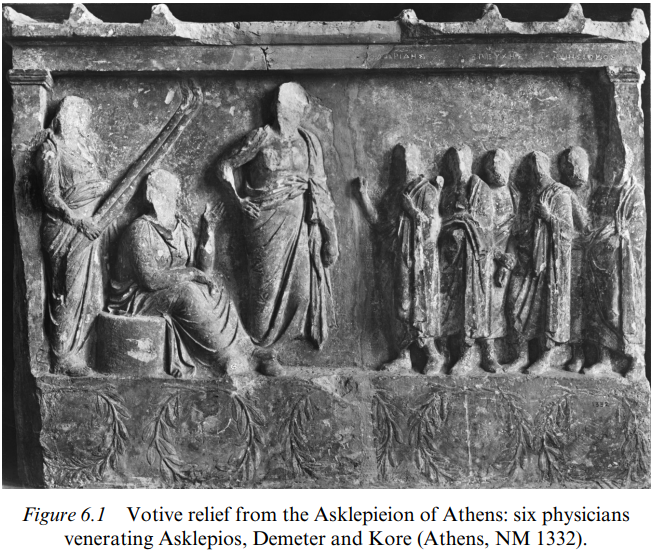
The gods are portrayed as personally present, recognizable, and recognizing the worshippers, reinforcing the idea of a reciprocal and personal relationship between humans and the divine.
“Visualizing the visit to the sanctuary not only as prayer in front of statues, but as an encounter with the gods in personam, demonstrates that the ritual communication has reached its goal. The dedicants, erecting solid marble slabs adorned with images of this kind, try to depict this encounter but also to perpetuate it in the medium of the relief. Of course the reliefs do not mirror the actions in the sanctuaries, but they transform them into images, based on iconographic and typological patterns used in contemporary art”
Function of Votive Reliefs
The function of votive reliefs is narrative, documentary, and representative, serving to tell a story, record an event, and represent a concept or relationship.
They visualize visits to sanctuaries as encounters with gods in personam, demonstrating successful ritual communication and the fulfillment of religious obligations.
Dedicants erect marble slabs to depict and perpetuate these encounters, ensuring continued divine favor and remembrance of their piety.
The reliefs transform actions in sanctuaries into images based on contemporary iconographic and typological patterns, reflecting both artistic conventions and religious beliefs.
Even if some images reflect common statue types, this does not imply that the gods are generally understood as statues but rather that certain visual motifs were used to convey divinity.
“Only a few, mostly late, examples depict the gods unequivocally as lifeless sculptures.”
A Hellenistic votive in Venice depicts Kybele and Attis as cult statues, rigid and without contact with humans, emphasizing the difference between human and divine spheres and the formal, symbolic nature of cult images.
In contrast, the Athenian relief combines both spheres into one spatial unit, showing gods acting and reacting to humans, illustrating a more dynamic and interactive relationship.
Modes of Divine Presentation
Different gods have specific modes of presenting themselves, and dedicants are characterized in various ways, reflecting their unique attributes and roles in the Greek pantheon.
Contacts between mortals and immortals are depicted in diverse manners, ranging from direct interactions to symbolic representations, further illustrating the complexity of human-divine relationships.
Emotions and Gender
Reverence
Reverence is typically shown discreetly, with worshippers praying upright and raising their right hand, a gesture symbolizing respect and supplication.
Body language and gestures can be more expressive, conveying deeper emotional states and personal connections to the deity.
Votive for Kybele from Tripoli
Kybele is depicted enthroned and motionless, with worshippers reacting visibly to her sight, highlighting her power and the overwhelming nature of her presence.
Women lean back, showing fear and awe, while men stand firmly upright, exemplifying gender-specific responses to the divine.
Iconographic Rule
Emotional gestures towards the divinity's appearance are mainly shown by women, conforming to societal expectations and gender roles.
Examples include shrinking back, kneeling, or raising both hands in prayer, all expressing vulnerability and heightened emotion in the presence of the divine.
A relief from Chalkis shows a woman venerating Dionysos and Plouton in this manner, leaning back slightly, further illustrating the conventional portrayal of female piety.
Votive to Zeus in Dresden
Contrasts a kneeling woman trying to touch the god with a self-controlled man standing upright, again reinforcing gender-specific expressions of reverence.
Gender-Typical Behavior
Images emphasize gender-typical behavior, with women showing fear and commotion and men displaying self-control, reinforcing societal expectations within religious contexts.
The main aim is to show correct veneration according to age, gender, and social status, rather than exaggerated devotion. Proper behavior was essential to maintaining social order and divine favor.
Caring Gods
Divine Movement
Images show gods turning towards their human counterparts with varying intensity, signifying their attentiveness and engagement with human concerns.
Deities and worshippers are depicted in close contact, using gestures, fostering a sense of intimacy and direct communication.
Some deities bend down to their worshippers, conveying compassion and a willingness to meet humans on their level.
Votive stelai, though schematic, are sculpted with meaningful variety, adding depth and nuance to the representations of divine-human interactions.
Expression of Closeness
The clearest expression of human-divine closeness is when a god touches humans, symbolizing a direct transfer of divine power and benevolence.
This is common in reliefs presented to healing gods like Asklepios and Amphiaraos, where physical contact signifies healing and divine intervention.
Healing Sanctuaries
Votive reliefs from healing sanctuaries often give thanks for successful healings, presupposing successful incubation and epiphany, validating the efficacy of the healing rituals.
The ritual aims at direct, personal contact with the god and his healing power, seeking tangible and immediate divine assistance.
Some participants claim to have experienced concrete intervention from the god while asleep, highlighting the immersive and personal nature of these religious experiences.
Iconography of Asklepios
Asklepios is shown as caring and similar to humans, clad in the large himation, like an Athenian citizen, making him relatable and accessible to worshippers.
He leans on a long stick and is often accompanied by his family, emphasizing his role as a benevolent patriarch and healer.
This dress and family presence are unusual for images of gods outside healing cults, setting Asklepios apart and underscoring his unique relationship with humans.
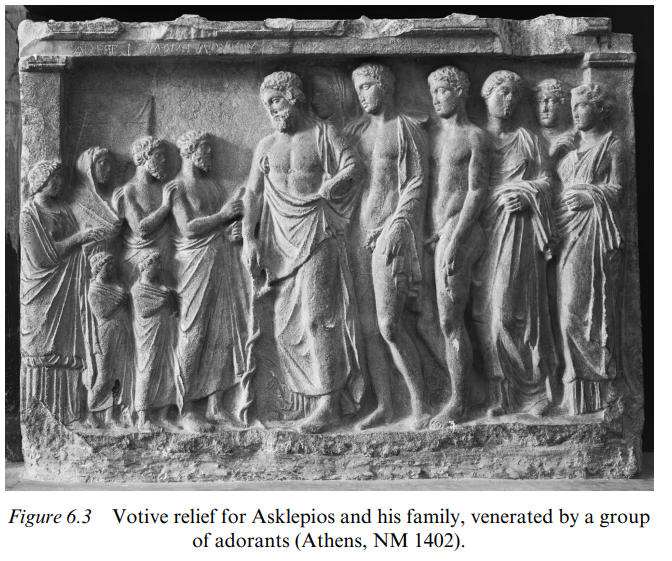
A relief from the second quarter of the fourth century BC shows divine and human families nearly interchangeable, differing only in size, illustrating the close approximation between the divine and human realms.
The hierarchic scale demonstrates approximation, not equality, maintaining the distinction between gods and humans while highlighting their interconnectedness.
In a relief from the Athenian Asklepieion, Asklepios has drooping shoulders and a rounded back, resembling aged men on contemporary Attic grave reliefs, further humanizing the god and emphasizing his empathy.
“But this remarkable trend towards rendering Asklepios as similar to an Attic citizen goes even further. In a relief from the Athenian Asklepieion the god is not sitting upright, as usual (Fig. 6.4).”
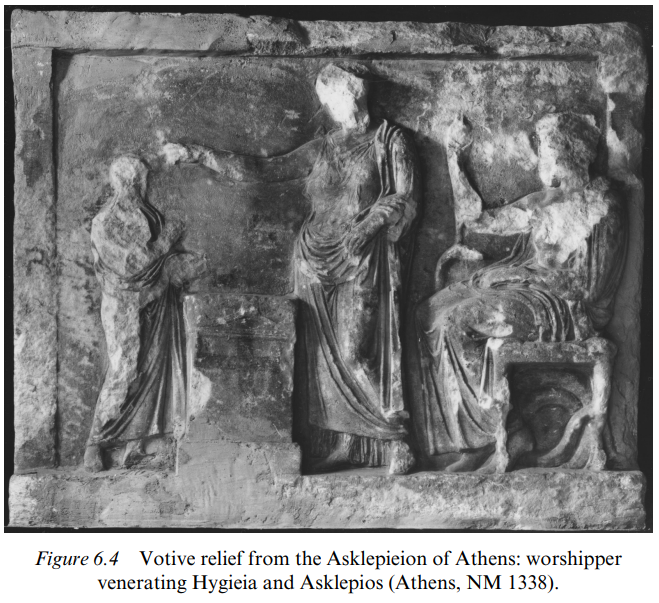
“Instead, he has drooping shoulders and a rounded back. His feet are not in front of the chair, but pulled back.”
“Aged men sit in this same way on contemporary Attic grave reliefs, for example on the stele of Theodoros and Praxiteles.”
“Asklepios is not only shown in the attire and the attitude of an Athenian citizen, he is even shown like a feeble and old one.”
“But using the iconographic pattern of aged men to depict a god cannot be taken as an indication of any kind of weakness.”
“Asklepios is shown like a dignified head of a respectable oikos.”
“It is his daughter Hygieia who turns herself to the worshippers, extending her right hand towards his head and demonstrating the divine concern for his needs.”
Concept of Epiphany
These images exemplify a concept of epiphany where gods reveal themselves as caring, giving attention to worshippers, and being venerated attentively, reinforcing the idea of a responsive and compassionate divine presence.
The Transitory Moment
Divine Movement
Another way to characterize deities as present is to depict them in motion, capturing the dynamic and fleeting nature of their appearances.
This is especially essential for the appearance of nymphs, whose connection to nature is inherently fluid and dynamic.
Nymphs
While some votive reliefs show nymphs sitting or standing quietly, most depict them dancing, emphasizing their lively and ephemeral nature.
A relief in Berlin shows nymphs passing by rapidly, with cloth fluttering around their legs, like a snapshot of fluid movements, capturing a fleeting moment of divine presence.
The nymphs do not seem to notice the worshipper, who is conspicuously small, highlighting the overwhelming and impersonal nature of their sudden appearances.
Unity of Time and Space
Images are not incoherent; they are meant to take place in a unity of time and space, reflecting the belief that divine encounters occur within specific sacred contexts.
Deities and worshippers are together in the sanctuary marked by the cave and altar, underscoring the importance of sacred spaces in facilitating divine-human interaction.
Deities tower above humans, characterizing their epiphany as overwhelming, reinforcing the power and grandeur of the divine presence.
Worshippers
Most reliefs show nymphs dancing alone, with few displaying worshippers, suggesting that the focus is on the divine apparition rather than the human response.
A concentration on certain types of worshippers, especially men, is noticeable, indicating gendered aspects of nymph veneration.
Inscriptions primarily name male dedicants, further supporting the idea that nymph encounters were more commonly sought and depicted by men.
“This is conspicuous, because women as dedicators of votive reliefs in general are of considerable importance and, moreover, women participated in the cults of the nymphs.”
“Families as worshippers in reliefs for the nymphs are very rare and figure almost exclusively in some late examples of rather poor quality. This is also noteworthy, because families are the most common type of worshippers on the votive reliefs in general.”
Veneration
“Obviously, in the case of the nymphs the act of veneration is a less attractive subject to depict than apparitions of goddesses frolicking through nature, who are conceived as friendly and frightening, as helpful and dangerous at the same time.”
The transitory moment of the dance stresses the suddenness of their epiphany, capturing the fleeting and unpredictable nature of divine appearances.
“Apparently the typical pattern of adoration is not apt to express the reaction caused by the epiphany of the nymphs. In the images of the nymphs, interaction, even contact between men and gods is avoided – as in the construction of religious reality, where the direct encounter with nymphs was imagined as potentially harmful. And obviously images of the nymph’s apparition were not suitable for votives of women and families, but mainly for men.”
Aphrodite
Votives for Aphrodite often render her epiphany as a transitory moment, capturing the goddess's sudden and fleeting appearances.
Images depict the suddenness of her appearance, especially on reliefs showing her riding on a goat, symbolizing her dynamic and unpredictable nature.
A fourth-century slab from the Athenian agora shows an altar under Aphrodite's feet, indicating her revelation at a specific sacred place in a fleeting movement, highlighting the importance of sacred locations in divine epiphanies.
Dedicators
Families are almost totally lacking on votives for Aphrodite; it is usually a single person showing reverence, emphasizing the personal and individual relationship with the goddess.
Iconographic elements connect the goddess and dedicators, stressing the intimate character of the encounter, reinforcing the idea of a personal connection between the worshipper and Aphrodite.
Votives are set up on behalf of individuals, as aspects of her divine power are experienced individually, celebrating the unique and personal experiences of divine interaction.
Hero Encounters
Nearness to Humans
It seems to be generally agreed that Heroes were popular in late classical times because they were believed to be especially 'near' to humans and easily approachable in cult, serving as intermediaries between the divine and human realms.
From the late 5th through the whole 4th century BC, votive reliefs of Heroes are by far the most popular votive reliefs of all, reflecting the increasing importance of hero veneration.
Heroic Presence
As in votives for the gods, the images stress that the heroes are really present, not as statues, but in personam, emphasizing the active and immediate presence of the hero.
This presence is mainly shown by action, movement, attention to the worshippers, and transitory moments, capturing the dynamic engagement of heroes with their devotees.
There are no fundamental differences between votives for the heroes and votives for the gods concerning the strategies of visual narrative, indicating a shared conceptual framework.
Votive reliefs for Herakles
often show the care of the hero towards his worshippers, highlighting his protective and benevolent nature.
He refers to them with gestures or touches the sacrificial animals, demonstrating that the offering is satisfactory, signifying divine approval and acceptance.
The importance of the transitory moment is particularly evident on the numerous reliefs for equestrian heroes, capturing the dynamic and fleeting nature of the hero's appearance.
Equestrian Heroes
In Attica, contemporary equestrian statues are not documented so any allusion to statues is ruled out, emphasizing the unique and immediate nature of these depictions.
The rearing up of the horse visualizes not only the dynamic of the youthful hero, but also the momentary character of his appearance, capturing the energy and immediacy of the heroic presence.
Its suddenness can be stressed by the fluttering chlamys or a running attendant, further emphasizing the fleeting and dynamic nature of the encounter.
Even the votives where the hero has already dismounted from the horse show, although more subtly, a transitory moment, suggesting that the action is paused rather than static.
Hero is not standing quietly, he is in action – in a sacral action, because he is going to make a libation from the cup in his right hand, which is filled by his female companion, reinforcing the theme of ongoing engagement and ritual participation.
Banqueting Hero
The largest group of hero reliefs of all are the votives for a banqueting hero, reflecting the popularity and cultural significance of this particular form of hero veneration.
These stelai show a heroic couple, venerated by adorants, symbolizing domesticity and shared honor between the hero and his consort.
Bearded, long-haired hero reclines on a kline, covered with a large cloth, a himation, and often a polos, a cylindrical headgear, presenting a picture of relaxed authority and divine status.
Hero Turns his head out of the image, suggesting a dynamic engagement with the surrounding worshippers.
Usually he handles drinking vessels: a rhyton in his right and a phiale in his left hand, with wine flowing from one to the other, symbolizing abundance and the continuous flow of divine favor.
Hero's consort, clad in chiton and himation, sits at his feet and frequently spreads incense on a thymiaterion, an incense burner, which stands on a side table in front of the kline, reinforcing themes of reverence and domestic harmony.
Table is loaded with vegetarian food: fruits, bread and cakes; nearly always, there is a wine pourer serving the heroic couple, emphasizing the shared meal and the hospitality offered to the hero.
The left-hand side shows the worshippers approaching, sometimes individuals and couples, often families, demonstrating the wide range of devotees and the inclusive nature of hero veneration.
The wide range of worshippers is similar to that in the votives of Asklepios, reinforcing the theme of accessibility and wide appeal.
Context
These reliefs seem to have been erected in numerous small hero shrines which were ubiquitous in ancient Greek cities and which were often very modest in size, design and furnishing, reflecting the widespread and accessible nature of hero veneration.
Statues in such hero shrines were rare, and we know of no sculpture of a hero in the pose of a banqueter, emphasizing the unique and symbolic nature of these reliefs.
When, from the end of the sixth century BC, votive reliefs became customary as media of religious communication, there was a demand for such offerings to the popular heroes, too, indicating the growing importance of visual representations in religious practice.
The pattern of the reclining banqueter had been in use in Greek art since the late seventh century BC in many media and for many deities and heroes, especially Herakles, and for human banqueters too, demonstrating a long-standing artistic tradition.
Theoxenia
The offering of food on a table and the invitation to the hero to participate in the prepared meal play an important role in hero cult, especially in the cults of the Dioskouroi and of Herakles, reflecting the importance of hospitality and shared meals in religious practice.
Therefore the reliefs have been interpreted not only as representing a banqueting hero, but as representing the hero participating in a banquet, which was dedicated to him by his human venerators (theoxenia), reinforcing the concept of direct interaction and shared experience.
Third Olympian Ode describes the heroic guests invited to the theoxenia as τῶν ἐπιδημούντων, ‘the ones who are visiting’, which suggests the idea of temporary presence, capturing the fleeting nature of divine encounters.
Iconography
The trapeza is of any importance for the worshippers - in sharp contrast to the sacrificial victim, and also in contrast to the small number of votive reliefs dedicated to other deities where a trapeza is definitely prepared, emphasizing the significance of the meal in hero veneration.
If we take into account the dedicators’ desire for prestigious representation, a reference to a costly animal sacrifice confers more symbolic capital than a reference to a rather modest offering of vegetarian goods, indicating that the reliefs held symbolic value beyond the material offerings.
The heroes might have been so popular in classical Athens because they were conceived as being ‘near’ to the worshippers. The images do not stress this closeness, though;
On the banquet reliefs, the trapeza is not meant to represent a cultic meal, offered by the worshippers, but as belonging to the sphere of the heroic couple and their joyful existence, shifting the focus from ritual offering to divine enjoyment.
Conclusion
The banqueting reliefs cannot be related iconography to images of theoxenia, indicating that they represent a unique and distinct form of hero veneration.
They do not focus on the ritual attempt to make the heroes present, but on their actual presence, visualized by the distinctive actions of the protagonists, shifting the emphasis from ritual procedure to immediate presence