Approaches
Origins of psychology
Emergence of Psychology as a science:
-17th- 19th century: Psychology was still considered a part of philosophy
-1879: First experimental lab of psychology opened by Wundt in Germany. Focused on scientific methods to understand the mind
-1900s: Emergence of the psychodynamic approach. Freud proposed the psychodynamic school of thought that focused on the unconscious minds, study of dreams and conflict within the mind.
-1913: Emergence of Behaviourism led by John B Watson. Focus on outward behaviour that is observable and measurable
-1950s: Emergence of Humanism, led by Carl Rogers and Abraham Maslow. Focus on inner self, free will and self-determination
-1960s: cognitive approach was developed during the cognitive revolution. Human mind compared to the workings of a computer
-1960s: Learning approach. Albert Bandura tried to bridge the gap between traditional Behaviourism and new age Cognitive approach through his social learning theory.
-1980s: Emergence of biological approach as a way to study human brain with the help of science and technology
-eve of 21st century: focus on cognitive neuroscience, bringing together cognitive and biological sciences, through the use of things like brain scans.
Wundt and introspection
Wundt believed that all aspects of nature (including the mind) could be studied scientifically. (method of introspection)
Introspection- with training mental processes can be worked out systematically by observing behaviours and breaking down their causes into simple components.
E.g.- ask a patient to look at something red. then ask how they feel/ what they think about. Ask them why they think they feel that way, any memories/ associations etc.
Wundt found his methods of introspection highly scientific
however, today this method would be seen as unscientific as it is far too subjective to be considered credible compared to the methods of studying the brain such as using FMRIs, PET scans and EEGs.
Pros:
first scientific study of the mind
revolutionised the subject (introspection)
made psychology a subject in its own right
Cons:
introspection is far too subjective
not deemed scientific by todays objective measures as it is all non measurable.
it is no longer applicable
The biological approach
B- BIOCHEMISTRY
A- ANATOMY OF THE BRAIN
G- GENES
GENES:
biological psychologists believe genes can influence behaviour
genetics can influence the development of an individual as genes carry out the instructions for a particular characteristics such as intelligence. This enables psychologists to examine animal behaviour to help us learn about our own behaviour.
Genotype- this is an individuals genetic makeup; it occurs at conception and provides the genetic code for how an individual will develop
Phenotype- The product of when the genotype interacts with the environment.
Twin studies:
concordance rates- the rate that both twins have a given disorder
Monozygotic twins- identical/ share the same genotype
if one twin had a disorder and the other didn’t we know that disorder is not genetically caused.
Dizygotic twins- fraternal/ different genotypes
Behaviour/ Disorder | Research | concordance rates for MZ twins | concordance rates for DZ twins |
Schizophrenia | Gottesman (1991) | 48% | 17% |
Due to the concordance rate of MZ twins being 48% and not 100% we can tell that schizophrenia is not genetically caused due to the fact that MZ twins have the exact same genotype meaning if one had a gene causing schizophrenia the other one would have the same gene. From this we can presume there could be a genetic influence on these disorders.
However, we cannot be certain that genetics cause the closer similarity in MZ twins than DZ twins because MZ twins are also usually brought up more similarly than DZ twins.
Adaptive- any trait that is ‘adaptive’ according to evolution means that it aids our survival and increases chances of reproductive success.
Research: Lea et al (2005)
found that the MAOA (warrior/aggression) gene in 1/3rd of men. This along with other research suggests that there might be a potential genetic underpinning to aggressive behaviour in men as that have needed to become more aggressive to hunt/ find resources/ protect.
Neurochemistry:
Motor cortex- behind the frontal lobe, receives information about, and, controls body movements.
Somatosensory cortex- behind the motor cortex, receives information about, and, controls body sensations.
Visual cortex- located at the back of the brain, receives information about, and, controls visual information.
Auditory cortex- located under the motor cortex, receives information about, and, controls auditory information.
Biochemistry
-Biological psychologists believe that biochemicals help to explain human behaviour. The brain produces neurotransmitters which influence the passage of electrical messages across neurons in the brain.
-Schizophrenia:
Has been linked to the neurotransmitter dopamine
this disorder may be caused by low amounts of dopamine
one reason why the biological approach assumes this is because when Parkinson’s patients were given L-dopa aimed at increasing levels of dopamine in their bodies, many started to develop schizophrenic symptoms.
-Depression:
has been linked to the neurotransmitter serotonin
this disorder is caused by high amounts of serotonin
one reason why the biological approach assumes this is because when giving anti-anxiety drugs aimed to reduce serotonin levels many patients experience depressive symptoms.
Exam question examples
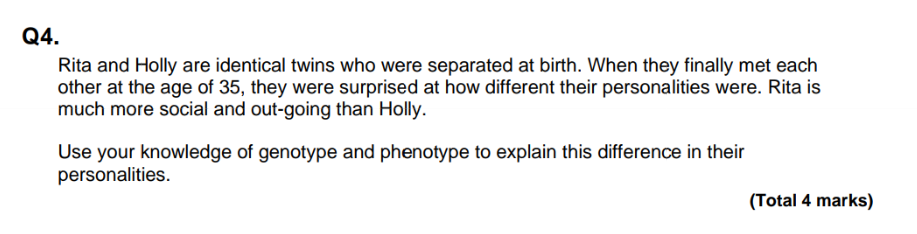
Rita and holly are identical twins and therefore their genotype is the same. This means their potential to be outgoing and sociable is the same. However, their phenotype is different because Holly and Rita had different upbringings. For example, Rita grew up with more friends than Holly, impacting their socialisation skills.
Outline and evaluate the Biological approach in psychology [16 marks]
one way in which biological psychologists study human behaviour is looking at biochemical levels and attributing these to human behaviours. For example biological psychologists have examined levels of serotonin in relation to symptoms of depression, concluding that some symptoms might be caused by low levels of this neurotransmitter. However, the biological approach might be seen as biologically reductionist. This is because the explanations fail to explain multiple different reasons for human behaviour, only considering the impact of biochemicals, brain anatomy and genetics on behaviour. For example when only considering neurotransmitter levels in the development of depression and anxiety, it is clear that there are issues here as the explanation suggests that you could not have both at the same time. As this is the most common comorbid diagnosis in the world we must accept that there are other causes, despite neurotransmitter levels in these disorders disputing the biochemical explanation. Therefore, this approach is considered far too simplistic to explain most human behaviours and this could potentially be dangerous if other explanations and treatments were ignored. However, for many humans the root causes of behaviour is biological and because biological causes are objectively measurable taking a biological reductionists point of view is quick to identify and at times effective.
another way in which biological psychologists explain the causes of human behaviour is by examining brain areas and attributing their activity to certain human behaviour. For example activity in the auditory cortex would suggest a human is processing sound. An advantage to the biological approach contributing to psychology is that it is considered highly scientific which heightens the approaches prestige and consequently subject funding. This is because the approach uses scientific methods for investigations, which are highly objective and non biased, consequently heightening the validity of the approach. For example, brain scans are used to map the function of the brain with precision and are clearly, observable, making them favourable to scientists. An approach with high validity ignores the chance of it being taken seriously by academics and consequently being funded further for research allowing the subject to thrive. However, it should be considered that topics that lack scientific rigour, such as Freud's psychodynamic approach, are not necessarily incorrect, they are just hard or imposible to falsify, which gets them labelled by modern day 'scientists' as pseudoscience. Claiming science is the only correct explanation of behaviour though, should be treated with caution as science itself is merely an ideology of its time and could too become outdated.
The final way biological psychologists examine human behaviour is by examining the genetic influences of behaviours and concluding if behaviours are caused by genes at all. Although no gene has been found to cause a given psychological behaviour, genes such as the MAOA gene (linked to aggression) have been found to influence behaviours.
The learning approach
A- associations (behaviourism)
I- imitation (social learning theory)
R- reinforcement (behaviourism)
Tabula rasa= we are born as a blank slate
Behaviourism
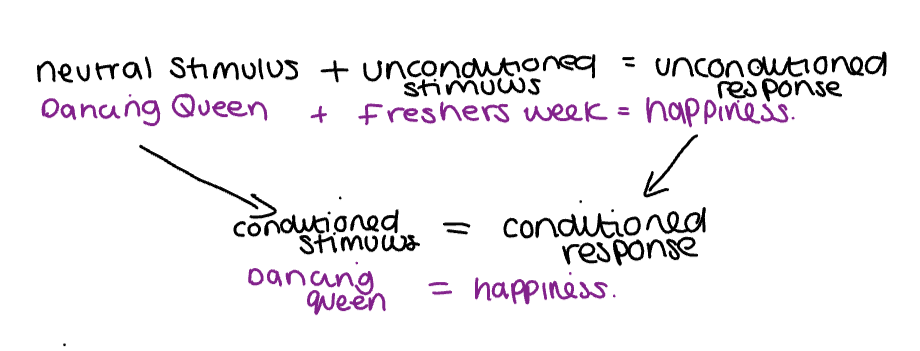
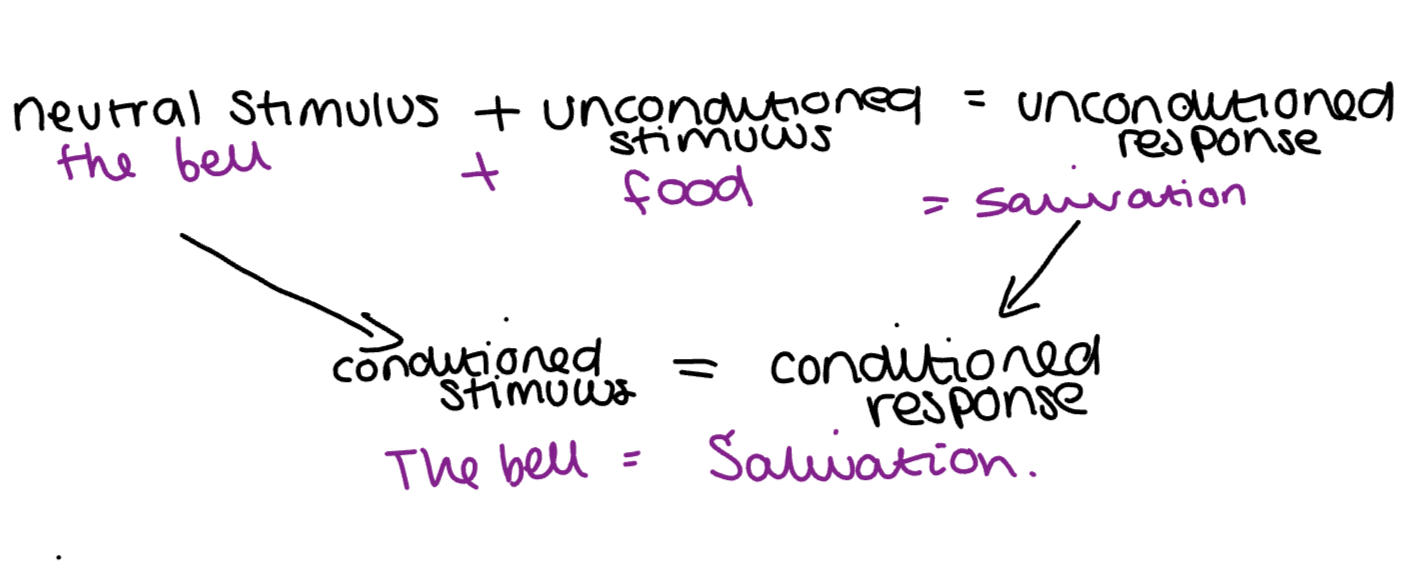
classical conditioning- learning occurs when an association is made between a previously neutral stimulus and reflex response. This reflex response can be positive or negative. If the association of the stimulus is with a positive feeling, then that positive feeling will arise whenever the person comes into contact with that specific stimulus. The same is true for negative associations.
Example of classical conditioning:
Catherine is an 18 year old student enjoying freshers week at uni. Dancing queen by ABBA is played a lot during this week and she dances to it. She will make a positive association with that song and for years to come when she hears that song she will feel happy.
Pavlov's dogs
pavlov was originally focused on the digestive system of dogs.
He harnessed dogs to a bench with a tube coming out of its mouth and going into a jar
Pavlov started to notice that when he opened the door and when the bell rang the dog started to salivate.
Pavlov's dog had clearly made an association with the arrival of food and the door opening.
stimulus generalisation- if the pitch and the tone of the bell was varied, the dogs would still salivate. This means if characteristics close to the conditioned stimulus then this association would be generalised to the new stimulus. Little Albert= white fluffy objects
stimulus discrimination- at some cut off point where an association will not be made and a stimulus generalisation will not occur. This is stimulus discrimination and happens when characteristics of a conditioned stimulus and an object becomes to different to be associated. Little Albert= he would not be scared of a brown fluffy dog
Time contiguity- association will only occur if the UCs and NS are present within a certain timeframe. If theres a gap in time- no association will be made. Little Albert= if the rat and the loud bang were not paired within a particular time frame, no association would have taken place and Albert would not be scared of white rats/ white fluffy things.
Operant conditioning- learning through consequence/ reinforcement
type | Definition | example |
positive reinforcement | performing a behaviour because you are given a reward for it. | being rewarded by a teacher with credits for doing homework. |
negative reinforcement | preforming a behaviour so as to avoid a negative consequence. | submitting homework on time to avoid detention. |
punishment | is an unpleasant consequence of behaviour. | punished by a teacher for not doing homework e.g detention. |
Skinners rats
positive reinforcement- tested by placing a hungry rat in a skinner box, containing a leaver on the side, and as the rat moved around the box, it would accidentally knock the leaver. This would then release a food pellet (reward). The rats quickly learned to pull the lever after a few times of being put in the box. The rates repeated this action because they were positively reinforced by the reward.
negative reinforcement- worked by placing a rat in the box and subjecting it to an electric current (punishment) As the rat moved about the box it would accidentally knock the lever. Immediately it did so the electric current would be switched off. The rats quickly learned to go straight to the lever (once the light was turned on) to avoid electrocution. The consequence of escaping the electric current ensured that they would repeat the action again and again.
skinners analysis of behaviour-
antecedents: what happens just prior to behaviour being preformed/ whether the rats pushed the leaver sporadically or unknowingly.
Behaviours: whether they're pushing the leaver
Consequences: this is what happens after the operant (the result) for the rat it got a pellet of food.
The social learning theory
The social learning theory assumes that behaviour is learned from the environment and from the environment and from observing others in terms of the reinforcement and punishment they receive.
V- vicarious reinforcement: the observer sees the model recieving a positive or negative consequence which affects likelihood of imitation.
I- imitation: copying someone's behaviour.
I- identification: copying someone you can relate too.
M- modelling: following the behaviour of something you think is good.
The Bobo Doll Experiment- Bandura
aim: to investigate if social behaviours (i.e. aggression) can be acquired by observation and imitation.
procedure:
36 males and 36 females aged between 3 and 6
aggression levels were tested before to eliminate any obscure aggressiveness and then assigned to one of the three conditions.
each of the three conditions involved 12 males and 12 females
the three stages of the experiment were
1- modelling: C1- male/female model being aggressive towards the doll. C2- non aggressive model played with the doll in a quiet manner. C3- a control group with no model at all.
2- aggression arousal: all children are subjected to mild aggression (not being able to play with toys)
3- delayed imitation: next room contained aggressive toys, non aggressive toys and the children's behaviour was observed for 20 minutes behind a one way mirror for 5 second intervals.
results: children who observed the aggressive model made far more imitative aggressive responses than those who were more in the non- aggressive or control groups.
evaluation:
this study has important practical application to society.
the study shows how children learn aggression through the process of observation learning, which is increasingly occuring in the media. Therefore the study can help to explain potential effects of media violence on children and seek to amend this (age ratings)
Bandura’s lab experiments had tight control over extraneous variables. For example Bandura testing the participant variables of aggression before the study to ensure he control this by using a matched pair design. This means that the internal validity of the experiment is reasonably high.
The role of mediating processes
there is some thought prior to imitation and this is called mediational processes. This occurs between observing behaviour (stimulus) and imitating it or not (response)
Bandura documented 4 mediational processes: ARRM
A- attention: for a behaviour to be imitated it must grab our attention first (if you see it or hear it it suggests you have attended to it)
R- retention: a memory of the behaviour ust be formed for it to later be imitated (thinking about it suggests you have a memory of it)
R- retention: whether we are physically able to reproduce the observed behaviour will influence our decision whether to imitate it or not.
M- motivation: the rewards and punishment will be considered before imitation; if the perceived rewards outweigh the perceived costs the behaviour will be imitated. If the costs outweigh the benefits then you wont imitate the behaviour.