Midterm Exam
CHAPTER 7 - ENVIRONMENTAL HAZARDS
Key Words
Risk - the statistical possibility of a given event on the basis of the number of such events that have already occurred in a defined population
Smoke plume - smoke created during the use of an ESU Electrosurgical unit or laser “contains toxic chemicals, vapors, blood fragments, and viruses”
Associations - private professional and government organizations that create standards and recommendations aimed at reducing injury in healthcare settings.
ERCI institute - non profit research evidence based practices
APIC - Association for professionals in infection control and epidemiology -
CDC - Center of disease control and prevention
U.S Enviornmental Protection Agency
FDA - U.S food and drug administration
The joint commission-
OSHA - Occupational Safety and health administration
FIRE SAFETY
Fire requires 3 components
Fuel
Patient Drapes
Hair
Nonmetal airway
Prep solutions
Gastro intestinal Gas - hydrogen, oxygen, nitrogen, Carbon dioxide , and methane
Oxygen
OEA - oxygen enriched atmosphere = greater than 21% oxygen concentration
Oxygen & Nitrogen
Source of ignition
Electrosurgical Unit
Laser
Faulty electrical equipment.
R - Rescue : patients in the immediate area of the fire
A - Alert : other people to the fire do that they can assist inpatient removal and response activate the alarm system.
C - Contain : the fire shut doors to slow spread of smoke shut off zone valves controlling in-line gases into room
E - Evacuate : personnel in the areas of the fire
PASS - Pull Aim Squeeze Sweep
Compressed gas cylinder - made of heavy steel strong enough to avoid puncture, contains oxygen, compressed nitrogen, argon, Nitrous oxide , carbon dioxide.
Two valves
one opens cylinder to allow gas to flow into regulator.
Second controls flow from regulator to the tubing.
PPE- Personal protective equipment - protects personnel from high concentrations of chemicals.
Musculoskeletal Risks
When lifting an object keep it close to your body
When pushing a cart back foot should be braced comfortably behind the other foot
Use Abdominal Muscles when lifting
Chapter 8
Bacterial structure
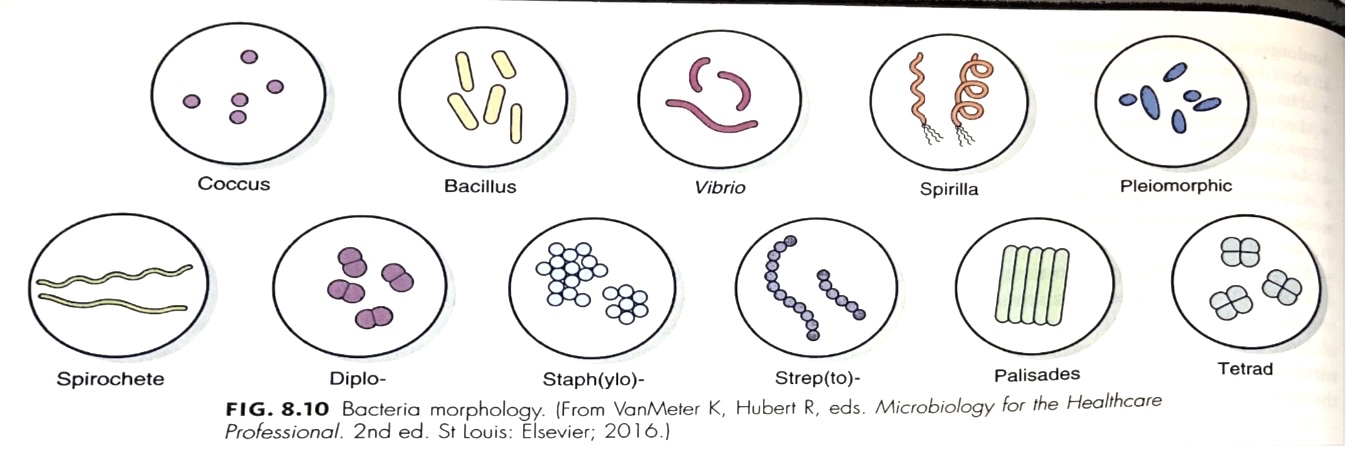
Bacilli - Rod shaped
Spirochete - curved or spiral shaped
Cocci - spherical
micro- singly
strep- chains
pairs - diplo
staph - groups of four or clusters
Vibrio - comma shaped
Important Bacterial Infections
GRAM POSITIVE COCCI
staphylococci
S. Epidermis
S. saprophyticus
S. aureus
Streptococci
BETA
S. Pyogenes
ALPHA
S.pneumoniae (V)
S. viridans
GROUP D
S. faecalis
GRAM NEGATIVE COCCI & BACILLI
Neisseria
N. Meningitids (V)
N. Gonorrhoeae
AEROBIC GRAM POSITIVE BACILLI
Spore Forming
Bacillus B. Anthracis (V)
Non Spore Forming
listeria L. Monocyteogenes
Corynebacterium
C. diptheriae (V)
C. urealyticum
C. jeikekium
Clostridium Difficile - spore forming severe diarrhea can be rapidly fatal
Myobacterium tuberculosis - causes TB disease causes dense nodules to form in lungs liver spleen and bone marrow.
Methicillin-Resistant Staphylococcus Aureus and Epidermis (MRSA) - transmitted through hands equipment and supplies
Vancomycin - Resistant entercocci - direct contact inhabits intestines and female genital tract
VIRUSES
Rubella
Varicella zoster - chicken pox
Variola - German measles
Morbillivirus - measles
Enterovirus - polio
Lyssavirus - rabies
Prion - proteinaceous infectious bacterial
No nucleic acid can not be cultured in a lab no sterilization can take from
Chapter 9
Recommendation = should, backed by evidence
Regulatory Requirement = must
Permissible - May, no evidence against
Sterility - is absolute free of all living microorganisms including bacterial spores. Nonsterile or contaminated
STERILE FIELD- draped patient draped instrument tables and equipment
contamination
physical contact
Droplet - coughing sneezing
Airborne - dust lint
Vectors - bugs
STRIKETHROUGH - contamination of sterile surface by penetration of non sterile fluid through covering
Disinfection - destruction of microorganisms on inanimate non living object
Anti sepsis- destruction of microorganisms on living tissue
antiseptics used for hand hygiene
HVAC - Heating, Ventilation, and Air Conditioning
Operating room : 20 air changes/hour +
SPCROOM : 4 +
Neutral Zone - designated space for ST and surgeon to place and pick up sharps without being hurt. Hands free tecnigu
Three areas of the operating room, unrestricted, semi-restricted and restricted (know an examples of each)
Average air exchange rate per hour in the operating room - 20
What bacteria are the on scalp and hair - Staphylococcus aureus
Squames - Dead skin cells
Two method of hand antisepsis - Surgical hand scrub and surgical hand rub
What is double gloving- two gloves of different colors to avoid puncture. close is for all surgical cases where gowning is required
SSI - Surgical Site Infection
Sharp - any object that can penetrate the skin what is a sharp
Common source of injury - Hypodermal needles, Sutures
Neutral Zone - an area designated for the safe handling and transfer of sharps, minimizing the risk of accidental injuries and promoting safer practices in surgical settings.
Hands Free and No touch Technique
Droplet, Airborne, Contact, and Transmission precautions are essential to prevent the spread of infections during medical procedures.
Standard Precautions
Chapter 10
AORN - association of perioperative nurses
SPD - Sterile processing department
Antiseptic
Disinfection - reduce microbe not eradicate
Bacteriostatic - chemical or process that inhibits bacterial growth
Spaulding system - provides health care professionals a way to determine if a patient car requires sterilization
CRITICAL ITEMS (HIGH RISK) - come in contact with sterile body tissues internal organ systems and vascular systems surgical instruments vascular cannulas hypodermic needles
SEMI CRITICAL (INTERMEDIATE RISK) - used on non intact skin or mucous membranes requires HLD - high level disinfection (reduces bioburben to an absolute minimum) endotracheal tubes and airways rectal/vaginal instruments
NON CRITICAL (LOW RISK) - intact skin blood pressure cuff stetescope
Reposable instrument - can only be sterilized a certain amount of times then disposed of
Cavitation -high frequency sound waves are generated through a water bath causing Tony air bubbles trapped within debris to implode and release debris from the instrument.
Chemical used inside water - Enzymatic Cleaner
Chemical indication - paper strips chemically treated to change color when a certain criteria is met
Biological indicator - used bacteria growth to test if sterilization was successful
IUSS - immediate use steam sterilization (flash sterilization)
Highly flammable Liquid - EO Ethelyne Oxide
MSDS - Material Safety Data Sheet
icidal - to kill
Chapter 36
MCE - Mass casualty Emergency
Emergency - Geographically Emergency
Natural Disaster - arises from a force of nature
Levels
1 local - local teams are able to manage
2 regional - regional assistance from communities required
3 state - statewide and federal assistance required
1042 & 1043 pages
Pandemic widespread rapidly contagious
FEMA -
EMA - State Version
Know Disaster Cycle - preparedness response…(fill in circle)
Surge capacity -
Triage -