The Living World
Introduction
A living organism is a self-replicating, evolving and self-regulating systems capable to sense the environment
Important Characteristics of Living Beings
- Growth
1. It is the increase in number & mass(size) of cells by cell division. 2. In plants, growth continues throughout their lifespan. 3. In animals, the growth is only up to a certain age. However, cell division occurs to replace lost cells. 4. In multicellular organisms growth and reproduction are separate unlike in unicellular organisms where growth and reproduction are same. 5. In living organisms, growth is from inside. Internal growth is the defining feature of living organisms.
- Reproduction
1. It is the production of progeny having features similar to those of parents. 2. Organisms reproduce asexually and sexually 3. In unicellular organisms, growth & reproduction are same because they reproduce by cell division. 4. Many organisms do not reproduce (e.g. mules, worker bees, infertile human couples, etc). 5. Reproduction can not be a perfect defining property of living organisms.
- Metabolism
1. It is the sum total of all biochemical reactions taking place inside a living system. 2. Cellular Organization is the defining feature of living organisms. 3. Metabolic reactions can be demonstrated outside the body in cell-free systems. Isolated metabolic reactions in vitro are not living things but are living reactions. 4. Anabolism is a biochemical process in metabolism where the simple molecules combine to generate complex molecules. Catabolism is the breakdown of complex substances to their constituent parts.
- Consciousness
1. It is the ability of organisms to sense their environment and respond to environmental stimuli (like light, water, temperature, other organisms, chemicals, pollutants, etc). 2. All organisms are ‘aware’ of their surroundings. So, it is the defining property of living organisms. 3. Only human beings have self consciousness.
Taxonomy and Systematics
Taxonomy is the study of identification, classification & nomenclature of organisms.
Systematics (Latin ‘systema’ = systematic arrangement) deals with evolutionary relationships between organisms. Systema Naturae is a book written by Linnaeus.
Basic processes of taxonomy
- Characterization: It is the understanding of characters of organisms such as external and internal structure, structure of cell, development process, ecological information etc.
- Identification: It is the correct description of the organism so that the naming is possible.
- Classification: It is the grouping of organisms into convenient categories (taxa) based on characters.
- Nomenclature (naming): It is the standardization of names of the organisms such that an organism is known by the same name all over the world.
The system of naming with two components(Generic name and specific epithet) is called Binomial nomenclature. It is proposed by Carolus Linnaeus.
Botanical names are based on the rules in the International Code for Botanical Nomenclature (ICBN). Zoological names are based on the International Code for Zoological Nomenclature (ICZN).
Universal rules of nomenclature:
- Scientific names are in Latin and written in italics. When handwritten, they are underlined separately.
- The first word is genus name (Generic name) and second word is the species name (specific epithet). E.g. Mangifera indica (Mango) - Mangifera represents the genus name and indica represents the species name.
- The Genus name starts with a capital letter and the species name starts with a small letter.
- Name of the author (in abbreviated form) appears at the end of the biological name. E.g., Mangifera indica Linn, it indicates that this species was first described by Linnaeus.
Taxonomic Categories
Classification involves hierarchy of steps in which each step represents a taxonomic category (rank). All categories together constitute a taxonomic hierarchy. Each category represents a unit of classification. A group of organisms occupying a particular category is called a taxon (pl. taxa). E.g. Class Mammalia.
Trick to remember: King (Kingdom) Philip (Phylum) Came (Class) Over (Order) For (Family) Good (Genus) Soup(Species)
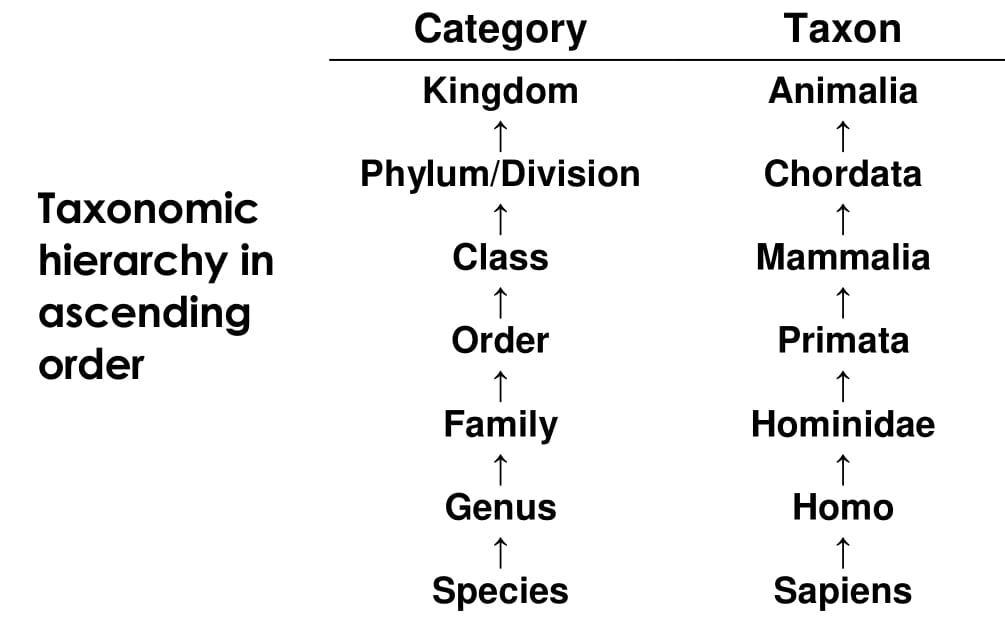
- Species: It is a group of closely related organisms capable of interbreeding to produce fertile offspring. It is the lowest category. They have fundamental similarities and morphological similarities.
- Genus: It is the aggregates of closely related species. E.g. Potato, tomato & brinjal are species of genus Solanum. Lion, leopard & tiger are species of genus Panthera. This genus differs from genus Felis (genus of cats).
- Family: It is a group of closely related genera. E.g. Family Solanaceae includes Genus Solanum, Genus Petunia and Genus Datura. Family Felidae includes Genus Panthera and Genus Felis. Dogs are from Family Canidae.
- Order: It is the assemblage of related families. The similar characters are less in number. E.g. Order Polymoniales includes Family Convolvulaceae and Family Solanaceae. Order Carnivora includes Family Felidae & Family Canidae.
- Class: It is the assemblage of related orders. E.g. Order Primata, Carnivora etc. is placed in class Mammalia.
- Phylum/Division: It is the assemblage of related classes. E.g. Classes Amphibia, Reptilia, Aves, Mammalia etc come under phylum Chordata (based on the common feature like presence of notochord and dorsal hollow neural system).
- Kingdom: The assemblage of related phyla. It is the highest category. E.g. Kingdom Plantae, Kingdom Animalia etc.
Lower the taxa, more are the characteristics that the members within the taxon share.
Higher the category, greater is the difficulty of determining the relationship to other taxa at the same level.
Taxonomical Aids
- Herbarium: It is a store house (repository) of plant specimens that are dried, pressed and preserved on sheets and are arranged according to universally accepted classification. Herbarium sheets are labelled with information about date and place of collection, English, local and botanical names, family, collector’s name etc.
- Botanical Gardens: These are specialized gardens having collections of living plants for reference and identification. Each plant is labelled with its botanical name and family. Famous botanical gardens: Royal Botanical Garden(Kew, England), Indian Botanical Garden (Howrah, IN), National Botanical Research Institute (Lucknow, IN).
- Museum: It is a collection of preserved plants and animals for study and reference. Mainly in educational institutes. Specimens preserved in preservative solutions in containers or jars. Preserved dry specimens of plants and animals. Insects preserved in insect boxes after collecting, killing and pinning. Stuffed larger animals like birds and mammals. Collections of animal skeletons.
- Zoological Parks: These are the places where live wild animals are kept in protected environments under human care. They are kept in conditions similar to their natural habitats. It helps to learn about their food habits and behavior.
- Key: It is an analytical method of identification of organisms based on similarities and dissimilarities. It is based on the contrasting characters generally in a pair called couplet. Each couplet has two opposite options. Of these, only relevant option is accepted and other is rejected. Each statement in the key is called a lead.
- Flora, manuals, monographs & catalogues
1. Flora: Actual account of habitat and distribution of plant species of a given area. 2. Manuals: The record that contains information for identification of names of species found in an area. 3. Monographs: The records that contain information on any one taxon. 4. Catalogue: Alphabetical list of species.
\n
\n