chp. 13 :((( </3 all caca cuz idk what im reading go back and relearn
Learning - process of acquiring new information
Memory - ability to store and retrieve that information
learning is not assured unless a memory is elicited later. Amnesia is a severe impairment of memory. loss of memory prior to a event like a trauma or surgery is retrograde amnesia. patient H.M henry Molaison - he was in an accident and his old memeories were intact but has diffulcty recollecting events that took place after his surger this is called antrograde amnesia(after the event). He proved that short term memory is different than long term memory.
his surgery removed the amygdala, most of the hippocamous, and surroudning cortext from both temporal lobes. memory loss was due to loss of MEDIAL temporal lobes, and hippocampus, ppl who had only the lateral toemporal cortex removed had no memory impairemtns. so ppl with with similar surgery but an intact hippocampus show no memory impairment.
Medial temporal lobe memory system -
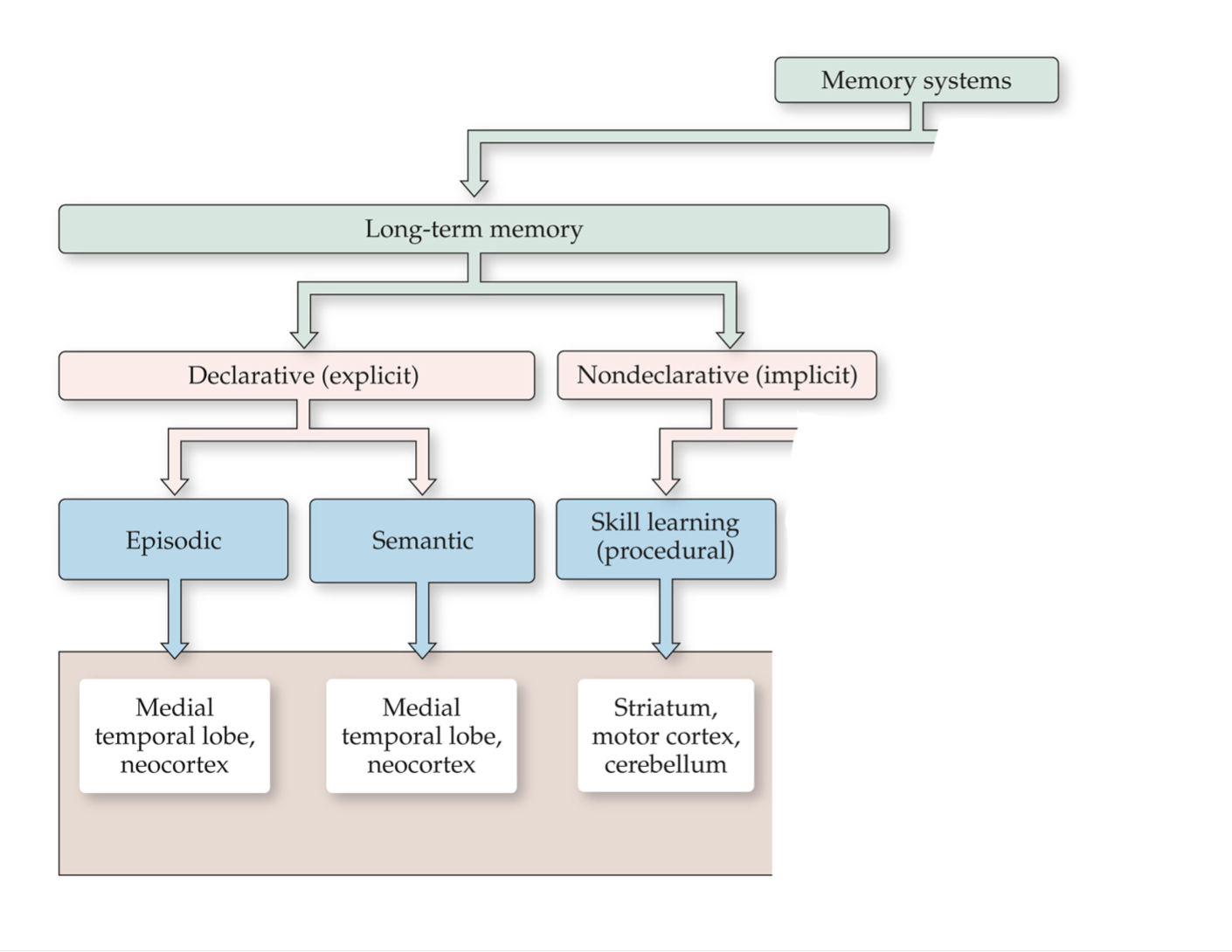
delcative memory //explicit memoroy - facts and infmroation aquired through learning, it is memory we are aware of accessing, which we can delcare to other. This is what was iimparied in hengry. “what” questions
Nondelcarative memory /implicit or precedural memory - about perceptural or motor procedures is shown by perfrmance than consiouc recollection. like mirror tracing tast , and skill of mirror reading, or riding a bike. it is hwo problems
way to measure declaritve memory in monkeys and other animals is the delayed non-matching-to-sample tast, a test of object recogntiion that requires monkeys to declare what they remmeber by identifying which of the two objects was not seen previously. Monkeys with damage to the medial temporal lobe like HM are severly impared on this task.
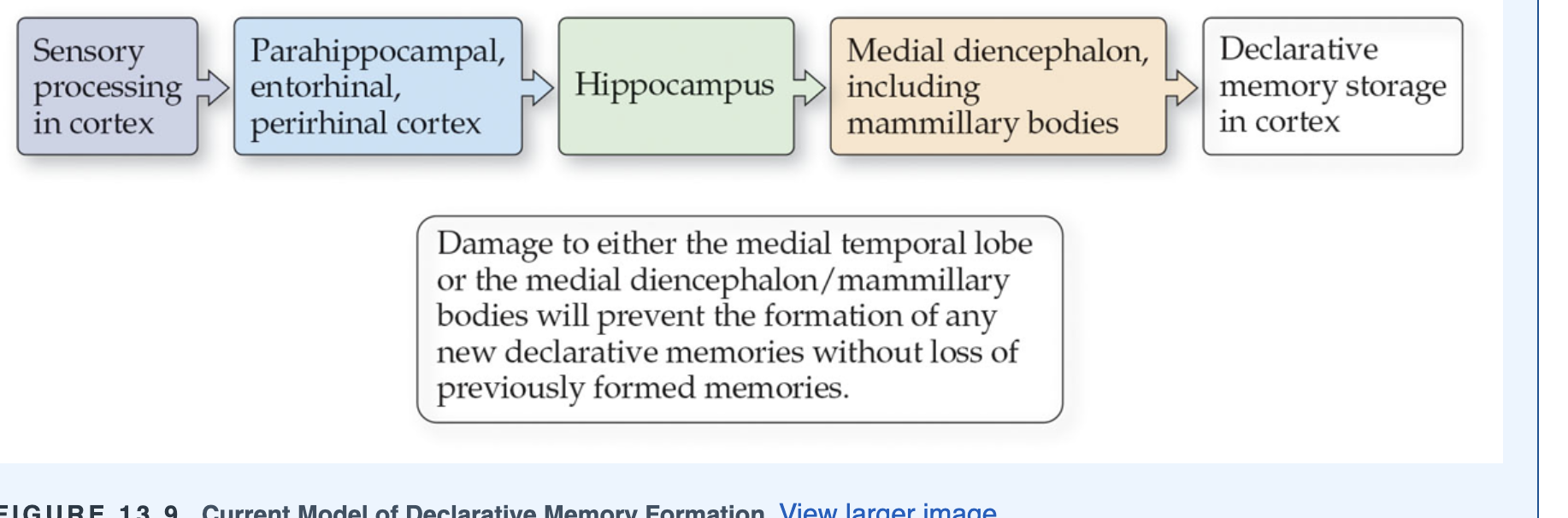
patient N.A - sword to his nostril injured his brain. Showed anterograde amnesia after his aciident, he can give little even after . early memories are good. MRI - damange to limbic system in the medial diencephalon - connections to the hippocampus: the dorsalmedial thalamus and the mamilliar bodies. Short term memory and can gain new nondeclaried memories. he is impaired in forming declaritve long term memroies. Like henrys medial temporal lobe damage.
KORSAKOFF syndrom - a degenerative disease in damage to the mammillary bodies and dorsal medial thalamus but NOT TEMPORAL lobe structures like hippo. The mammillary bodies serve as a processing system connecting the medial temporal lobes to the thalamus and other cortical sites. Confabulate - fill a gap in memory with falsification that ppl think is true. Damage to the frontal cortex also found in ppl with korsakoff syndrom, also causes denial and confabulation.
cause of korsakoff syndrome is due to the lack of vitamin thiamine. Alcoholics who obtain most of their calories from alochol and neglect their diet have this deficiency. Treating with thiamine prevents further deterioration of memory funciton but not recesre the damage. SOOO hippocampus, mammillary bodes, and dorsomedial thalamus is needed to form new declaritve memories. declaritve memories ar enot stored in the long term. candiate is the cerebral cortex.
patient KC, motor cycle accident can no longer retrive any personal memory of his fast, general knowdlege is good. detailed autobiogrpahical declarive memory of this short is episodice memory - memory when u recall a specific episode in ur life but not a particular time and place. Semantic emmeory - known the meaning of a word without knowning where or when u learned that workd.
13.2
Skill learning - a process of learning how to perform a challenging tast rhgough practive. Improving at mirror tracing tas is a learning skill. Henry demonstrated that the medial temporal libes is not required to gain skills and retian them. sensori motor siills and perceptural skills and cogntive skills. all three kinds of skill learning are impaired in ppl with damange to the basal ganglia. Other regions that are damanged are in the motor cortex and cerbellum. Basal ganglia, cerebellum, and motor cortex are important for sensorimotor skill learning
Priming - a change a way you prpcess a sitmulus, a word or a picture because youve percieved it or soemthign similar previously. If a person is shwon the word stamp in a last and then later to complete the workd stem STA the personi s more likley to reply stamp than start. Priming doesnt require declaritve memory of the sitmulus. priming is not ipared by damage to the basal ganglia,perceptural primgin is related to reduced activity in bilateral occipitotemporal cortext, conceptural priming is associated with red
idk what im reading what the FUK
blah blah bullshetttt
nondeclaritve memory - skill learning - learning to perfom a challenging task through repeitition: ther eis sensorimotor,perceptual, and cogntiive
Impaired by damage to the basal ganglia.
cognitive skill learning: tower of hanoi
other types of nondelcarive meories are relationship between events. two or more stimuli, between a stimuli and a reponse or between a reponse and its conseuqnece. This is called associative learning,. classical condition - a neutral sitmulus comes to predict and even, ivan pavlov found that a dog would learn to salivate when presented with audotry or visual stimuli if the sitmulus came to predict the presentation of food. So repeatly ringing a bell will cause a dog to salivate because it came with the food reward. So the meat /food is the unductioned stimulus which evokes the undoncidiotn reposne (slivation) the conditions stimulus is the bell and the conditionsed reposne is saltivation.
Okie the food is the unconditined stimulus
salivation is the unconditioned reposne
The bell is the conditioned stimulus
and the saltivation is the conditioned reponse
experimental evidence in lab animals shows that circuits in the cerebellum are needd for simple eye blinding conditioning.