4.1 - 4.2 study guide
What processes is cell division essential for?
Cell division is important for growth, repair, and making new organisms.
Describe the difference between chromatin and chromosomes. How / When does one become the other?
Chromatin is the loose form of DNA in the nucleus when the cell is not dividing. Chromosomes are the tight forms of DNA seen when the cell is dividing. Chromatin turns into chromosomes during the M phase, specifically in prophase.
What are sister chromatids? How / When are they produced?
Sister chromatids are identical copies of a chromosome that are connected. They are made during the S phase when DNA is copied.
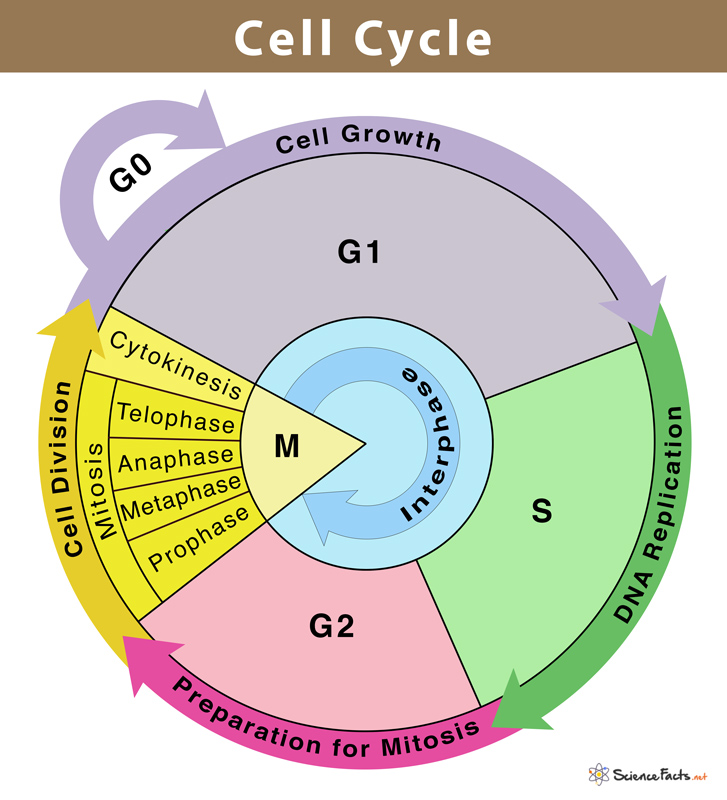
Summarize the events of G1, S, and G2 of interphase.
In G1 phase, the cell grows and makes proteins. In S phase, the DNA is copied. In G2 phase, the cell gets ready to divide by growing more and making the proteins and parts it needs.
Why must the cell grow and copy its DNA before dividing?
The cell must grow to have enough resources for two new cells, and it must copy its DNA so that each new cell gets the same genetic information.
What happens during the M phase of the cell cycle?
During the M phase, mitosis happens, where sister chromatids separate. This is followed by cytokinesis, which divides the cell's cytoplasm.
Summarize the events of each phase of mitosis and cytokinesis.
Prophase: Chromatin turns into chromosomes and the nuclear envelope disappears.
Metaphase: Chromosomes line up in the middle of the cell.
Anaphase: Sister chromatids pull apart.
Telophase: Nuclear membranes form around each set of chromosomes.
Cytokinesis: The cytoplasm splits into two.
You should also be able to identify them in diagrams!

What role do spindle fibers play during division?
Spindle fibers help separate sister chromatids and pull them to opposite sides of the cell.
When / Why does the nucleus break apart during division?
The nucleus breaks apart during prophase so that spindle fibers can access the chromosomes and move them.
How / Why is telophase and cytokinesis different between animal and plant cells?
In animal cells, a cleavage furrow forms to separate the cells, while in plant cells, a cell plate forms to create a new cell wall.
Describe the cells that are produced at the end of one round of mitosis.
At the end of mitosis, two identical daughter cells are made, each with the same number of chromosomes as the original cell.