Hearing
Sound waves are physical vibrations of air/water, produced by a solid object by making alternating phases of compression and dilution of the medium.
The frequency (= pitch) of a sound is determined by the number of times the object vibrates per second.
Frequencies below 16 Hz are called infrasounds
Frequencies above 20,000 Hz are called ultrasounds
The intensity of a sound corresponds to the energy it contains, and depends on the amplitude of the vibration.
The wavelength of the sound wave is determined by its velocity divided by the frequency. Sound propagates at 334 m/s in air, while it’s much faster in water, thus making the wavelengths longer.
Invertebrate ears
Many invertebrates detect sound by direct vibrations via the mechanoreceptors in their legs.
E.g. spiders use substrate waves to locate prey, and water striders use water waves caused by prey animals on the water surface.
Only a few groups have developed true hearing, e.g. crustaceans, spiders, and insects
E.g. cerci of cockroaches
Johnston’s organ on mosquitoes
Tibiae on forelegs of crickets (abdomen on grasshoppers and cicadas)
Ears on abdomen of moths to avoid bats
Vertebrate ears
Use hair cells just like in the vestibular organs
React to deflections of a few nanometers
Human ear
Outer ear
Pinna collects auditory stimuli
Funnels them into the auditory canal toward the tympanum
Also modifies the incoming sound, allowing directional hearing
Middle ear
Acts as an amplifier of the incoming sound
Sound causes vibrations of the tympanic membrane
Membrane vibration is transferred via the ossicles (malleus, incus, and stapes) to the oval window of the fluid-filled cochlea
Inner ear
The oval window causes movement of the fluid in the cochlea and subsequent stimulation of the hair cells
The organ of Corti
The cochlea is divided into three chambers by two membranes (basilar membrane and Reissner’s membrane
Attached to the basilar membrane lies the organ of Corti = the hearing organ
3 rows of outer hair cells and 1 row of inner hair cells connect the basilar membrane with the tectorial membrane
Each hair cells has 20-100 stereocilia
Stand in several rows, connected by tip links
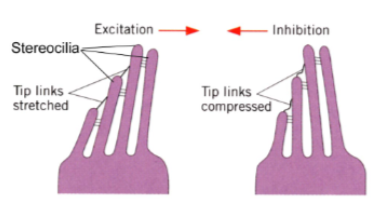 When sound causes the oval window to vibrate, a pressure wave moves along the cochlea and causes the basilar membrane to vibrate up and down. The basilar membrane and the tectorial membrane will move very slightly relative to each other, causing deflection of the stereocilia. The tip links will stetch and open membrane channels, and then subsequently relax and close membrane channels. This generates an electrical signal in the hair cells.
Frequency discrimination
Takes place along the basilar membrane
A long pressure wave wanders along the membrane and causes it to vibrate.
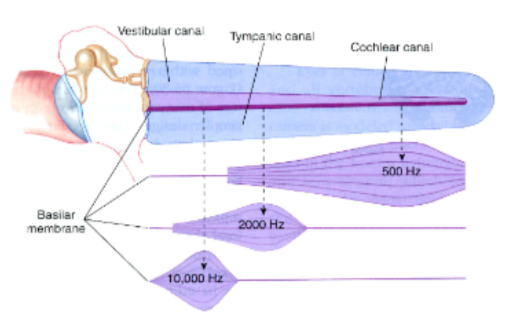 - The membrane is narrow and stiff at the base of the cochlea, and broad and flexible at the apex.
Low sound frequencies cause higher amplitudes of vibration at the apex end
High frequencies cause larger vibrations at the basal end
Other vertebrates
Many mammals have large pinnae that are movable.
Can listen to sounds coming from a certain direction
Large animals are generally more sensitive to low frequencies, while small animals are usually more sensitive to high frequencies.
Bats and toothed whales use ultrasound for echolocation, since small prey animals only reflect sounds of short wavelength
Birds, reptiles, and amphibians do not have outer ears and pinnae
Instead, the tympanum lies exposed
Only one or two middle ear bones (the columella, homologous to the stapes + extra columella (missing in some groups)
Attached to the oval window just like in mammals
Birds and reptiles have the lagena (homologous to mammalian cochlea) and builds the inner ear
Barn owls have facial feathers (facial ruff), which collects and directs sound to the ears
Have spatial differences in the vertical position of the ears, thus allowing them to locate sounds in more planes than the horizontal plane (due to sound waves hitting the ears at milliseconds difference)
Amphibians have a third bone in the middle ear (operculum)
Inner ear (sacculus) contains hearing organs
Has both basilar papilla and amphibian papilla
Much simpler than in other tetrapods
Many frogs produce calls with two frequency components, heard by the two different hearing organs in the sacculus
Fish hear through their whole bodies (hearing in water is much easier)
Some species, bones or swim bladder amplify sound waves
Auditory processing
Auditory nerve is part of the cranial nerve VIII
Projects to the cochlear nucleus in the medulla
Signals from both ears are integrated in the olive nuclei and then sent to the thalamus and finally the primary auditory cortex.