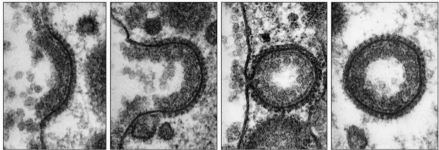
1.7 Transport
The types of Passive Transport
Simple Diffusion
Facilitated Diffusion
Osmosis
Passive Transport
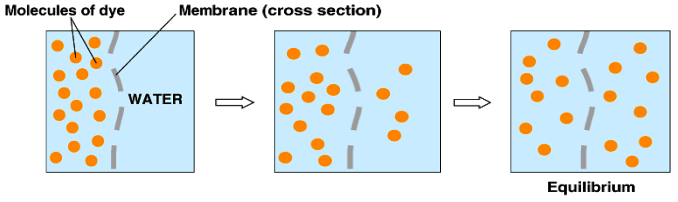
Simple Diffusion
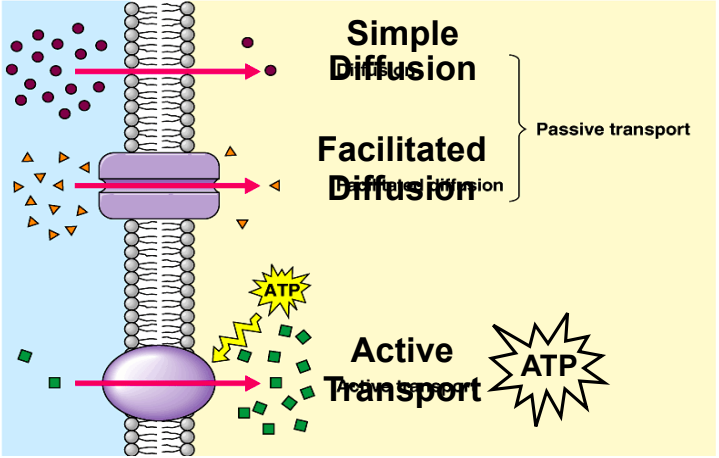
Movement of small substances directly across membrane from HIGH concentration to LOW concentration until equilibrium reached
No energy needed
Small and non-polar molecules (e.g. O2, CO2, glycerol)
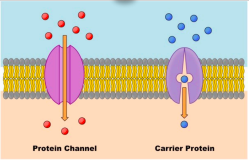
Facilitated Diffusion
Facilitated = with help
Movement of large, charged, or hydrophilic particles through protein channels or by carrier proteins from HIGH to LOW concentration
No energy needed
Osmosis
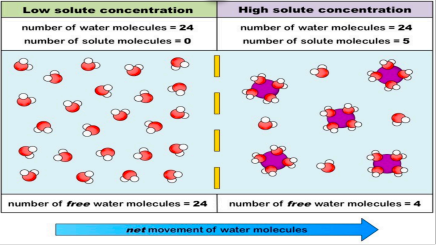
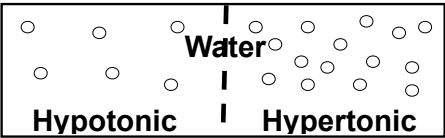
Diffusion of water across a semi-permeable membrane from HIGH concentration to LOW concentration
Equal concentration of water and dissolved substances on both sides of membrane - equilibrium
Osmolarity
measure of solute concentration
Direction of osmosis is determined by comparing total solute concentrations
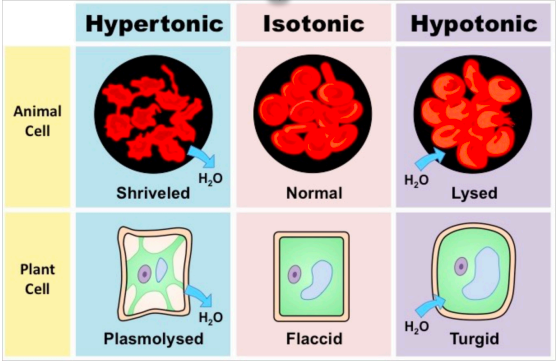
Hypertonic - high solute (high osmolarity)
Hypotonic - low solute (low osmolarity)
Isotonic - equal solute concentration (no net water flow)
Managing Water Balance
Cell survival depends on balancing water uptake & loss
 Active Transport
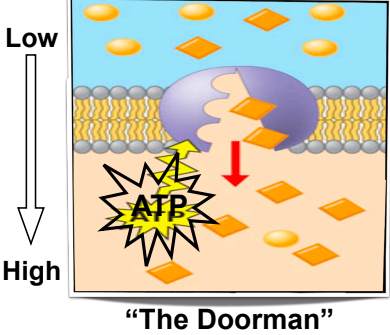
Movement of molecules against concentration gradient
Protein pump transports solutes “uphill”
“Costs” energy = ATP
Vesicular Transport
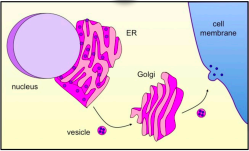
Materials destined for secretion are transported around cell in vesicles
E.R - membrane bulges/buds to create vesicle sent to Golgi
Golgi - vesicles fuse, materials modi ed, then secreted via fusing with plasma membrane, or directly into extracellular fluid, or sent in vesicle to lysosome
Bulk Transport
Bulk Transport - movement of very large molecules or large quantities in/out of cell through vesicles and vacuoles
Endocytosis - enter cell without crossing membrane
Phagocytosis = solid substances are ingested
Pinocytosis = liquids/dissolved substances are ingested
Exocytosis - exit cell without crossing membrane