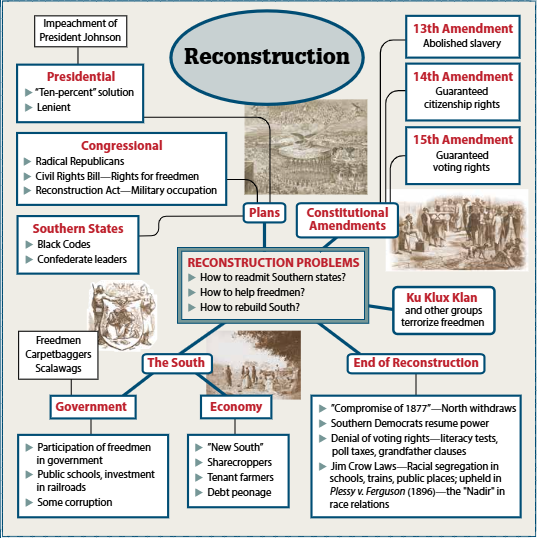
Review cards 2
The Battle over Reconstruction
Reconstruction was the period after the Civil War when the South had to be rebuilt. At the end of the war, the 13th Amendment abolished slavery.
Presidential Reconstruction
Lincoln wanted to readmit Southern states when 10% of the voters pledged allegiance to the Union and recognized the end of slavery. But he was assassinated in April 1865.
Johnson insisted Confederate leaders seek personal pardons.
Black Codes: New Southern state governments with former Confederate leaders passed Black Codes, restricting the rights of freedmen. These were sets of laws based on earlier slave codes. Freedmen could not travel freely or leave their jobs.
Congressional Reconstruction
The Republicans were the political party of President Lincoln. Republicans became divided over Reconstruction. Shocked at the Black Codes and the election of Confederate leaders, a group of Republicans known as the Radical Republicans, who wanted to give full rights to the freedmen, refused to seat Southerners in Congress.
The Civil Rights Act of 1866, passed over Johnson’s veto, granted freedmen rights of citizenship, overturning Black Codes.
The Civil Rights Act was rewritten as the 14th Amendment. This amendment defined who was a U.S. citizen. Everyone born in the United States was a citizen. It also granted all citizens:
■ “Due process of law”: right to fair procedures before a state government takes away a person’s property or freedom
■ “Equal protection of the laws”: state laws should treat people equally
Reconstruction Act (1867) divided the South into military occupation zones.
Impeachment of President Andrew Johnson
Radical Republicans passed the Tenure of Office Act: The President needed Senate consent to remove cabinet members.
Johnson was impeached for removing his Secretary of War. He became the first President to be impeached. When tried in the Senate, Johnson was saved from removal by one vote.
Reconstruction Governments
Carpetbaggers (Northerners who came to the South), scalawags, and freedmen participated in Reconstruction governments.
African Americans voted and served in government during this period. Hiram Rhodes Revels became the first African American in Congress.
Reconstruction governments took steps to ban racial discrimination, establish public schools, and
encourage railroad construction—but many of them were also guilty of corruption.
The Fifteenth Amendment stated that suffrage, the right to vote, could not be denied or abridged (limited) on the basis of race.
Reconstruction Economics
Sharecropping: The sharecropper used the land and tools of the landlord in exchange for part of crop
Tenant farmer: Rented land from landlord, often his former master
Debt peonage: People lost their freedom to move away because of debts (money owed) to their landlord or business owner
“New South”: New economy of South with greater crop diversity, more railroads, and some manufacturing
Some freed people chose to leave the South, leading to an increase in African-American migration (moving to the North or West in order to live there)
The End of Reconstruction
The North lost interest in Reconstruction after an economic depression in 1873.
Rutherford B. Hayes withdrew troops in a deal to win the disputed 1877 Presidential election.
Southern Democrats returned to power.
Ku Klux Klan and other groups terrorized African Americans, threatening them with violence.
The Jim Crow Laws: the “Nadir” in Race Relations
Southern state governments took steps to stop African-American voting: literacy tests, poll taxes, residency requirements. Whites were exempted by “grandfather clauses.”
African Americans were intimidated by violence and economic dependence.
Southern state governments passed Jim Crow laws requiring racial segregation, or separation of -whites and blacks, in schools, railroads, restaurants and other public places.
Jim Crow laws upheld by the Supreme Court in Plessy v. Ferguson (1896): Facilities could be “separate but equal.” Many consider this the “nadir,” or worst period, in relations between the races.