Lecture 15: American Imperialism, the Philippine Reaction / The American Colonial Experience
The Americans needed to have a reason to present to the American people and also to the Philippines that they had to have a viable motivation for colonizing another territory which was very far from the United States in the Pacific, it was needed to be sold.
That is how Pres. William McKinley came up with the concept of benevolent assimilation. Unlike empires in the past that colonize only to take advantage economically, which the Americans also did, they took economic advantage of the availability of sugar, abaca, and in return many mestizos, hacienderos became rich. But aside from that, they had to present a viable reason to govern another territory.
Benevolent Assimilation (Propaganda)
They had to build an impression to the American public that Filipinos were uncivilized, uneducated, and needed American guidance in order to prosper. They needed to be taught civil government, and Christianized.
This was based on a lack of information about what Philippine society was like and that was probably intentional
They created an image in which the Americans had to be in the Philippine otherwise they would be pitiful and nothing would happen to them.
There is a racist element and motivation
This is a propaganda
The Treaty of Paris
After the Treaty of Paris was signed, the Philippines was officially an American territory
As it was signed, the Philippine-American war was going on. This war started off as a conventional war
What does this mean?
There are two opponents and the goal is to occupy the territory of your opponent. There is a front, or a line on the map.
Supposedly, the Philippines is a territory of the Americans and the Ph revolutionary forces who were labeled as rebels were scattered.
What happened was an unconventional warfare
The idea of Luna was to switch to conventional warfare because the Ph revolutionary forces can’t go against the Americans.
Attack dito attack doon, walang agawan ng teritoryo. Ang gagawin nila ay pagurin ang American forces, weaken their morales and maybe they would leave eventually.
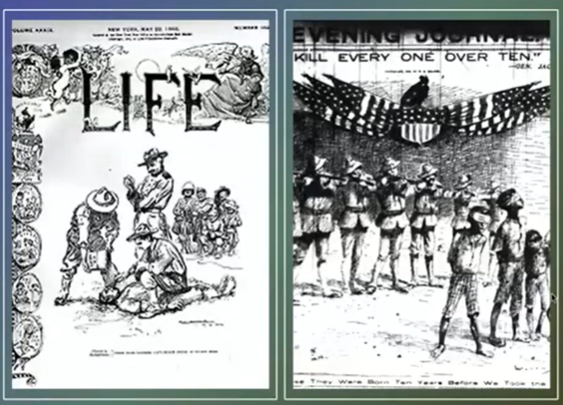
However, Americans responded to that mode of unconventional war. By doing unconventional acts themselves, by resorting to all forms of human rights violations—torture and summary execution. All of this were war crimes.
This was the manner in which the Philippine-American war was conducted until the generals of the Philippines gave up one-by-one. The last being Miguel Malvar who officially put atrocities to an end, at least in the non-Muslim portions of the Philippines.
At the end of the war, the institutions for civil government has to be established, so the Organic Act was crafted by the US Congress as the first set of laws that formally apply to the entire Philippines. This is like our first Constitution in 1902, it contains a bill of rights, delineation of authority, and it has several pages to support the mining industry.
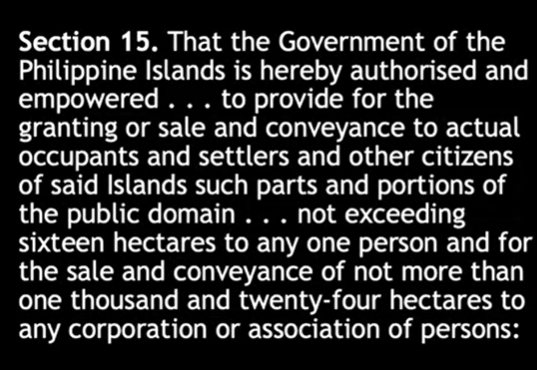
This one section has very significant implications to the property rights of the wealthy mestizo hacienderos. When William Howard Taft convinced the Americans to purchase all the friar lands, they transferred so there were many rich mestizos during this time.
Basically, the Organic Act prevented American citizens from owning more than 16 hectares and prevented American corporations from owning more than 1,024 hectares. There was no incentives for Americans and corporations to invest heavily in Philippine agriculture, so it protected the hacienderos’ interest.
When the economy of the Philippine grew from the trading of sugar and abaca, hacienderos also became wealthy without any threat of competition from foreigners.
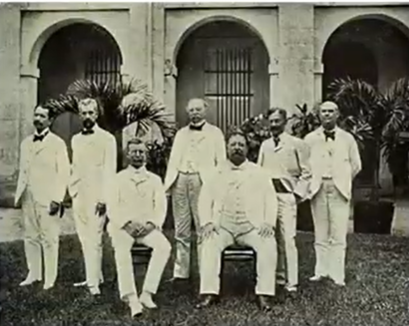
Taft has a big historical agency participation in the Philippines. When American policy was being crafted, he was the one to suggest to the US government because he was the head of the Philippine Commission.
Americans wouldn’t want to spend so much resources to control their new colony
Taft’s observations about Filipinos:
On one hand, there were uneducated Filipinos, medyo iba ugali, at may mga pinag-aralan pero corrupt, sariling interest lang hinahabol
The educated mestizos lacked moral character and easily yielded to pecuniary considerations; they considered public office a personal perquisite and an opportunity for a “squeeze”. He belittled the Malolos Constitution, adopted by the Filipinos early in 1899, as the work only of two men and as a mere imitation of other constitutions.
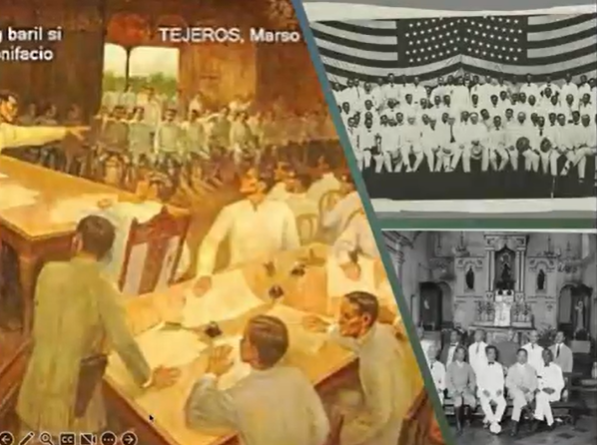
Looking at the types of government that we had so far,
Government that was elected in Tejeros
Andres Bonifacio was killed
Emilio Aguinaldo built a government that involves ilustrados, wealthy mestizos na minamaliit naman siya
Eventually, the Philippine Assembly was formed in 1907, you have the high ranking members of the Ph Commission there but the lawmakers were also them which mostly are from the Tejeros.
This evolved after the enactment of the Jones Law to the introduction of a bicameral legislature
The American Colonial Experience
Public Education
were spread throughout the country, including the parts of the Philippines that was not colonized by the Americans, the Cordilleras and Muslim Mindanao
Thomasites were American teachers and educators who were sent to the Philippines in 1901 to establish and expand the public school system. Their name came from the boat they road named “Thomas”.
The first batch went to Bicol, many died but they were imbibing the benevolent assimilation spirit
The very first teachers were American soldiers who taught in parochial schools in areas where the war ended.
Public education was reformed during the Spanish colonial period but why was it not implemented effectively?
This was because of the existence of a backward institution throughout the pueblo in the form of different friar orders.
Higher Education
From the public school system, the best of the best were given a scholarship by the US government to study in the Estados Unidos which is part of the pensionado Act which was passed by the Philippine Commission in 1903. A lot of them became qualified in different disciplines.
Up until the 60s and even the 70s, the American government was very generous in giving scholarships to Filipinos.
Some universities that was established during the early 20th century
Philippine Merchant Marine Academy
1820 because it was supposedly a reopening of the Philippine Nautical School during the Spanish period
Philippine Normal University (government)
Philippine School of Arts and Traits (government)
now known as “Polytechnic University of the Philippines”
University of the Philippines
Silliman University
it’s not a state school but was founded by the Protestant group.
Many Protestant groups ang nagtayo sa Binan, including Philippine Christian University, because of the concern that a lot of protestants would be setting up education institutions in the Philippines, biglang andaming nagpasukan na mga Philippine Catholic Schools including De Lasalle University.
The Estados Unidos encourage the creation of more Catholic institutions because of the concerns of too much secularism.
Public Health
Filipinos have no concept of food preservation, food safety, and hygiene.
Philippine General Hospital was originally founded by Dean Worcester as the Philippine Medical School in 1907 which was formally incorporated in the UP system
A typical household (bahay kubo), the people are living above and under them are the animals, with their feces and flies. There was also no toilet, so it’s a nightmare that the Americans tried to fix. This is an issue even with the wealthy ones living in bahay na bato.
Culion Leper Colony
Leprosy was a major disease when the Americans arrived. Andres Bonifacio died because of leprosy.
Culion left so much legacies of this American institution marker
Only place in the Philippines where they erected a monument to Leonard Wood
Many research were made here to cure leprosy
Urban Planning
Before the arrival of the Americans, Manila had further planning outside of Intramuros. The Americans implemented significant changes to the city's infrastructure, modernizing transportation (Trambiya) and sanitation systems, which aimed to improve public health and accessibility.
Baguio became the Summer Capital of the Philippines because it was literally of how hot it is in the Philippines.
The Ph Commission transferred the functions of the government to Baguio.
Americans coined a word for a fictional disease called “Filipinitis”. Sobrang init kailangan magpunta ng Baguio.
Gabaldon School Buildings
became Philippine heritage sites
Culture and Entertainment
Music, Sports, Films
The Philippine Constabulary Band
In 1902, William Taft decided that the Philippines must have a marching band to represent the success of benevolent assimilation in the Philippines, to showcase Philippine talent, to show what American influence can do to the Philippines
There were a lot of great musicians from different regions in the Philippines. Walter Loving, black American band conductor, recruited musicians from different marching bands across Luzon to form the Philippine Constabulary band
They became very very famous in the US
During the St. Louis Exposition in 1904, they participated in the band competition and the organizers tried to sabotage the performance, turning the light off while they’re performing.
The Philippine Constabulary Band was conducted by the most famous band leader in history John Philip Susa.
They were so good that they were invited by William Taft to perform when he was inaugurated as president of the US
Sport and Entertainment Icons
The Manila Carnival
Mall and Shopping
American consumer culture