Very basics of chemistry
Basic Concepts of Chemical Reactions
Chemical Reactions and Equations
Definition: In a chemical change, a new substance is formed, and energy may be either released or absorbed.
Definition: Chemical reactions are processes where two or more molecules interact to produce new product(s).
Reactants and Products:
Reactants:
The compounds that react to create new compounds.
Products:
The newly formed compounds after the reaction.
Role of Chemical Reactions:
Play crucial roles in industries, day-to-day life, and natural processes (e.g., rusting of iron, fermentation of wine).
Requirements for Reactions:
Chemical reactions involve chemical changes alongside observable physical changes, such as:
Precipitation (formation of solid)Z
Heat production
Color change
Atom Conservation:
During reactions, atoms are neither destroyed nor created; a new product results from the rearrangement of reactant atoms.
Factors Affecting Reaction Rates:
Pressure
Temperature
Concentration of reactants
Chemical Equations
Definition: A chemical equation is a mathematical representation
symbolizing product formation from reactants and specifying the conditions under which the reaction occurs.
Reactants are displayed on the left side, and products on the right, connected by one-headed or two-headed arrows.
Example Format: A + B—→ C + D
In this equation, and represent reactants, and and are the products.
Balancing Equations:
To adhere to the law of conservation of mass, a chemical equation must be balanced; the number of atoms on both sides should be equal.
Example of Balancing: In the reaction between Methane (CH₄) and Oxygen (O₂), the atoms on both sides are equal, showcasing mass conservation.
Types of Chemical Reactions
Chemical reactions can be categorized by the nature of the products formed, the underlying changes, and the reactants involved. Common types include:
Combustion Reaction
Involves a combustible material reacting with an oxidizer, typically oxygen, resulting in oxidized products.
Example: The combustion of magnesium:
Decomposition Reaction
A process in which a single compound breaks down into two or more simpler products.
This usually requires external energy (heat, light, electricity) to break the bonds.
Example: The thermal breakdown of Calcium Carbonate:
Neutralization Reaction
A chemical reaction between an acid and a base producing salt and water.
The water produced results from combining hydroxide ions (OH⁻) and hydrogen ions (H⁺).
Example: Hydrochloric acid reacts with Sodium Hydroxide:
Redox Reaction
Involves the transfer of electrons between chemical species, leading to simultaneous reduction and oxidation.
Example: Redox reaction in an electrochemical cell:
Precipitation or Double-Displacement Reaction
A reaction where two compounds exchange ions, forming new products.
Example: Silver Nitrate reacts with Sodium Chloride:
Synthesis Reaction
Multiple simple substances combine under specific conditions to form a more complex product.
Example: The synthesis of Sodium Chloride from sodium and chlorine:
Important Points to Remember about chemical equations
A chemical change results in new compounds, whereas a physical change involves a change in the state of matter.
Identifying reactants (substances that undergo change) and products (new substances formed) is crucial.
Compliance with the law of conservation of mass is fundamental in chemical reactions; no atoms are lost or created, only transformed.
Frequently Asked Questions (FAQs)
Q1: What is meant by a chemical reaction?
A: A chemical reaction is a process where molecules collide, break, and form new products, involving reactants that produce new compounds.
Q2: What is a chemical equation?
A: A chemical equation is a statement symbolizing the formation of products from reactants in a chemical reaction. Reactants are on the left, and products are on the right, indicated by arrows.
Q3: What are the chemical reaction types?
A: Types based on products include combustion, decomposition, neutralization, redox, and precipitation (double-displacement) reactions.
Q4: What defines a combustion reaction?
A: A combustion reaction occurs when a substance reacts with oxygen, releasing energy as heat and light.
Q5: What is a decomposition reaction?
A: A decomposition reaction breaks down a compound into simpler components, exemplified by the thermal breakdown of Calcium Carbonate: CaCO3 (s) + \text{Heat} \rightarrow CaO (s) + CO2 (g)
Q6: Describe a neutralization reaction.
A: It occurs between an acid and a base, forming salt and water:
Q7: Define a redox reaction.
A: A process where oxidation and reduction take place, with electrons transferred between reactants:
Q8: Explain a precipitation or double displacement reaction.
A: This reaction involves the exchange of ions between reactants to produce two new compounds:
Q9: What is a synthesis reaction?
A: It combines simple compounds to form a more complex product:
Difference between Metals and non-metals (properties)

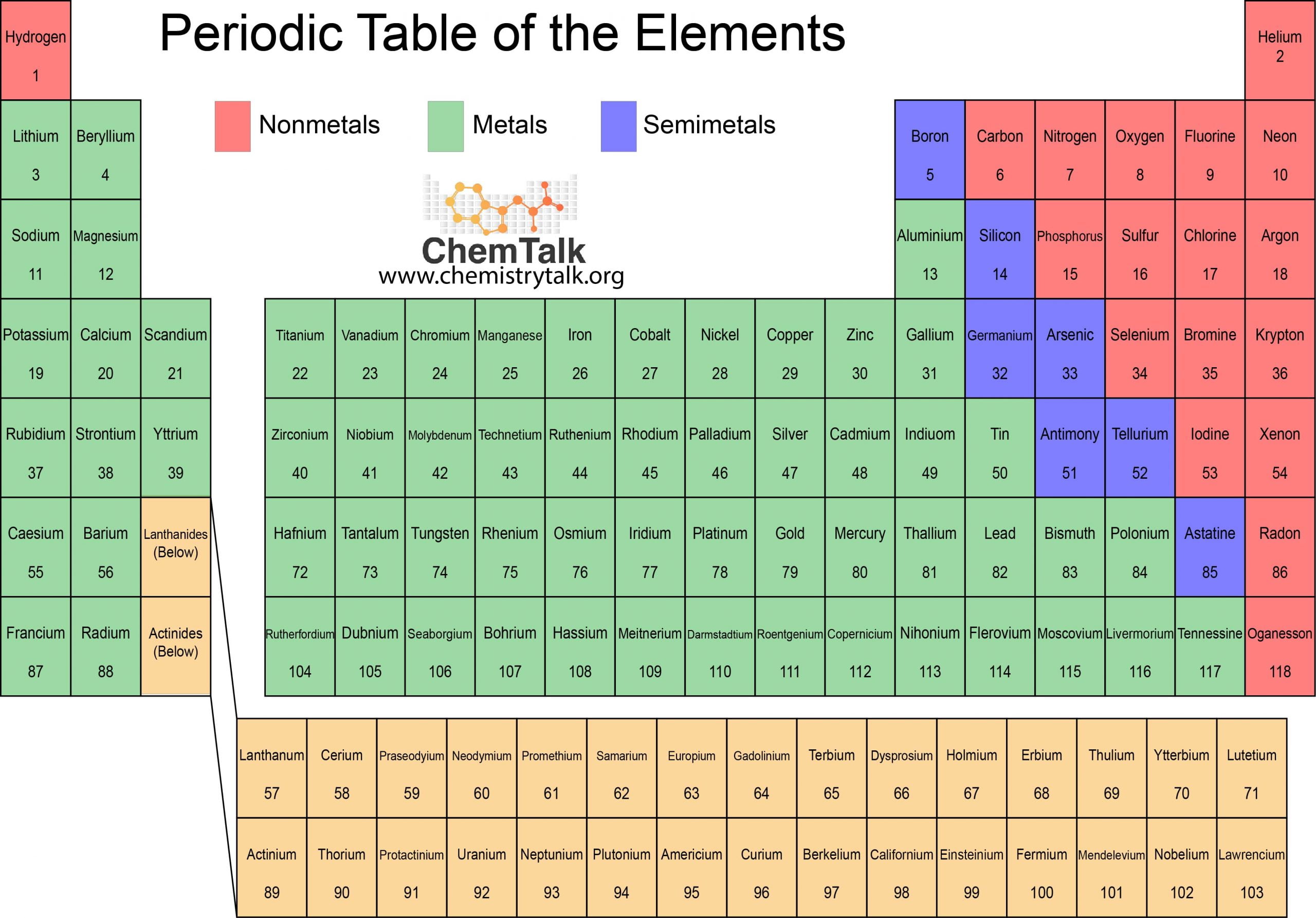
Property | Metals | Nonmetals | Metalloids |
|---|---|---|---|
Appearance | Shiny (lustrous) | Dull | Shiny (lustrous) |
Malleability/Ductility | Malleable and ductile | Brittle | Brittle |
Electrical Conductivity | Good conductors | Poor conductors | Intermediate (often semiconductors) |
Thermal Conductivity | Good conductors | Poor conductors | Intermediate |
Density | High | Low | Intermediate |
Examples | Gold, Iron, Copper | Oxygen, Carbon, Nitrogen | Silicon, Boron, Arsenic |
Elements and Molecules
Element Definition: a pure substance that is made of only one type of atom and cannot be broken down into simpler substances by chemical means.
Molecules Definition: Two or more atoms chemically bonded together; they can be molecules of an element (like H2) or a compound (like water, 𝐻2𝑂)
Compounds Definition: formed when different elements combine in a fixed ratio, resulting in a new substance with properties different from its constituent elements (e.g., sodium chloride, NaCl)
✅ FULL CORRECT ANSWER SHEET and Practice questions ✅
🔹 Physical vs Chemical Changes
1. Which is a physical change?
Melting ice ✔
2. Which observation indicates a chemical reaction?
Formation of a precipitate ✔
3. Why is evaporation not a chemical change?
Because the substance stays the same (H₂O). Only the state changes, not the chemical composition.
4. Two differences between physical and chemical changes.
Physical changes:
No new substance forms.
Change in state/appearance only.
Chemical changes:
New substance forms.
Often difficult or impossible to reverse.
5. Bread going moldy: physical or chemical?
Chemical change — mold is a new substance.
6. Two signs of chemical reaction when mixture gets warm & cloudy.
Temperature change (exothermic).
Cloudiness/precipitate forms (new solid).
🔹 States of Matter & Particle Theory
7. Particles tightly packed but vibrating in place?
Solid ✔
8. When liquid becomes a gas, the particles…
Speed up ✔
9. Particle arrangement in a liquid.
Particles are close together but can slide past each other; medium kinetic energy.
10. Why gases can be compressed but solids cannot.
Gas particles are far apart, so they can be pushed closer.
Solid particles are tightly packed.
11. Difference between boiling and evaporation.
Evaporation: happens at the surface at any temperature.
Boiling: happens throughout the liquid at its boiling point.
12. Water droplets forming on a cold cup: state change?
Condensation — gas → liquid.
Warm air cools, particles lose energy, become liquid water.
🔹 Chemical Reactions & Evidence
13. Which is NOT evidence of a chemical reaction?
Melting ✔
14. Hydrogen peroxide → water + oxygen is what type?
Decomposition reaction
15. Define reactants and products.
Reactants: Starting substances.
Products: New substances formed.
16. Why must atoms be conserved?
Because of the Law of Conservation of Mass — atoms cannot be created or destroyed, only rearranged.
17. What is a precipitate?
An insoluble solid that forms from two solutions during a reaction.
🔹 Balancing Chemical Equations
18. Balance: H₂ + O₂ → H₂O
2 H₂ + O₂ → 2 H₂O
19. Balance: Mg + O₂ → MgO
2 Mg + O₂ → 2 MgO
20. Balance: Al + Cl₂ → AlCl₃
2 Al + 3 Cl₂ → 2 AlCl₃
21. Balance: Na + H₂O → NaOH + H₂
2 Na + 2 H₂O → 2 NaOH + H₂
22. Balance: Fe + O₂ → Fe₂O₃
4 Fe + 3 O₂ → 2 Fe₂O₃
23. Why do we balance equations?
To show that atoms are conserved — the same number of each atom must appear on both sides.
24. Law that requires equations to be balanced?
Law of Conservation of Mass
🔹 Challenge / Application Questions
25. Burning magnesium ribbon.
Reactant: Magnesium (Mg)
Product: Magnesium oxide (MgO)
Evidence of chemical reaction:
Bright white light (energy released)
White powder forms (new substance)
26. Water vapor condensing on a window.
State change: gas → liquid (condensation)
Particle explanation: As temperature drops, particles lose energy and move closer together.
27. Vinegar + baking soda → bubbles.
a) Gas produced: Carbon dioxide (CO₂)
b) Mass is still conserved because:
The gas escapes, but the atoms are still present — they just spread into the air.
28. Sealed container of gas is heated.
Particles move faster (gain kinetic energy)
They hit the container walls harder → pressure increases