Polarization
only the electric field that is responsible for most optical phenomena
polarization refers to the process of filtering light so that only light waves oscillating in a specific direction are allowed to pass through, essentially "selecting" the orientation of the light waves while potentially blocking other orientations of light waves that don't align with the filter's axis
Electric Field in Light Waves: Light waves have both electric and magnetic fields, but when we talk about polarization, we mainly focus on the electric field. This electric field component "wiggles" in directions perpendicular (sideways) to the direction the light is moving. The magnetic field is there too, but for most optical effects we see, it’s the electric field that’s relevant.
its the direction and amplitude of the electric field that is relevant to polarization
Transverse Waves and Polarization: A transverse wave is one where the wave oscillates (vibrates) in a direction perpendicular to its travel path. Imagine a rope being waved up and down—if the wave is moving forward, the rope moves up and down (or side to side), which is transverse movement. Light is also a transverse wave, meaning its electric and magnetic fields oscillate in directions that are sideways to its forward movement.
only transverse waves can have polarization
Polarization and the Electric Field Direction: Polarization happens when we control the direction of the electric field’s "wiggle" in light. Unpolarized light has electric fields vibrating in random directions, but when polarized, the light’s electric field is aligned in a specific direction (like only up and down or only side to side).
light is a transverse wave
In essence, polarization is about controlling the direction in which the electric field part of a light wave vibrates, which we only see in transverse waves like light.
If the E vectors are all lined up within one plane: The light is said to be plane polarized
Polarization in optics is about the direction in which light waves vibrate. Light waves move in a straight line but can "wiggle" in different directions as they travel. Normally, light from the sun or a light bulb vibrates in all directions around that straight path, making it unpolarized.
When light is polarized, it means the light waves are forced to vibrate in only one direction. For example, if you have polarized sunglasses, they block out light that’s vibrating in certain directions, especially horizontal light that reflects off surfaces like water or roads. This reduces glare and helps you see more clearly.
So, in short: polarization is a way to control the direction light waves "wiggle" as they travel.
Methods of Polarization
Let's go through each type of polarization in simpler terms:
1. Polarization by Anisotropic Substances
Birefringent Crystals: Some crystals, like calcite, can split a light wave into two separate waves that vibrate at different angles. When light enters these crystals, it’s split into two polarized beams, each traveling in different directions. This is because the crystal has a special structure that affects light differently depending on its direction.
Dichroic Crystals: These are crystals that absorb light differently depending on the light's direction. For example, light vibrating in one direction might pass through, while light vibrating in a perpendicular direction gets absorbed. Sunglasses often use this principle to reduce glare from certain directions.
2. Polarization by Reflection
Brewster’s Angle: When light hits a surface (like water or glass) at a specific angle, called Brewster's angle, the reflected light becomes polarized. This means that the light bouncing off the surface has its electric field aligned in one direction. This is why polarized sunglasses can reduce glare from reflective surfaces, as they block light vibrating in the reflected direction.
3. Polarization by Scatter
Rayleigh Scattering: When light passes through the atmosphere, it hits small particles and gets scattered. The scattered light is often polarized because of the way it interacts with particles. This is why, when you look at the sky at a 90-degree angle from the sun, the light you see is often polarized. This phenomenon is also part of why the sky appears blue, as shorter blue wavelengths scatter more.
In summary:
Anisotropic substances like special crystals can polarize light by splitting or absorbing it differently depending on direction.
Reflection, especially at the right angle, can polarize light in one direction.
Scattering of light by particles in the air can also polarize it, depending on the angle.
•Anisotropy – directionally dependent
•Isotropy- identical properties in all directions
•For glass, plastic, and similar substances: Optically Isotropic
•The molecular structure acts identically on incident light from any direction
•Refractive index (n) and absorption are the same regardless of angle of incidence
•Some crystalline substances: anisotropy
•Different molecular profile and n at different directions
•Depending on orientation to crystal lattice
•Orientation of E vector
has an optic axis- a line along which there is some degree of rotational symmetry in an optical system
the optic axis of a crystal has no birefringence (splitting into two rays)
note: The optic axis is a term used in crystallography, while the optical axis is a term used in optics to describe the path of light through an optical system.
Yes, a crystal can have an optic axis, which is a direction where no birefringence occurs, but still be considered a birefringent crystal overall;this means that light traveling along any other direction through the crystal will experience double refraction (birefringence) due to the different refractive indices in different directions within the crystal.
Explanation:
Optic axis:
This is a specific direction within a crystal where light travels without experiencing birefringence, essentially acting as if the crystal were isotropic along that axis.
Birefringence:
This property refers to the phenomenon where light splits into two rays with different refractive indices when passing through a crystal due to its anisotropic nature.
Key points to remember:
Not all directions are the same: Even though a crystal has an optic axis, light traveling along any other direction within the crystal can still experience birefringence.
Uniaxial vs. Biaxial: Crystals can have one optic axis (uniaxial) or two optic axes (biaxial).
Example:
Calcite: A common example of a uniaxial crystal where light traveling along the optic axis does not experience birefringence, but light passing through any other direction will split into two rays.
Yes, if a crystal has one optic axis, you will experience birefringence (double refraction) when light travels through the crystal at any axis except along the optic axis; meaning, the birefringence is observed along any other axis within the crystal, not specifically at a single "different axis.".
spherical waves are ordinary waves which are polarized waves perpendicular to the plane
ellipsoidal wavefronts which are extraordinary waves that are polarized parallel to the plane
Explanation:
What is an optic axis: An optic axis is a direction within a birefringent crystal where light travels with the same speed regardless of its polarization, essentially acting like an isotropic material along that specific direction.
Uniaxial crystals: A crystal with one optic axis is called "uniaxial".
How birefringence occurs: When light enters a uniaxial crystal at an angle to the optic axis, it splits into two rays with different refractive indices, causing the "double refraction" effect.
Key point: If you shine light directly along the optic axis of a uniaxial crystal, you will not observe birefringence as the light behaves as if it were passing through an isotropic material.
if the sphere is larger than the ellipsoid than you have positive birefringence
if the ellipsoid is larger than the sphere you have negative birefringence
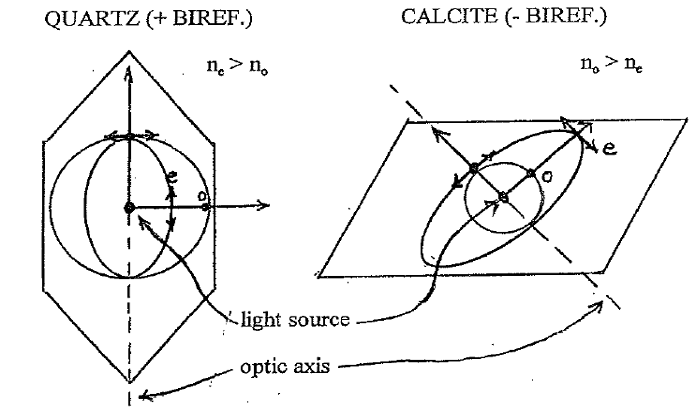
If an unpolarized ray enters a birefringent crystal in a direction other than parallel to the crystal’s optic axis:
•The two e- and o-rays will be acted upon by different n's and will be refracted at different angles.
•Two images will be seen
Consisting of light polarized with the E vectors at right angles to each other
The optic axis does not produce polarized light.
if an unpolarized ray enters a birefringent crystal at a direction that is not parallel to the crystals optic axis the two e and o rays will be acted upon by different indexes and refracted at two different angles and two images will be seen
The nicol prism used to be used to accomplish producing polarized light from unpolarized light
the o ray is unpolarized and elimated by total internal reflection while the e ray exits the prism as polarized light
dichroism is light rays having different polarizations are absorbed by different amounts (e vectors orientation)
tourmaline is dichroic and e vectors that are parallel to the optic pass relatively freely while those that are perpendicular to the optic pass are strongly absorbed and plane polarized beam leaves the crystal
J -sheet dichroic herapathite crystals were mixed with nirtocellulose and pulled into thin sheets which aligned the crystals with all of their optic axes in one direction
H -sheet is a better sheet. is polyvinyl alcohol stretched in one direction with and a sheet is impregnated with iodine that attached to the hydrocarbon molecules which absorbs the component of the E vector in their direction of alignment and only the E vectors perpendicular are fully transmitted
The pass axis is the axis that allows a particular orientation of light ti pass through, if a pass axis is vertical only vertical light should pass. light of a different orientation is partially transmitted and absorbed and if its perpendicular it is fully absorbed. The max amount of light that can pass through a polarizer is 50% of the original intensity of the light.
Polaroid filters can be used to demonstrate the effect of crossed polarizers.
Unpolarized light passed through a polaroid filter:
polarizer: the first filter that matches the filters pass axis
analyzer: the second filter that will be able to pass or not pass depending on the orientation of the second filter
Crossed polarizers
•If the pass axis of the analyzer is rotated to some angle between parallel and perpendicular to the pass axis of the polarizer
•The component of the E vector amplitude (AP) that can be projected onto the analyzer pass axis will get through.
•Ax = Ap cos θ.
•Ax: passing light which is parallel to the pass axis of the analyzer
•Ap: incident light
•Ay will not get through → perpendicular to the pass axis.
•Ax = Ap cos θ where θ is the angle at which the pass axis of the analyzer differs from the axis of the polarizer.
The intensity is proportional to the amplitude squared which Ix= Ip cos² theta which is the law of malus •Ex: If the pass axis of an analyzer is set at θ = 45° to the pass axis of a polarizer, then
•Ix = Ip cos2 θ
•Ix = Ip cos2 45° = 0.5 Ip.
Liquid Crystal Displays
which flow like a liquid but its molecules may be orientated in a crystal-like way way
crossed polarizers and two glass plates create the conditions for light manipulation in LCDs. The twisted arrangement of LC molecules, in the absence of an electric field, enables light rotation, allowing it to pass through both polarizers. With an electric field, the molecules align along the field, stopping the twist, so the light remains polarized in one direction and is blocked by the second polarizer.
Basic Setup and Molecule Orientation
Imagine the liquid crystal as made of long, rod-like molecules that want to line up in a particular direction.
If we place the liquid crystal against one glass plate with tiny grooves, the molecules will line up along these grooves, like pencils placed along a line.
If we then add a second glass plate on top, but with its grooves turned 90° (perpendicular) to the first, the molecules will twist gradually between the two plates to align with each set of grooves.
So, between these two plates, the liquid crystal molecules form a gentle twist, turning by 90° from the bottom plate to the top plate.
Crossed Polarizers and Light Rotation
Now, imagine two "crossed polarizers" — think of these as sunglasses with different polarization directions, like one going vertically and one horizontally. If you only shine light through both polarizers without any liquid crystals, no light would pass through because they block each other’s light direction.
But when the twisted liquid crystals are placed between the polarizers, something interesting happens. As light passes through the liquid crystals, it gradually twists with the molecules, rotating 90°.
By the time the light reaches the second polarizer, it has rotated enough to pass through, allowing light to come through to our eyes. This setup makes the screen look bright because light can travel through both polarizers thanks to the twist.
Adding Voltage (How an LCD Pixel Turns Dark)
When voltage is applied across the plates, an electric field causes the liquid crystal molecules to align straight up and down (perpendicular to the plates).
This alignment removes the twist in the liquid crystals, so light can no longer rotate as it passes through.
Without any twist, the light stays polarized in one direction and gets blocked by the second polarizer, making the screen look dark.
Summary
No Voltage: The liquid crystal molecules form a twisted structure between the plates, rotating light so it can pass through both polarizers. The screen appears bright.
With Voltage: The molecules align straight up and down, removing the twist and preventing light from passing through the second polarizer. The screen appears dark.
This twist, or lack of twist, is what allows LCDs to control each pixel’s brightness and display images by applying or removing voltage across different areas of the screen.
The LCD screen is a filter •fluorescent tube or white LED array (trichromatic)
The screen limits which colors (blue, green, or red) get through in varying amounts on a pixel by pixel basis (each pixel has a window for red, green, and blue)
Black pixel – all light blocked by crossed polarizer
White pixel – all light allowed through by aligned polarizers
Polarization by Reflection
a beam of nonpolarized light is incident on a smooth dielectric material the fraction of the beam that is reflected will be polarized with its E vector oriented predominately perpendicular to the plane the ray travels in.
Brewster’s angle is the reflected bean will only be totally polarized for one angle of incidence.
at other angles light is partially polarized
tan ia=n2 then ia=tan^-1 n2
Polarization by scatter
when light encounters and atom or molecule electrons of the atom or molecule oscillate in the direction of and frequency of the E vector of the light. The amplitude of oscillation is largest if the frequency of the light is near a resonant frequency for the atom or molecule
in condensed matter - resonant frequencies result in absorption since the energy is converted to heat rather than reemitted as light.
in low pressure gasses little interaction between neighboring particles photons absorbed at a resonant frequency are reemitted as photons of the same frequency rather than being converted to heat
The EMR is most strongly perpendicular to the dipole axis radiated at the same frequency and E vector orientation as the stimulating light but not necessarily in the same direction of propagation. Scatter is the reemission.
for atmospheric gas molecules a resonant frequency is in the UV range, the closer the visible wavelength approaches this resonant frequency the more it is absorbed and more effectively scattered, blue light is scattered more effectively than red light.
•This relationship between wavelength and effectiveness of scatter only holds if the scattering particles are much smaller than the wavelength of the incident light.
•This is known as Rayleigh scattering and is described by the following equation:•
• ▭(I_s∝1/λ^4 )
•In words, the intensity of scatter (Is) is inversely proportional to λ4 (or directly proportional to ν4).
•Rayleigh scattering is similar to the Tyndall Effect
•Short wavelength light preferentially scattered
•
•Tyndall effect is responsible for:
•Blue appearance of veins beneath the skin (this is not due to low oxygenation in venous blood)
•Blue iris color (there is no blue pigment; only the absence of a brown pigment, melanin)
•Blue appearance of the flare in aqueous "cells and flare.”
•Structural color, not pigment color
•
•However, Tyndall scattering does not polarize light
•Scattering particle: of similar size to scattered wavelength
Then you have the mie scattering which is particles larger than the wavelength of the incident light the amount of scattering is no longer dependent on the specific wavelength and all component colors are scattered equally
Scattering | Preferentially Scatters | Scattering Particle | Polarizes Light? |
Rayleigh | Short wavelengths | Far smaller than wavelength of light | Yes |
Tyndall | Short wavelengths | Colloidal particles – roughly the same size as scattered wavelength | No |
Mie | All wavelengths | Spherical particles of similar size or larger than scattered wavelength | No |