subjunctive
in subordinate clauses
purpose clauses
Expresses the purpose of an action (hence the name)
ut + subjunctive = so that / in order to / to
puer arborem ascendit ut milites videret. The boy climbed the tree to see the soldiers.
Negative: purpose
ne + subjunctive = so that… not Also note: ne + quis/quid = ne aliquis/aliquid – so that no one / nothing
puer arborem ascendit ne milites se viderent. The boy climbed the tree so that the soldiers would not see him.
Using relative pronouns (but the translation remains the same)
qui, quae, quod (or other relatives) + subjunctive
milites emisit qui puerum depellerent. He sent out soldiers to (lit. who were to) drive the boy away.
The tense of purpose clause is determined by sequence of tense.
The tense of the main verb determines the tense of the subjunctive in a subordinate clause.
Tense in main clause | Subjunctive in purpose clause |
PRIMARY (present, future, imperative) | Present subjunctive |
HISTORIC (imperfect, perfect, pluperfect) | Imperfect subjunctive |
In practice, primary means present/future and historic means past.
LBGCSE – translate 1.25 and 1.27
indirect commands
Many Latin verbs meaning ‘warn’, ‘persuade’, ‘order’, command’, ‘encourage’ (e.g. monere, persuadere, imperare, mandare, hortari) are followed by:
ut / ne + subjunctive.. (Sometimes, an indirect command may not immediately appear to contain any kind of ‘command’, but if you work your way back to the original direct statement, it will be there!)
Usually translated by the infinitive in English.
The verbs iubere and vetare are followed by an infinitive.
puerum imperamus ut arborem ascendat. We order the boy to climb the tree.
puerum imperavimus ut arborem ascenderet. We ordered the boy to climb the tree.
Translate 1.32
verbs of fearing
A fear clause will be introduced by ne or ut.
Verb of fearing + ne + subjunctive = that/lest.
puer timet ne leonem videat. The boy fears that he will see the lion.
Verb of fearing + ut + subjunctive = that… not
timeo ut ea litteras accipiat. I fear that she will not receive the letter.
It will be signalled by a main verb meaning ‘to fear’ (e.g. timere, metuere, vereri).
Fear clauses seem to do the opposite of what you expect – if you fear something will happen, you use ne, but if you fear something will not happen, you use ut. All you are doing, in fact, is saying that you want one thing to happen, but you are afraid that the opposite will. It is this fear which is expressed in the fear clause.
Fear clauses follow the rule of sequence of tense
Translate 1.34
result clauses
Expresses the result (consequence) of an action
ut + subjunctive = that
Negative result: ut… non
after signpost word a main clause : tam, tnatus, tot, talis, adeo, ita, totiens (so….tantus = so big;
tot= somany; talis = such, of such a sort; adeo= so much, to such an extent (with verb);
ita= so, insuch a way (with verb) ; totiens = so often, so many times (with verb)
The tense of result clauses is determined by sense (it is the same as in English, not according to sequence of tenses!)
If the emphasis is on a single outcome actually achieved, the perfect subjunctive is preferred:
> tam celeriter heri cucurrit ut praemium acceperit. He ran so fast yesterday that he received the prize.
if it describes a result currently true a present subjunctive can follow a historic main verb,
> tam celeriter heri cucurrit ut hodie ab omnibus laudetur. He ran so fast yesterday that today he is being praised by everyone.
NB! RESULT VS PURPOSE CLAUSE
Roma discessit ne patrem videret . *
Roma tam celeriter discessit ut patrem non videret *
SE and SUUS - (reflexive pronoun and possessive adjective) in purpose clauses usually refer to the subject of the main verb (whose thought the purpose clause represents)
In a result clause a reflexive refers to the subject of that clause itself (which because it describes an event is more like a separate sentence) so that an appropriate part of the non-reflexive is ea id has to be used to refer back to the subject of the main verb.
> puer clamavit ut puella se audiret. The boy shouted so that the girl would hear him. (purpose)
> puer adeo clamavit ut puella eum audiverit. The boy shouted so much that the girl heard him. (result)
Translate 1.36
cum clause
cum + present subjunctive = since (causal), although (concessive)
cum + pluperfect/imperfect subjunctive = when / since / although
puer, cum consilium audivisset, contentus erat. When the boy had heard the plan, he was pleased.
indirect questions
Expect a question word to introduce the indirect question, whose verb is subjunctive. There will not necessarily be any verb of ‘asking’.
e.g. quando, quis/quid, num, cur + subjunctive
The subjunctive is translated like an indicative.
puerum rogavimus cur arborem ascenderet. We asked the boy why he was climbing the tree.
sciebat cur pugnaret. He knew why he was fighting.
IN REPORTED SPEECH - ORATIO OBLIQUA (and extended oratio obliqua)
In Latin, a speech or narrative is often not given in the actual words of the speaker but is reported indirectly as the object of a verb of saying. A speech so reported is called Oratio Obliqua.
(JT, pate 89) > The verb in any subordinate clause within indirect speech normally becomes subjunctive if it is not already. This typically applies, for example, to relative clauses (with qui), time clausses (with words such as ubi, or postquam), causal clauses (with quod) and concessive clauses (with quamquam), and usually within indirect statement (though it also occurs in indirect commands and questions). The tense of the subjunctive is by sense within the rule of extended sequence.
Dicit se libtum legisse quem sibi dederim. He says that he has read the book which I gave him.
Iuravit se librum lecturum esse quem scripsissem. He swore that he would read the book which I had written. Translate: 3.23 LBGCSE page 90
in main clauses - independent/freestanding
jussive subjunctive
let's do X, may X happen – present subjunctive
A command in the 3rd person (‘let him…).
arborem ascendat. Let him climb the tree.
pro patria pugnent. May they/let them flight for the fatherland.
The negative with jussive subjunctive is ne.
Exhortative/(ad)hortative subjunctive 1st person plural only!! – present subjunctive!
Hortatory subjunctive (from hortari ‘to urge’)
As above, but in the first person.
vivamus, mea Lesbia, atque amemus. Let us live, my Lesbia, and let us love.
gaudeamus! let's rejoyce!
deliberative - present and imperfect
Generally used in the first person, when the speaker is thinking out loud what to do next, or when he/she wishes to express doubt or disbelief. English translation is often ‘should’.
quid faciam? What am I to do?
utrum hic maneam an arborem ascendam? Should I stay here or climb the tree?
Less commonly, the imperfect subjunctive is used to look back on a similar thought process in the past.
quid de hac re putarem? What was I to think about this matter?
optative (wishes for the future)
The subjunctive is used in wishes, often with utinam (I wish that…).
ne is used to express a negative wish.
Present is used to express a wish for the future, with or without utinam, translates ‘may’.
Imperfect, usually with utinam, used to express a wish that is impossible for the present, translates ‘might’ or ‘were’.
Pluperfect, usually with utinam, expresses an impossible wish in past time, translates ‘had’.
(utinam) arborem ascendat. May he climb the tree.
(utinam) Caesar adesset. I wish that (would that) Caesar were here (now).
(utinam) me vidisses! I wish (would that) you had seen me (then)!
utinam ne adesses. If only you were not present.
potential
Used to express an opinion politely and tentatively, a possibility. Translated as "should", ‘would’, "may" or "might"
Often with velim, nolim
Cf. French je voudrais
velim hanc arborem ascendere. I should like to climb this tree.
aliquis hoc dicat. Someone may say this.
With an imperfect subjunctive (often in the second person singular, referring to an unspecified you) it describes what someone might have thought or done at some point in the past:
crederes eos victos esse. You would have believed they had been defeated.
Translate 1.17 (1.18) 1.19 (1.20) 1.21 (1.22) 1.23 (1.24)
questions
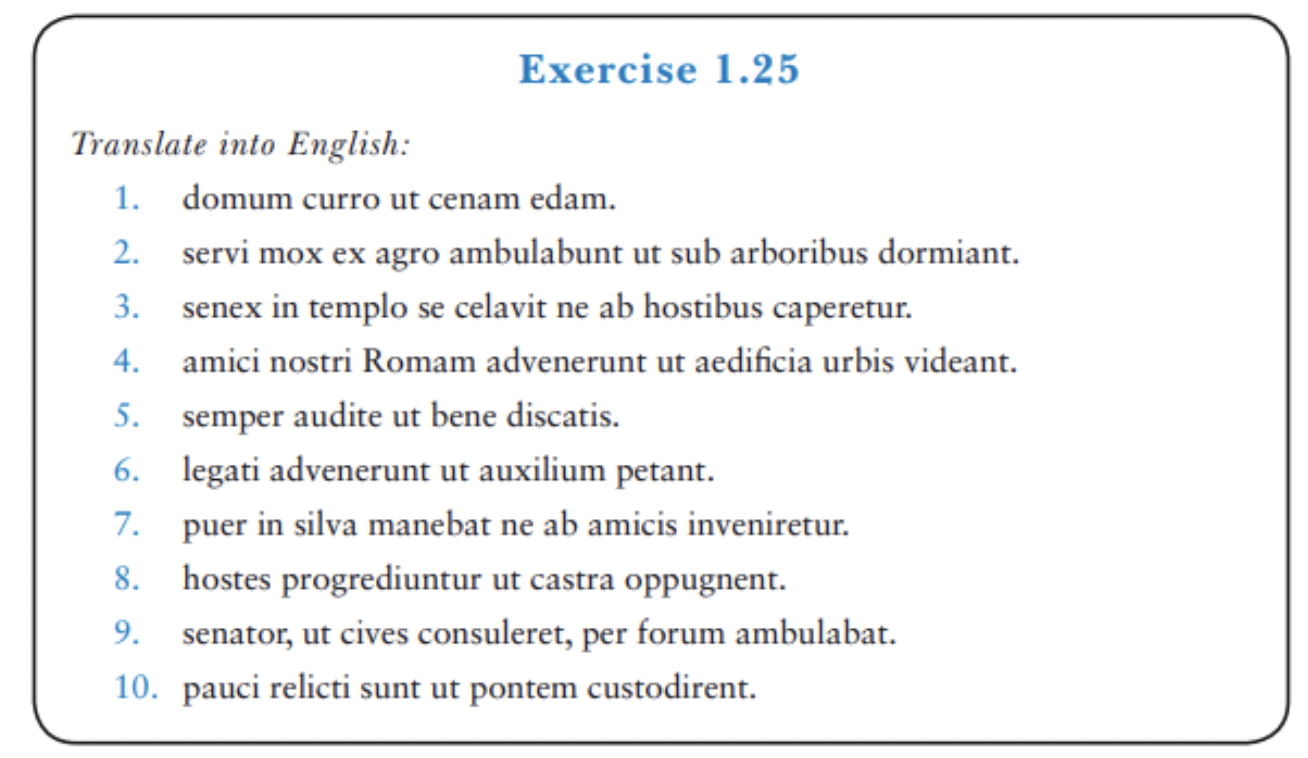
Translation | subjunctive | |
1 | I run home so that I will eat dinner. | ut… edam – present subjunctive |
2 | soon the slaves will walk out of the field to sleep under the tree. | ut… dormiant - present subjunctive |
3 | the old man hid himself in the temple so that he would not be captured by the enemies. | ne… caperetur - imperfect subjunctive |
4 | Our friends went backk to rome to see the buildings of the city. | ut… videant - imperfect subjunctive |
5 | always listen in order to learn well. | ut… discatis - present subjunctive |
6 | the legion returned to seek help. | ut… petant - present subjunctive |
7 | the boy remained in the woods so that he would not be found by his friends. | ne… inveniretur - imperfect subjunctive |
8 | the enemies advanced to attack the camp. | ut… oppugnent - present subjunctive |
9 | the senator was walking through the forum, to consult the citizens. | ut… consuleret - imperfect subjunctive |
10 | a few were left behind to guard the bridge. | ut … custodirent - imperfect subjunctive |