3. Leases, Leaseholds & Co-Ownership of Land
Leases
A lease is both an estate in land (proprietary) and a contract.
leasehold owner is a temporary property owner, enjoying possession and freedom from interference.
landlord owns the freehold reversion
Subletting: A tenant may carve out a new lease from their headlease, known as a sublease, for a sublessee. The duration of a sublease must be shorter than the headlease.
Covenants: Promises between the parties, contained in the lease. These can be express (documented) or implied (by statute or court).
Lease vs Licence:
Lease → proprietary right enforceable against third parties
License → personal interest/contract allowing temporary use of land
Essential Lease Characteristics
A lease can bind third parties and give a leaseholder the following rights: (i) security of tenure (entitlement to occupy the land for the full term of the lease and possibly after the lease ends), and (ii) exclusive possession/control of the land
Generally, a lease is made up of two documents:
Agreement for the Lease
Lease Deed (some leases have no agreement to lease, just the lease/deed itself)
On exchange, lease deed is attached to agreement but not dated/signed until completion – both docs are sent to land registry to be registered
Licence → personal permission vs. Lease → proprietary interest.
Three Key Lease Requirements:
Certainty of Term:
Tenancy must have fixed term + certain start date
If determinable upon someone’s life or marriage = it automatically has a term of 90 years
Wording like “until required”/ “while X continues”/ “for as long as Y wants” = treated as lease for life as long as tenant is an individual
If lease duration depends on an uncertain event (like the war ending, or someone’s life ending) = it is void for uncertainty.
Exclusive Possession
Rent (Usually in exchange for rent, but not essential)
Formalities for a Valid Lease
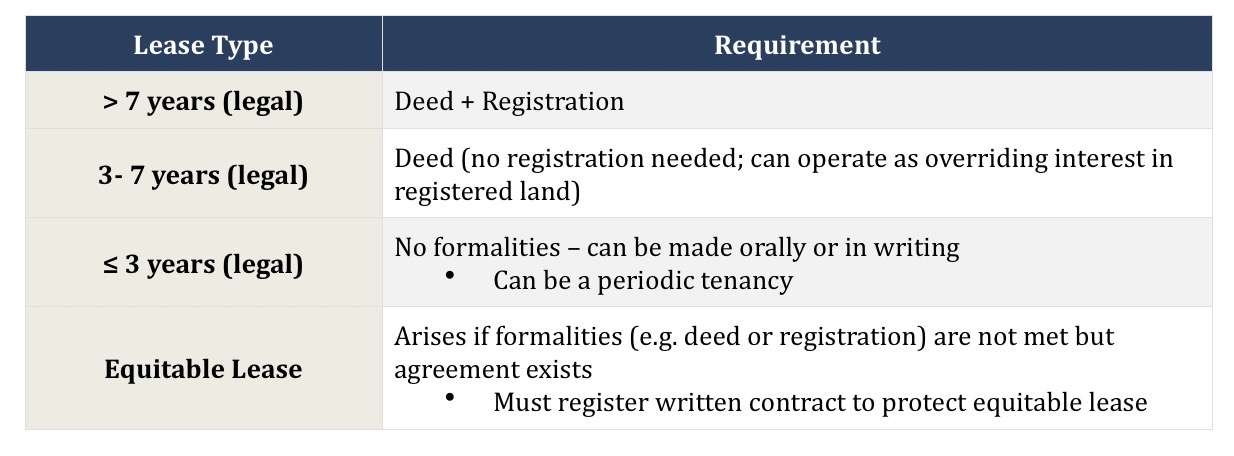
Periodic Lease vs Tenancy at Will
Periodic lease (periodic tenancy) – Renews automatically until terminated by notice
Implied Periodic Tenancy: Arises where a tenant moves in and pays rent (calculated monthly or yearly) without a written agreement. This satisfies "certainty of term" through the rent period.
Tenancy at will – No fixed term, can be ended at any time by either party.
Leasehold Covenants
These are promises made by landlord or tenant in a lease — typical covenants:
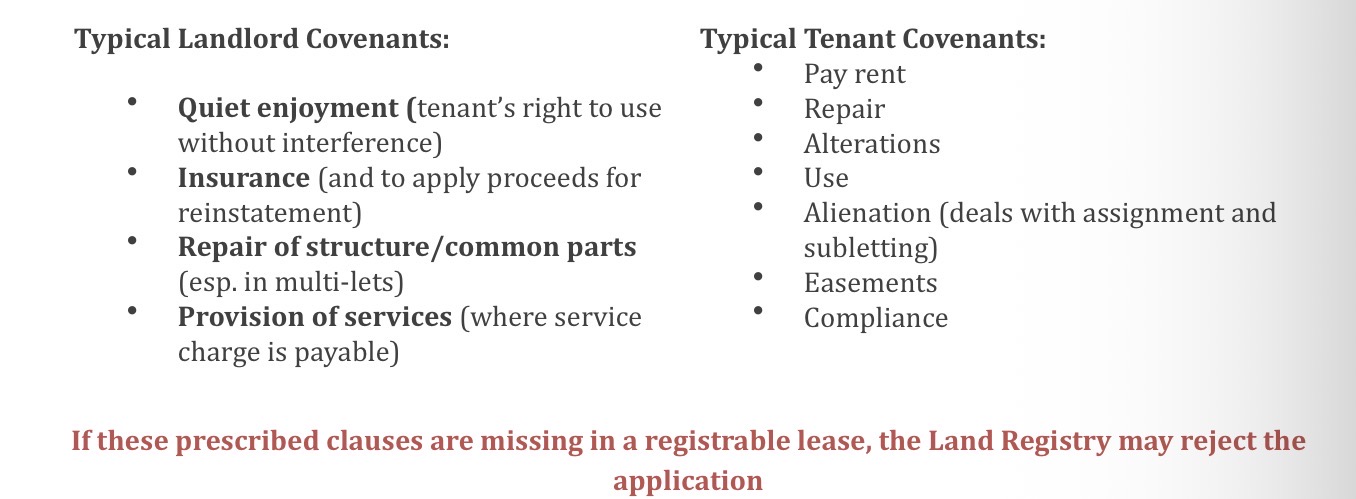
These covenants may either be express (written in the lease itself), or implied (imposed by law even if not written)
Assignment of Lease + Express Covenants
This is when the remaining term of a lease is passed to a third party (the original tenant drops out) — e.g. Landlord grants a 10-year lease to A. After 3 years, A assigns the lease to B. B takes over the remaining 7 years.
Assignment must be by deed + If assigned lease is for more than 7 years, the assignment must be registered at HM Land Registry to take effect in law
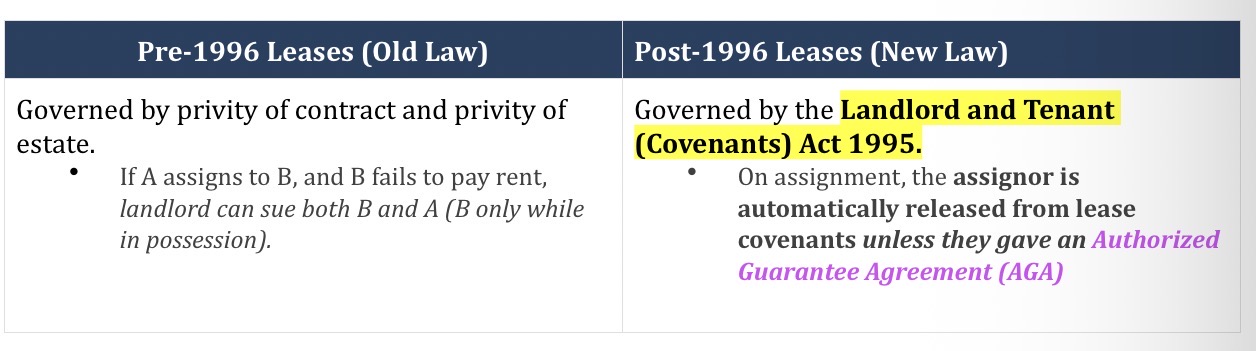
Authorized Guarantee Agreement
On assignment, assignor is automatically released from lease covenants unless landlord requires outgoing tenant to give an Authorized Guarantee Agreement (AGA)
Landlord assignment is different: original L is not automatically released from liability on assignment of reversion (ownership)
L must apply to tenant to be released before the assignment or within 4 weeks of it
If T refuses, L can apply to court to be released from personal covenants only
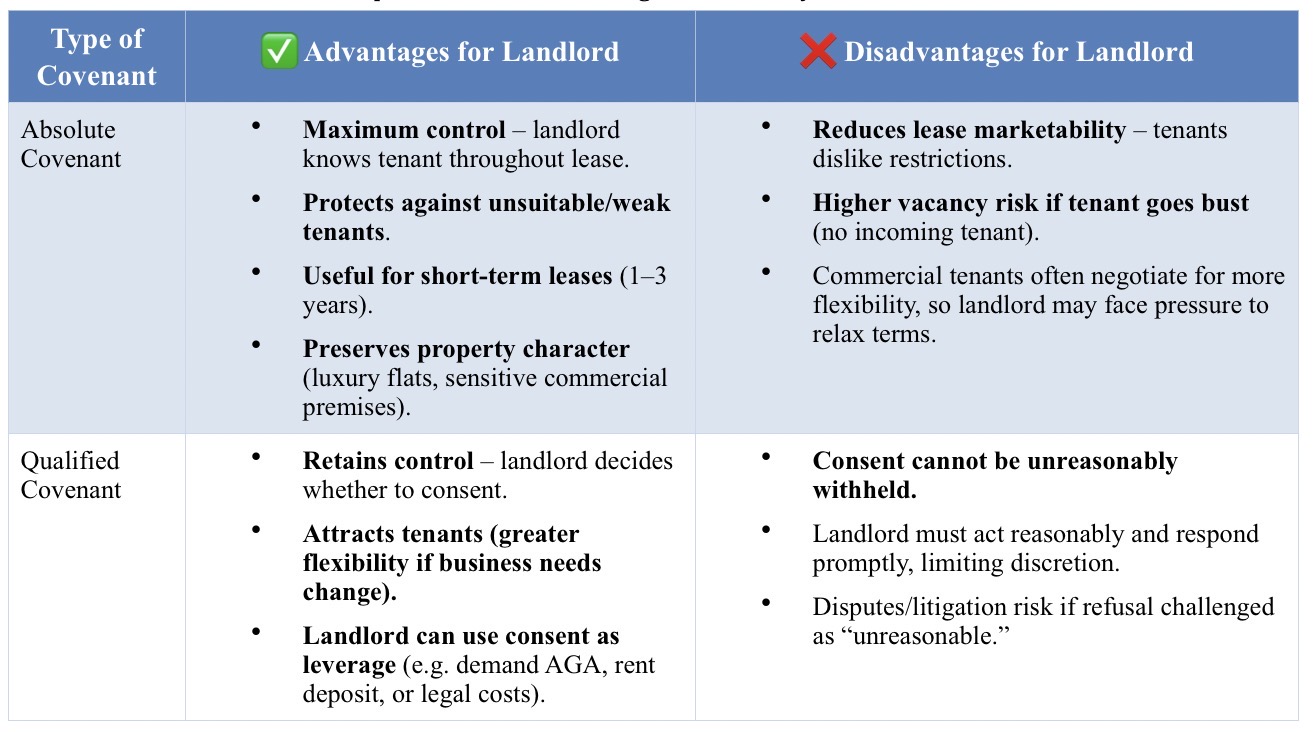
Alienation: Landlord’s Consent + Covenants Against Assignment
Many leases contain an alienation covenant to restrict the tenant’s ability to assign — this includes:
Absolute prohibition (no assignment at all – this is rare).
Qualified (assignment only allowed with landlord’s consent – which cannot be unreasonably withheld)
An assignment in breach of covenant = still legally effective btw tenant and assignee
Assignee becomes tenant and now acquires the leasehold interest (becomes a tenant in law and equity)
Assignor will still be liable for the breach BUT accepting rent from new assignee = waiver of breach
Remedies for breach of covenant:
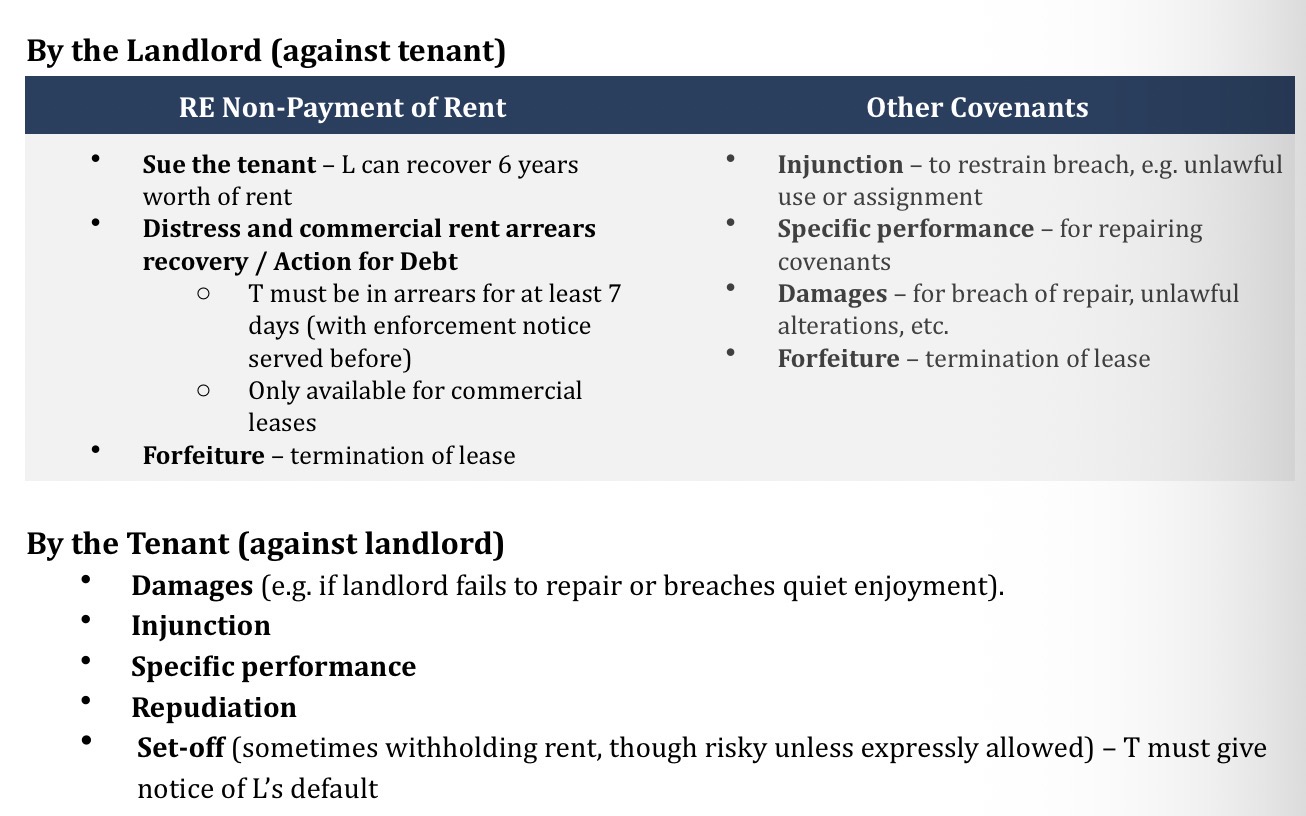
Non-rent arrear breaches are forfeited via a s146 notice
Rent arrears can be forfeited in the following ways:
Residential property → court order for seizure/possession
must be for arrears > £350 or > 3 years old
Commericial property → no court order required; can rely on CRAR
peaceable renetry allowed to forfeit unpaid rent
Rent Review
Applies to long leases (10+ years)
Protects L from being locked into below-market rent
Should occur at agreed intervals → Must be clear the review period starts from lease completion, not exchange (to avoid earlier rent increases)

Sublease
This is when a tenant rents out part of their leased property to a third party for a portion of their original lease term → some reversion remains with the head tenant
If the sublease is for the whole remaining term, it’s treated as an assignment, not a sublease
Headlease = superior lease; Underlease = sublease
Headlease usually requires landlord’s consent before granting an underlease
Underlease must be consistent with the head lease (it cannot undermine head lease)
Subletting the whole is often prohibited
Freeholder can forfeit a headlease if the tenant breaches the contract
Underlease will be automatically terminated as a result, leaving the undertentant exposed unless they apply for relief from forfeiture
Enforcing Covenants on Subtenants
L cannot enforce covenants directly against a sub-tenant unless it is a restrictive covenant – otherwise:
L can sue T; or
Create a direct covenant with sub-tenant via a license to sub-let
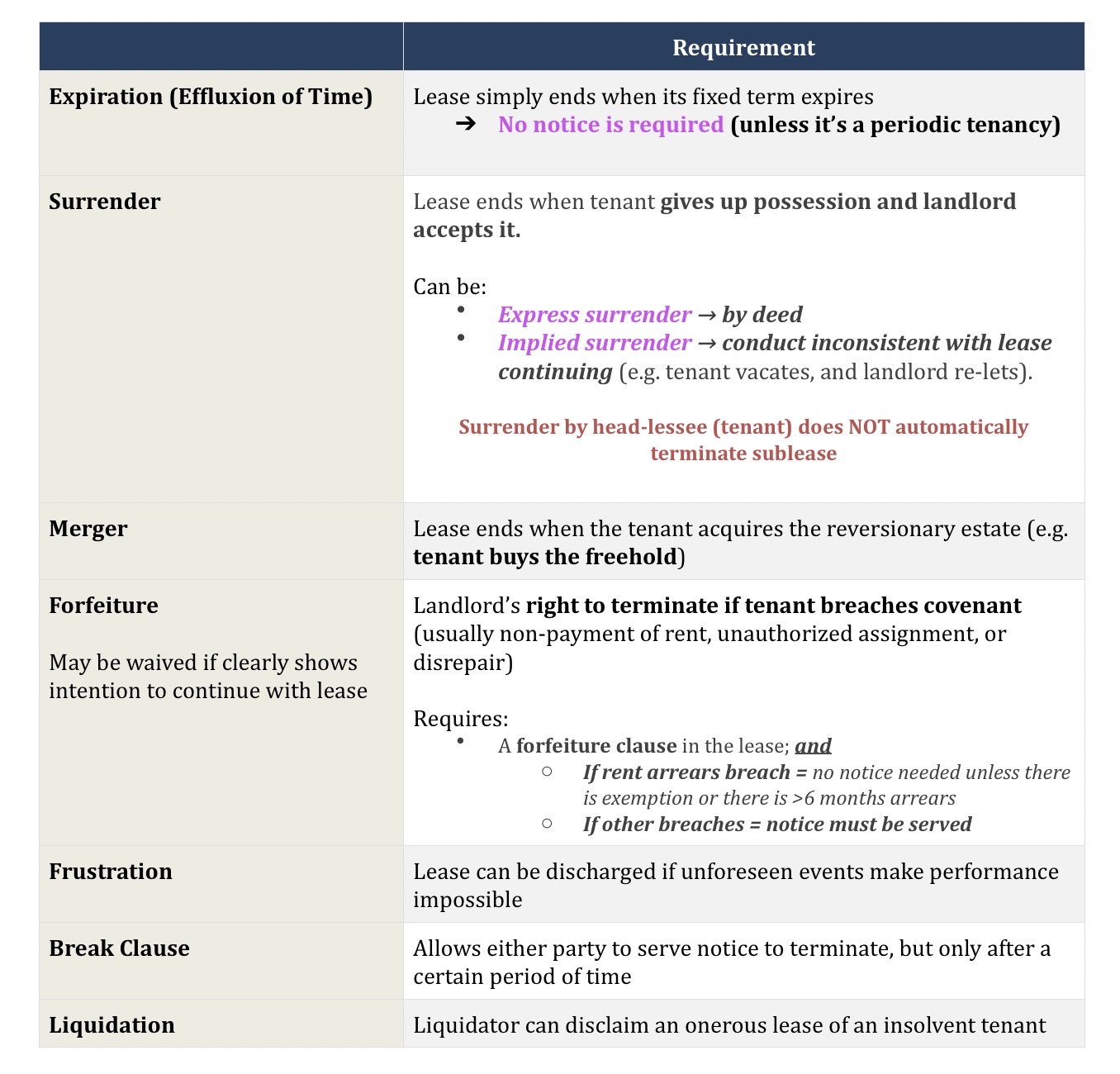
Termination of a Lease
A lease may come to ends in the following ways:
Protection of Businesses via Security of Tenure
Business tenants have statutory protection under the Landlord and Tenant Act 1945 → at the end of their lease term, they normally have the right to remain in occupation and to request a new lease, unless the landlord can prove specific statutory grounds to oppose renewal.
When a tenant stays past the Contractual Expiry Date (CED), they are "holding over," and the lease is deemed to continue.
Applies to tenancies (not licenses) of premises occupied for business purposes
Parties have the option to ‘contract out’ of this act by following a strict procedure:
Landlord serves a health warning notice before lease is entered into, which explains that tenant will lose security of tenure
Tenant makes a simple or statutory declaration acknowledging they understand they are giving up protection
Simple declaration → valid if lease is completed at least 14 days after warning notice
Statutory declaration → if lease is to be signed within 14 days
Tenant must receive independent legal advice confirming they understand they are giving up their statutory rights + notice from landlord to remove security of tenure
Lease must explicitly state that the LTA 1954 protections are excluded
Ending a Tenancy Under Security of Tenure
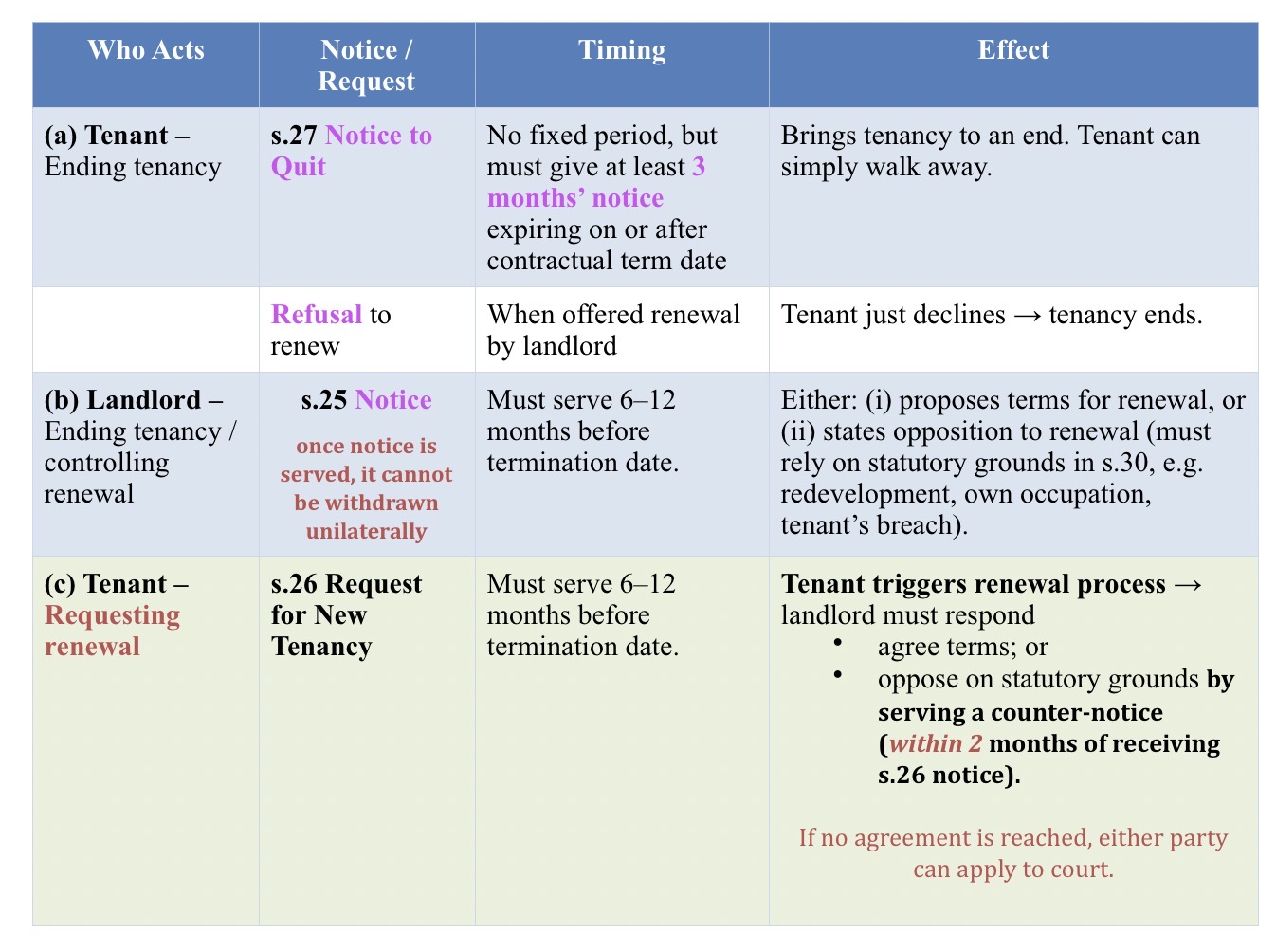
s.25 notice – Statutory Grounds for Opposing Renewal
Discretionary/Fault Based Grounds (tenant fault)
(a) Disrepair – Failure to repair
(b) Persistent delay in rent
(c) Other substantial breaches of covenant or statutory duty
(d) Subleasing that prevents disposal of the whole property
The court has discretion whether to refuse renewal; if proved must refuse new tenancy
Mandatory/Non-Fault Based grounds (No Fault)
(e) Intention to Redevelop– landlord intends to demolish/reconstruct/develop
(f) Landlord intention to Occupy – landlord intends to occupy premises for own business/residence
(g) Suitable alternative accommodation – Landlord can provide suitable alternative premises for tenant)
Tenant Compensation (if landlord succeeds):
For no-fault grounds → tenant may get statutory compensation
if tenant occupied property >14 years → compensation = 2*rateable value of the tenant
if tenant occupied property <14 years → compensation = rateable value of the holding
If the court grants a new tenancy and parties cannot agree on terms, the court imposes the following:
Duration: Decided by the court, but cannot exceed 15 years\,\text{years}$$
Rent: Based on market rent, disregarding goodwill and improvements made by the tenant.
Commencement Date: Generally 3 months + 4 weeks after the court order.
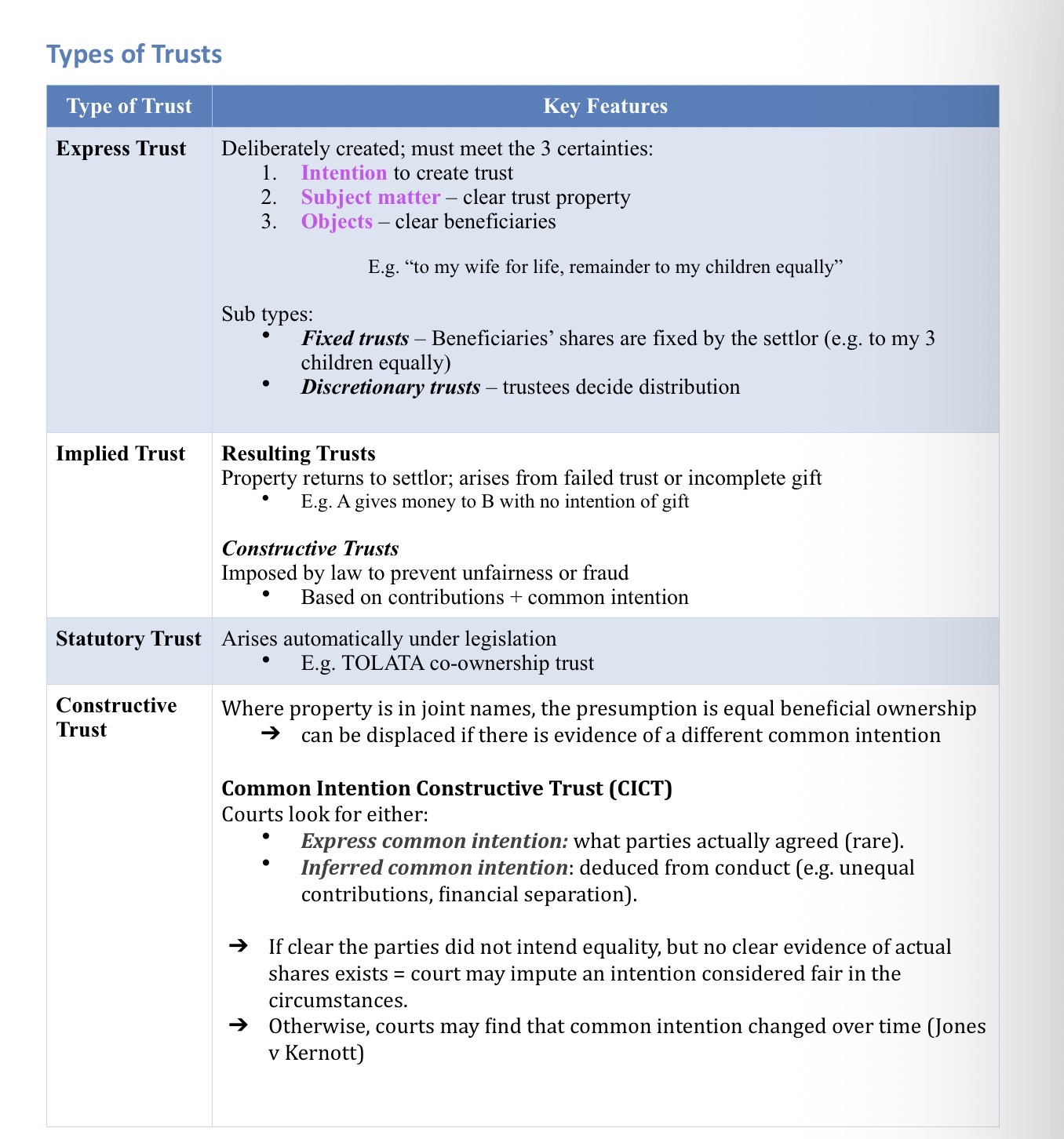
Co-Ownership
When 2 or more people share legal title of land at the same time → this creates a trust in land where the trustees hold legal title + beneficiaries hold the equitable title
Trustees must exercise powers as per their duties and for the benefit of the beneficiaries – beneficiaries must be consulted where practical
Beneficiaries have the right to occupy the land if the trust purpose makes it available for occupation
Under legal title, beneficial interest can be held in 2 different ways:
Joint Tenancy
An undivided beneficial ownership in possession, interest, title, and time (transaction)
No one has distinct share – everything shared between owners as a whole
Right of survivorship applies – if one owner dies, their share automatically passes to the other trustees
Joint tenancy has a maximum of 4 people
If > 4 people, the law requires some to be trustees holding the property on behalf of others in equity.
Tenancy in Common
only exists in equity: each co-owner holds a distinct share (may be unequal)
no right of survivorship – co-owners share passes by will or intestacy
Requirements to be a Trustee of Land:
Must be at least 18 years old
Must have mental capacity
Cannot be more than 4 trustees
Joint Tenancy Severance
This is when a joint tenancy is converted into a tenancy in common
Only affects equitable ownership and not the legal estate, which must always remain a joint tenancy under LPA 1925
Severance ends the right of survivorship → each co-owner now has a distinct share that can pass by will or intestacy.
Methods of Severance
(A) By written notice of intention to sever, served on the other co-owners; must be:
In writing.
Must show a clear, immediate, and irrevocable intention to sever.
Must be served (e.g. by leaving at last known address).
(B) By “common law methods” — The courts recognize three alternative routes:
Joint tenant operating on their own share: E.g. sale or mortgage
Mutual agreement: All joint tenants agree (expressly or impliedly) to treat their interests as separate — Must be a clear, genuine agreement.
Mutual Conduct/Course of dealing: Where the conduct of the parties shows a common intention that their shares should be separate.
Examples: consistent references to “my share” or treating proceeds of sale as divided.
Words of Severance: Phrases like "in equal shares" or "to be divided between" indicate a TIC
Unequal purchase contributions in:
commercial context = suggest TIC
family context = presume JT even with unequal contributions
Co-Ownership & IHT
this section has not been edited yet, but should be ok for information
When co-owners die, the way they hold their beneficial interest (joint tenancy vs tenancy in common) directly affects how inheritance tax is assessed.
> Joint Tenancy IHT
Right of Survivorship applies → the deceased’s equitable share automatically passes to the surviving co-owner(s).
IHT Position → the deceased’s share is still included in the estate for IHT purposes, even though it passes automatically to the survivor
If survivor is a spouse or civil partner = estate is usually exempt from IHT for spouse exemption
If survivor is not a spouse/civil partner (e.g. child, sibling, friend) = value of the deceased share is taxed for IHT as part of the estate
Example: If A and B own as joint tenants, and A dies, A’s notional 50% is included in A’s estate for IHT. But the property itself passes directly to B outside the estate.
> Tenancy in Common
No survivorship → each co-owner has a distinct share that passes under will or intestacy.
IHT Position → the deceased’s share is included in their estate for IHT
If left to spouse/civil partner = exempt from IHT
If left to someone else = may be subject to IHT depending on nil-rate band
Example: A and B hold 60:40 TIC. A dies. A’s 60% passes via will or intestacy → included in A’s estate for IHT.
Tenancy in common gives estate-planning flexibility — shares can be left to children or into trusts, rather than passing automatically to co-owners.
Joint Tenancy IHT | Tenancy in Common IHT |
In both cases the deceased’s “share” is considered for IHT, but the big difference is in succession:
| |
Simple, automatic transfer, but no control over who inherits | TIC commonly used in wills to:
|