Business
Basics
Business: An organisation that combines factors of production in order to create goods and services to satisfy consumes’ needs and wants.
Needs: Essential Items
Wants: Non-essential Items
Aim: The main goal of the business (financial/non-financial)
Objectives: Help to achieve the aim (multiple targets).
Understanding Business Activity
Factors of Production/Inputs
Capital: financial resource or assets (machinery, equipment, etc.) for the purpose of investing/starting a business.
Enterprise: The skills and risk taking of the person who oversees the business.
Land: The natural resources or physical area used to produce goods or services
Labour: the human effort/skill required for production
Enterprise/Entrepreneurship
An entrepreneur is someone who operates, oversees and takes risks on a business to gain a reward.
Risks:
Financial Loss
Security
Rewards:
Profit
Characteristics:
Optimistic
Strong-minded
Creative
Physically/mentally fit
Mindful
Patient
Independent
Humorous
Benefits:
Independent
Chance of fame/success
More profitable
Make use of personal interests/skills
Disadvantages:
Risk (unlimited liability)
Opportunity cost (lost profit from working at another company
Capital
Lack of knowledge/experience
Entrepreneurs/Leadership
Autocratic leadership: Leader expects to be in charge and orders followed
Democratic leadership: Employees’ opinions are considered at every decision
Laissez-faire leadership: Make major decisions known to employees, but alone on decision-making process.
Outputs
Goods: Physical/tangible Objects to satisfy consumers’ (someone who buys goods/services from a business) needs and wants
Services: Actions to satisfy consumers
Internal
Operations: The operations function is centred on creating the product or delivering the service that the business offers to customers, including
Ensuring the quality of output
Sourcing and purchasing raw materials and components
Managing the design and testing of new products
Inventory management
Human Resources: The human resources (HR) function is responsible for managing the workforce within an organisation and ensuring employee welfare, including
Recruitment and selection
Training and development
Maintaining healthy industrial relations
Ensuring compliance with health and safety regulations
Marketing: Marketing focuses on understanding the needs and wants of both existing and potential customers, including
Researching the market to plan products that meet consumer demand
Organising their distribution
Persuading customers to purchase a company’s goods or services
Determining pricing tactics that attract and retain customers
Finance: The finance department is tasked with managing the organisation’s money, including
Recording all incoming and outgoing financial transactions
Collecting debts owed to the business
Ensuring that bills and salaries are paid on time
Setting and maintaining budgets
Conducting financial forecasting
Managing banking operations
Preparing the annual financial report
External Pressures
Laws/Regulations (Minimum wage, etc)
Economy (Exchange rates)
Ethics (Fair trade)
Environmental Impact (can be linked to marketing)
Consumer Needs
Price: Needs to be realistic for the target demographic/price range.
Quality: Ideally as high as possible. Should be considered alongside price as higher quality = higher cost, thus, to generate suitable profit margins price must be higher as well.
Convenience: Make it easy for consumers to access. E.G: an easily navigable website for e-commerce.
Choice: Cater to a large variety of customers. Give them choice.
Sectors of Industry
Primary: The sector concerned with the extraction of raw material
Secondary: The sector concerned with the manufacturing of raw material.
Tertiary: The sector concerned with providing a service. Includes retailers, utility services and leisure services
Private Sector
Businesses are operated and owned by private individuals/companies. Generally, run for profit.
Sole Trader: 1 owner
Partnership: A formal arrangement by two or more entrepreneurs to manage and operate a business and share its profits
Private Limited Company: Shares given out to trusted individuals.
Public Limited Company: Company that sells shares on the stock market to generate investments
Public Sector
Owned/run by the government/its organisations on behalf of the public to provide goods and services to the public.
Non-profit Organisations: A business that is set up to pursue objectives that benefit society
Examples:
Local authority undertakings (local government)
State Service (Defense, education)
Public land
Private Sector + Public Sector = Mixed Economy
Growth
Internal Growth
External Growth
Mergers: Consolidation of two entities
Takeover: One entity takrs ownership of another entity (E.g. Brave Group & Idol)
Joint Venture: Where 2 or more businesses start a new project together, sharing capital, risks and profits
These increase market share, secure point of sale, supplies, reduce risk and acquire knowledge
Franchise
Franchise: A business utilising the brand name, promotion and product ideas of a preexisting successful company.
Franchisee: A person who buys the license to operate an outlet of an existing business from the franchisor
Franchisor: The original business that sells the right to a franchisee to use its name and idea. The franchisor sells the right to open stores and sells products/services using its brand name
Advantages of Franchise for the Franchisee:
More business support
More brand power
More buying power
Less risk
Disadvantages of Franchise for the Franchisee:
Less flexibility
High initial cost
More regulations
Conflict
Integration
Types of Intergration
Horizontal: One firm joins up with another in the same industry and the same point in the supply chain. To expand by merging or taking over companies that produce similar products
Vertical (forwards): One firm joins up with another in the same industry but further up the supply chain. Move closer to the end consumers of its products
Vertical (backwards): One firm joins up with another in the same industry but down the supply chain. Move closer to suppliers/sources of raw material
Conglomerate: One firm joins up with another in a different industry. Unrelated industries
Organisations
Annual General Meeting: Mandatory for Public Limited Company. Shareholders attended and vote on Board of Directors for next year
Dividends: Payments made to shareholders from a part of the company’s profit
Unincorporated business: Owners are the company. Unlimited liability
Incorporated business: Companies that have separate legal status from their owners
Partnership agreement: The written and legal agreement between business partners. Not essential but recommended
Shareholders: The owners of a limited company. They buy shares that represent part-ownership of a company.
Social Enterprise: Has social objectives as well as an aim to make a profit to reinvest back into the business.
Measuring Business Size
Why Businesses Fail
No Growth:
Type of industry
Market size
Owners’ objectives
Limited capital
Failure:
Lack of finance/poor financial control
Lack of effective marketing (poor brand image)
Changes in technology
Changing market conditions
Poor planning
Competition
Overexpansion
Economic factors
Problems with growth
Types of Measurements
Amount of Employees
Advantages:
Easy way to judge
Disadvantages:
Some firms are more capital-intense (focus on usage of capital over labour)
Hard to count part-time employees
Value of Output
Advantages:
Easy to compare businesses in the same industry
Disadvantages:
A firm employing few people may produce very few expensive products per year.
Might have a very low output if few products are sold.
Value of Sales
Advantages:
Easy to compare retail businesses
Disadvantages:
Cannot compare other markets (e.g. street market to luxury shop)
Value of Capital Employed
Advantages:
none i think
Disadvantages:
Similar to number of employees. Could be labour-intensive, so small output levels and less capital equipment.
Stocks
Floatation: “Going public”, The process of a private limited company offering shares for sale on the stock market; a private limited company becoming a public limited company.
Registrar of Companies
Memorandum of Association:
Articles of Association:
Benefits:
Raise external finance
Stable business ownership structure
Higher prestige
Shareholders retain limited liability
Become larger
Disadvantages:
Expensive (Bank/legal fees)
Anyone can buy shares (conflicts/takeovers)
Increased legal requirements
Short-sighted investors
Stakeholders
Stakeholders: Anyone with an interest/influence on the business.
Stakeholders could be:
Internal:
Owners
Shareholders
Employees
External:
Customers
Suppliers
Community
There will definitely be conflicts within any decision made.
Miscellaneous
Division of Labour: Splitting people into specialised roles of labour
Limited Liability: the condition by which shareholders are legally responsible for the debts of a company only to the extent of the nominal value of their shares.
Added Value: The extra value for a product a business creates through its production, distribution and marketing process.
Opportunity Cost: The sacrificed value of the next best alternative given up when choosing one option over the other.
Business Plan: A document containing the business objectives and important details about the operations, finance and owners of the new business.
Executive Summary: A short summary of the business in its business plan.
Who needs a Business Plan?
Bank
Entrepreneurs
Managers/Employees
People in Business
Organisational Structure
Organisational Structure: An organisational chart is a visual representation of the reporting relationships, roles and responsibilities of employees in an organisation
Businesses must determine what the best structure is for them so as to effectively implement ideas and achieve their objectives
structure may affect management and effectiveness of operations and communications
promotes clarity, efficiency and accountability
Chain of Command: the formal line of authority that flows downward from the top management to lower-level employees
who reports to whom and who is responsible for making decisions
clear communication channel and helps to maintain accountability
Span of Control: number of employees that a manager or supervisor can effectively manage
It is based on the principle that a manager can only effectively manage a limited number of employees
A narrower span of control means that there are more layers of management
A wider span of control means that there are fewer layers of management
Tall Organisational Structure:
A long chain of command usually results in a narrow span of control
Advantages:
Provides a clear hierarchy of authority and defined roles and responsibilities
Promotes specialisation and expertise within each department or function
Disadvantages:
Can create communication barriers between upper and lower levels of the hierarchy
Decision-making can be slow as information must pass through multiple layers of management
Flat Organisational Structure:
A short chain of command usually results in a wide span of control
Advantages:
Promotes a culture of collaboration and open communication
Decision-making can be faster and more efficient
Disadvantages:
Can lead to a lack of clear hierarchy
May require employees to take on multiple roles and responsibilities leading to burnout and feeling overwhelmed
Centralisation: All orders come from people at the top
Advantages:
Consistent company policies/decisions
Most expertise/experience at the top
Disadvantages:
Decision making can be slow
Decisions become disconnected from reality
People at top may not have specialised expertise in each sector
Decentralisation: Decision-making responsibilities are delegated from the top to lower-level managers.
Advantages:
Faster decisions
Specialist knowledge in sectors of the business
Disadvantages:
Inconsistent decisions
Decisions may not be aligned with the overall aims/objectives of business
Delayering: A process where a business removes layers of its management to make its structure flatter.
Delegation: A process where tasks are given to members of staff, where often managers give tasks to employees further down the chain of command.
Disadvantages:
Harder in smaller businesses
Cannot/should not delegate responsibility
Depends on quality/experience of subordinate
May increase workload and stress of subordinates
Subordinates: Members of staff below a manager in the chain of command.
Recruiting/Selecting Employees
Recruitment: Attracting/identifying potential job candidates who are suitable for a vacant role
Internal Recruitment: When a vacancy is filled by a pre-existing employee of the business.
Advantages:
Saves time and money (recruitment process)
Already know the employee
Employee knows company’s policies
Motivating for employees to see colleagues get promoted
Disadvantages:
No new skills/experience coming into the business
Jealousy from other employees
External Recruitment: When a vacancy is filled by someone who is not an existing employee and will be new to the business.
Advantages:
Larger pool of potential candidates
Less likely to be internal conflict
New ideas/skills/experience coming into business
Helps avoid complacency among existing employees
Disadvantages:
Takes longer, costs more
New external recruits must undergo induction training during which they may not be working/producing output
Externally recruited managers may have conflicting leadership styles with the company
May leave the company quickly if other promotion possibilities are elsewhere
Employee Selection: The process of evaluating candidates for a specific job and selecting an individual for employment based on the needs of the organisation.
Job Analysis: The exact nature of the job and the duties to be undertaken.
Prepare a Job Description: The tasks and duties to be undertaken by the successful applicant
Prepare a Person Specification: Details of the type of person required, qualifications, experience and personal qualities
Job Advertised in Appropriate Media
Application Forms and Shortlisting
Interviews and Selection
Vacancy Filled
Full-time: More than 35 hours a week
Part-time: Between 1 and 30-35 hours a week
Advantages (for employer):
More flexible hours of work
Easier to ask employees to just work at busy times
Easier to extend business opening/operating hours by working evenings/weekends
Less hours so lower pay
Less expensive than full-time employees
Disadvantages:
Less likely to be trained because job is seen as temporary
Takes longer to recruit 2 part time workers than 1 full-time worker
Less committed to the business
Less likely to be promoted because less skill gain than full-time employees
More difficult to communicate with when they are not in work
Training
Training is a post-recruitment activity. (IT IS A LEGAL OBLIGATION)
Induction
An introduction given to a new employee
Explains business’ customs, activities and procedures
Introduces them to other employees
Advantages:
It helps new employees understand their job roles and responsibilities
Improves employee confidence and motivation
Reduces time for new employees to become productive
Clear expectations
Health and safety
Disadvantages:
time-consuming and expensive to organise
May not cover all aspects of the job role
May not be effective in all cases, leading to employee dissatisfaction and higher staff turnover rates
On-the-Job
Employees learn skills/knowledge from other employees while performing their duties
Can involve shadowing
Advantages:
Employees learn new skills and knowledge while performing their job duties
Training is tailored to the business and the employee's specific job role and responsibilities
Training is often practical and relevant to the employee's job duties
Can be low-cost as it takes place during working hours
Disadvantages:
Employees may make mistakes while learning or trainers could pass on bad habits which may impact productivity and quality
Can be disruptive to the workplace as it requires the trainer to devote time to training the employee
May not be effective in all cases, leading to employee dissatisfaction and higher staff turnover rates
Off-the-Job
Takes place away from the business (usually at workshops/college courses/seminars)
Advantages:
Employees learn new skills and knowledge outside of the workplace
Training can be tailored to the employee's specific needs and interests
Training can be used as a reward or incentive for high-performing employees
Can be cost-effective if training is provided online or through webinars
Disadvantages:
Can be expensive to organise (transportation/accommodation)
Employees may miss work while attending training, which can impact productivity
The training may not be directly applicable to the employee's job role or the needs of the firm
Laws
Employment Law: Laws protecting the rights of employees which must be obeyed by employers
Contract of Employment: A legal document stating hours, rate of pay, duties and other conditions under which a person is employed.
Rates of pay and how often an employee will be paid
Lengths of holidays and regular working hours
Normal place of work
Details of the business pension schemes
National Living Wage (Right to a Minimum Wage): An hourly rate of pay that is set by the government. All employees above a certain age must receive at least this rate of pay.
The Equality Act 2010 (No Discrimination in the Workplace): Says that employees cannot be treated differently from other employees in the workplace on the basis of factors such as gender, sexuality, race, religion, etc.
Health and Safety at Work Act (Safe Working Conditions): Employers must ensure they safeguard employees’ health, safety and welfare at work. Also requires employees to follow all health and safety procedures and to take care of their own and others’ safety.
the installation and maintenance of safety equipment and clothing
providing protection against dangerous substances
fitting guards on dangerous machinery
writing and displaying safety policies
Protection Against Unfair Dismissal: Dismissal takes place when an employer ends an employee’s Contract of Employment with the business.
Communication
Communication: A message passed from the sender to the receiver, who understands it.
Sender: The person who sends the message
Channel: The method of message transportation
Receiver: The person who receives the message
Feedback: The receiver indicates to the sender that they have received
One-way: Does not require a response.
Two-way: Receiver gives a response and there is discussion.
Channels
Internal:
Verbal:
Intranet
Meetings
Training
Newsletters
Phone calls
Emails
External:
Advertising
News Releases
Conferences
Speaking Engagements
Barriers:
Fault in technology
Body language
Tone of voice
Misinterpretation
Message too long
Unclear message
Sent to wrong person
Too many people pass on message
Message may be lost
Wrong channel
Lack of trust
Poor attitude
Does not listen
Not sent
Not asked for
Downward Communication: Messages from managers to their subordinates i.e. from the top to the bottom of an organisational structure.
Upward Communication: Messages from subordinates to managers i.e. from the bottom to the top of an organisational structure.
Horizontal Communication: Occurs between people on the same level of an organisational structure.
Remember to state whether it is internal/external
HR Issues
Flexible Working: Allows employees to choose when to stop and start work and where to work, as long as the contract hours are completed.
Advantages:
Better work-life balance
Allows care responsibilities to be managed
Choose work times
Trust
Motivation
Could open earlier/close later
Cost of premise reduced
Disadvantages:
Reduced feeling of belonging
May miss meetings
Communication becomes difficult
Less teamwork
Home Working: When an employee works from home instead of commuting to a centralised workplace such as an office
Advantages:
No time/money wasted on commute
More control/flexibility
No office distractions
Relocation does not impact productivity
Cost of premise is lower
Job satisfaction and morale increase
Less chance of employees leaving
Disadvantages:
Pay for aircon/heating
Lack of social contact
Less likely to meet up with managers/supervisors
Have to be well-motivated to work
Less teamwork
More difficult to monitor
Not suitable for all jobs
Communication is difficult
Motivating Employees
Motivation: The reason why employees want to work hard and work effectively for the business.
Motivational Theories
Taylor (1911): Money is the main motivator
F.W Taylor
Workers motivated by personal gain, mainly money
Therefore, increasing pay increases productivity (amount of output produced)
Introduced piece-rate system, whereby employees would get paid based on the number of output they produce
Suggested companies use a scientific management method in production for division of labour in order to maximise output
However, money is not the only motivator within the workplace
The piece-rate system is not very practical when output cannot be measured (service industry) and it could result in poor quality.
Maslow (1954): Hierarchy of needs
Self-actualization: Morality, creativity, spontaneity, problem-solving, lack of prejudice, acceptance of facts (Promotion/given more responsibility)
Esteem: self-esteem, confidence, achievement, respect of others, respect by others (given recognition for a job well done)
Love/belonging: friendship, family, sexual intimacy (work colleagues that support you at work)
Safety: Security of body, of employment, of resources, of morality, of the family, of health, of property (job security)
Physiological: Breathing, food, water, sleep, sex, homeostasis, excretion (wages high enough to meet weekly bills)
Herzberg (1959): “Hygiene” and “Motivation”
Two sets of needs (hygiene/motivation)
Hygiene: Basic animal needs NOT MOTIVATORS
Working conditions
Salary
Supervision
Company policy/administration
Interpersonal relations
Motivation: Needs that allow humans to grow psychologically
Achievement
Work itself
Recognition
Responsibility
Advancement
Financial Rewards
Salaries: Generally paid to administrative and management employees. Based on their work for the year.
Wages: Generally paid to shop/factory floor employees based on time rates and/or piece rates.
Time Rates: Paid to employees based on the number of hours worked.
Piece Rates: Paid to employees based on the number of output produced.
Overtime: A higher hourly rate paid to employees for any additional hours worked
Performance Related Pay/Bonus: An additional payment to an employee for achieving an agreed target.
Commission: A payment to an employee based on achieving a certain level of sales.
Profit Sharing: An additional reward paid to employees to reflect the profits earned by the business.
Fringe Benefit: Rewards to employees not shown in their traditional pay. Such benefits may include company cars or staff discounts.
Unions
Trade Union:
A group of people who have joined together to ensure their interests are protected.
Higher pay
Better working conditions
Training opportunities
Opportunities to contribute to business decisions
Job security
The key role of the trade union is to represent its members during negotiations with employers on employment issues.
Benefits to Employees of being a member:
Strength in numbers when negotiating with employers
Negotiating with employers for improved work environment
Negotiating with employers for improved benefits for members who are not working
Improved job satisfaction by encouraging employers to offer training opportunities
Advice/financial support if dismissed/made redundant
Benefits that have been negotiated or provided for union members
Workforce Planning: Establishing the workforce needed by the business for the foreseeable future in terms of the number and skill of employees required.
Dismissal: When employment is ended against the will of the employee, usually for not working in accordance with the employment contract.
Redundancy: When an employee is no longer needed and so loses their job. It is not due to any aspect of their work being unsatisfactory.
How to recommend and justify which employee(s) to make redundant in any given situation:
Length of time employed: Loyal employees may be retained. Redundant payments will be highest for these.
Essential skills
Future potential
Employment record
Voluntary redundancy
Why reducing the size of the workforce may be necessary:
Automation: Automated machines require little to no employees to operate them. Frequently results in job losses. New jobs in programming may be created, but the original employees may not have the skill to do this work.
Reduced demand for a product
Marketing
Marketing: The management process involved in identifying, anticipating, and satisfying customer requirements. The process of getting the right product, to the right place, at the right price and the right time.
Customer loyalty: When existing customers continually buy products from the same business
Customer relationships: Communication with customers to encourage them to become loyal to the company and its products
Market share: The percentage of the total sales revenue for the whole market held by the company/business
Marketing Mix (4Ps): All the activities which go into marketing a product/service
Promotion
Sales promotion
Advertising
Public relations
Direct marketing
Product
Features
Quality
Branding
Packaging
Services
Warranties
Place
Channels
Marketing coverage
Assortment
Location
Inventory
Transport
Price
Price strategy
Pricing
Allowances
Discounts
Payment terms
Reasons for market change:
Changes in tastes/fashions
Changes in disposable incomes
Demographic changes
Global influences
Changes in technology
Mass vs Niche Market
Mass market: A very large number of sales for a product
Advantages:
Sales could reach a high level, leading to high revenue and potential economies of scale
No additional costs of producing different products for different customer groups
Promotions appeal to the whole mass market, keeping costs low
The business and brand name will be well known
Disadvantages:
Difficult to differentiate standardised mass market product from similar products sold by other businesses
Some customers may not be attracted by mass market marketing as it does not suit their particular needs
May be difficult to sell mass market products globally unless cultural differences are taken into account in marketing
Competition can be high
Niche market: A small, usually specialised segment of a larger market
Advantages:
Small businesses may be able to sell successfully as large businesses may not have identified niche markets and focus on mass markets instead, reducing competition.
Customer needs can be focused on and targeted. Leads to high levels of customer loyalty and good customer relationships.
Customers may be willing to pay higher prices for specifically branded products that satisfy their particular needs.
Disadvantages:
Niche markets are usually small and have limited sales potential. If the business wants to grow, it may have to look outside the niche market to develop products for the mass market
Often businesses in the niche market will specialise in one product. If the product is no longer in demand the business will fail if it has not spread its risks
If niche market is successful, new competitors may see this and may be attracted to enter the market too.
Marketing Research
Marketing-oriented: a business reacts to what customers want. The decisions are based around customers' wants and needs.
Product-oriented: means the business develops products or services based on what they are good at making or doing, instead of what a customer wants. Innovations create the need rather for a product.
Market segment: An identifiable sub-group of a whole market in which consumers have specific characteristics and preferences.
Advantages:
Needs of each customer groups can be more completely satisfied by products designed specifically for them. Helps build customer relationships.
Total sales should increase if different products are accurately marketed at different customer groups
Promotion/advertising will use information about each customer group to appeal to them directly, which makes more effective use of the marketing budget
Revenue should increase as customers are willing to pay higher prices for a product that meets their needs.
Disadvantages:
Might not be profitable to target market segments with a small number of consumers
Costs of developing different products for several different consumer groups are high. Expensive market research
Storage costs of different kinds of products are high
Developing different advertisements and promotions for different products and consumer groups is costly.
Market research: The process of gathering, analyzing and interpreting information about a market
Types of data:
Quantitative: Answers questions such as “how many”, “how often”, “who”, “what”, “where”.
Often on larger samples
More statistically valid
Usually in various forms of survey (telephone/postal/face-to-face)
Benefits:
Relatively easy to analyse
Numerical data provides insights into relevant trends
Can be compared with data from other competitors/history
Drawbacks:
Focusing on data rather than explaining why things happen
Doesn’t explain the reasons behind numerical trends
May lack reliability if sample size and method are not valid
Qualitative: Based on opinions, attitudes, beliefs, and intetions
Answers questions such as “why”, “would”, or “how”
Aims to understand why customers behave in a certain way or how they respond to a product or service
Focus groups/interviews
Benefits:
Essential for important new product development or launches
Focused on understanding customer needs, wants, expectations
Can highlight issues that need addressing
Effective way of testing elements of the marketing mix
Drawbacks:
Expensive
Based around opinions
Market Research:
Primary Research: Data collected first-hand for a specific research purpose
Advantages:
Directly focused for research purposes/objectives
Tends to be up-to-date
More detailed insights (customer views)
Disadvantages:
Time-consuming and often costly to obtain
Risk of survey bias
Secondary Research: Data that already exists and which has been collected for a different purpose
Advantages:
Often free/easy to obtain
Good source of market insights
Quick to access and use
Disadvantages:
Can quickly become out-of-date
Not always tailored to specific research needs
Specialist reports quite expensive
Products
Successful Product:
Satisfies existing needs and wants of customers
Design consistent with the brand image
Capable of stimulating new wants from the consumer
Not too expensive to produce (relative to charging price)
The first business to produce the new product or introduce new changes to original product from competitors
Has something very distinctive that makes it different (USP)
Consumer Goods: Goods which are bought by consumers for their own use. They can be goods that do not last long, such as food or cleaning materials or goods that last a long time such as furniture and computers.
Consumer Services: Services that are bought by consumers for their own use. Examples include repairing cars, hairdressing and education.
Producer Goods: Goods that are produced for other businesses to use. They are bought to help with the production process. Examples include trucks, machinery and components.
Producer Services: These are services that are produced to help other businesses. Examples include accounting, insurance and advertising agencies.
Branding: The process of creating a strong, positive perception of your company and its products in the customer’s mind
Advantages:
Provides unique identity to products
Improves goodwill and customer loyalty
Creates barrier for other competitors to enter the market
Increases profitability
Makes easy to launch new products
Disadvantages:
Requires huge investment
It creates brand monopoly
Lacks flexibility
Customers have to pay premium price for branded products
Discourages new companies
Packaging: The physical container or wrapping for a product. Also used for promotion and selling appeal\
Extension Strategy: A way of keeping a product at the maturity stage of the life cycle and extending the cycle
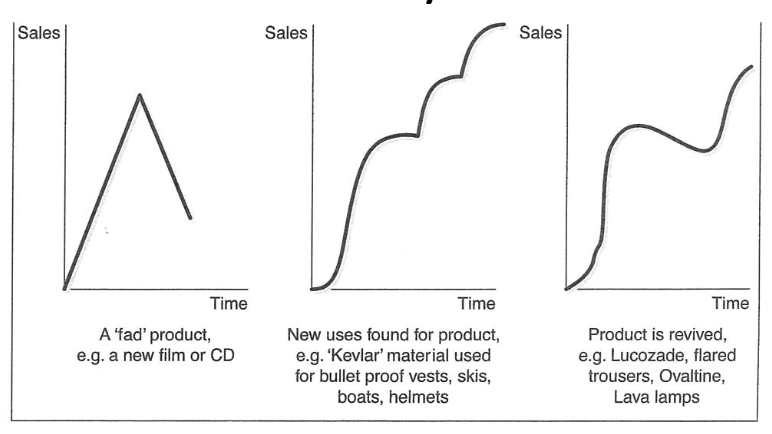
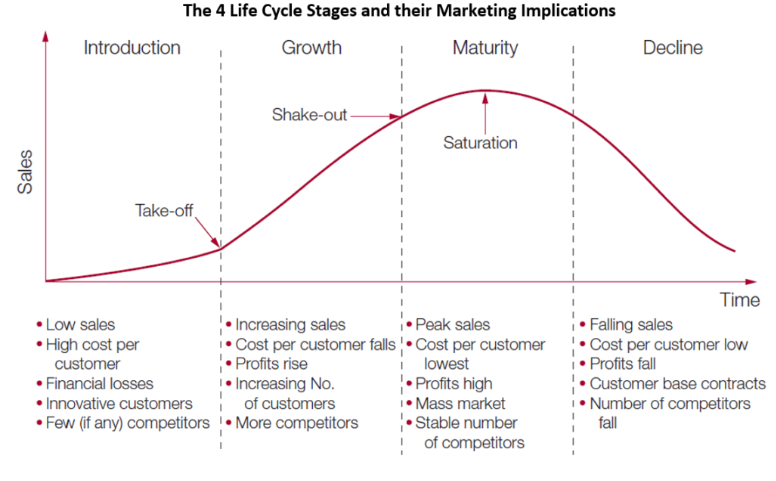
Pricing
Cost-plus pricing: The cost of manufacturing the product plus a profit markup
Advantages:
Easy to calculate
Different profit mark-ups used in different market
Each product contributes to profit of the business
Easy to explain to customers
Disadvantages:
Total profit only made if sufficient units are sold
Ability and willingness of consumers to pay a cost-plus price is not considered
No incentive to reduce costs
Price cannot be changed if market conditions change.
Penetration pricing: Price set lower than competitors in order to enter a new market.
Advantages:
Often used for newly launched products
Low average costs = still maybe profitable
Competitors may find it difficult to reduce prices
Law of Demand: When price increases demand will fall. When it decreases demand increases in the market
Price elastic demand: Where consumers are very sensitive to changes in price. When price increases, demand decreases and vice versa.
Price inelastic demand: When consumers are not sensitive to changes in price
Place
Distribution channels:
Direct → Customers
Direct → Retailers → Customers
Direct → Wholesalers → Retailers → Customers
Direct → Agent → Wholesalers → Retailer → Customer
E-Commerce
Advantages
Legal Controls
Laws designed to protect consumers from unfair or unsafe business practices.
Force businesses to adopt ethical, responsible and consumer-friendly marketing strategies. Non-compliance can lead to:
Financial penalties
Bans on advertising
Lawsuits
Damage to brand image and customer trust
As a result, marketing teams must work closely with legal advisors
Weights and measures
Trade descriptions
Sale of Goods
Production
Production of Goods/Services
Job production: One-off products/services
Advantages:
Each meets the exact requirements of the customer
Economies of Scale:
The factors that lead to a reduction in average costs as a business increases in size
Factors:
Financial economies - Lenders (banks) will be more likely to lend money to large businesses with lower interest rate.
Purchasing economies - Suppliers will offer discounts as a reward to buyers for buying large amount of goods.
Marketing economies - Costs of items such as research and development, advertising and distribution do not increase in proportion to increase in production and sales.
Managerial economies - Larger firm, however, can employ specialist managers and other staff who can improve the efficiency of the business.
Technical economies - Large businesses can afford expensive machinery and technology to develop automated flow production methods.
Diseconomies of Scale:
The factors that lead to an increase in average costs as a business grows beyond a certain size
Factors:
Bureaucracies - as a business grows, it tends to develop large administration, or bureaucracies, leading to wasteful 'red tape' and low efficiency, such as slow decision-making process.
Poor communication - large organizations develop large structures, giving rise to long communication chain, therefore, slowing the decision-making process.
Low Morale - workers have difficulties identifying feeling part of a large organization, leading to a drop in motivation.
Poor control - a business that grows too large becomes difficult to control and manage. For example, when financial department has to coordinate with production department while they have different objectives.
Finance
Sources of Finance
Internal Sources
Sole trader/partner savings
Sale of inventories
Retained profit (not for new business)
Sale of existing assets
Short Term Sources
Micro-finance (lends small amount of money but interest paid, no security, for poorer groups)
Overdraft (Interest only paid on amount borrowed, flexible, cheaper than loans in short run, higher interest rate than bank loan, often repayable on demand)
Factoring debt (Immediate cash, no risk of debt
Trade credit
Long Term Sources
Grants and subsidies (no need to repay but many have strings attached)
Bank loans
Selling debentures (long term finance but repaid with interest.
Hire purchase
Crowdfunding
Leasing
Issue of shares
Be sure to consider:
Starting a business? Limitations
Opening new location Expensive/location factors
Expand the business? New markets'
Financial crisis? Liabilities
TO motivate employees?
Income Statement: Measures the business’s performance over (income and costs) over a given period of time, mostly over one year
Balance sheet: A snapshot of the business’s assets and its liabilities on a particular day.
Cash flow statement: Shows how the business has generated or disposed of cash and liquid funds over a specific period.
Formulas
Number of Units Sold x Average Price Per Unit = Sales Revenue
Gross Profit = Sales Revenue - Variable Cost
Gross Profit - Fixed Cost = Net Profit
Gross Profit / Sales = Gross Profit Margin
E.G. RM 500 / 3,000 = 0.16
0.16 × 100 = 16%
Net Profit / Sales = Net Profit Margin
(Sales revenue of business / Total sales revenue for the whole market) x 100 = Market Share (%)
(Total number of units sold by the company / Total number of units sold by the market) x 100 = Market Share (%)
(Total cost/output) + percentage markup = Cost-plus pricing
Break Even Point = Fixed Cost/Sales Price Per Unit - Variable Cost Per Unit
round up
Exam Methods
Application: Copy the text. Make sure to include what the question asks for.