Unit 4 (4.1 & 4.2)
Unit 4.1
Linear Momentum
Linear Momentum:
Unit: kg * m/s
Inertia: The tendency to resist motion, the object with the greater mass has the most inertia
Momentum is a vector quantity
Total Momentum is calculated using the SUMs
Example:
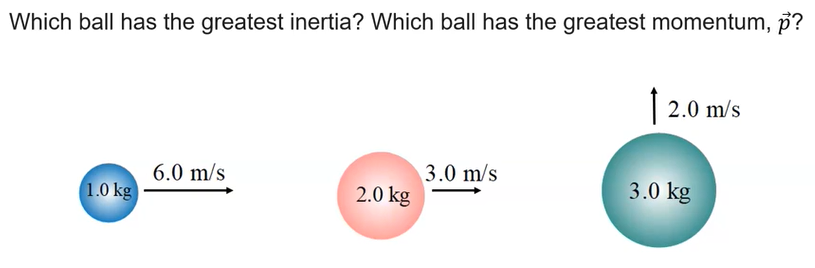
Solution
All objects have the same momentum (6 kg*m/s)
The 3.0 kg ball has the most inertia
Force and Momentum Change
Newton’s Second Law: When a net force acts on an object, the velocity of the object changes
(an object in motion stays in motion unless affected by a net force)
Relating Force to Momentum
1.)
2.)
3.)
4.)
5.)
1.) Original Equation
2.) acceleration is the derivative of velocity
3.) Take out the mass & velocity
4.) Momentum (p) is equal to mass * velocity (p=mv)
5.) Equate Force to change in momentum
Final Equation:
Example 1
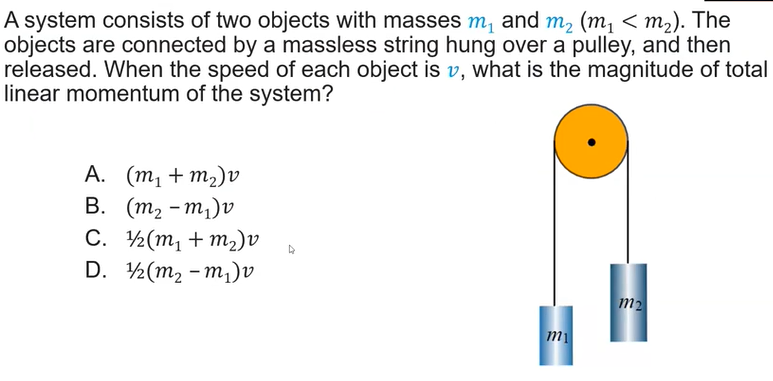
Solution
B
Example 2
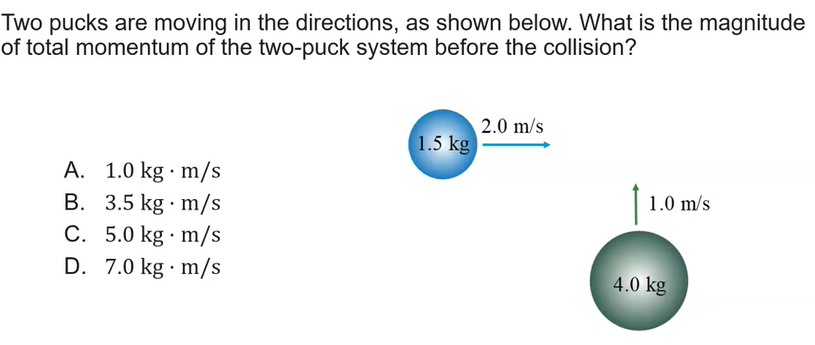
Solution
C
We are taking the magnitude of the system’s momentum
***Momentum is a vector!!
Taking the magnitude of a vector is used by the formula
Example 3:
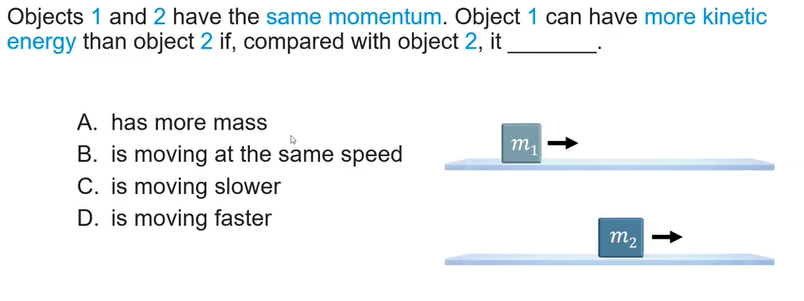
Solution
D
Relate Kinetic Energy with Momentum
First Way:
1.) KE = & p = mv
2.) KE = (mv) v
3.) KE =
1.) List out Kinetic Energy & Momentum Formulas
2.) Associative Property?? idk,
3.) Substitute momentum in for (mv), since p = mv
Final Equation: KE =
The object with more velocity has MORE kinetic energy IF momentum is constant
Second Way:
1.) KE = & p = mv
2.) KE =
3.) KE =
1.) List out Kinetic Energy & Momentum Formulas
2.) Using the fact that velocity in KE is squared, square momentum to make them equal
4.) Put a singular mass variable in the denominator to show that since p = mv & p2 = m2v2, to make it equal to KE, you need to eliminate one of the mass variables in the numerator. You can do that by listing momentum in the denominator as well so one of the momentums cancel out.
Final Equation: KE =
Mass is inversely proportional to kinetic energy IF momentum is constant
Example 3
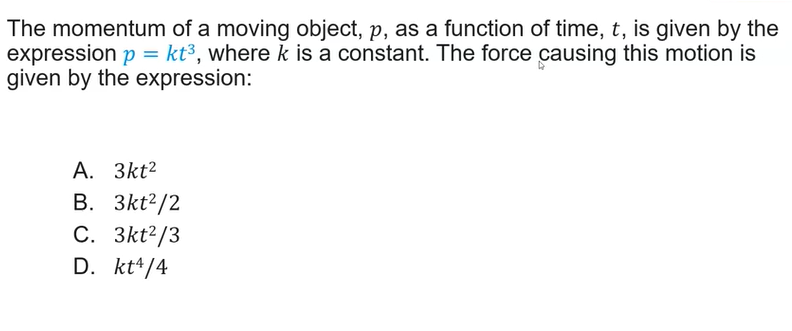
Solution
A
Fnet = , so Force is the DERIVATIVE OF MOMENTUM
Unit 4.2
Impulse-Momentum Theorem
Impulse: J = OR OR
Unit: N OR kg * m/s
Example 1
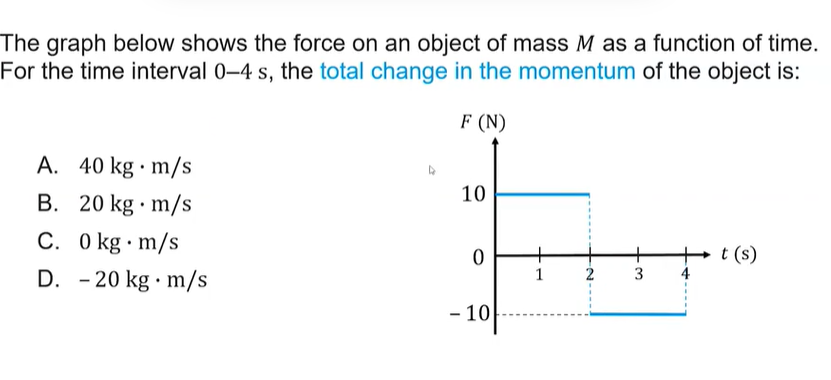
Solution
C
To calculate the change of momentum we look at Impulse, since we have an Force v Time graph
Impulse = area under the curve of a force v time graph, AND change in momentum
so for the interval (0,2), the area under the graph is 20 N*s
for the interval (2,4), the area under the graph is -20 N*s
To find the TOTAL Momentum, we add the momentum together
20 + (-20) = 0
Example 2a
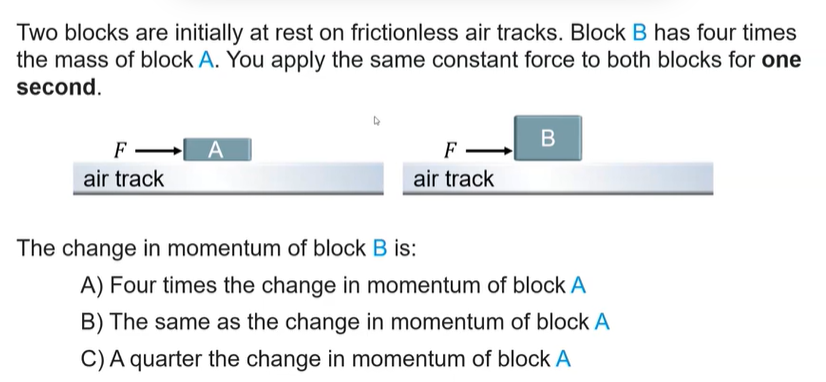
Solution
B
Force and Time is constant for both blocks, so using impulse-momentum theorem
J = , so Impulse is constant
If impulse is constant then Momentum is ALSO constant
Example 2b
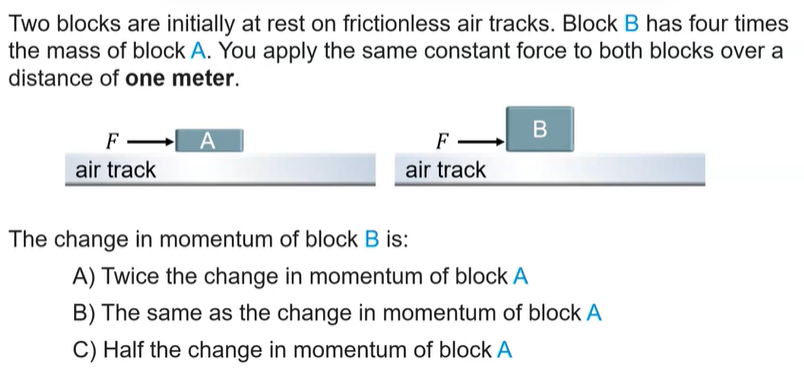
Solution
Now that we have Force and distance, we cannot use impulse-momentum theorem anymore
Instead we will use the Work-Energy Theorem
W = OR
If we know that Force and Distance are both constant, then the Work & KE are constant as well
We can relate KE to momentum with the formula: KE =
KE = ——> KE(2m) = p2
If KE is constant in both scenarios, then when comparing the two momentums, we can eliminate KE from the equation SO
2m = p2
If Scenario A has mass m, then p2 = 2m
If Scenario B has mass 4m, then p2 = 8m
Taking the square root of both we get
Scenario A =
Scenario B = OR this can be rewritten as 2
So Scenario B has TWICE the change of momentum than scenario A does
Difference Between Theorems
Impulse-Momentum Theorem:
change in object’s momentum is due to impulse which depends on force AND TIME
J =
Work-Energy Theorem
Change in object’s KE is due to work which depends on force and DISTANCE
W =
W =
Example 3
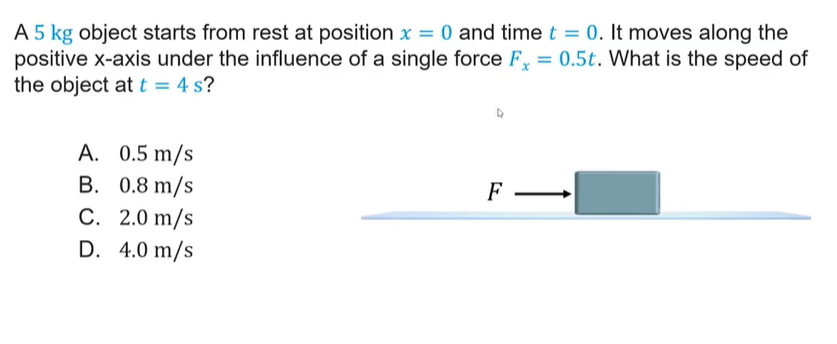
Solution
B
Knowing that we are given the force v time function and time, we can use the Impulse-Momentum Theorem
Impulse =
The integral of 0.5t ———> 0.25t2
Inputting values we find that J = 4,
since Impulse = , we know = 4
= mv, inputting values we find that 4 = 5v. so v = OR 0.8
Example 4a
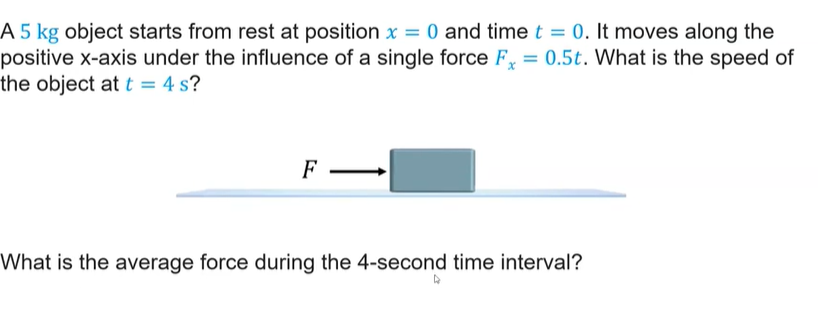
Solution
1 N*s or 1 kg*m/s
If we know that Impulse-Momentum Theorem is viable then using J = and best
We know that J = 4, so = 4
Inputting values into ————> Favg = 4/4, SO
Favg = 1 N*S
Example 4b
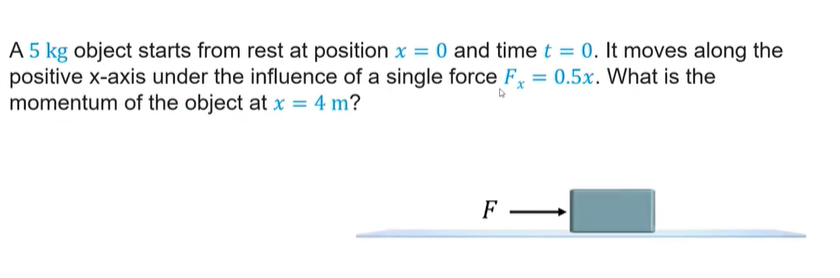
Solution
p = 6.3 kg *m/s
We cannot use Impulse-Momentum theorem here, since there is no time variable
Since there is a Force v position function, we use the Work-Energy Theorem
W =
Integrating Fx = 0.5x ———→ Fx =
Putting values we get Fx = 4, so W = 4
Relating KE to momentum we get: KE =
4 = ———> 40 = p2
p = 6.3 kg *m/s
Collision Time and Impact Force
WITHOUT increasing Force
You can increase an object’s change in momentum by increasing the collision time
Impulse =p
Impulse =
p =
If Force is constant, then to increase , you would need to increase the change in time (increase the time the force is applied to the object)
You can calculate the Collision Time:
1.) using a Force v Time graph by looking directly at the time-axis
2.) Using Momentum and the Average Force
Impulse =p and Impulse =
So p = , to isolate time we divide p by ( = )
Example 1
Solution
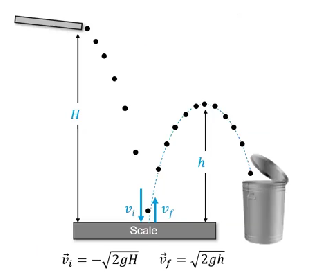
Using Energy Conservation Theorem, we can calculate the velocity and as such the momentum using what is given
Finding change in Momentum from drop height & rebound height:
PE = KE ————————→ mgh =
Isolate velocity: = v
For Initial velocity, Since the ball is going down, height is negative
=
using a Scale:
Find out the Normal Force of the ball to find out the Fnet
The Free-Body diagram reveals Fg and FN for the Y-Component
FNET = fN - fg
So Divide the Force by the change in momentum, ( ), we found by using velocity ( = ), gives us collision Time
Example 2
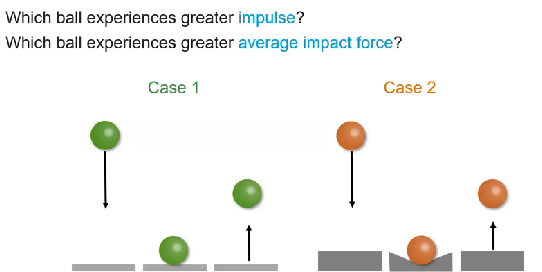
Solution
Both balls experiences the same impulse
Both balls drop from the same height and rebound to half the drop height, so the change in Kinetic Energy, i.e. change in velocity is the same
Since p = mv, then the is the same as mass is constant
Case 1 experiences the greater average impulse force
Dropping a ball on a rubber floor makes the collision time longer
Generally rubber and stretchy materials decrease impact force and increase collision time
As a result, if momentum is constant between the two cases, then the impulse force of Case 2 must be less, as Case 2’s collision time is longer
p =
Example 3
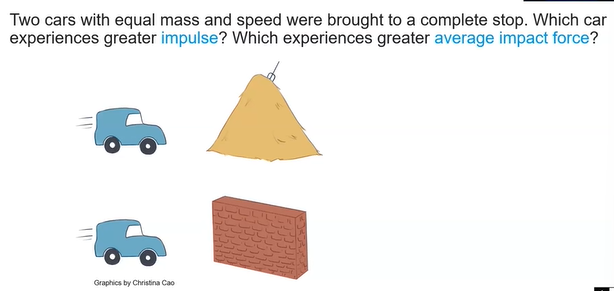
Solution
Both of the cars have equal impulse since their start and end momentum is the same, their change in momentum is the same, as a result, their impulse is the same
The car hitting the brick wall experiences a greater average impact force
The brick wall decrease the collision speed, since you stop almost as soon as you hit it
so the average impact force needs to be higher
The opposite of increasing collision time decreases average impact force is why wearing your seat belt is important
Example 4
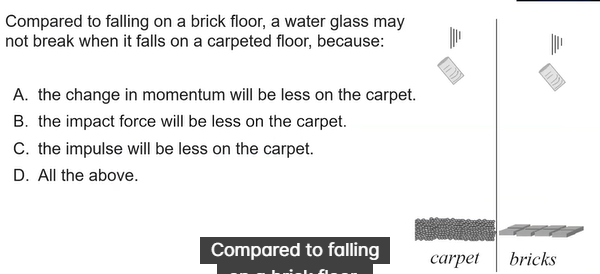
Solution
B
The impulse is equal in both cases as they were dropped from the same height and both ended up stopping in some way
However, since the carpet increases the collision time, its impact force is less on the glass
Example 5
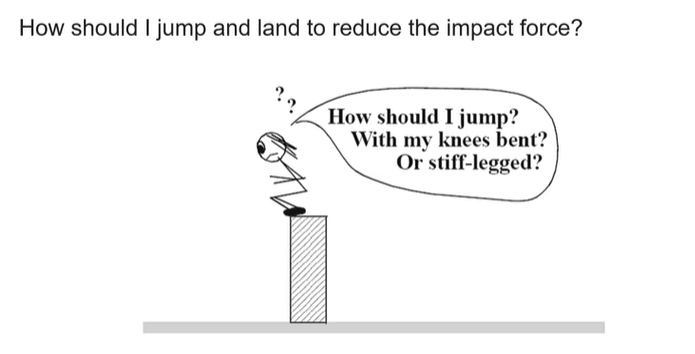
Solution
Knees bent
Impulse is equal in both cases
It takes more time for the girl’s center off mass to come to a stop with her knees bent so less average impact force occurs
Bouncing
The greater the rebound effect, the greater the change in velocity & momentum
Greater Average Impulse Force
Greater acceleration, etc
Example 1
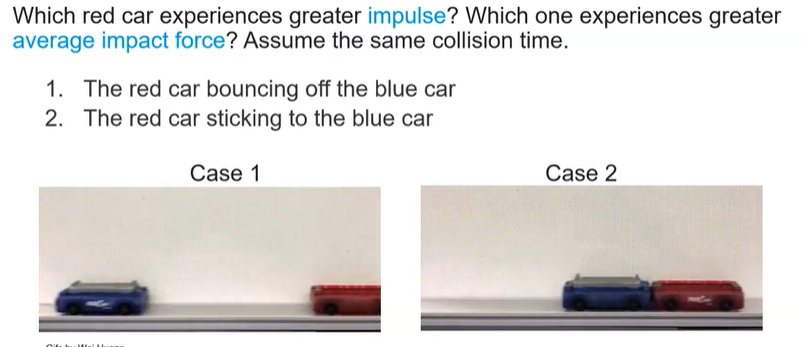
Solution
Case 1 has the greater impulse
Case 1 rebounds, the collision has a change in direction of motion
velocity change & momentum change is greater
Case 1 has the greater impact force
In Case 2, the crumbling nature of the collision extends the collision time
also minimizes the change in impulse and momentum
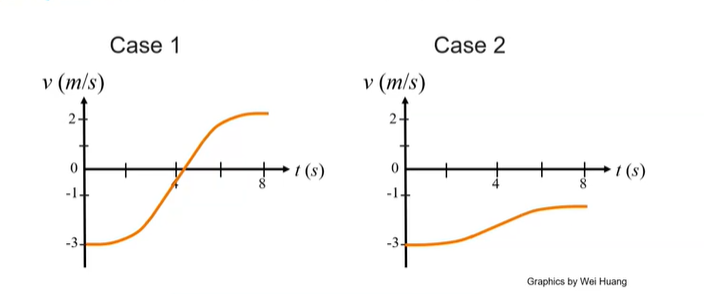
The slope of Case 1 is steeper which implies a greater slope
the derivative of velocity is acceleration, so the greater slope implies greater acceleration
Acceleration implies greater average impulse force
Example 2
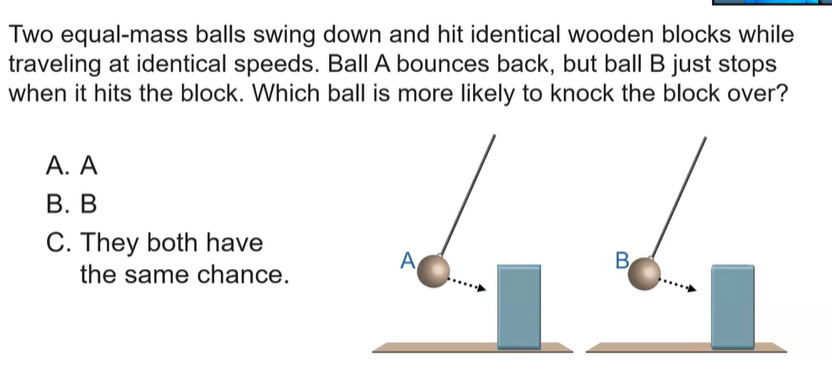
Solution
A
Bounding results in greater change in momentum and velocity
creates greater impulse
Given they both have equal collision time, the bouncing ball has greater average impulse force
Example 3
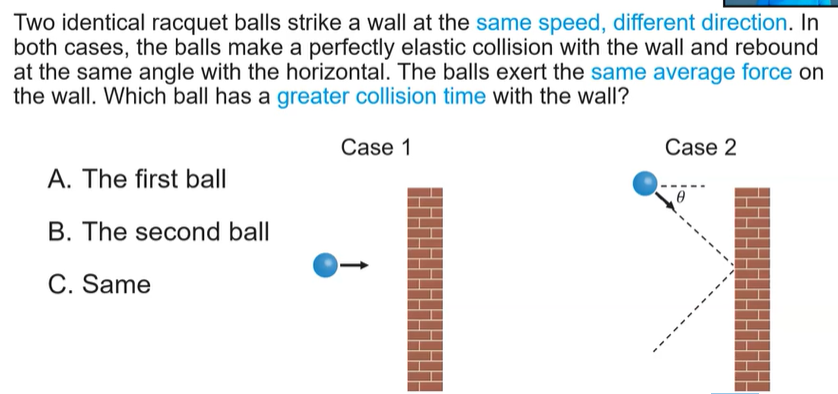
Solution
A
The magnitude of momentum change is greater for case 1, so if they both have equal average impulse force, then Case 1 has greater collision time
m1vf - m1vi =
Case 1: mv - (-mv) = 2mv
The ball is perfectly elastic: all KE is preserved, so the rebound and initial velocity are equal
V initial is negative relative to V final because theyre in opposite directions & velocity is a vector
Case 2: m v - (-m v) = 2m v
Example 4
MultiPart Examples
Ball and Block (Unit 1 + Unit 4)
Solution
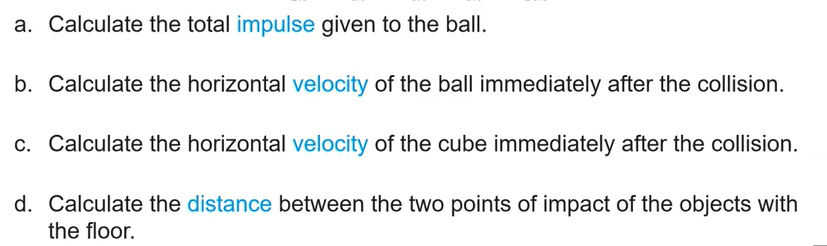
a.) 12 N*s
b.) vb = 2.4 m/s
c.) vc = 2 m/s
d.) 0.2 m
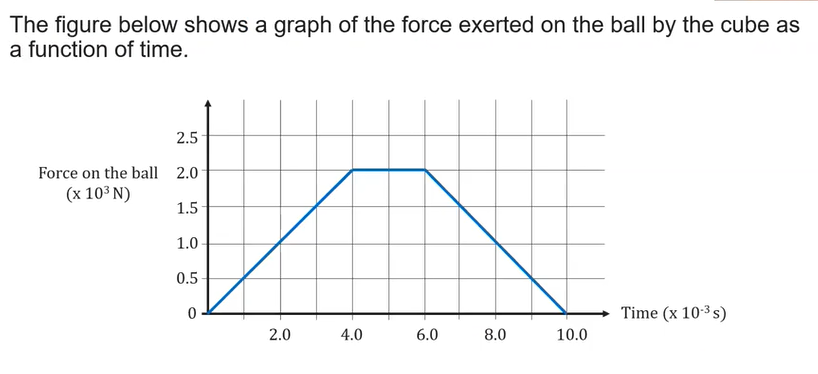
a.) 12 kg * m/s
Since we are given a Force v time graph, we’ll use the formula Impulse =
b.) vb = 2.4 m/s
To find the velocity after the collision of the ball, we use the fact that
According to part A, Impulse = 12, so = 12
Since the ball was initially at rest, vi = 0, so
12 = 5(vf) ————> vf = 2.4
c.) vc = 2 m/s
According to Newton’s second law FAB = -FBA, so the force done onto the ball over the collision time has the same magnitude as the force done on the block.
Using that we can find the Impulse is now -12
Using ,
we get -12 = 0.5(vf - 26) ———→ -24 = vf - 26 ————→ vf = 2
d.) 0.2 m
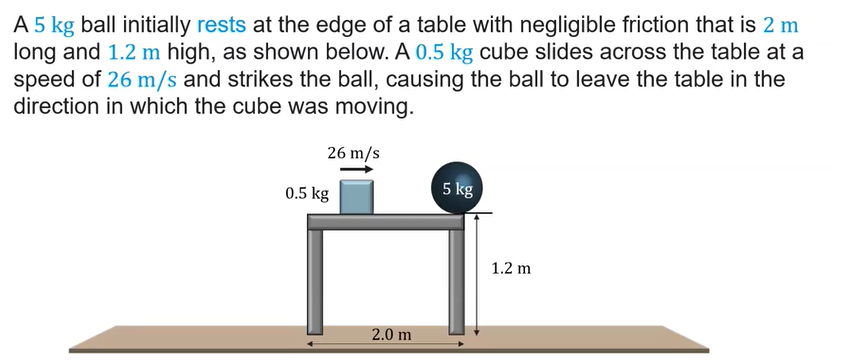
Knowing the distance from the ground gives us a possibility if using kinematics to find the horizontal distance each ball goes.
D = vi(t) - (a)t2
Under this Tom & Jerry problem, dx = vi(t) & dy = - (a)t2
So we find time using the formula we have for dx,
1.2 = - (10)t2———→ OR 0.50 sec
Plugging that in the dx formulas for both ball and block
Block: 1 m
Ball 1.2 m
The distance between the two is 0.2 m
Toy Rocket Launch
Solution
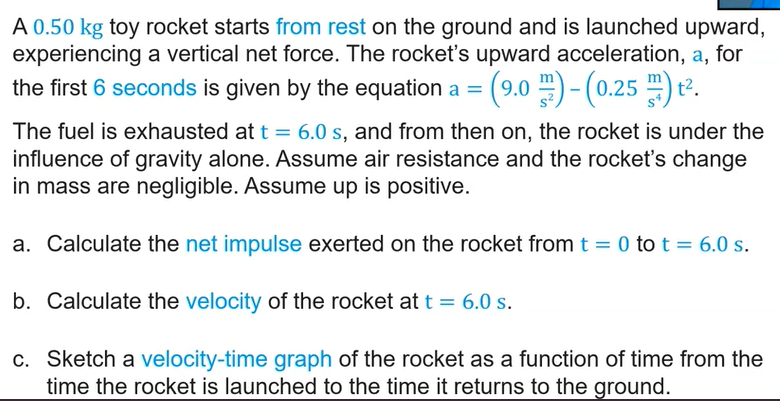
a.) Impulsenet = 18 N*s
J =
Fnet = ma
we can separate Force into mass * acceleration
J = m
Since we have the equation for acceleration, we can integrate that and then multiply by mass
a = 9 - 0.25t2 ——→ a. = 9t - OR
b.) vf at 6 seconds is 36 m/s
c.)
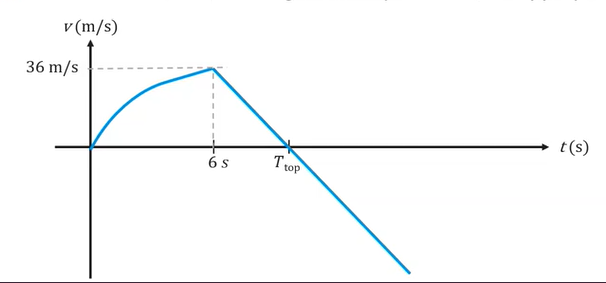
We already know one point from part a and b, so we can plot, (6, 36).
Rocket still goes up even though the fuel is exhausted due to momentum & inertia
eventually reaches top height, max
velocity decreases from (6, Ttop) because the acceleration is less, so the velocity is less
From (Ttop, ), the velocity is negative since the rocket turns around and goes back to the ground
velocity is a vector
negative y-direction = negative velocity
(6, ) has the same slope, since gravity is the slope
Mass Changing Over Time
Newton’s Second Law of Motion describes Force with a constant mass
Impulse-Momentum Theorem describes force with a variable mass
Example 1
Solution
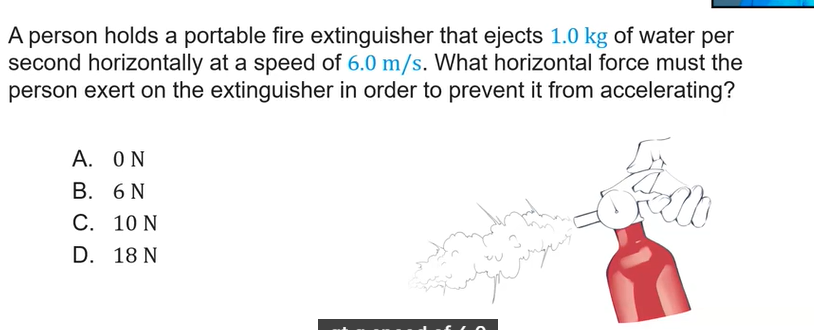
B.)
F =
The extinguisher ejects 1.0 kg per second, so its mass changes by -1, at a speed of 6 m/s
F = = -6 N
To make the extinguisher not acceleratem the person must exert an opposite but equal force
Fnet = ma
Fextinguisher + FPerson = 0
-6 + Fperson = 0
Fperson = 6 N
Example 2
Solution
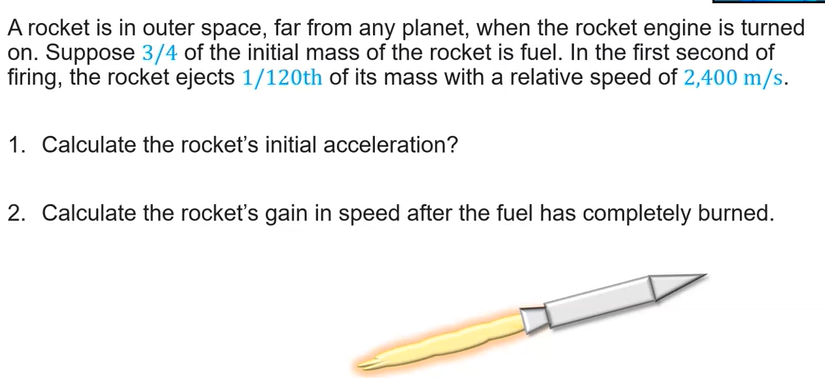
Thrust