Cell Signalling
transferring information from outside the cell to initiate a response from within the cell
chemical signalling
Elements for cell communication
signalling molecule
signalling cell
receptor molecule
receptor cell
Bacteria Signalling (bacteria, prokaryotic cells)
bacteria take up DNA from the environment
QUORUM SENSING
pneumococcal bacteria cells continuously synthesize and release a peptide
bacterial cells express a specific receptor that binds to this peptide
when peptide binds to receptor, genes are expressed that allow bacteria to take up DNA from environment
Low density of bacteria means a low density of peptide levels
gene expression is OFF
signals fall below threshold therefore DNA reuptake genes are turned off
high density of bacteria mean high density of peptide levels
turns on genes for environmental gene uptake
peptide binds and relay signal through signal transduction
MULTICELLULAR ORGANISM (humans, eukaryotic cells)
signalling molecule
signalling cell
epinephrine/adrenaline
receptor molecule
receptors on target organs
receptor cell
physiological changes (ex. increase of heart rate)
Cell Signalling
Receptor activation
signal molecule binds
Signal transduction
signal transmits into cell
shape of ligand changes
Cellular response
specific for target cell
Signal termination
stops response

RECEPTOR ACTIVATION
receptors can be surface proteins that recognize specific molecules
LIGANDS
extracellular ligands are molecules that are secreted by cells
result of cell-to-cell contact or extracellular matrix
receptors can be found inside the cell
ligands travel inside to bind to receptor
receptor is turned ON once the ligand or signalling molecule binds to the receptor
no receptor = no response
When a ligand binds to a receptor
change in the receptor triggers chemical reactions within the cytosol
SIGNAL TRANSDUCTION
receptor is activated
sends a signal to the cytosol
this is called SIGNAL TRANSDUCTION
ligand is the STIMULUS
once it binds, signal transduction relays the message
the message stays in the cytosol or goes to the nucleus
series of proteins that are activated/inactivated in a sequence are often amplified
THE RESPONSE
cell responds to signal
response could activate enzymes, turn on genes, signal other cells, etc
response depends on type of cell
specific proteins and signalling pathways
ex. epinephrine causes the heart to contract more forcefully and quickly
TERMINATION
once the signal has been received and acted upon it is terminated
stops cellular response
CELLULAR TRAVELLING
long distance vs short distance communication
four types of signalling
ENDOCRINE
long distance through the bloodstream
uses hormones as chemical signalling molecules
produced by endocrine cells
target cells expresses the receptor for the hormone
PARACRINE
short distance, neighbouring cells
signalling molecule moves through diffusion
small, water soluble
travel within range of 20 cells
important in multicellular organisms —> embryonic development
AUTOCRINE
when a cell that secretes a signalling molecule is the target cell
important in multicellular organisms —> embryonic development
CONTACT-DEPENDENT SIGNALLING (juxtacrine signalling)
cells have to touch, direct contact
transmembrane protein on the surface of cell A is the signalling molecule, transmembrane protein on adjacent cell B is receptor
CELLULAR RECEPTORS
INTRAcellular receptors
non polar signalling molecules can pass through the membrane
signals do not need receptors on surface of the cell
ligand can bind to receptor in the cytosol or nucleus
CELL SURFACE receptors
polar signals cannot cross the cell membrane
bind to receptors on the surface of cell
changes the shape of the receptor and ACTIVATES IT
cell signalling proteins
G protein coupled receptors (GPCRs)
receptor kinases
ion channels
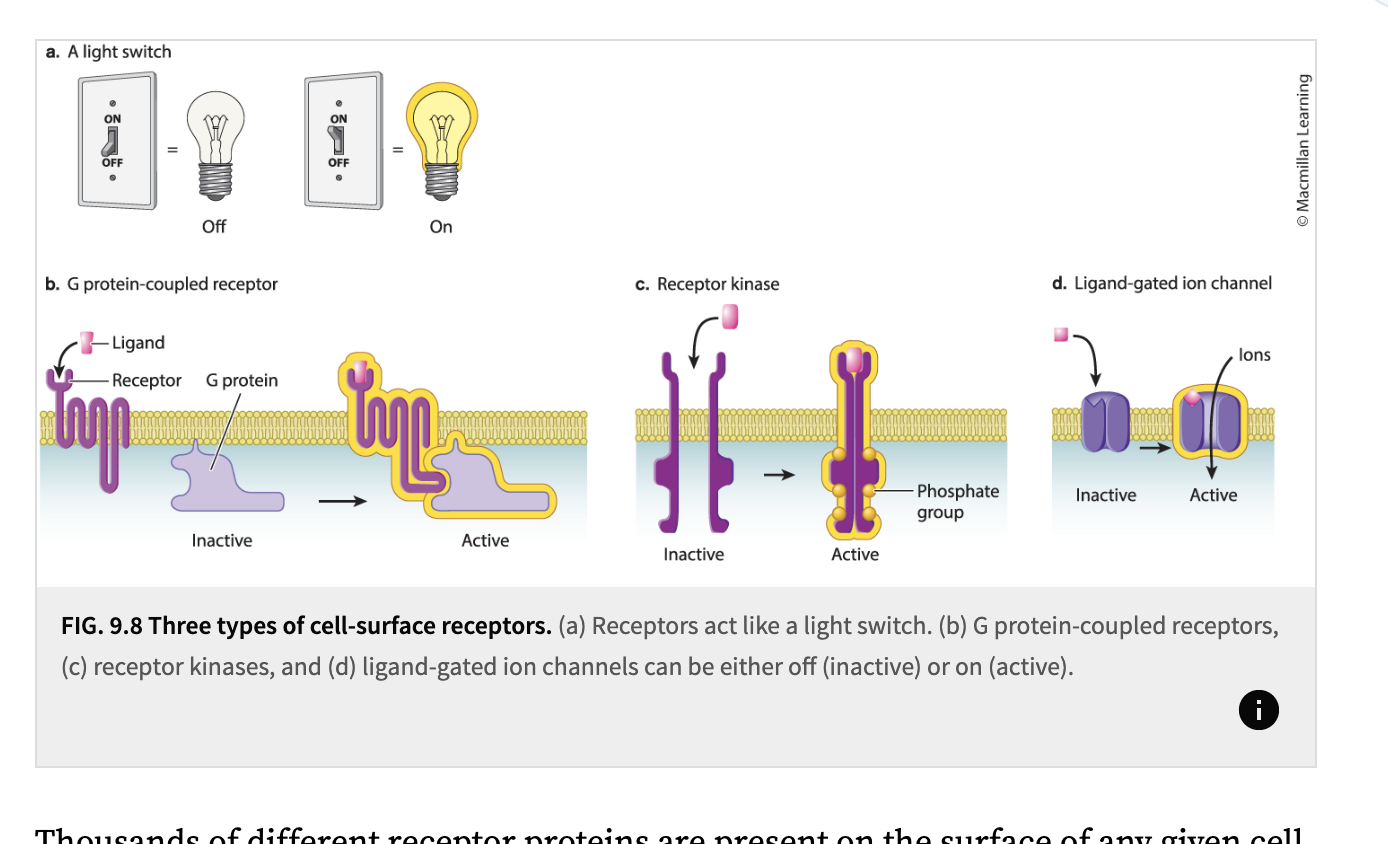
GPCRS
background
found in all eukaryotic organisms
GPCRs bings to GTP and GDP in cytoplasm
G-proteins
Three subunits
alpha
When the a subunit is bound to GDP, the three subunits are joned
beta
gamma
When the G protein is bound to GTP, it is active
when it is bound to GDP, it is inactive
regulates activity
activation
GPCR is inactive until ligand binds to the receptor
ligand binds to receptor, activates the G protein by replacing GDP with GTP
if already bounded to GTP, the G protein is ‘on’ and the signal is transmitted
the a subunit separates from other units and binds to the target protein to activate it
Example: heart rate can be influence by a GPCR system through epinephrine
when adreline binds to GPCR on heart muscle, it activates the G protein
GDP on subunit a is replaced with GTP
GTP-bound a subunit binds to
activates an enzyme, adenylyl cyclase
enzyme converts ATP into the small signalling cyclic molecule AMP (cAMP)
cAMP
second messengers
binds to and activates another enzyme (protein kinase A (pkA))
kinases are enzymes that phosphorylate target proteins
add phosphate group
pkA
phosphorylates proteins in the heart to increase the rate of contraction
heart rate will remain high while epinephrine is bound to the receptor
notes: gpcr is a transmembrane protein
activated a subunit activates the adenylyl cyclase enzyme
SIGNAL AMPLIFICATION
signals created by GPCR are amplified
meaning a small signalling molecule can produce a big response
ex. epinephrine (signal is amplified in three places)
epinephrine receptor —> activates multiple G proteins
adenylyl cyclase —> produces a large amount of cAMP
protein kinase A (pkA) —> activates multiple protein targets

SIGNAL TERMINATION
the time a ligand is connected depends on how thight the receptor holds it BINDING AFFINITY
ex. epinephrine
epinephrine leaves receptor —> G proteins dont get activated
G protein converts GTP to GDP —> protein is inactivated
adenylyl cyclase no longer produce —> cAMP isnt produced
enzymes in cytosol degrade cAMP —> pkA isnt produced
phosphotases (ezyme that dephosphorylates) removes PO4 groups
inactivates proteins
RECEPTOR KINASES
receptor becomes active when ligand binds
associate into dimers —> dimerization
dimers: two subunits that come together to form a functional complex (dimers)
converts external signals into internal cellular responses
examples:
formation and elongation of limb buds —> become our arms and legs
insulin signalling —> transport glucose to cytosol
would healing
wound healing:
cells need to be repaired
blood encounters area and releases platelets
platelets have plate-dereived growth factors (PDGF)
PDGF stimulates repair and binds to PDGF receptor kinases (surface)
receptors dimerize and become active
phosphorylated receptors activate other proteins in the cell
MAP (Mitogen activated protein) kinase —> activates cytoplasmic signalling protein Ras
GTP-bound Ras starts a kinase cascade (singal transduction)
End of cascade, kinase enters nucleus and turns on gene associated with cell division
terminated when GTP is replaced by GDP on Ras
LIGAND GATED ION CHANNELS
ion channels change the flow of ions across the membrane
influx (in the cell)
efflux (out the cell)
ion channels are gated
ligand-gated → respond to binding of signal molecule
voltage-gated —> respond to change of voltage in cell
mechanically gated —> respond to force applied to cell
gate regulates movement
prevents movement of ions
gate is closed
allows movement
gate is open