Lecture 8: Natural Selection History and Gene Pools
Natural Selection
Charles Darwin as a pivotal figure in evolutionary theory
His journey to the Galapagos Islands inspired his later theories.
Pre-Darwinian Theories
Pre–Darwinian Theories of Change
Greek Philosophers: Early thinkers who laid foundations for evolutionary ideas.
Empedocles (495 to 435 B.C.):
Aristotle (384 to 322 B.C.):
Dominant philosophical ideas before Darwin were influenced by ancient Greek thought and a Judeo-Christian worldview, which posited:
The Earth was around 6,000 years old.
Species were static and unchanging.
Georges–Louis Buffon (1707 to 1788): attributed change in organisms to the action of the environment
Erasmus Darwin (1731 to 1802): Charles Darwin's grandfather
accepted the idea of a common ancestry of all organisms
Jean Baptiste Lamarck (1744 to 1829):
Key Idea: Change results from the “need,” leading to traits adapted during an organism's lifetime being passed down to offspring.
Proposed the idea of acquired traits:
Suggests that organisms can pass on traits acquired during their lifetime to their offspring.
Example: Giraffes stretching their necks to reach food resulting in longer necks passed to their young.
His theory also included the concept of an ideal or perfected individual through evolution.
Contrast with Darwin’s views:
Darwin emphasizes evolution is not goal-driven; it's a response to environmental pressures rather than a journey towards perfection.
Darwin’s Observation and Research
Describes the voyage of the HMS Beagle starting in 1831 as a Naturalist:
Explored the Galapagos Islands, gathering crucial observational data.
His findings led to the seminal work "On the Origin of Species by Means of Natural Selection" published in 1859.
Challenging Previously Held Ideas:
Geology:
Charles Lyell: Developed uniformitarianism
uniformitarianism: Proposed that geological change occurs over hundreds of millions of years and has been responsible for shaping the earth
Earth is much older than 6.000 years
Study of Fossils:
Fossils indicated a deeper geological history and suggested changes in the Earth and its life.
Galápagos Islands Observations:
Species Observed:
Tortoises and Finches which featured variations.
Adaptive Radiation: Formation of new forms from an ancestral species due to adaptation to different environments and ecological niches.
traits shift or vary depending on environmental needs
example: finches beaks shifted based on diet
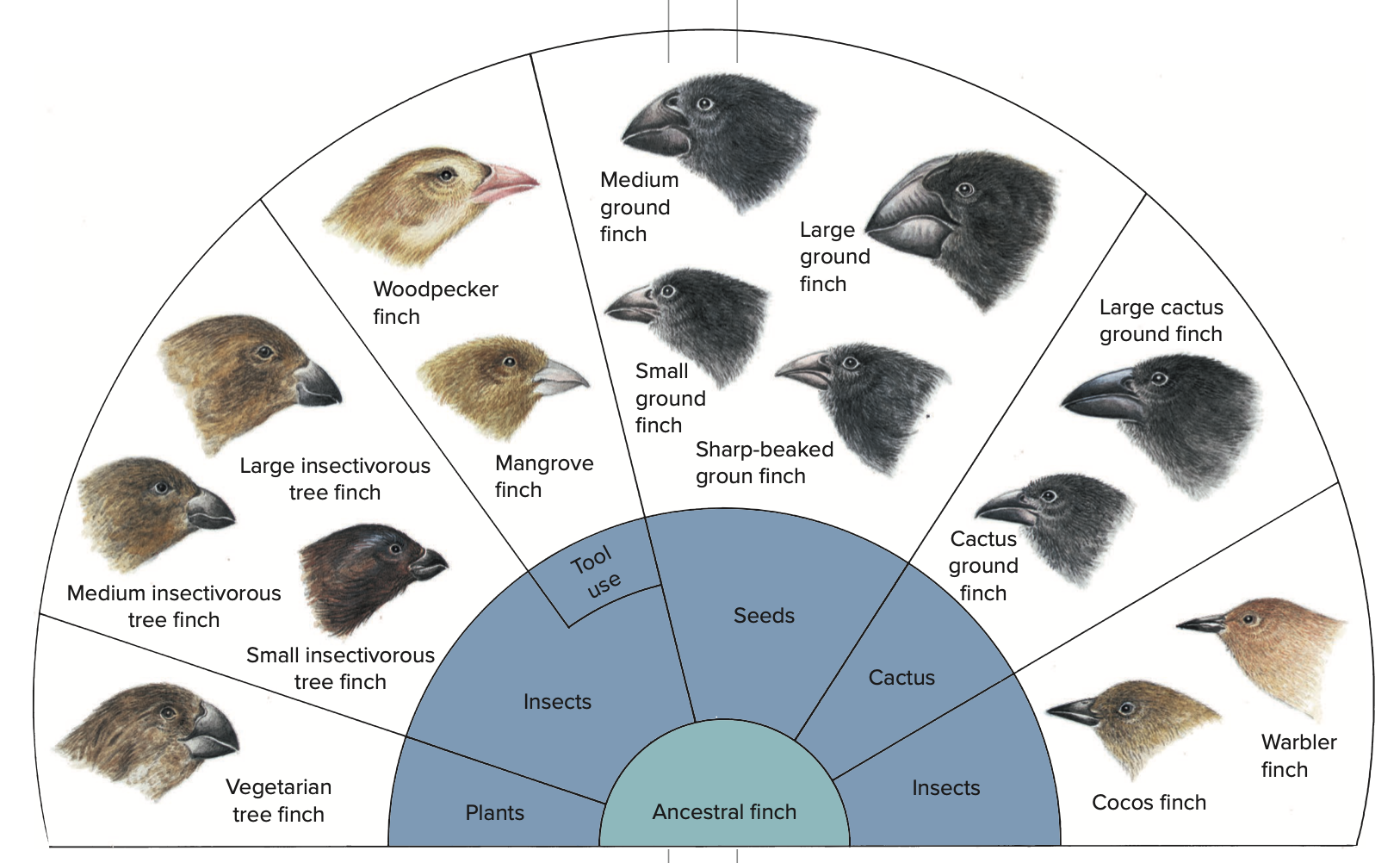
Questioned adaptations, such as the different neck lengths in tortoises based on vegetation types.
Artificial Selection
Artificial Selection: Mechanism where humans select for desired traits in breeding.
showcases the potential for significant changes in populations under human influence.
Thomas Malthus (1766 to 1834): Malthusian theory of population stated that populations grow exponentially while not enough resources are available to support them
resulting in competition and survival of the fittest.
Malthusian theory influenced Darwin’s understanding of the struggles for existence in nature.
Principles of Natural Selection
Natural Selection - Key Elements:
High Reproductive Potential: Populations produce more offspring than the environment can support.
Inherited Variations exist in all populations: Variations exist in traits among individuals in a population.
Constant Struggle for limited Resources, many people die: Environment limits resources leading to competition, causing many individuals to die
populations often produce more offspring than environments can support
Adaptive Traits become more common in subsequent generations: Traits that enhance survival become more common across generations.
natural variation among individuals within a populations
Alfred Russel Wallace
Co-developed theory of evolution similar to Darwin’s.
Collaborative publication with Darwin, which spurred Darwin to publish the Origin of Species.
Geological Time and Mass Extinctions
Understanding these timescales and major events that result from geological, climatic, and astronomical forces have helped scientists trace the course that evolution has taken over 4.6 billion years of Earth’s history
Relative dating techniques (stratigraphy): estimate time relationships between events based on the position of one event in a rock stratum (layer) relative to surrounding strata
does not assign absolute dates to events, but geologists can use it to correlate strata around the world.
Absolute dating techniques: provide chronological estimates of the age of fossils or materials associated with fossils.
radiometic dating techniques
molecular dating techniques
Assign absolute dates to geological events based on radioactive decay.
can be used to assign dates to rock strata and events that occur in the past
5 mass extinctions appear in the Phanerozoic eon
two major hypotheses for mass distinctions:
Hypothesis 1: Asteroid Impacts - suggested to cause global cooling and mass extinction.
Atmospheric debris could have led to the extinction of photosynthetic organisms.
Hypothesis 2: Volcanic Events - massive volcanic eruptions possibly causing widespread climate change and toxic atmospheres.
would have resulted in deadly sulfureous and CO2 emissions that spread across the globe
Phylogenetic Trees
Phylogenetic Trees: show line of descent
branches: show evolutionary connections
nodes: branch points that represent changes in ancestral species, genes, or populations
Paleontology
Paleontology: study of fossil record
Fossils: evidence of plants and animals that existed in the past and have become incorporated into earths crust
direct evidence of sequences of appearances and disappearances of organisms
Epigenetics and Evolution
Epigenetics: Study of modifications in gene expression that take place without altering DNA base sequence
Examples include environmental factors that influence gene expressions, such as temperature affecting coat color in rabbits.
same genes but changes phenotype to reduce heat loss
Epigenetic changes may allow organisms to adapt to their environment without requiring genetic mutations.
Gene expression alternations can be passed between cell generations and inherited between animal generations
can effect evolution
environmental conditions can influence epigenetically determined traits
population-specific epigenetic change could boost reproductive success of that population over another
Types of Evolution
Microevolution vs. Macroevolution
Microevolution: changes in allele frequencies in a population over time.
Macroevolution: larger-scale changes that result in extinction and formation of new species
Gene Pool and Populations
gene pool: all alleles present in a population
sum of all the alleles for all traits in a sexually reproducing population
pool of hereditary resources
each individual only has set number of genes in entire pool of genes
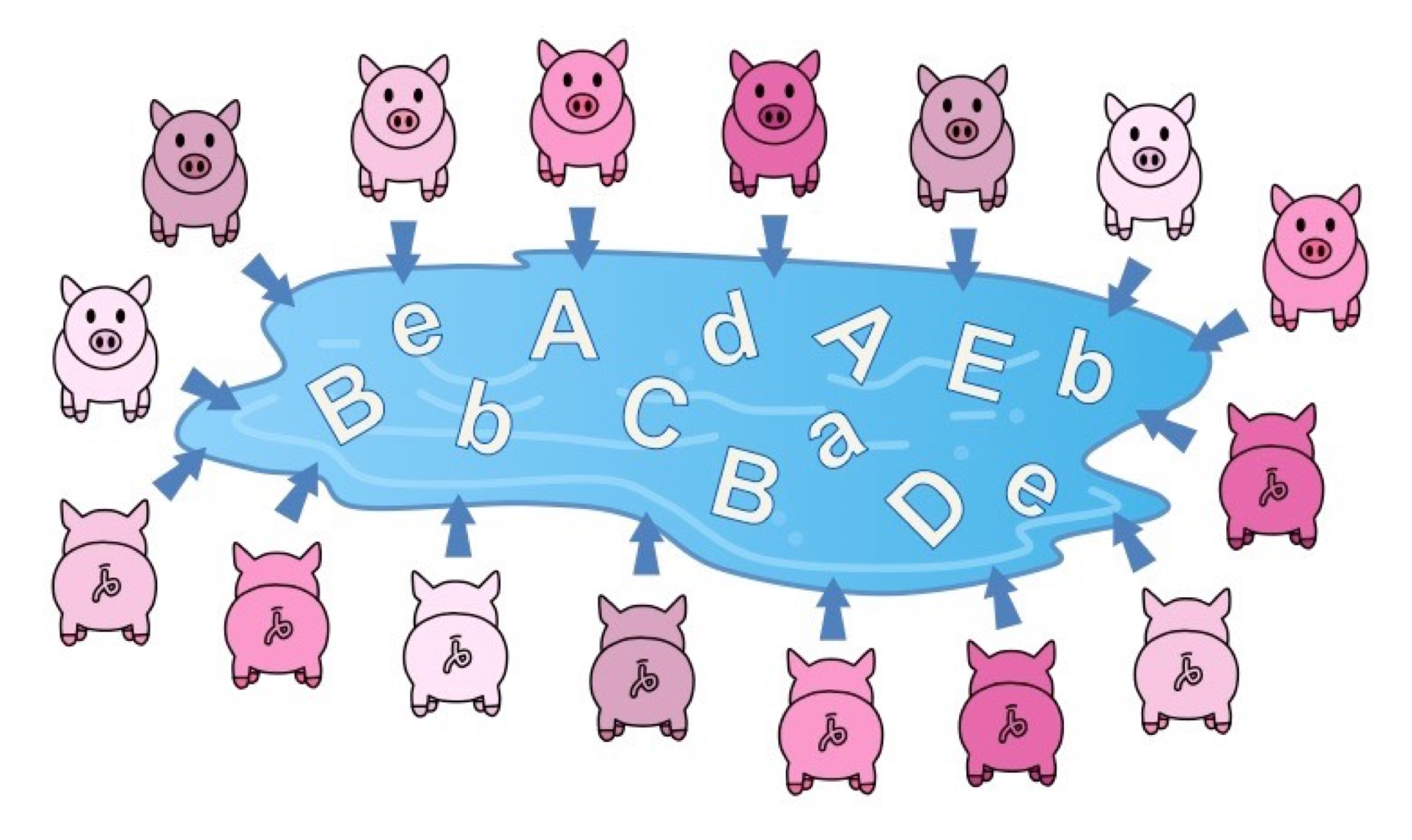
Population: group of individuals of the same species that occupy a given area at the same time and share a common set of genes
characterized by the frequency of alleles for a given trait
Sources of variation in a gene pool
independent assortment of chromosomes resulting in random distribution of gametes
crossing over between homologous chromosomes
chance fertilization of an egg by a sperm
rearrangements in the number and structures of chromosomes
mutations of existing alleles
potential for genetic variation within a population is unlimited
evolution occurs with relative frequency of alleles change across generations
Adaptation: occurs when a Heritable phenotype changes enhancing an organism's reproductive success.
increases chance of successful reproduction
Resulting of chance mutations.
slow gradual changes within generations
Example: Adaptations of Snowshoe Hare (Lepus americanus) in coloration for camouflage and thermal regulation.
Hardy-Weinberg Equilibrium
Populations are not evolving when the following criteria hold true:
Large population size.
gene frequencies will not change by chance alone
No migration into or out of a population
migration may introduce new alleles, or add or delete copies of existing alleles
No mutations.
mutations are the sources of new alleles
Sexual reproduction must be random
non random sexual reproduction allows for natural selection
When these conditions are met, allele frequencies remain constant, indicating no evolution.
when any one or more of these assumptions are not met, allele frequencies are changes and evolution is occurring
few populations meet all assumptions
all populations have experienced evolutionary change or are evolving
4 Mechanisms of Evolutionary Change
1. Genetic Drift
Genetic Drift: Refers to random changes in allele frequencies due to chance events
most important in small populations.
Example: snow storm (not always environmental)
Bottleneck Effect: A random event that results in near extension of a population, thereby affecting the allele frequencies of the survivors.
If a dominant allele was overrepresented in the deceased individuals, with their death, the frequency of that allele may decrease in future generations.
Example: Poaching of cheetahs led to a significant decrease in genetic diversity within the species.
Founder Effect: Occurs when a small number of individuals migrate from a larger population to establish a new population.
Individuals may not represent the genetic diversity of the original population, potentially leading to higher frequencies of certain alleles.
Example: amish population migrated and brought only specific set of genes
Gene Flow
Gene Flow: The transfer of alleles or genes between two populations through migration and interbreeding.
This exchange can alter allele frequencies within a population, making them ore similar
absence of gene flow can lead to genetic isolation and formation of new species
Mutation
Mutation: permanent change in DNA sequences, resulting in new alleles in a population.
Not all mutations are beneficial, most are detrimental or neutral
beneficial mutations increase in frequency through natural selection.
mutation pressure: measure or tendency for gene frequencies to change through mutation
Natural Selection
Natural selection remains a preeminent theory in modern biology
Occurs when some phenotypes are more fit than other phenotypes
Animals possessing more fit phenotypes leave more offspring than those with less fit phenotypes
Alleles responsible for greater fitness increase in frequency in subsequent generations.
Changing allelic frequencies mean that Hardy–Weinberg equilibrium is absent, and evolution is occurring
gradualism: slowly progressing of new traits
punctuated equilibrium: change stays for a while, then big shift that stays for a while, and repeats
Selection Pressure: The environmental factors that favor certain phenotypes over others, thereby influencing allele frequencies.
Natural Selection Types:
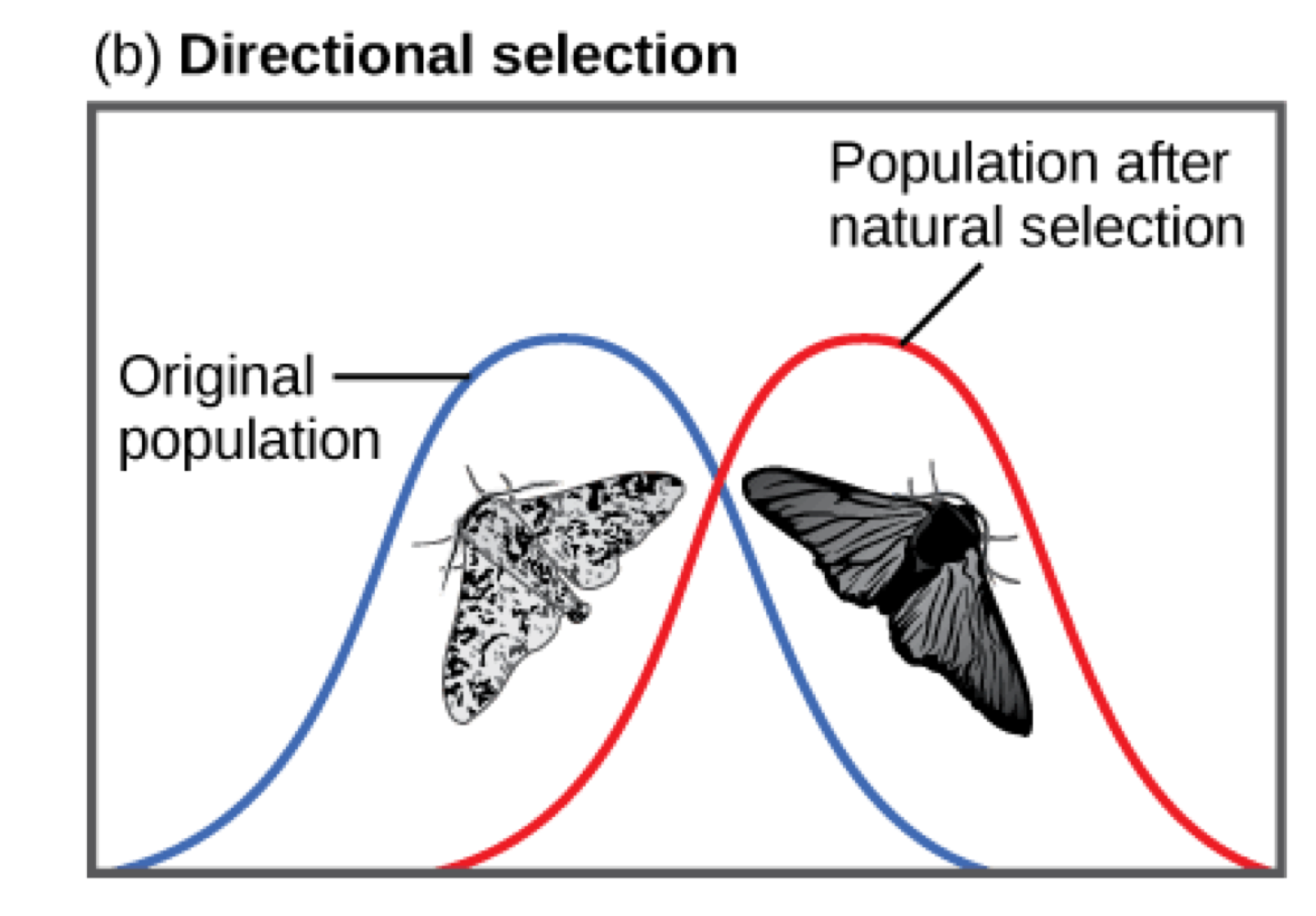
1. Directional Selection
Directional Selection: A type of selection that favors one extreme phenotype over others.
population shifts due to one allele/trait being able to survive better in environment and reproduce more successfully than others, leading to a gradual increase in that trait within the population.
Example: Mice coloration affected by background color changes.
In an environment where dark soil becomes prevalent, darker mice may survive better due to their camouflage against predators.
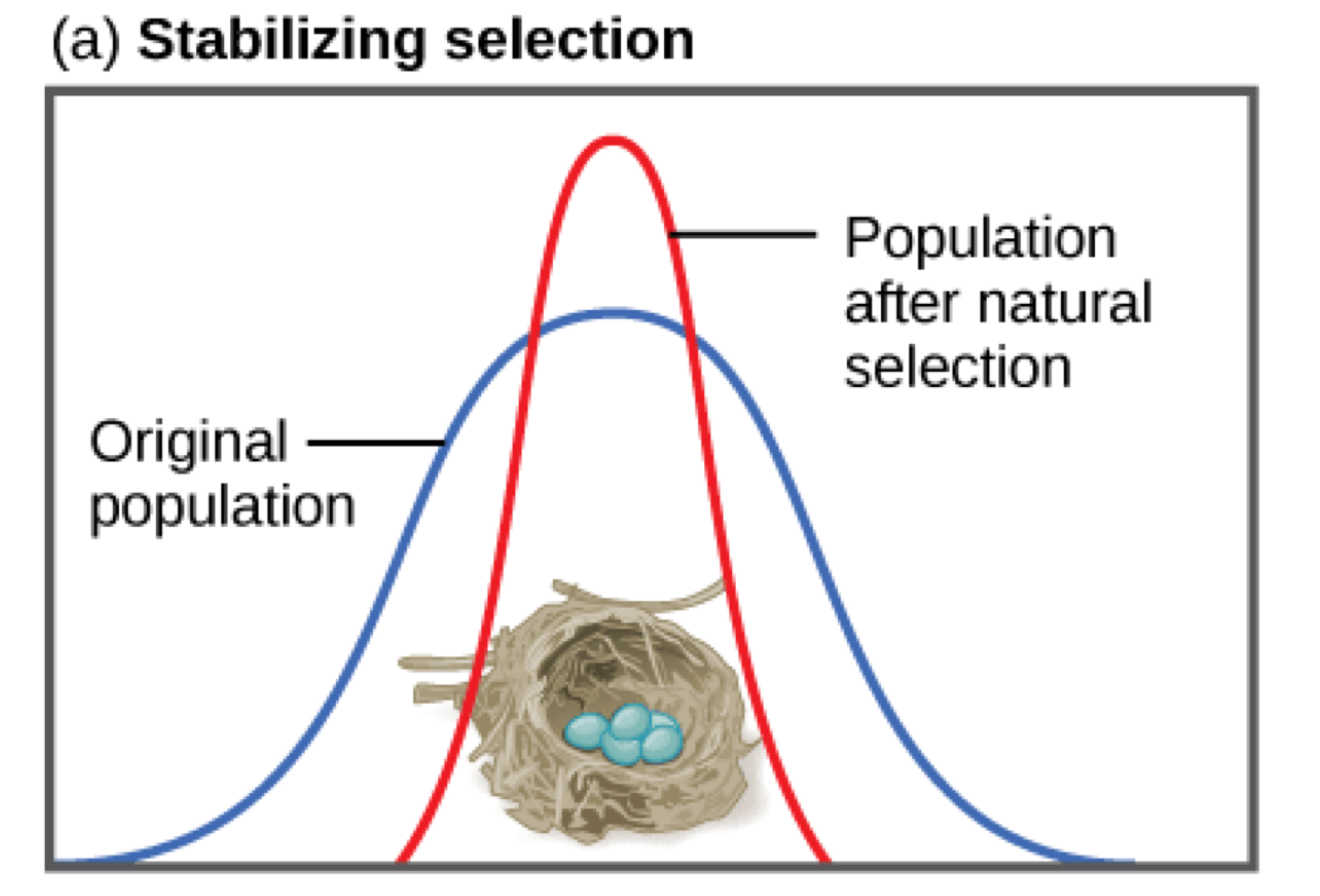
2. Stabilizing Selection
Stabilizing Selection: Favors intermediate variants and acts against extremes.
Example: Human birth weights.
Distribution of birth weights shows that weights between 6-8 pounds are optimal for survival, while weights that are too low (underweight) or too high (overweight) reduce survival chances due to complications for both the baby and mother.
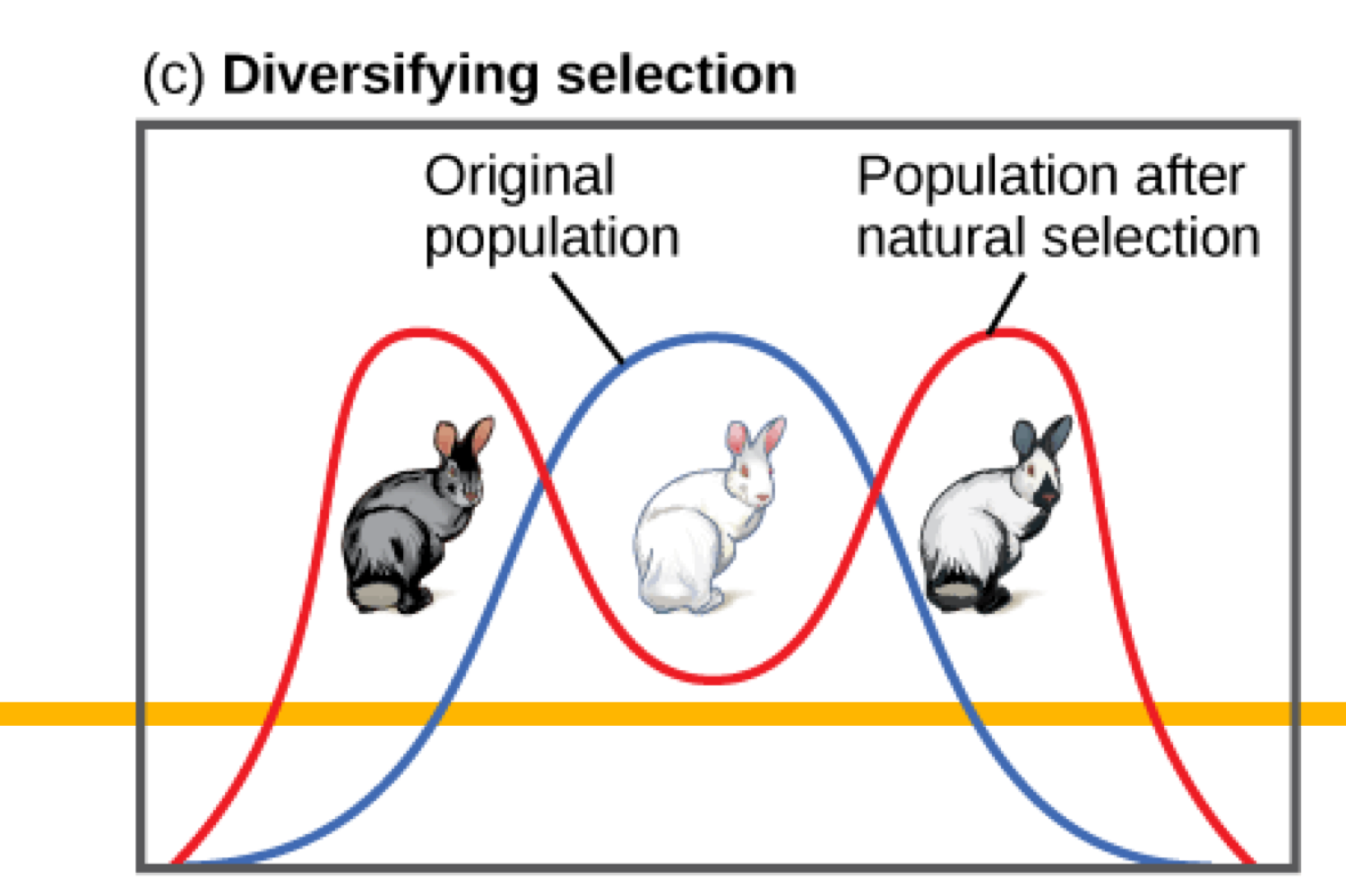
3. Disruptive Selection
Disruptive Selection: Favors individuals at both extremes of the phenotypic range over intermediates.
Example: Darwin's finches.
In environments where either small or large seeds are available but not medium-sized seeds, individuals with either very small or very large beaks are favored over those with intermediate beak sizes.