Plant Anatomy
Plant Structure Systems
Root System
Anchors plants + absorb nutrients/water.
Interactions w/ soil-fungi
Types:
Taproots (Carrot): Storage roots.
Fibrous roots (Grasses): Major anchoring and absorption role.
Adventitious: Arrangements like aerial roots (Bonsai).
Pneumatophores: Aerial roots for oxygen in waterlogged areas (Mangroves).
Tuberous Roots (Sweet Potato): For nutrient storage.
Stem System
Photosynthesis (in leaves)
Gas exchange
Reproduction (flowers/cones)
Transporting nutrients and water.
Types:
Runners/Stolon (Strawberries): Asexual reproduction.
Rhizomes: Underground stems for propagation.
Tubers (Potatoes): Storage for carbohydrates during dormancy.
Corms: Thickened stem for starch storage.
Leaf Structure and Function
Function: Gas exchange and photosynthesis.
Structure includes:
Cuticle (waxy layer): Protects against dehydration.
Mesophyll layers: Site for photosynthesis, including spongy parenchyma.
Stomata regulation through guard cells.
Leaf Diversity and Modifications:
Simple and compound leaves.
Modifications for specific functions - tendrils for climbing, succulents with spines, carnivorous plants.
Plant Development Mechanism
Growth - elongation of stem and root
Primary growth: lengthening
Secondary growth: thickening
Morphogenesis - changing of forms
Differentiation - Specializing cells into tissue types
Apical Meristems - cell division growth from root and stem
Epidermal, Ground, Vascular tissue
3 main: Dermal, Ground, and Vascular
Dermal Tissue
Function: Protective layer covering roots, stem, and leaves.
Location: Surrounds whole plant structure.
Vascular Tissue
Components: Xylem (water) and Phloem (sugars).
Arranged in bundles
Central location in the roots, along the stems and in the leaf veins
Ground Tissue
The bulk of the plants inner tissue
Function: Responsible for photosynthesis and storage
Components: Includes leaves Mesophyll
Types of Ground Tissue
Parenchyma - Most abundant, involved in storage + photosynthesis
Primary cell wall → retains a nucleus, thin, and lacks 2ndary cell wall
Mesophyll can also be Parenchyma → Palisade mesophyll (photosynthetic)
Collenchyma - Provides support while also allowing growth in young structures
Polygonal shapes w/ unevenly thickened cell walls → thicker than Parenchyma
Primary cell wall only, found in stems
Sclerenchyma - Strongest ground tissue providing max. support
Has primary cell wall and a thick 2ndary cell wall → latter having lignin
Types: Fibers and crystalized forms called Sclerids.
Surrounds the phloem vascular tissue the provide support (older plants)
Components of Vascular Tissue
Xylem - Transports water + minerals from roots to other parts of the plant.
Tracheid’s: long, narrow overlapping cells. Allows water movement in form of air bubbles
Vessel Elements: Larger, pipe-like structures w/ perforation plates facilitating water passage
Both cell types are dead at maturity and get lignified secondary walls for efficient water transport.
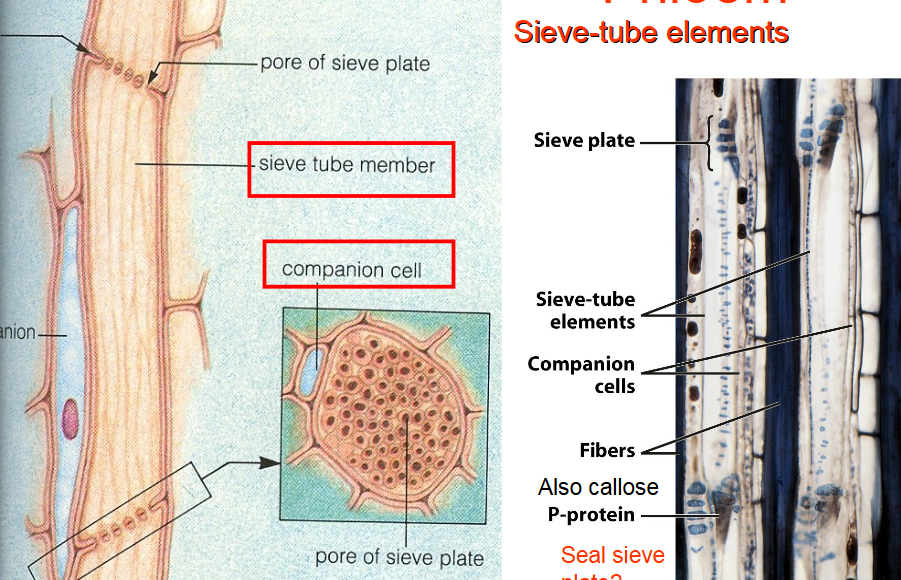
Phloem - Transports sugars (sucrose)
Sieve Tube Elements: Porous aiding in sugar solution flow.
Companion Cells: Assist loading and unloading sugars. Alive at maturity to repair after pest damage.
Cells can produce proteins for damage repair and a long-term plug (callose) for sustained repair.
Dermal Tissue Detail
Epidermis - Outer layer; woody parts (periderm)
Cuticle: waxy layer (cutin + other waxes) on plants surface
Stomata: Regulate intake of CO2 and release of water.
Trichomes: Hairs that deter pest and reduce light absorption for cooling
The 3 Species Concepts → Defines (new) species based off…
Biological: Interbreeding natural populations which are reproductively isolated from other groups
Morphological: Based on observing morphological feature differences
Phylogenetic: Based off shared ancestry and evolutionary history, using genetic data