2. Thermal Physics
Solids, Liquids, and Gases
In solids, intermolecular forces are strong, keeping particles closely packed in a regular arrangement, leading to definite shape and volume, and limited particle motion (they vibrate in place).
Liquids have weaker intermolecular forces, allowing particles to be close but not arranged regularly. This results in a definite volume but no definite shape, as they can flow to match their container.
Gases exhibit very weak intermolecular forces; their particles are widely spaced, move randomly, have no definite shape or fixed volume, and can flow easily, making them highly compressible.
Internal Energy of Matter
Internal energy is the total of the kinetic and potential energy of molecules. Kinetic energy varies with temperature, increasing as temperature increases, and generally the kinetic energy of gases is greater than that of liquids, which in turn is greater than that of solids.
Potential energy depends on the separation of molecules. As particles are more spaced out, potential energy increases: gases have more potential energy than liquids, and liquids have more than solids.
Changes in States of Matter
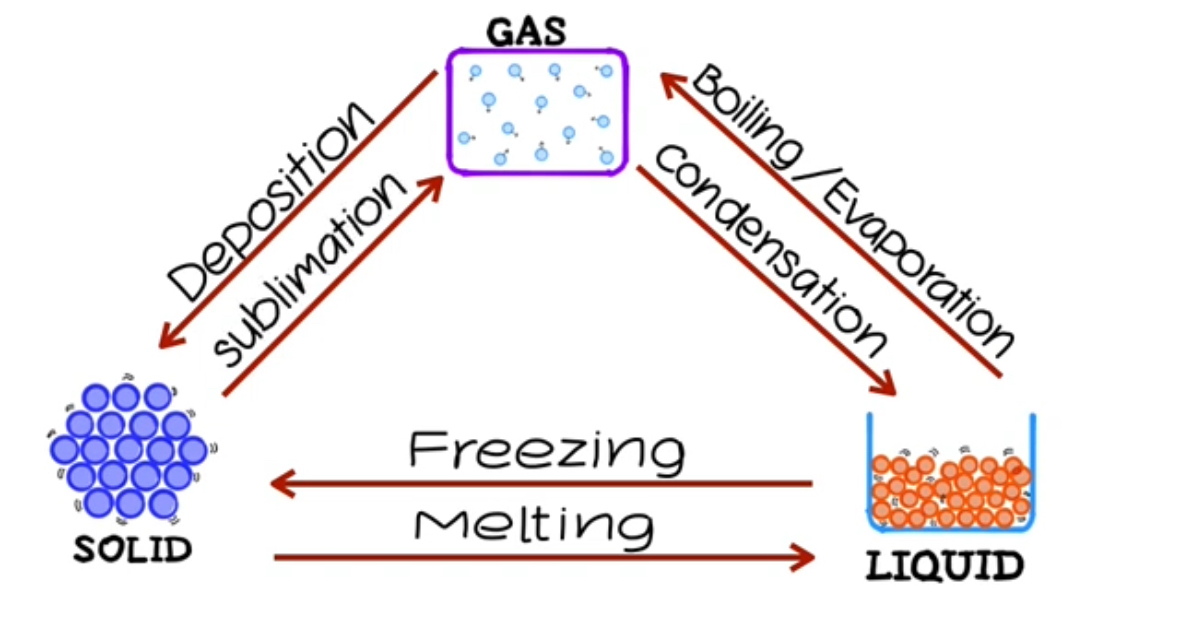
Melting occurs when a solid becomes a liquid, while boiling (or evaporating) is when a liquid transforms into a gas. Condensation reverses this process, changing gas to liquid, and freezing turns liquid back into solid.
Additional processes include deposition (gas to solid) and sublimation (solid to gas), each involving energy changes and transitions between states.
Explain More
Heating and Cooling Processes
When a solid melts, it absorbs thermal energy at the melting point, causing potential energy to increase while kinetic energy remains constant, leading to an increase in internal energy.
During boiling, a liquid absorbs thermal energy at the boiling point, which increases potential energy while maintaining constant kinetic energy, resulting in increased internal energy.
Conversely, during freezing, the liquid releases thermal energy, causing a decrease in potential energy while kinetic energy remains constant, thus decreasing internal energy.
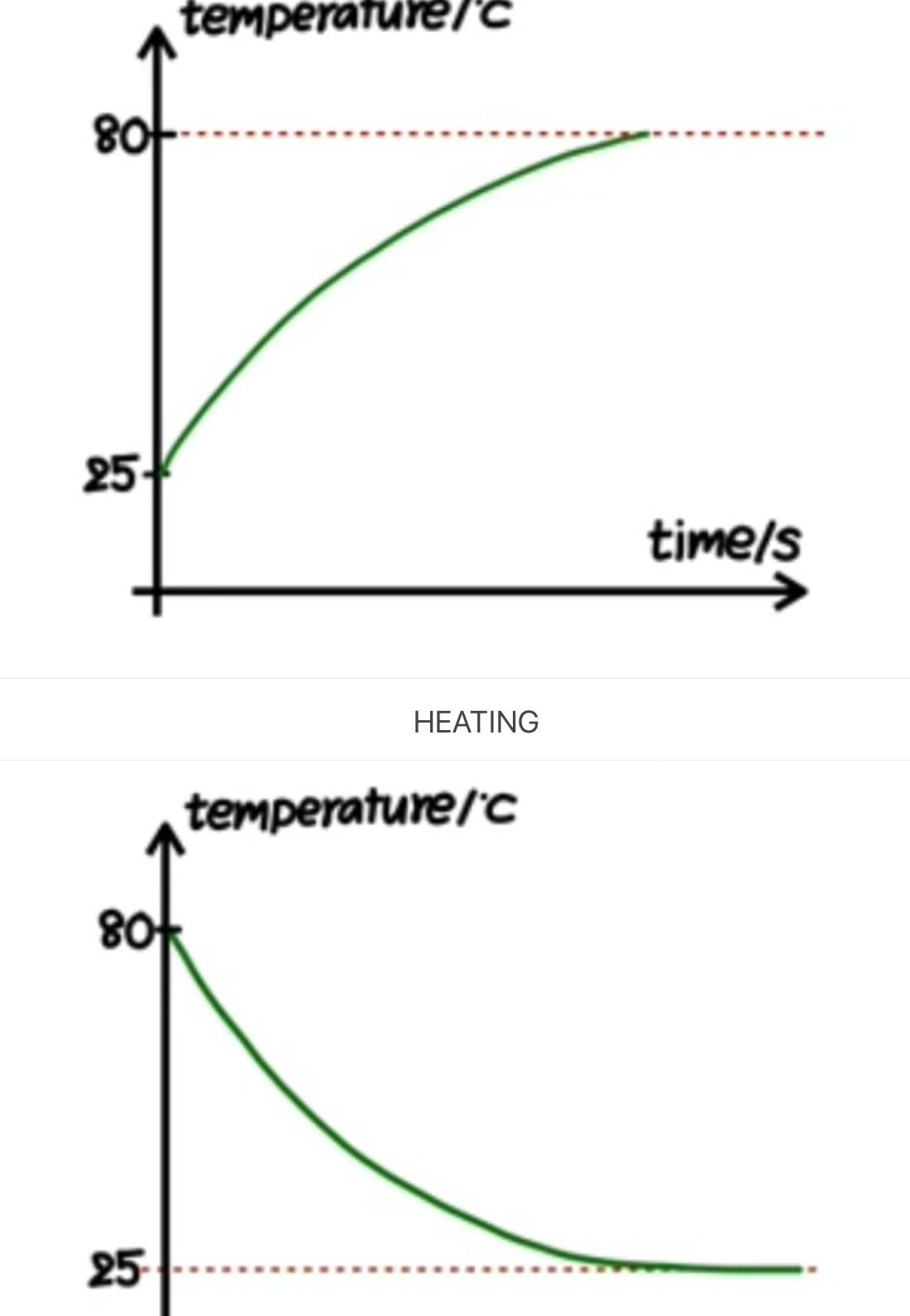
Cooling processes involve a temperature decrease, leading to a reduction in kinetic energy, but potential energy may slightly decrease due to compression.
Heating processes result in increased temperature, so kinetic energy rises, while potential energy remains constant or slightly increases due to expansion.
Absolute Temperature
The absolute temperature or Kelvin scale defines absolute zero as 0 Kelvin (equivalent to
273°C). An increase of 1 Kelvin corresponds directly to an increase of 1°C.
It is impossible to have temperatures below absolute zero, meaning temperatures in Kelvin are always non-negative.
The conversion from Celsius to Kelvin can be done using the equation: T(K) = 0(°C) + 273.
Brownian Motion
Brownian motion is the random movement of small particles suspended in a liquid or gas.
First observed by Scottish scientist Robert Brown in 1827 while studying pollen grains in water under a microscope.
The significance of Brownian motion lies in its demonstration of the kinetic theory of matter, which posits that matter is made of tiny particles in constant motion.
An example includes observing smoke particles in a glass cell under a microscope, revealing their constant movement, which illustrates their zigzag paths due to collisions with faster, smaller air particles.
Brownian motion has applications in biology and medicine, such as measuring the size and mass of particles and studying the movement of cells and molecules in the bloodstream.
Pressure of Gases
Gas pressure results from the collisions of gas molecules with the surfaces of objects.
The momentum of gas molecules changes as they collide and bounce off surfaces, leading to forces that exert pressure on those surfaces.
Pressure is defined as force per unit area, directly relating to how often and forcefully gas molecules collide with container walls.
Gas Laws
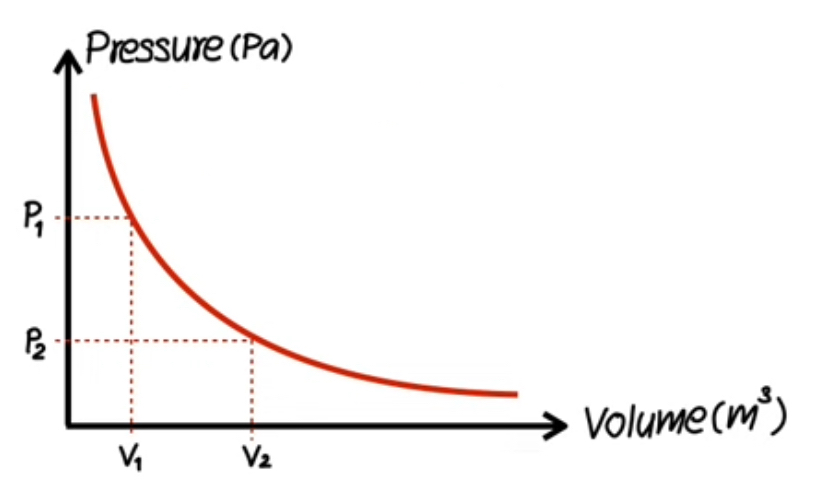
Boyle's Law describes the relationship between pressure and volume when a gas's mass and temperature are constant.
When gas is compressed (volume decreases), pressure increases due to more frequent collisions of gas molecules with container walls.
Conversely, when a gas expands (volume increases), pressure decreases as gas molecules collide less frequently.
The equation illustrating this relationship is P1V1 = P2V2, where P1 and V1 are the initial pressure and volume, and P2 and V2 are the final pressure and volume.
Pressure-Temperature Relationship
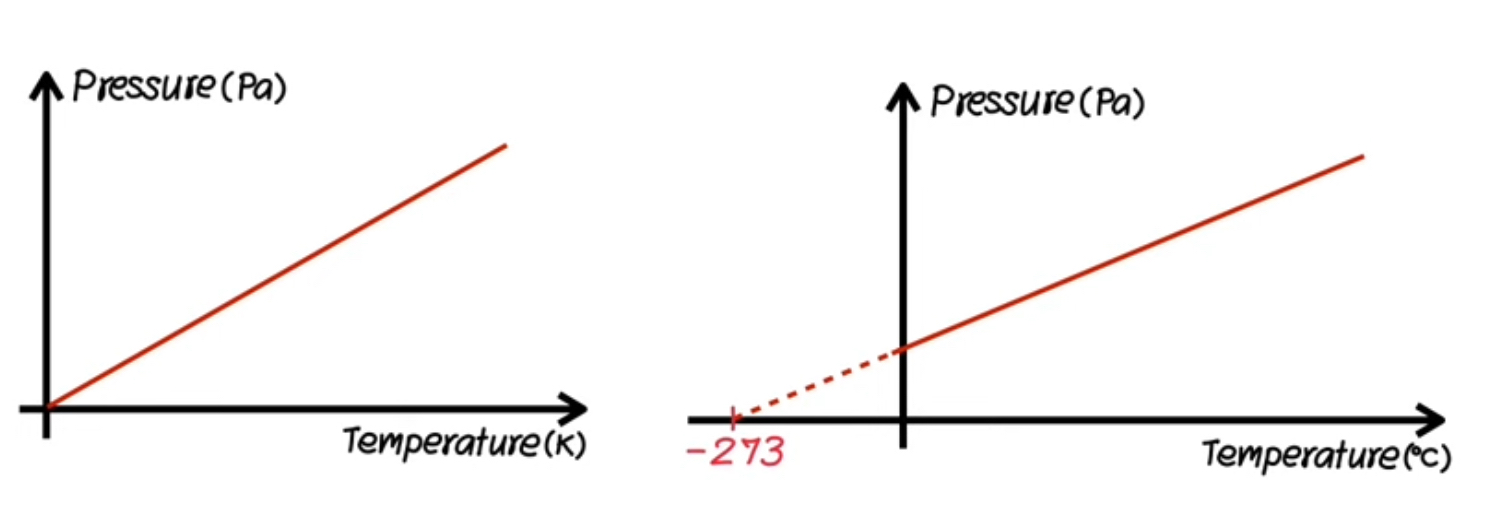
The Pressure Law (or Gay-Lussac's Law) outlines how pressure changes with temperature, maintaining constant volume and mass.
If temperature decreases, gas molecules' speed decreases, leading to less frequent and weaker collisions with container walls, thus lowering pressure.
If temperature increases, gas molecules' speed increases, causing more frequent and stronger collisions, resulting in higher pressure.
The relationship can be graphically represented, showing direct proportionality between pressure (in Pascals) and temperature (in Kelvin), with different lines depicting variations when using Celsius.
Thermal Expansion
When solids, liquids, or gases are heated, their particles gain kinetic energy, increasing their movement. This results in particles in solids vibrating more rapidly, while those in liquids and gases move faster.
The increase in kinetic energy leads to greater distances between particles, resulting in an increase in volume known as expansion.
Conversely, cooling reduces kinetic energy, causing particles to move more slowly and come closer together, leading to a decrease in volume, known as contraction.
Solids have strong intermolecular forces that keep particles tightly packed, making them less susceptible to expansion and compression compared to liquids and gases.
Properties of States of Matter
Solids have the least ability to expand and compress due to their tightly packed particles and strong intermolecular forces.
Liquids can expand and compress more easily than solids because their intermolecular forces are comparatively weaker.
Gases, with their very weak intermolecular forces, are the most expandable and compressible, as their particles are far apart.
Everyday Applications of Thermal Expansion
Bimetallic Strips: Composed of two different metals that expand at different rates, they bend when heated and are used in temperature-activated switches, such as fans.
Railway Lines: Expansion gaps are included in railway tracks to accommodate thermal expansion and prevent buckling during hot weather.
Thermometers: Utilize the expansion of liquids (usually mercury or alcohol) to measure temperature; liquid rises in the tube when heated.
Electrical Cables: Should have slack to allow for thermal expansion, preventing them from breaking during temperature fluctuations.
Car Tires: The air inside expands with heat, necessitating higher pressure in the summer than in winter.
Jar Lids: Running hot water over a stuck lid expands it, making it easier to unscrew due to thermal expansion.
Temperature and Internal Energy
An increase in temperature of an object leads to an increase in its internal energy and the average kinetic energy of its particles.
Potential energy may remain constant or only slightly increase due to expansion, while separation between particles may also stay the same or marginally increase.
The internal energy, or thermal energy, of an object increases with temperature and is defined in
the equation E=mc△T
Specific Heat Capacity
Specific heat capacity (C) is defined as the thermal energy required to raise the temperature of one unit mass of a substance by 1° C or 1 Kelvin.
The specific heat capacity remains constant for a given substance throughout temperature changes.
Example equation: (C = E/mc△T, where Delta E) is thermal energy in joules, (m ) is mass in grams or kilograms, and (Delta T) is the temperature change in degrees Celsius or Kelvin.
Measuring Specific Heat Capacity of a Solid
An experimental setup includes a thermometer, heater, voltmeter, ammeter, insulating material, and stopwatch.
Steps include measuring the mass of the metal block, heating it while monitoring temperature changes, recording voltage and current, timing the heating, and calculating thermal energy added.
Thermal energy is calculated using E=Pt or E=VIt
The formula for specific heat capacity derived from the experiment is C= E/m△T
• The calculated specific heat capacity may be greater than the actual due to thermal energy loss to the surroundings.
Measuring Specific Heat Capacity of a Liquid
The experimental setup uses an insulated container filled with liquid that has an insulated lid to minimize heat loss.
The mass of the liquid is determined by weighing the container empty and then full, calculating the difference.
The calculation for specific heat capacity follows the same formula as for solids: C= E/m△T
Particle Behavior in Water States
Foreign candidates should be able to describe melting and boiling in terms of water particles.
Condensation and solidification should also be described in terms of the particle behavior of water.
The primary difference between boiling and evaporation needs to be understood in terms of energy and state changes.
States of Water and Temperature Changes
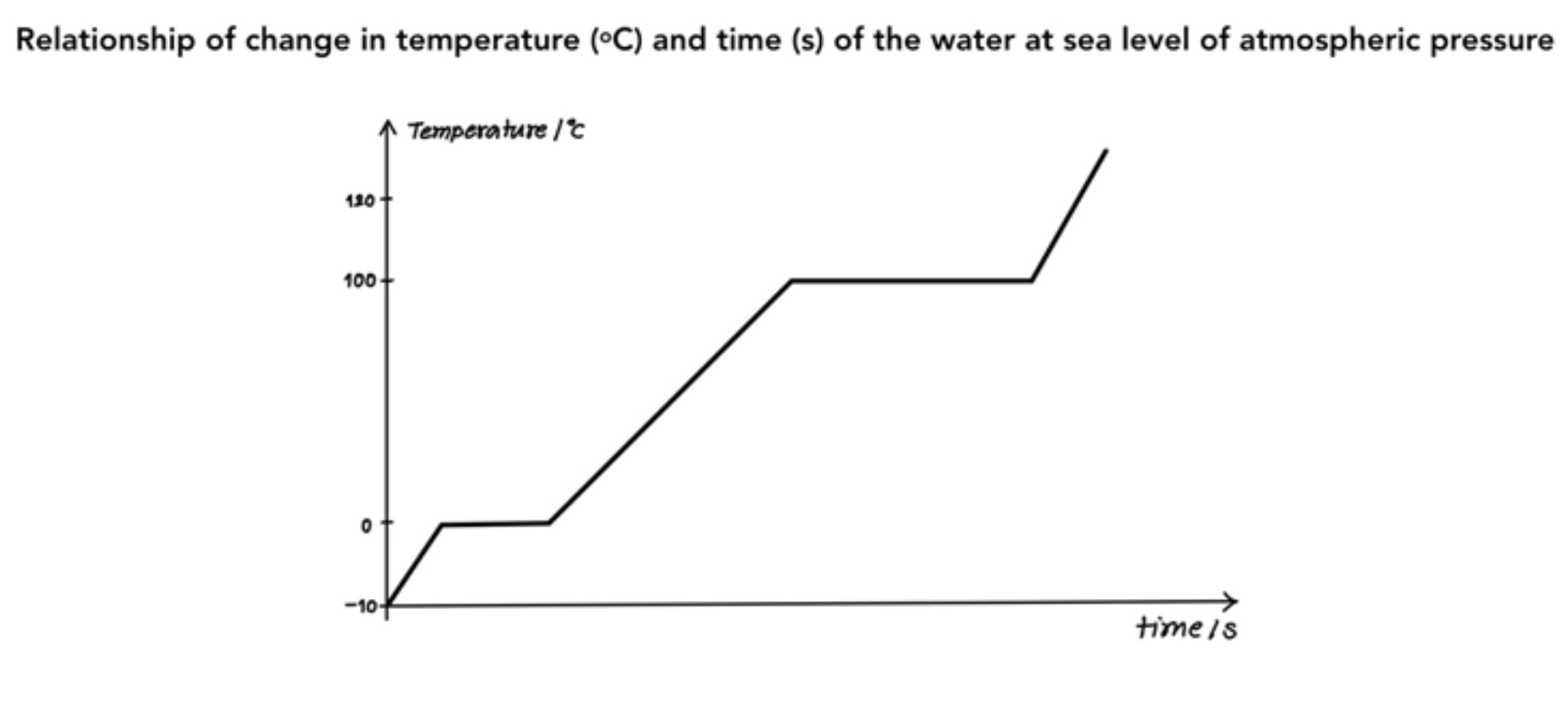
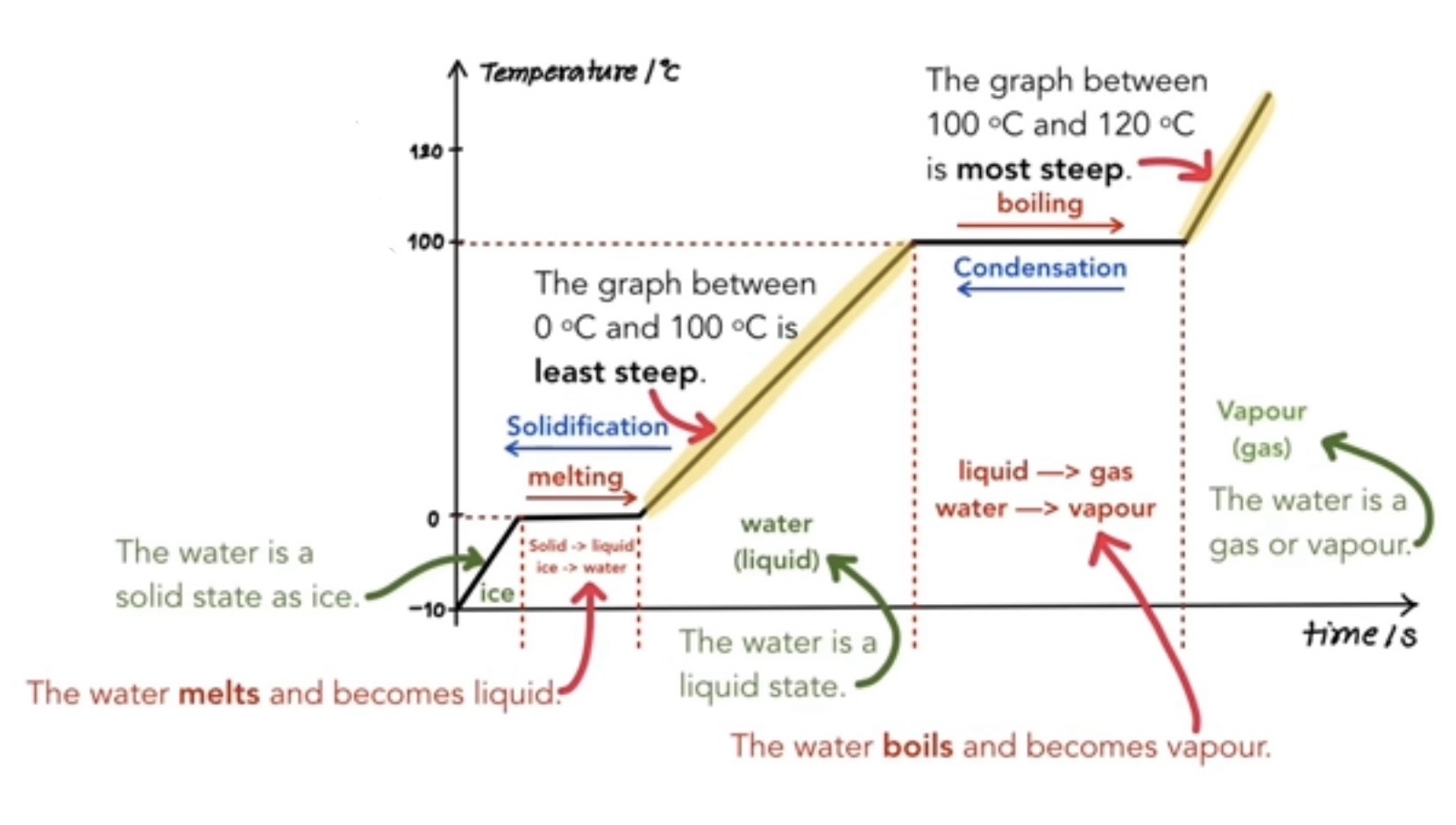
Between -10 and 0 degrees Celsius, water is in a solid state as ice. At O degrees Celsius, ice melts into liquid water, maintaining a constant temperature as it absorbs energy to break intermolecular forces, thus increasing potential energy while kinetic energy remains constant.
Between 0 and 100 degrees Celsius, water exists as a liquid. At 100 degrees Celsius, water boils and transforms into vapor. Similarly, this process maintains a constant temperature as water absorbs energy, again breaking intermolecular forces and increasing potential energy while keeping kinetic energy constant.
Above 100 degrees Celsius, between 100 and 120 degrees Celsius, water exists as a gas or vapor.
Specific Heat Capacity
The specific heat capacity of water is greater than that of ice, while the specific heat capacity of ice is greater than that of vapor. C of water>C of ice > C of vapor(gas)
This means it requires more energy to raise the temperature of water by one degree Celsius compared to ice or vapor, resulting in a less steep graph between 0 and 100 degrees Celsius and a steeper graph between 100 and 120 degrees Celsius.
Phase Changes
Condensation occurs when vapor at 100 degrees Celsius removes thermal energy and transitions from gas to liquid. The temperature remains constant during this phase change as thermal energy is removed, leading to increased intermolecular forces and decreased potential energy with constant kinetic energy.
Solidification (or freezing) occurs when liquid water at 0 degrees Celsius removes thermal energy and transitions to solid, also maintaining a constant temperature while the potential energy decreases.
Boiling vs. Evaporation
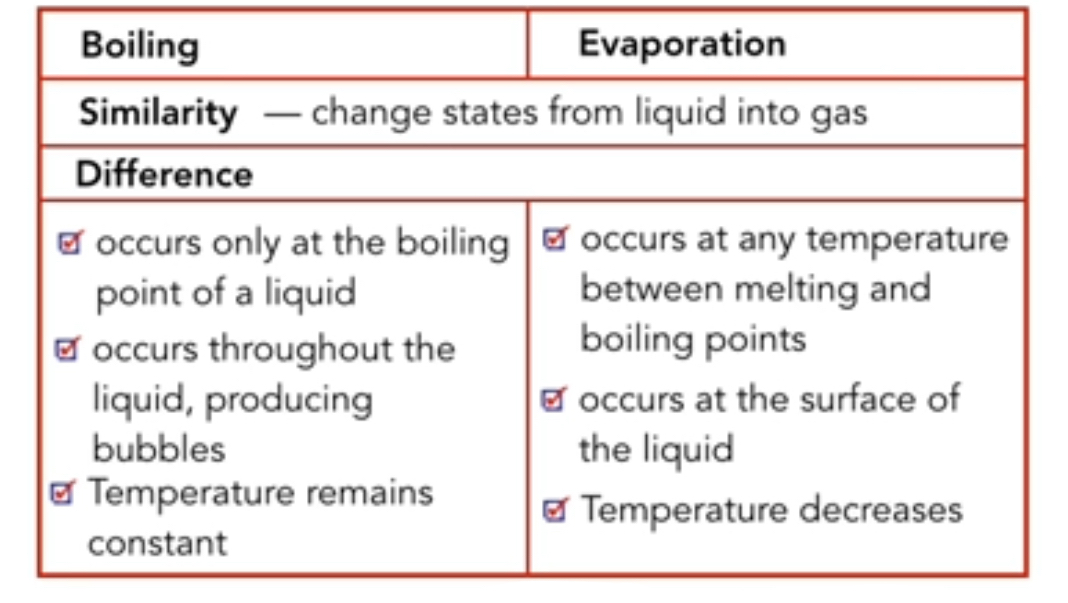
Boiling happens when a liquid reaches its boiling point and continues to absorb energy, breaking intermolecular forces, leading to increased potential energy while average kinetic energy and temperature remain constant.
Evaporation occurs when the most energetic molecules at the surface of a liquid escape into the air, resulting in a decrease in temperature because lower energy molecules are left behind.
Key similarities include that both processes involve a transition from liquid to gas; differences include boiling occurring only at the boiling point, while evaporation takes place at any temperature between melting and boiling points.
Factors Affecting Rate of Evaporation
Temperature: Higher temperatures increase the rate of evaporation due to more energetic molecules being present at the surface.
Surface Area: A larger surface area of the liquid results in a higher evaporation rate because it allows more energetic molecules to escape.
Wind Speed: Increased wind speed accelerates evaporation by removing water vapor from the liquid surface, facilitating more escape.
Humidity: Lower humidity levels lead to a faster evaporation rate since there is less water vapor in the air, allowing more to escape.