Volcanoes
A volcano is a hole or opening in the Earth’s crust, through which magma, ash and gases erupt.
They are formed by the accumulation of erupted lava over time.
Volcanoes can occur / form at both divergent and convergent plate boundaries.
At divergent boundaries, magma rises as the plates move apart. These volcanoes are usually less explosive and often occur or form underwater, subsequently forming mid-ocean ridges. Example: Mid-Atlantic Ridge
At convergent boundaries, as one plate moves towards the other, one subducts beneath the other. These volcanoes are often violent in nature and can form chains of islands. Example: The Pacific Ring of Fire
Volcanic Structure
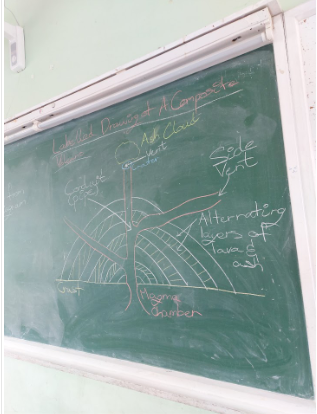
Labelled Diagram of a Composite Volcano
Parts of a Volcano
Vent - also known as volcanic openings / fissures; a pathway through which magma travels up to the Earth’s surface, from the magma chamber
Vent (at the top)
Side vent (at the sides of the volcano)
Crater - this is the mouth of the volcano, which surrounds the (main) vent; it looks like a depression at the top of the volcano
Ash Cloud - a cloud of ash which results from a volcanic explosion and contains volcanic debris such as ash, rocks, gas etc.
Conduit (pipe) - a pipe which runs up the middle of the volcano from the magma chamber to the vent (and through the crater *)
Magma chamber - this is where magma (molten rock) is stored, within the mantle of the Earth.
→ N.B. Magma can exit the volcano in the form of molten lava flow, volcanic bombs (composed of lumps of molten rock which solidify upon contact with the atmosphere), or simply as a cloud of ash, gas and dust.
Crust -
Layers of ash & lava - settled from previous eruptions
Refer to the image below for a visual comparison of the differences between a composite or shield volcano. The shield volcano diagram should also be added to your notes.
Reminder: A shield volcano has layers of solidified lava, which form from previous eruptions of thin, runny lava.
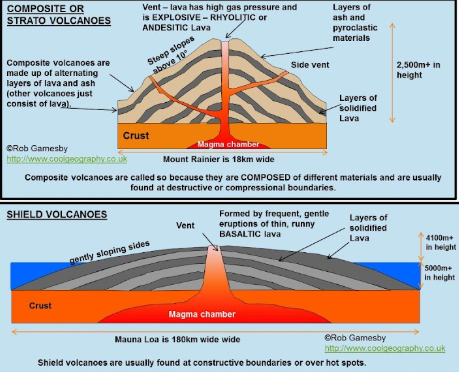
Labelled Diagram Comparing the Structure of a Composite Volcano w/ a Shield Volcano
Materials Ejected from Volcanoes
Not all volcanoes simply eject lava. There are various materials which can be ejected from a volcano during an eruption, either individually or a combination of 2 or more types of materials.
Lava
This is the most common type of volcanic material.
While under ground, it is referred to as magma. Lava refers only to magma which has erupted from a volcano.
Composite volcanoes erupt thick lava, which is called high viscosity lava.
Shield volcanoes erupt thin, runny lava, which is called low viscosity lava.
Ash
Volcanic ash is composed of rock and volcanic glass. It forms during an eruption when the rock and glass are pulverised, i.e. smashed together into tiny particles.
Volcanic ash is different from regular ash from a fire, as its particles are much coarser and harder. It has a sand-/grain-like appearance.
It also does not dissolve in water.
Volcanic ash can be extremely dangerous and harmful.
Volcanic bombs
A volcanic bomb is a large piece of molten rock which is ejected during a volcanic eruption.
To be deemed a volcanic bomb, the rock must be more than 6.4 cm wide, however, they can be as wide as 5 m and larger.
Gases
Numerous gases are emitted during an eruption. Some volcanoes may erupt only gases. The most common gases erupted are:
Carbon Dioxide (CO₂) - This can be deadly. Volcanoes often emit CO₂, even when not actively erupting. Having small amounts of CO₂ in the atmosphere is not harmful. However, at high concentrations, it can lead to headaches, dizziness and in extreme cases, death.
Sulphur dioxide - This is more irritating than it is deadly / harmful. This gas can irritate your eyes, nose and throat.
Hydrogen sulphide - This is a highly toxic gas. In small concentrations, we can smell it in the air - it has a distinctive smell of rotten eggs. However, the more gas present, the less we can smell it. This makes it extremely dangerous, as it is less noticeable. High concentrations of Hydrogen Sulphide can be fatal.
Pyroclastic materials
A pyroclastic flow refers to a cloud of extremely hot gas and ash, which erupts from a volcano and then travels down volcanic slopes, destroying everything in their path.
Temperatures can go up to 1000 ℃ and travel at speeds of 720 km/h.
These flows are extremely dangerous and are one of the deadliest effects of volcanic eruptions.
Example: In 1997, 19 people were killed in Montserrat, as a result of a pyroclastic flow down Mosquito Ghaut.
Effects of Volcanoes (Positive & Negative)
When we think of the effects of a volcanic eruption, we primarily think of negative, devastating effects. However, positive effects also occur. Both of these types of effects are detailed below.
Positive Effects
Tourism
People are attracted to volcanoes and the unique features and landscapes present, such as mud pools and geysers. The idea of being so up close and personal with a volcano is also exciting.
This helps the economy as it can lead to an influx of tourists, and many businesses cater to them. These include cafés, restaurants, shops etc. being established in close proximity to areas filled with tourists.
Examples: Mount Vesuvius in Italy is one of the deadliest volcanoes, however it is one of Italy’s most popular tourist attractions; Soufrière in St. Lucia is a major tourist attraction, particularly its nearby sulphur springs where patrons have the opportunity to bathe in natural sulphur, which is said to bring benefits to the skin.
Mineral Springs - These often develop around volcanoes and are sometimes referred to as volcanic spas, with a popular spa being the Blue Lagoon, in Iceland. A mineral spring is a man-made pool which is heated by the lava flow to temperatures of 37 °C. These springs are rich in minerals such as silica, which have medicinal properties.
Fertile Soils
Many farmers choose to live near volcanoes, as the land surrounding volcanoes can be very fertile. Fertile soils are soils which are very rich in nutrients, where plants can flourish well.
The ash from volcanic eruptions provides nourishment to the soils. These nutrient rich soils promote very productive farming areas, which can contribute to economic growth.
Example: The land surrounding Mount Vesuvius, Italy is extremely fertile, allowing farmers to grow crops, vines and other plants.
New Land
Volcanic eruptions have created many countries in the world.
Examples: Iceland, Hawaii, Bermuda - these 3 volcanic islands are inhabited, i.e. they have people living on them.
However, there are many more islands which developed as a result of volcanic eruptions, which remain uninhabited.
Geothermal energy
Volcanic regions have a unique opportunity to use the heat from below the Earth's surface, to generate electricity.
The Process of Electricity Generation: The rocks underground heat up the water which produces steam. The steam then drives the turbines, which generate electricity.
This process is a type of geothermal energy.
Geothermal energy - this refers to the use of a clean and sustainable renewable energy source, i.e. heat. The energy generated is natural, formed in the earth, causes no pollution and is free to use (i.e. has no economic cost attached to its usage).
Geothermal energy can be used to heat homes and offices, and to generate electricity.
Negative Effects
Damage to Buildings
Buildings can be completely destroyed during an eruption.
The eruption itself doesn't usually damage buildings. However, a pyroclastic flow or lahar can have devastating effects.
Pyroclastic flows can entirely destroy anything in their path, including buildings and roads.
Lahars are also devastating. A lahar is a fast-moving flow of water and volcanic debris, which can bury entire buildings and roads.
Whilst travelling, lahars can pick up large amounts of debris, which are then able to cause even more damage to structures such as buildings, roads and bridges.
Volcanic ash can be extremely dangerous and problematic, as when it is mixed with rainwater, it becomes very heavy and dense, which can cause roofs to collapse.
Destruction of Vegetation
Pyroclastic flows can burn or singe plants, trees and other types of vegetation. This is because these plants cannot withstand such high temperatures.
Lahars also have the power to uproot entire trees and transport them downhill.
Effects on the Climate
Volcanic eruptions can have major effects on the climate.
During an eruption, large quantities of gases such as sulphur dioxide, and dust are ejected into the atmosphere. Having these substances present at high concentrations, can prevent sunlight from penetrating the atmosphere and therefore lowers temperatures at the Earth’s surface.
Loss of Life & Property
While volcanic eruptions may not usually be the deadliest form of natural disasters, there have been a number of deadly volcanic eruptions over the years.
The eruption of Mount Vesuvius in Pompeii (now Naples) is one of the deadliest eruptions in history, as it killed the entire population of Pompeii.
More recent eruption examples include:
Krakatoa, 1883 - killed 36,000 people
Mount Lamington, 1951 - killed 2,942 people
Chances Peak, a part of the Soufrière Hills (Montserrat), is a volcanic area. It erupted in 1995 after being dormant for almost 300 years. It then continued to erupt for 5 years. During these 5 years, the small island population had to be evacuated.
Travel Disruption
Eruptions can be a major disruption to air travel, which can negatively affect a country's economy.
In 2010, an eruption in Iceland caused planes all over Europe to be grounded for almost 8 days. This resulted in a loss of €1 billion for airlines.
The reason why air traffic is suspended during an eruption is because the volcanic ash can be extremely harmful to plane engines. If the ash got into the plane engines, it can cause planes to stall and crash.
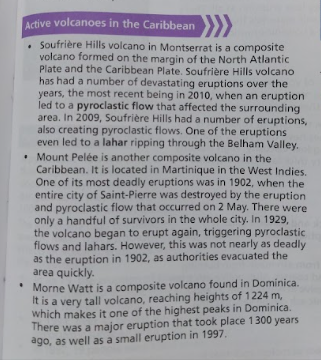
Active Volcanoes in the Caribbean
Highlight ( Summary )
A volcano is a hole or opening in the Earth’s crust, through which magma, ash and gases erupt.
They are formed by the accumulation of erupted lava over time.
Volcanoes can occur / form at both divergent and convergent plate boundaries.
At divergent boundaries, magma rises as the plates move apart. These volcanoes are usually less explosive and often occur or form underwater, subsequently forming mid-ocean ridges. Example: Mid-Atlantic Ridge
At convergent boundaries, as one plate moves towards the other, one subducts beneath the other. These volcanoes are often violent in nature and can form chains of islands. Example: The Pacific Ring of Fire
Volcanic Structure
Labelled Diagram of a Composite Volcano
Parts of a Volcano
Vent - also known as volcanic openings / fissures; a pathway through which magma travels up to the Earth’s surface, from the magma chamber
Vent (at the top)
Side vent (at the sides of the volcano)
Crater - this is the mouth of the volcano, which surrounds the (main) vent; it looks like a depression at the top of the volcano
Ash Cloud - a cloud of ash which results from a volcanic explosion and contains volcanic debris such as ash, rocks, gas etc.
Conduit (pipe) - a pipe which runs up the middle of the volcano from the magma chamber to the vent (and through the crater *)
Magma chamber - this is where magma (molten rock) is stored, within the mantle of the Earth.
→ N.B. Magma can exit the volcano in the form of molten lava flow, volcanic bombs (composed of lumps of molten rock which solidify upon contact with the atmosphere), or simply as a cloud of ash, gas and dust.
Crust -
Layers of ash & lava - settled from previous eruptions
Refer to the image below for a visual comparison of the differences between a composite or shield volcano. The shield volcano diagram should also be added to your notes.
Reminder: A shield volcano has layers of solidified lava, which form from previous eruptions of thin, runny lava.
Labelled Diagram Comparing the Structure of a Composite Volcano w/ a Shield Volcano
Materials Ejected from Volcanoes
Not all volcanoes simply eject lava. There are various materials which can be ejected from a volcano during an eruption, either individually or a combination of 2 or more types of materials.
Lava
This is the most common type of volcanic material.
While under ground, it is referred to as magma. Lava refers only to magma which has erupted from a volcano.
Composite volcanoes erupt thick lava, which is called high viscosity lava.
Shield volcanoes erupt thin, runny lava, which is called low viscosity lava.
Ash
Volcanic ash is composed of rock and volcanic glass. It forms during an eruption when the rock and glass are pulverised, i.e. smashed together into tiny particles.
Volcanic ash is different from regular ash from a fire, as its particles are much coarser and harder. It has a sand-/grain-like appearance.
It also does not dissolve in water.
Volcanic ash can be extremely dangerous and harmful.
Volcanic bombs
A volcanic bomb is a large piece of molten rock which is ejected during a volcanic eruption.
To be deemed a volcanic bomb, the rock must be more than 6.4 cm wide, however, they can be as wide as 5 m and larger.
Gases
Numerous gases are emitted during an eruption. Some volcanoes may erupt only gases. The most common gases erupted are:
Carbon Dioxide (CO₂) - This can be deadly. Volcanoes often emit CO₂, even when not actively erupting. Having small amounts of CO₂ in the atmosphere is not harmful. However, at high concentrations, it can lead to headaches, dizziness and in extreme cases, death.
Sulphur dioxide - This is more irritating than it is deadly / harmful. This gas can irritate your eyes, nose and throat.
Hydrogen sulphide - This is a highly toxic gas. In small concentrations, we can smell it in the air - it has a distinctive smell of rotten eggs. However, the more gas present, the less we can smell it. This makes it extremely dangerous, as it is less noticeable. High concentrations of Hydrogen Sulphide can be fatal.
Pyroclastic materials
A pyroclastic flow refers to a cloud of extremely hot gas and ash, which erupts from a volcano and then travels down volcanic slopes, destroying everything in their path.
Temperatures can go up to 1000 ℃ and travel at speeds of 720 km/h.
These flows are extremely dangerous and are one of the deadliest effects of volcanic eruptions.
Example: In 1997, 19 people were killed in Montserrat, as a result of a pyroclastic flow down Mosquito Ghaut.
Effects of Volcanoes (Positive & Negative)
When we think of the effects of a volcanic eruption, we primarily think of negative, devastating effects. However, positive effects also occur. Both of these types of effects are detailed below.
Positive Effects
Tourism
People are attracted to volcanoes and the unique features and landscapes present, such as mud pools and geysers. The idea of being so up close and personal with a volcano is also exciting.
This helps the economy as it can lead to an influx of tourists, and many businesses cater to them. These include cafés, restaurants, shops etc. being established in close proximity to areas filled with tourists.
Examples: Mount Vesuvius in Italy is one of the deadliest volcanoes, however it is one of Italy’s most popular tourist attractions; Soufrière in St. Lucia is a major tourist attraction, particularly its nearby sulphur springs where patrons have the opportunity to bathe in natural sulphur, which is said to bring benefits to the skin.
Mineral Springs - These often develop around volcanoes and are sometimes referred to as volcanic spas, with a popular spa being the Blue Lagoon, in Iceland. A mineral spring is a man-made pool which is heated by the lava flow to temperatures of 37 °C. These springs are rich in minerals such as silica, which have medicinal properties.
Fertile Soils
Many farmers choose to live near volcanoes, as the land surrounding volcanoes can be very fertile. Fertile soils are soils which are very rich in nutrients, where plants can flourish well.
The ash from volcanic eruptions provides nourishment to the soils. These nutrient rich soils promote very productive farming areas, which can contribute to economic growth.
Example: The land surrounding Mount Vesuvius, Italy is extremely fertile, allowing farmers to grow crops, vines and other plants.
New Land
Volcanic eruptions have created many countries in the world.
Examples: Iceland, Hawaii, Bermuda - these 3 volcanic islands are inhabited, i.e. they have people living on them.
However, there are many more islands which developed as a result of volcanic eruptions, which remain uninhabited.
Geothermal energy
Volcanic regions have a unique opportunity to use the heat from below the Earth's surface, to generate electricity.
The Process of Electricity Generation: The rocks underground heat up the water which produces steam. The steam then drives the turbines, which generate electricity.
This process is a type of geothermal energy.
Geothermal energy - this refers to the use of a clean and sustainable renewable energy source, i.e. heat. The energy generated is natural, formed in the earth, causes no pollution and is free to use (i.e. has no economic cost attached to its usage).
Geothermal energy can be used to heat homes and offices, and to generate electricity.
Negative Effects
Damage to Buildings
Buildings can be completely destroyed during an eruption.
The eruption itself doesn't usually damage buildings. However, a pyroclastic flow or lahar can have devastating effects.
Pyroclastic flows can entirely destroy anything in their path, including buildings and roads.
Lahars are also devastating. A lahar is a fast-moving flow of water and volcanic debris, which can bury entire buildings and roads.
Whilst travelling, lahars can pick up large amounts of debris, which are then able to cause even more damage to structures such as buildings, roads and bridges.
Volcanic ash can be extremely dangerous and problematic, as when it is mixed with rainwater, it becomes very heavy and dense, which can cause roofs to collapse.
Destruction of Vegetation
Pyroclastic flows can burn or singe plants, trees and other types of vegetation. This is because these plants cannot withstand such high temperatures.
Lahars also have the power to uproot entire trees and transport them downhill.
Effects on the Climate
Volcanic eruptions can have major effects on the climate.
During an eruption, large quantities of gases such as sulphur dioxide, and dust are ejected into the atmosphere. Having these substances present at high concentrations, can prevent sunlight from penetrating the atmosphere and therefore lowers temperatures at the Earth’s surface.
Loss of Life & Property
While volcanic eruptions may not usually be the deadliest form of natural disasters, there have been a number of deadly volcanic eruptions over the years.
The eruption of Mount Vesuvius in Pompeii (now Naples) is one of the deadliest eruptions in history, as it killed the entire population of Pompeii.
More recent eruption examples include:
Krakatoa, 1883 - killed 36,000 people
Mount Lamington, 1951 - killed 2,942 people
Chances Peak, a part of the Soufrière Hills (Montserrat), is a volcanic area. It erupted in 1995 after being dormant for almost 300 years. It then continued to erupt for 5 years. During these 5 years, the small island population had to be evacuated.
Travel Disruption
Eruptions can be a major disruption to air travel, which can negatively affect a country's economy.
In 2010, an eruption in Iceland caused planes all over Europe