Chapter 21: Radioactivity and Nuclear Chemistry
Positron Emission Tomography (PET) and Radioactivity
PET (Positron Emission Tomography) is a medical imaging technique that involves the emission of positrons.
Individuals undergoing a PET scan are injected with contrast agents that enhance imaging signals.
Certain injectable compounds, such as radioactive antibodies, target infections directly and aggregate at sites of infection, allowing visualization through various scanning techniques.
Knowledge of radiochemistry and nuclear chemistry is essential for medical professionals involved in the use of PET scans.
Principles of Radioactivity
Definition of Radioactivity: The emission of particles from atomic nuclei, where these particles are typically subatomic and possess high energy.
Types of particles emitted:
- Different particles exhibit varying energy levels and health hazards.
- Understanding the protection measures against these particles is crucial.
Radioactive Decay
Overview of different forms of radioactive decay, emphasizing identification and nuclear equations.
Atomic Number and Mass:
- The atomic number represents the number of protons.
- The mass number is the total count of protons and neutrons.
- To find neutrons:
-Isotopes: Atoms of the same element with different neutron counts.
Notation for subatomic particles
Proton Symbol: P
Neutron Symbol: n
Electron Symbol: e
Types of Radioactive Decay
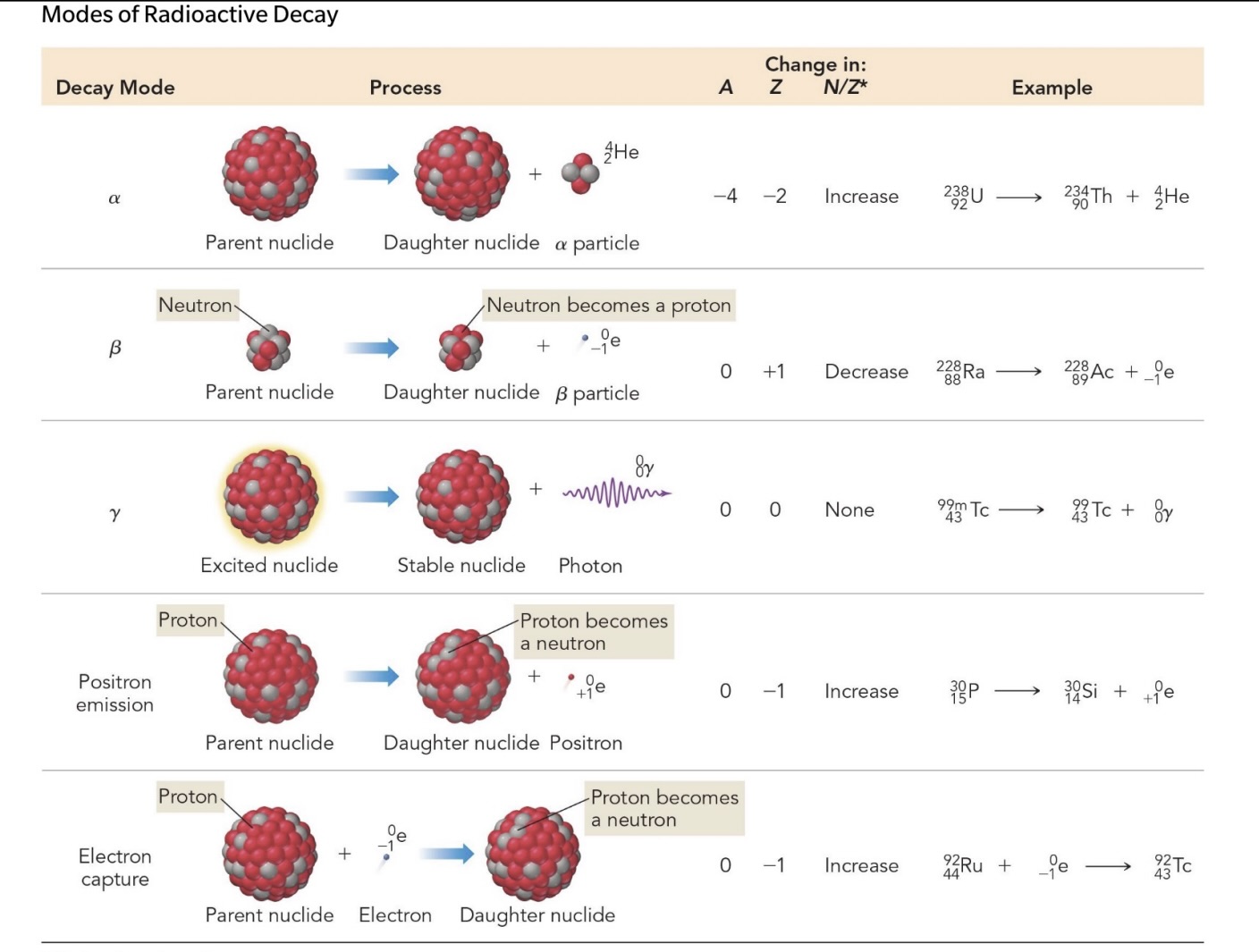
Alpha Decay
Definition: Emission of alpha particles, equivalent to helium nuclei (2 protons and 2 neutrons).
Transformation:
- Changes the original element due to loss of protons.
- Example: Uranium-238 decaying to Thorium-234 via alpha emission.
- Nuclear equation for alpha decay:
-
parent nuclide daughter nuclide
A nuclear equation must be balanced with respect to atomic numbers and mass numbers:
Penetration and Safety:
Largest radioactive particle
Alpha particles are highly ionizing but poorly penetrating; a sheet of paper can block them.
Dangerous if ingested or inhaled.
Beta Decay
In some unstable nuclei, a neutron changes into a proton and emits an electron
Definition: Transformation of a neutron into a proton while emitting an electron (beta particle).
Electron Emission:
- The neutron converts, yielding an increase in protons.
- Example: Carbon-14 undergoing beta decay.
- Nuclear equation for beta decay:
Penetration and Safety:
Less massive than alpha particlesBeta particles are lower ionizing but higly penetrating; precautions involve metal shielding.
Consumption of beta emitters less damaging than alpha emitter
Gamma Decay
Definition: A form of electromagnetic radiation with no mass and high energy (short wavelength) photons
Connection to Decay: Usually emitted from nuclei in conjunction with other types of radiation
Gamma Nuclear symbol:
Penetration and Safety:
- Lowest ionizing power yet high penetration; requires thick shielding (e.g., lead/concrete).
Positron Emission
Definition: Emission of positrons, the antiparticle of electrons from unstable nuclei.
Transformation of Particles:
- A proton transforms into a neutron while emitting a positron; proton neutron + emitted positronWhen an atom emits a positron, its atomic number decreases by 1 because it has one less proton after emission, however top number (atomic mass which is the neutrons + protons) stays the same as one simply swaps for another
Positron Nuclear symbol:
Example:
Electron Capture
Electron capture involves a particle being absorbed by rather than emitted from an unstable nucleus
Definition: An atom captures an inner-shell electron and converts a proton into a neutron.
Proton + electron neutron
The atomic number decreases by 1 because it has one less proton
Nuclear Equation:
Example:
- From an element going into another element with decreased atomic number.
-
Nuclear Decay Chart