Equilibrium Superdoc
Part 1 Packet
General Stuff About equilibrium
Equilibrium concentrations do not have to be equal to one another
chemical equilibrium: rate of fwd and reverse reactions are equal
amount of reactants and products are CONSTANT @ equilibrium unless its disturbed
Keq is unitless
K
K > 1: Reaction is product favored
concentration of products are much greater than concentration of reactants @ equilibrium
K < 1: Reaction is reactant favored
concentration of reactants are much greater than concentration of products @ equilibrium
Think of like a number line (left, K is less, reactants)
Q vs K
Q = K, @ equilibrium
Q > K, too many products, net reaction proceeds to the reactants
Q < K, too many reactants, net reaction proceeds to products
ALWAYS WRITE Q THEN K, WHEREVER THE OPEN SIDE GOES IS WHERE THE REACTION PROCEEDS
Remember that with FRQ problems with Q and K, don’t say shift
say that the EQUILIBRIUM PROCEEDS
Rxn Mechanisms
Remember the substituting for the rate with the intermediates?
if a step of the reaction mechanism is at equilibrium, isolate and solve for the concentration of the intermediate and plug it into the rds
Homogenous Equilibria
all reactants and products are in same phase
Gas Phase:
eq constant can be expressed in terms of concentration or partial pressures
if volume of a reactant/product is so large → you can define the concentration as constant
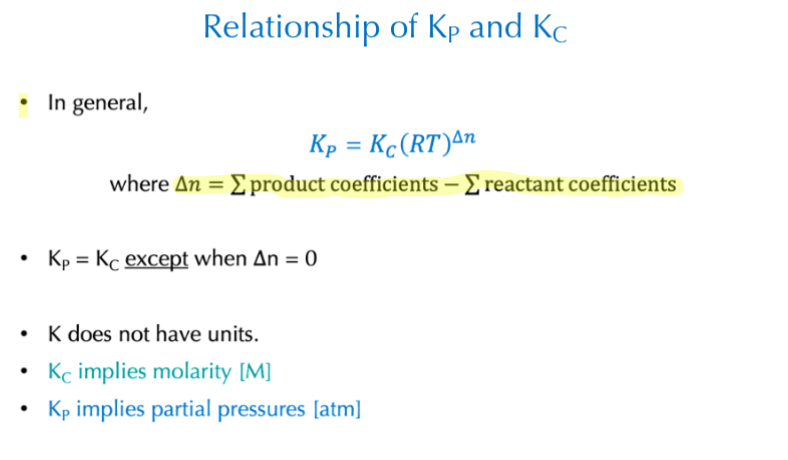
Relationship btwn Kp and Kc
PV = nRT
C = n/V = P/RT
P = CRT
Concentration of a solid/pure liquid
substitute 1 for the concentration of a solid or pure liquid
Heterogeneous Equilibrium
reversible rxn where reactants and products are in different phases
Multiple Equilibria
Add the Reactions: If the overall reaction is obtained by adding the two individual reactions, then the equilibrium constant for the overall reaction is the product of the equilibrium constants of the individual reactions.
Koverall=K1×K2
Subtract the Reactions: If the overall reaction is obtained by subtracting one reaction from another, then the equilibrium constant for the overall reaction is the quotient of the equilibrium constants of the individual reactions.
Koverall = K1/K2
Multiply or Divide by a Factor: If a reaction is multiplied by a factor nn, the equilibrium constant is raised to the power of nn.
Knew=KnKnew=Kn
Reverse the Reaction: If a reaction is reversed, the equilibrium constant is the reciprocal of the original equilibrium constant.
Knew=1KKnew=K1
Example
Le Chateliers
Concentration
Volume
equilibrium will shift to side of reaction with
fewer moles of gas if volume is reduced to offset increased pressure
greater moles of gas is volume is increased to offset decresaed pressure
Temperature
consider if rxn is endo or exothermic
Endothermic
energy is absorbed when rxn runs in fwd direction (think of energy as a reactant)
Kc increases when temperature is raised and vice versa
Exothermic
energy is absorbed when rxn runs in reverse direction (think of energy as a product)
Kc decreases when temperature is raised and vice versa
Temperature changes how the fuck does K change