Notes on Projectile Motion
Learning Objectives
Define Projectile Motion
Explain Projectile Motion
Identify and differentiate the types of Projectile Motion
Explain kinematics equations relevant to Projectile Motion
Solve Projectile Motion problems
Definition of Projectile
Projectile: Any object projected by some means that continues to move due to its own inertia (mass).
Motion Characteristics
Two Dimensions: Projectiles move in two dimensions, resulting in two components similar to a resultant vector.
Velocity Components
Horizontal Velocity:
Constant, does not change
Covers equal displacements in equal time intervals
Gravity does not affect horizontal motion.
Vertical Velocity:
Changes due to gravity
Magnitude decreases on ascent and increases on descent
Direction: UPWARD on ascent, DOWNWARD on descent.
Combining Components
Horizontal: Constant magnitude and direction.
Vertical: Changing magnitude and direction.
Creates a parabolic trajectory.
Horizontally Launched Projectiles
Characteristics:
No upward trajectory, no initial vertical velocity
Initial vertical velocity = 0 m/s.
Equations:
Horizontal:
Vertical:
Example: Projectile from a plane
Time of fall calculated with:
Vertically Launched Projectiles
Characteristics:
No vertical velocity at the peak
Vertical velocity decreases on ascent and increases on descent.
Separate components used in calculations:
Horizontal component:
Vertical component:
Key Equations for Projectile Motion
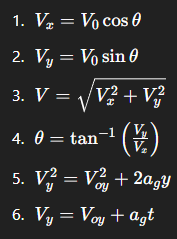
Practice Example
A place kicker kicks a football with a velocity of 20.0 m/s at an angle of 53 degrees:
Time in air, distance traveled, and maximum height calculated using component breakdown and kinematic equations.
Evaluation Samples
Calculate hang time and distance for a football kick.
Determine height of a ramp from which a skier launches.
Quote
"Project, launch yourself and be discovered…"