3.2: Photosynthesis
Structures
Leaves
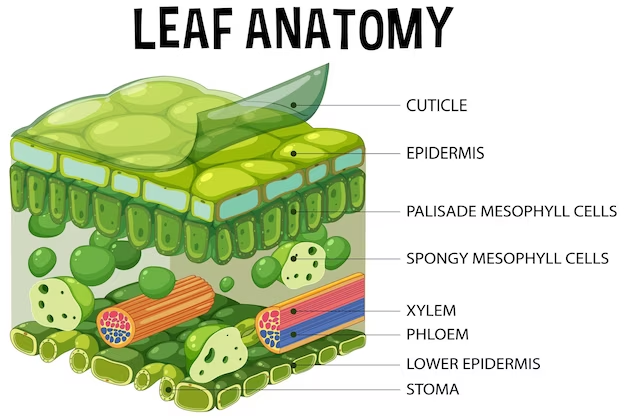
From top to bottom, a leaf is structured:
At the top is the upper epidermis, which is protected by the cuticle.
The cuticle and epidermis are transparent to allow for light to pass through.
Then there is palisade mesophyll, which are cylindrical and elongated at right angles.
This shape allows leaves to accommodate a large number of these cells.
They have a large vacuole, allowing them to form a single layer at the periphery and avoid shading each other.
The cells have spaces between each other to allow carbon dioxide to diffuse in.
They have thin cell walls for maximum light absorption.
Then there is the spongy mesophyll.
They have air spaces to allow carbon dioxide to diffuse in.
They have thin cell walls for maximum light absorption.
Then the lower epidermis, which also has a cuticle and stomatal pores.
The cuticle and epidermis are transparent to allow for light to pass through.
The stomatal pores open and close to allow gas diffusion depending on the conditions.
Overall, leaves are:
Thin, so light can penetrate right through.
Have a large SA so as much light is captured as possible.
Chloroplasts
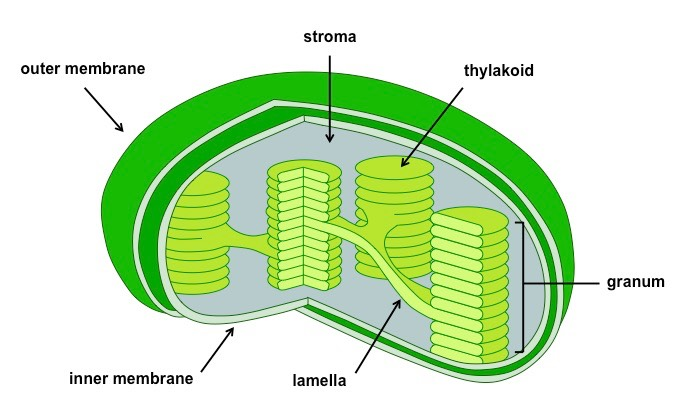
Chloroplasts are also known as biological transducers (able to change energy from one type to another) as they convert light energy to chemical energy. Their internal structure is well adapted to this function:
They have a double membrane, to allow for ETC.
They have thylakoids - membrane bound flat sacs - which stack to become a granum. Often, one will attach to the inner membrane of the chloroplast.
These are long for a larger SA to absorb light energy.
Pigments are in a single layer at the surface of the thylakoid membrane, maximising light absorption.
They also have 70S ribosomes, lipid droplets, starch and have a liquid inside known as the stroma.
Chloroplasts themselves:
Move inside palisade cells - towards the sun in dim days and further away when the light intensity may risk bleaching.
They have a large SA, for maximum light absorption.
Are in higher concentrations in different cells. For example, there are 5x more in palisade cells compared to spongy mesophyll cells.
This is because they are more exposed to light.
Photosynthetic pigments
There are two types of photosynthetic pigments:
Chlorophylls absorb light at both ends of the spectrum:
Chlorophyll A is in all plants, and has a yellow-green pigment.
Chlorophyll B is in more complex plants, such as flowering plants, and has a blue-green pigment.
Carotenoids absorb light in the blue-green region:
β-carotene is in all plants, and has an orange pigment.
Xanthophylls is in most plants, and has a yellow pigment.
An absorption spectrum shows where the pigments best absorb this light.
This correlates with an action spectrum, which shows the rate of photosynthesis with light intensity wavelengths.
This suggests these pigments are responsible for better light absorption.
Engelmann proved this by placing algae along a light spectrum, with oxygen-attracted bacteria. As the algae produced oxygen via photosynthesis, the bacteria were attracted to the areas which produced the most.
From this, 400-450 and 650-700 wavelengths were shown to produce the most oxygen, therefore perform the most photosynthesis. This shows that photosynthesis occurs better at these wavelengths.

Photosystems
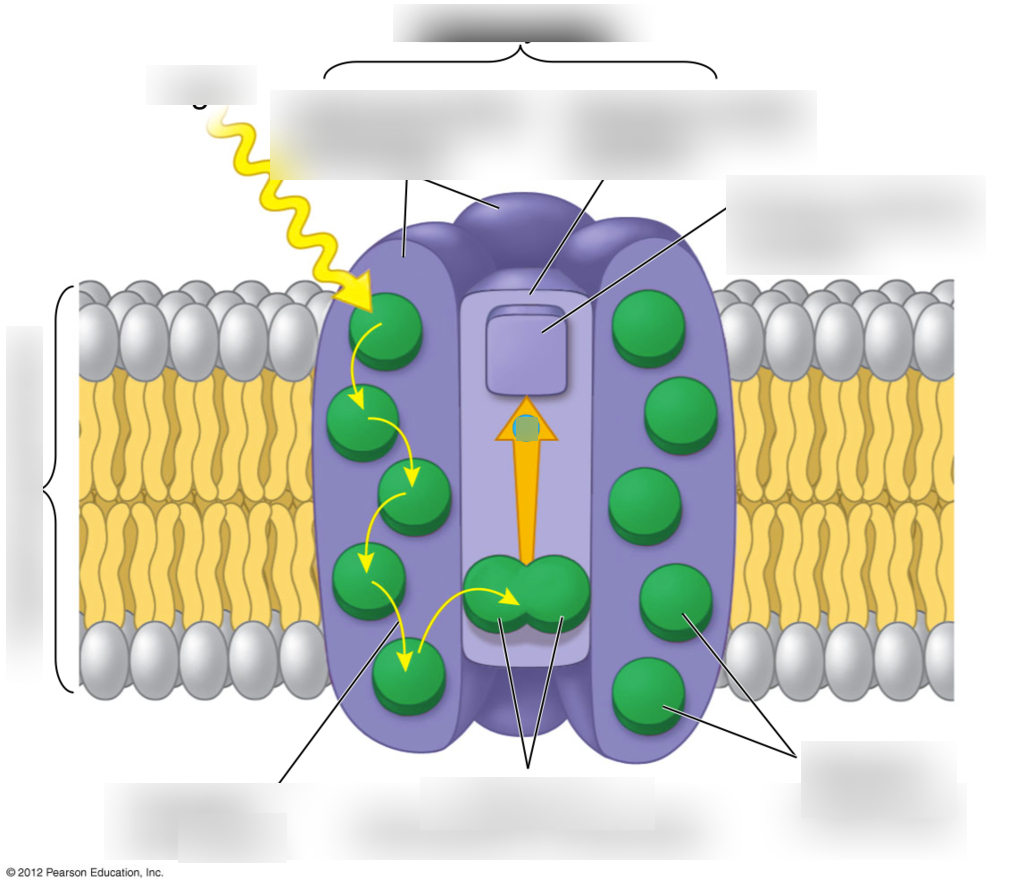
This is a collection of pigments that collect light energy and pass it to special chlorophyll A.
They lie in the plain of the thylakoid membrane, and are anchored in the phospholipids of said membrane. They are held together by protein molecules in clusters of up to 400 molecules.
There are two parts:
Antenna complex: Comprised of accessory pigments, which are chlorophylls and carotenoids.
Reaction centre: At the centre of the antenna complex, with two molecules of chlorophyll A, known as the primary pigment. There are two types:
Photosystem 1: Discovered first, but occurs second in the light dependent stage. Arranged around a chlorophyll with an absorption peak of 700 nm, and is also known as P700.
Photosystem 2: Discovered second, but occurs first in the light dependent stage. Arranged around a chlorophyll with an absorption peak of 680 nm, and is also known as P680.
Photosystems have two steps:
A photon of light is transferred through the accessory pigments in the antenna complex to the chlorophyll A pigments.
The chlorophyll A is excited, reaching a higher energy level. It then releases an electron to the electron carriers. Therefore, the chlorophyll A is oxidised, and the light is a reducing agent. This is known as photoionisation.
Stages of photosynthesis
There are two stages of photosynthesis:
Light-dependent, which relies on light and produces oxygen, ATP and reduced NADP.
Light-independent, which does not require light and produces glucose.
Light-dependent
Occurs in the thylakoid membranes.
This is where photophosphorylation occurs, and has two pathways:
Non-cyclic photophosphorylation involves PS1 and 2, and the electron pathways are linear.
Cyclic photophosphorylation involves only PS1 and electrons go through a cycle.
These can be shown together in a Z diagram.
Non-cyclic
This occurs in six main steps:
Photolysis occurs. Water molecules absorb light, indirectly causing them to dissociate into hydrogen, oxygen and electrons. This is enhanced by a protein complex in PS2.
Electrons can replace those lost from PS2.
Oxygen can be a waste product, diffusing out of the chloroplast, then the cell, then out of the stomata. It can also be used in respiration.
The hydrogens can be used to reduce NADP and maintain the proton gradient.
PS2 is powered by photons, and an electron is released.
The electrons are transferred along electrons carriers.
The energy from these redox reactions powers proton pumps, which move protons from the stroma to the thylakoid space, which creates an electrochemical gradient.
Protons then pass through the protein complex via chemiosmosis. This energy generates ATP.
Some of these electrons are given to PS1, which uses them to power electrons to reduce NADP in the stroma
This is done to maintain the proton gradient.
Cyclic
This occurs in 2 main steps:
PS1 powers electrons to electron carriers behind it, which then powers proton pumps and moves forward.
The electron is then passed back to PS1, allowing it to continue.

Hill experiment
Hill proved that isolated chloroplasts produce oxygen from water with an oxidising agent, known as the Hill Reaction (photolysis).
Hill used DCPIP in the lab, which loses its colour when reduced in the presence of light.
In the cell, NADP is the oxidising agent which removes hydrogen from water.
Light independent stage
Occurs in the stroma, and involves many reactions.
Calvin cycle
There are 5 steps:
Ribulose bisphosphate (RuBP) is a five carbon acceptor molecule which combines with carbon dioxide from the air.
This reaction is catalysed by the enzyme ribulose bisphosphate carboxylase (rubisco) which is the most abundant protein in the biosphere.
This makes an unstable 6 carbon compound.
This unstable compound immediately splits, creating two glycerate-3-phosphates.
These molecules are reduced by NADP and phosphorylated by ATP from the light dependent stage.
This creates triose phosphate, the first carbohydrate made in photosynthesis.
This triose phosphate can be used in two different ways; product synthesis or the regeneration of RuBP. 5/6 triose phosphates are used for regeneration.
Some triose phosphate is converted to glucose phosphate, which is condensated to starch.
Other products synthesised include carbohydrates, fats and proteins.
The 5/6 triose phosphate goes through a series of reactions which converts it to ribulose phosphate.
This is then converted back to ribulose biphosphate using ATP.

Product synthesis
Photosynthesis is able to make all the molecules necessary for organisms that use it, using the 3 carbon compounds from the Calvin cycle.
Carbohydrates:
The first hexose made is fructose phosphate, which can be converted to glucose and combined with it to make sucrose.
a-glucose can be made into starch.
b-glucose can be polymerised into cellulose for cell walls.
Fats:
AcCoA can be synthesised from glycerate-3-phosphate and made into fatty acids.
Triose phosphate can be converted to glycerol.
AcCoA and glycerol can be condensed to form triglycerides.
Proteins:
Glycerate-3-phosphate can be converted to amino acids for protein synthesis.
The amino group is derived from NH4+ ions, made from nitrate ions taken in through the plant roots.
Calvin’s experiments
Calvin discovered the Calvin cycle by:
Growing Chlorella in lollipop containers (thin and lollipop shaped).
He exposed this to radioactive C14 CO2 (normal is C12) for varying amounts of time, and then killed them by dropping them in hot ethanol.
Chromatography was used to separate the photosynthesis products, using 2 different solvents.
Autoradiographs were done to show what compounds had C14.
At 5 seconds, there was glycerate-3-phosphate, showing this was the first product.
This then divided into other products over longer periods of time, showing that GP was what synthesised the other products.
Limiting factors
The limiting factor is the one that controls the rate of photosynthesis, meaning it is the least optimum.
This determines the overall rate of photosynthesis, known as the rate-limiting step.
In light independent reactions, the rate limiting step is the reaction catalysed by rubisco.
Carbon dioxide
Carbon dioxide concentration rises until it reaches an optimum, then plateaus, and then decreases.
This is because the more carbon dioxide the more RuBP can be carboxylated, until it is limited by rubisco.
Then, when it is too high, the stomata close, preventing CO2 uptake.
This optimum can vary in different plants:
In crops this is around 0.1%.
Algae can increase CO2 concentration using carbonic anhydrase, to prevent it becoming a limiting factor. Their optimum is around 0.1%.
Tomatoes show an optimum of 0.5%, only in short term.
Aquatic plants using CO2 from HCO3-.
Light intensity
Light intensity increases until it reaches an optimum, then plateaus, and then decreases.
This is because the more light the more electrons are excited from photosystems.
Then, the pigments are bleached, preventing the absorption of any wavelengths.
This is again different for different plants:
Sun plants are more efficient at high intensity.
Shade plants are more efficient at low light intensity.
The light compensation point is a light intensity where so little CO2 is needed that respiration provides all that is needed.
Therefore, no gas exchange occurs.
Temperature
Temperature increases until it reaches an optimum, then steadily decreases.
Kinetic energy increases, lowering activation energy. Eventually, the high kinetic energy breaks the bonds in the enzymes causing them to permanently denature.
Water
While this does limit photosynthesis, lack of water affects so many of a plant systems (plasmolysed cells, wilting, etc) that it is hard to measure this alone.
Mineral nutrition
Inorganic nutrients are needed for plants and can be a limited factor in metabolism. They are needed for:
Structure, such as calcium in cells walls middle lamella.
Synthesis of growth necessary compounds, such as magnesium which is an enzyme activator for ATPase and DNA polymerase.
They can form integral parts of molecules, such as magnesium in chlorophyll, iron is ETC carriers and manganese in PS2.
Macronutrients (needed in higher quantities than micronutrients such as copper and manganese) include nitrogen, potassium, sodium, magnesium, calcium, nitrate and phosphate.
Nitrogen
Nitrogen in the soil is in organic molecules of decaying organisms.
They are taken up as NH4+ (ammonium ions) or NO3- (nitrate ions).
It is taken up by root nodules, to the xylem, and then delivered to the cells.
It is then converted to ammonium ions, which become the amino group of amino acids.
Nitrogen deficiency causes:
Reduced growth across the plant.
Chlorosis, a yellowing of the leaves due to inadequate chlorophyll production.
This happens in the older leaves first.
Magnesium
It is absorbed as Mg2+, transported in the xylem and delivered to cells.
It forms part of the chlorophyll molecule, so a lack of it causes chlorosis.
It begins in the veins of older leaves as magnesium is transported to newer leaves.
It is also an important enzyme activator, for enzymes such as ATPase.