3. Text linguistics
1.Text and text linguistics
What makes text a text?
→ text is used to refer to any passage, spoken or written, of whatever length, that forms unified whole, prose or verse, dialogue or monologue
communicative function → produced to achieve specific purposes
usually extends beyond single utterance
contextually sitauted
perceived as complete unit → has boundaries and internal unity
From sentence to text
Traditional linguistic analysis
focused to units up to sentence level
sentence viewed as largest unit of grammatical structure
text as collection of individual sentences (not unified whole)
Text linguistic perspective
sentences as components of larger textual structures
meaning emerges from relationship btw sentences
grammatical choices influenced by position within text
patterns of organisation extend across sentence boundaries
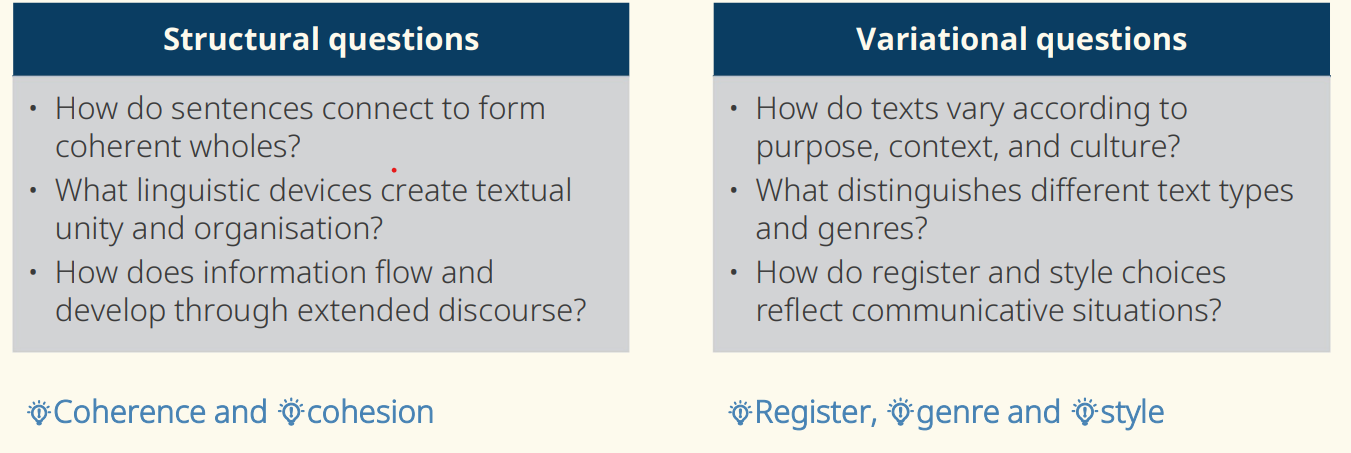
Key questions in text linguistics
2.Standards of textuality
Overview
De Beigrande and Dressler: Seven Standards of textuality
Text-centred standards:
Cohesion:
surface structure of text must linguistically fit together grammatically/semantically (right sentence order)
creates continuity
Coherence
content of text must be functionally connected
conceptual connectivity that creates unified meaning underneath surface text, more abstract
User-centred standards
Intentionality
communicative goals, writer’s purpose
Acceptibility
expectations reader has towards text (connectedness and relevance)
Informativity
extent to which contents of text are new
Situationality
text must be relevant in specific context
Intertextuality
recipient has to have idea about characteristics of text genre/other texts
3.Coherence and cohesion
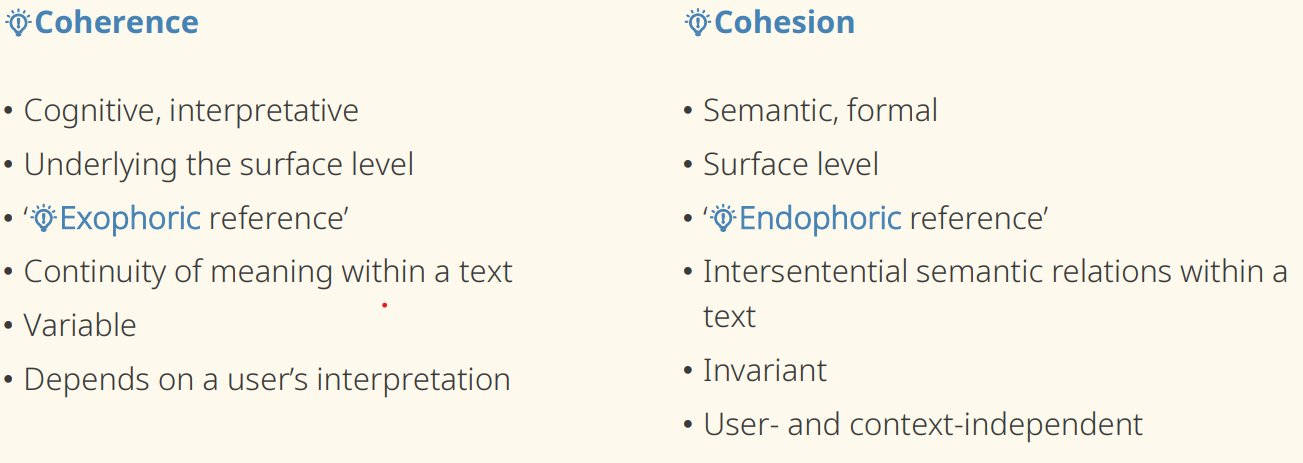
Comparison
Grammatical cohesion
Reference
personal reference, demonstrative reference, comparative refence
anaphoric vs. cataphoric reference
Substitution and ellipsis
avoiding repetitiion while maintaining textual connections
Conjunctions
additive conjunction (and)
adversative conjunction (because)
temporal conjunction (first, then)
Lexical cohesion
How
repetition
synonymy
hyponymy
collocation
expansion
condensation
lexical fields, same word class
lexical set (not necessarily same word class but association)
Cohesion =/ coherence
Coherent text: order and structure
explicit: chapters, headings, sub-headings
implicit: using cohesive devices “textual glue”
meaningful thematic progression
4.Thematic progression
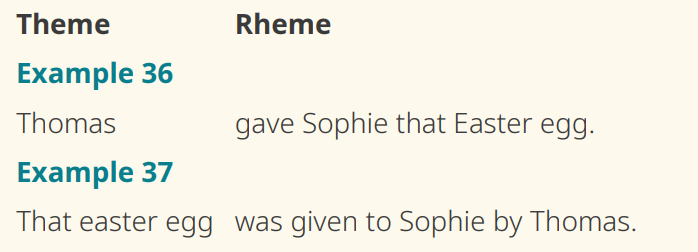
Theme and rheme
→ 2 complementary communicative functions of semantic components of statement, what is being communicated (topic) and what is being said about it (rheme)
→ Theme
what sentence is about
information producers take for granted
previously mentioned
world knowledge
clear from context
→ Rheme
what is said about theme
new information producer do not take for granted
Types
Danes: 5 types of thematic progression
1.Simple linear progression
rheme of one sentence bcomes theme of next one
e.g. Hannah bought a new car. The car was very expensive
2. Progression with constant theme
same theme appears in series of sentences with different rhemes
e.g. Jim loves cooking. He makes pasta. He baked bread
3.Progression with derived themes
themes derive from hypertheme
e.g. Our house needs work, The roof is leaking, The walls need painting
4.Development of split rheme
rheme contains multiple elements that become separate themes
e.g. They travelled to Lagos and Accra. Lagos was rainy. Accra was sunny
5.Progression with thematic leap
theme derived from previous rheme but not immediately preceding one
e.g. We visited a museum. The tour was fascinating. The paintings were impressive
5.Text types
Introduction
text type = idealizes norm of distinctive text structuring serving as deep structural matrix of rules/elements for encoder when responding linguisticallly to specific aspects of his experience
fundamental rhetorical patterns that structure information
based on communicative functions and linguistic features
relatively stable across languages/cultures
→ 5 types
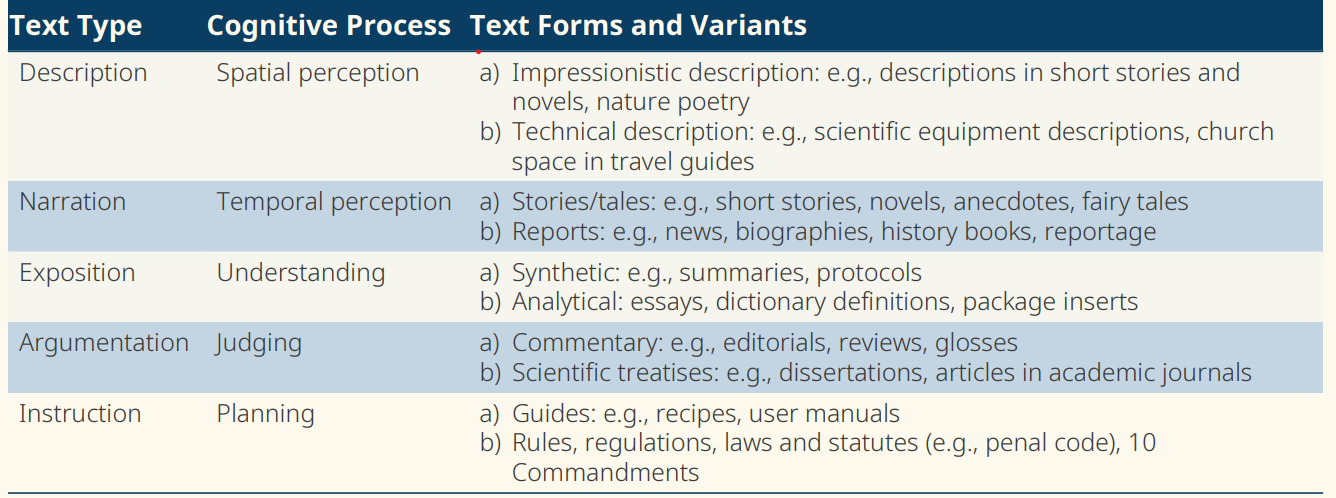
Description
focus on depicting what is observed in space
rich descriptive adjectives
Highlight of noun phrases
existential sentences with “there”
verbs of being and positioning
Narration
focus on events unfolding over time
strong verbs indicatinf change and action e.g. ran, go
temporal orientation through corresponding conjunctions
chronological sequence in past tense
adverbs indicating time
Exposition
focus on explaining concepts
abstract elements brought together
“it consitst of”, “we refer to”
synthetic or analytic approaches
focus on relationship and positions in nominal phrase
Argumentation
focus on evaluating and persuading
problem-solution structure
evaluative terminology
rhetorical questions with indirect function
supporting evidence presented with causal link
Instruction
focus on directing actions and behaviours
direct imperative forms
questions with imperative function
modals expressing obligation
sequential markers
specific handling specifications
Genre
= comprises class of communicative events which share communicative purposes, purposes recognized by expert member of community
→ constitute rationale for genre, shapes schematic structure of discourse and influences choice of content/style
users learn genre knowledge as they become competent users of discourse community (content, structure, form, language)
6.Register
Introduction
Register = variety associated with particular situation
→ 3 major components
situational context of use (including communicative purposes)
linguistic features (and analysis of words and structures commonly occuring)
functional relationship between two
→ Linguistic features always functional in registers
features occur bc they suit purpose/context
pervasive across text
Situation and linguistic features
Situational characteristics
participants: addressors, addressees, relationships
channel
mode, production circumstances
setting (time, place, shared context)
communicative purposes (functions, factuality)
Linguistic features
Lexico-grammatical features
word choice, vocabulary, grammatical structures
distribution patterns
frequency, co-occurence relationships
Functional associations
links to communicative purposes and situations
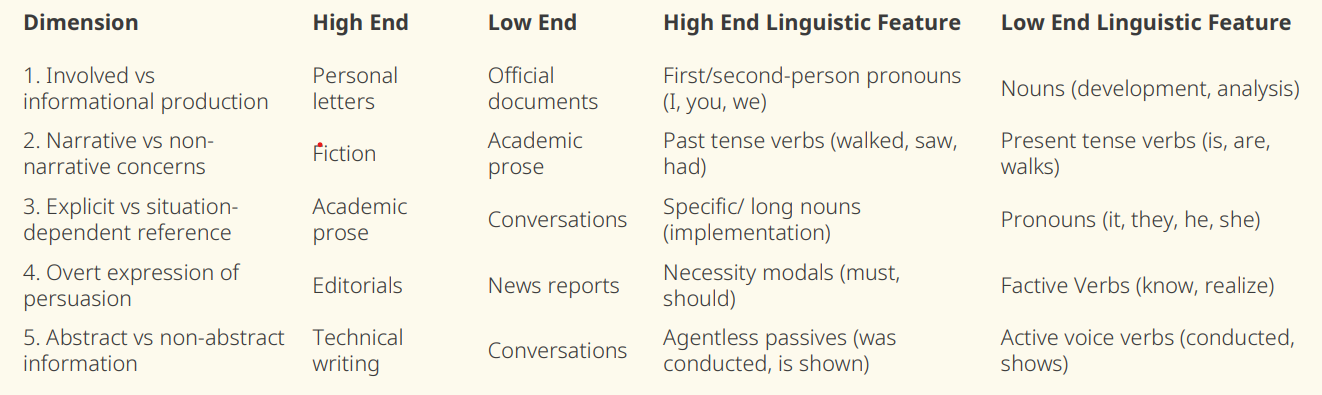
Biber’s Multidimensional analysis
→ Statistical technique for analysing co-occurence patterns of linguistic features
Benefits:
empirical foundation for register comparison
reveals clusters of registers with similar linguistic characteristics
connects linguistic patterns to communicative functions
provides quantitative measures of register differences
→ Application to various languages and historical periods