Electricity
Current = rate of flow of charge
In a single loop, current is the same everywhere
Resistance is anything that slows the flow down
Potential difference is the driving force that pushes charge round.
The greater the resistance across a component, the smaller the current that flows (for a given potential difference across the component).
Resistance Practical:
- Attach a crocodile clip to the wire level with 0cm on the ruler
- Attach the second crocodile clip to the wire 10cm from the first clip. Write down the length of wire between the clips
- Close the switch, and record the current and potential difference across the wire
- Open the switch, and move the crocodile clip another 10cm from the first clip. Record new length, p.d., and current.
- Repeat this for a number of different lengths of the test wire.
- Use V=Ir to calculate the resistance of the wire.
Resistance
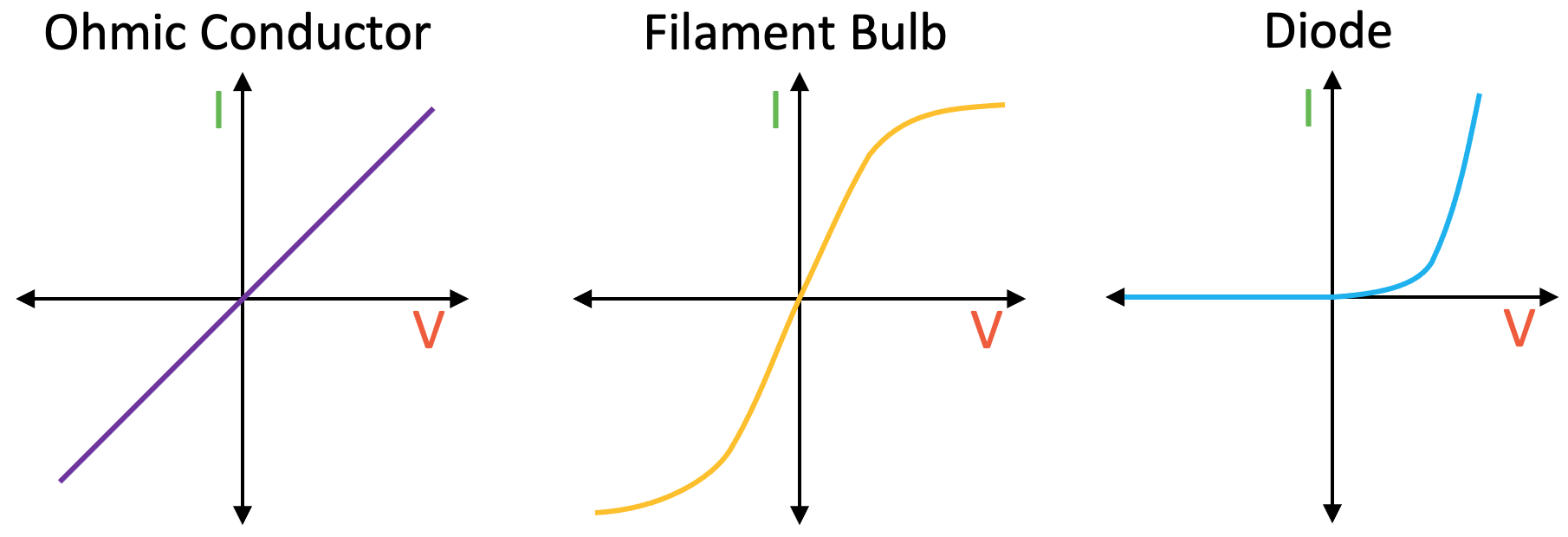
- The resistance of ohmic conductors doesn’t change with current. At a constant temperature, the current flowing through an ohmic conductor is directly proportional to its potential difference.
- I-V characteristics are graphs that show how current changes as the potential difference is increased.
I-V Characteristic Practical:
- Set up a variable resistor, ammeter, battery and component (diode, ohmic conductor or filament lamp) in series. Attach a voltmeter in parallel to the component
- Begin to vary the variable resistor
- Take several pairs of readings from the ammeter and voltmeter to see how the potential difference varies as current changes
- Swap over wires connected to the battery, to reverse the current direction
- Plot a graph of current against voltage
Light dependent resistors depend on light intensity. In bright light, resistance falls and vice versa. Used in automatic night lights and burglar detectors.
Thermistors depend on temperature. In hot conditions, resistance falls and vice versa. Used as temperature detectors and electronic thermostats.
Sensing circuits are used to increase power to components depending what condition they’re in.
In series, potential difference is shared
In series, current is the same everywhere
In series, resistance adds up
In series, the potential differences of cells add up
In parallel, potential difference is the same across all components
In parallel, current is shared between branches
Adding a resistor in parallel reduces total resistance
Investigating resistance practical:
- Find 4 identical resistors
- Connect a resistor in series with a battery and ammeter.
- Record pd of the battery.
- Measure current and calculate resistance
- Add another resistor in series
- Measure current, pd and resistance again
- Repeat until all resistors are added.
- Plot a graph of number of resistors against total resistance
- Repeat same experiment but adding resistors in parallel and plot graph
- Graph 1 is straight line through origin, graph 2 is curved facing upper right
Electricity in the home
- Mains supply is ac, battery supply is dc
- Alternating current constantly changes direction - positive and negative ends keep alternating
- UK mains supply is 230V
- ac mains supply is 50Hz
- Direct current always flows in the same direction
- Wires have copper cores and coloured plastic coatings
- Live wire is brown - provides alternating pd from mains supply
- Neutral wire is blue - completes the circuit, around 0V
- Earth wire is green and yellow - protects wiring, stops appliance casing becoming live.
- The human body is 0V so if you touch a live wire, a large pd is produced across the body and current flows through you. This causes electric shock. Even when plugs are turned off, current isnt flowing but theres still pd in the live wire so if you made contact with it, your body would provide a link between the supply and earth so current would flow through you. If the link creates a low resistance path to earth, a huge current will flow resulting in a fire
Power is the rate of energy transfer.
The National Grid is a giant system of cables and transformers that covers the UK and connects power stations to consumers. Power stations have to meet the electricity demand. P.S. often run well below their maximum power output so there’s always spare capacity to cope with high demand. T.N.G. uses a high pd and a low current because it is cheaper and is more efficient since energy lost by current is decreased. To get the pd up to 400 000v for efficient transmission, we use transformers. They have 2 coils - a primary and secondary, joined with an iron core. pd is increased using a step up transformer, they have more turns on the secondary coil than primary. As the pd is increased by the transformer, current is decreased. The pd is then reduced again at the consumer end using a step down transformer which have more primary coil turns. Transformers are nearly 100% efficient. So pd across 2ndry coil x current in 2ndry coil = pd across primary coil x current in primary coil
Static electricity
- When certain insulating materials are rubbed together, electrons are scraped off one and put on the other.
- This leaves the materials electrically charged, one +ve and one -ve.
- As electric charge builds on an object, the pd between the object and the earth increases.
- If the pd gets large enough, electrons can jump across the gap between the charged object and earth causing a spark
- 2 things with opposite electric charge are attracted to each other but 2 things with like charges repel each other
- \