Forging the US Constitution
The Articles of Confederation
Remember at the beginning of the last lesson that we mentioned that the United States Constitution was the second attempt made at creating a federal constitution for the new country? The first attempt at a federal constitution was the Articles of Confederation. This document was created in the middle of the War for Independence. A committee started the draft in 1776, but it was not adopted until 1777. By 1779, all of the states had ratified the Articles except for Maryland, which held out until 1781. The adoption of the Articles did not really change the function of the government significantly. The Continental Congress had already been using many of the same principles contained in the document. The Articles granted federal power to a central authority. Not all of the citizens were completely comfortable with allowing a central authority to rule the newly formed country. It was important for the people that the Articles allow the states to keep their sovereignty, freedom, and independence. Under the Articles, Congress was only allowed to do what the states allowed it to do.
The powers of the Confederation Congress (i.e., the Congress that operated under the Articles of Confederation) were limited and mostly confined to foreign policy. They included making war and peace, fixing quotas of men and money for the Continental Army, deciding interstate disputes, borrowing money, regulating standards of coinage and weights and measures, and establishing the post office. The Confederation Congress could also make treaties of alliance with foreign nations, levy import taxes, and admit new states.
The Articles established a unicameral (one house) legislature with one vote per state. Each state's delegation consisted of two to seven members. Any action taken required that two-thirds of the thirteen states agree. Unfortunately, the Confederation Congress had no power to levy taxes on the states, and the money it requested and received from the states to help pay the debt of the Revolution was not sufficient. The states were simply unable to raise the money the federal government needed to cover the debt.
The Constitutional Convention
As the nation moved forward under the Articles of Confederation, many of the Founding Fathers began to understand that the governmental structure was not adequate as it was. The problems found in the Articles made it difficult to run an effective government. The main issues were that Congress did not have the power to tax or the ability to regulate domestic and foreign commerce. More importantly, it lacked an executive or judicial branch that supported the legislature, leaving Congress with no ability to enforce any laws it passed. These serious problems were further compounded by the fact that unanimous consent was needed to amend the Articles of Confederation.
In February 1787, leaders of the nation decided to call a convention to decide what might be done to solve their governmental problems. They invited delegates from each state to gather in May in an attempt to revise the Articles of Confederation.
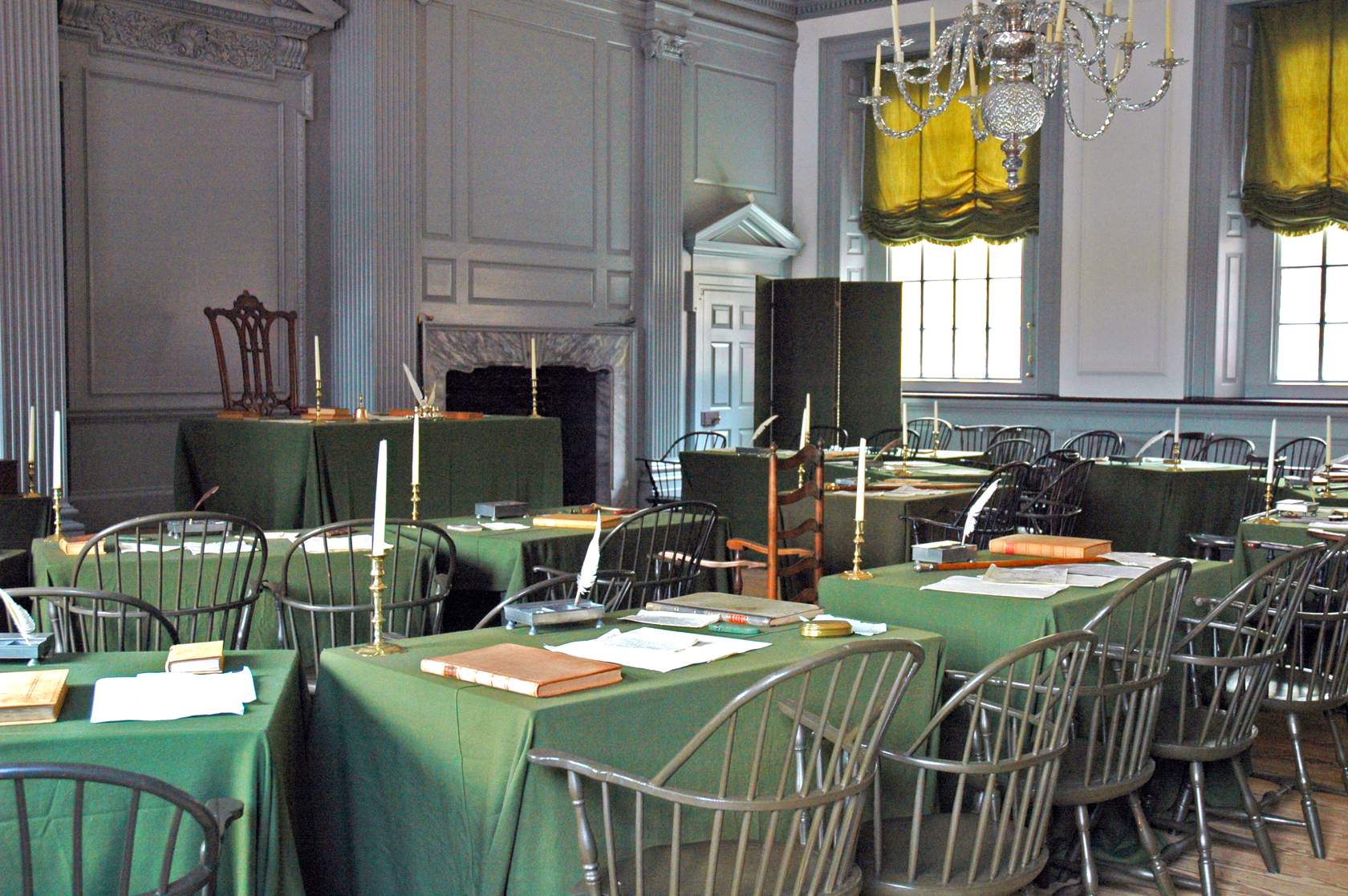
Assembly Room - Independence Hall
The Constitution was debated and written in this chamber.
In May 1787, the convention began in Philadelphia. There was a total of fifty-five delegates present for at least some portion of the deliberations. Some delegates were there for the entire convention, but others came and left at various times. Only Rhode Island chose not to send anyone to represent the state. This fact proved the fatal flaw in the Articles. If an amendment was to be added to the Articles, unanimous consent was needed. Rhode Island was a member state, and no delegate was present at the convention. No delegate, no vote, no amendment. It left the delegates with the question of what to do. Their answer was to ditch the plan of revising the Articles at all. Instead, they decided to start fresh.
Most of what we know about the Constitutional Convention of 1787 comes to us through the work of a delegate from Virginia: James Madison. When the delegates made the decision to scrap the Articles and begin again, the convention voted that complete secrecy was needed. Technically, they were breaking the public trust by doing this because it wasn't the purpose for which they had been called. Madison, however, kept detailed notes on the proceedings, including the debates that raged regarding how the new government should be set up. His documentation provides us with the best record we have of the decision-making process that established the United States government as we know it.