3) Profitability
Profitability is the business’s ability to generate earnings (sales) with its expenses.
Relates to efficiency because it shows how well business management decisions are keeping expenses controlled and using their assets to generate income.
Profitability ratios can be used to compare businesses efficiency in generating profits compared to its competitors. Businesses can also review the trend of these ratios over time to check whether they are improving or deteriorating.
1. Gross Profit Ratio
A calculation that determines the association between a business’ cost of goods sold and the net sales.

GROSS PROFIT
The amount business can earn from the sale of its goods and services before general operating expenses have been taken into account.
Gross Profit = revenue sales - cost of goods sold (production or delivery costs)
NET SALES
Sales less any sales returns.
Net sales = sales - sales returns
Interpretation
The higher the gross profit ratio, the better.
“For every $1 of Net Sales, there is $0.00 Gross Profit.”
Needs to be compared with like businesses to determine if your business is procuring its stock/inventory at a competitive rate.
Ratio needs to be high enough to cover all expenses as well as provide a sufficient profit.
Can compare ratio with historical business data - consistent improvement over past years indicates continuous improvement in efficiency within the procurement of stock/inventory.
LOW
Business is inefficient, paying too much for raw materials or wholesales prices from suppliers.
Negotiate better deals with suppliers (bulk buy discounts)
Improve production efficiency (energy efficient, technology vs labour)
HIGH
Business is efficient in its cost of goods sold and is using raw materials in the production process efficiently
Things to consider
Inflation - causes increased Cost of Goods Sold, leading to decreased profit ratio.
Global supply chain - shop across the globe to find raw materials at cheaper costs.
Locally sourced, premium raw materials may be used as part of their ethical or corporate social responsibility - leads to lower ratio, but premium price charged.
2. Profit Ratio
Measures the amount of profit earned with each dollar of net sales to evaluate the profitability of the business from its primary operations.

PROFIT: funds left from revenue after all expenses have been deducted (Revenue less Costs of Goods Sold less Operating Expenses)
NET SALES: sales less sales returns
Investors want to make sure profits are high enough to distribute dividends.
Creditors want to make sure the company has enough profits to pay back its loans.
Study overtime to see continuous improvement - increasing or decreasing.
Compare to other like businesses for competitive advantage - above or below benchmarks.
Interpretation
“For every $1 of net sales there is $0.00 of profit.”
LOW
Expenses are too high and the management needs to budget and cut expenses.
Generate more revenue/sales
Lower operating expenses
HIGH
Efficient management of business expenses and sales.
3. Expense Ratio
Expresses a specific category of expenses as a percentage of total revenue, and helps to identify areas where a business may be spending too much or managing costs effectively.
Shows the relationship between an individual operating expense or group of expenses to sales.
Indicates the proportion of sales which is consumed by various operating expenses → analyse the cause of variation of the operating expenses.
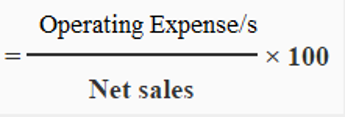
OPERATING EXPENSE/S
Direct labour cost
Office and administration expenses
Selling and distributing expenses
Marketing expenses
Some expenses vary with the change in sales, whilst others do not.
Fixed operating expenses - do not increase as net sales increase or decrease (operating expenses ratio may not give a true indication of the business efficiency)
Variable operating expenses will increase or decrease in relation to net sales (expense ratio will show improved efficiency in this area as economies of scale are reached)
The ratio indicates areas of high or rising costs, so businesses can increase sales or decrease expenses.
4. Return on Equity
Amount of profit earned from the owner’s investment.

PROFIT:
Revenue from sales - (Cost of Goods + Operating Expenses)
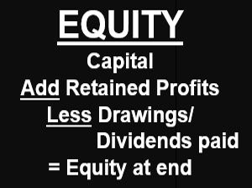
EQUITY (how much is invested into the business):
Capital invested into the business by shareholders or proprietors + Retained Profits not distributed or drawn out - Dividends paid or Share if profit distributed to proprietors.
Interpretation
The higher the better.
“For every $1 of Equity, the business generates $0.00 of profit.”
Important for potential investors because they want to see how efficiently a company will use their money to generate profit. Investors want to see a high return on equity because this indicates that the company is using its investors’ funds effectively (earns a lot compared to its shareholders equity).
Also an indicator of how effective management is at using capital and funds by selling shares to fund operations and grow the company. It gages the management of capital allocation decisions and ability to drive shareholder investment.