Summary notes of Manipulating Genomes
Principles of DNA sequencing
DNA sequencing begins with the process of mapping where the existing information about the genome is used to identify the locus of a particular gene within the genome. The DNA is fragmented with the use of restriction enzymes and the fragments produced are inserted into bacterial artificial chromosomes. This step results in the formation of a genomic DNA library. The fragments obtained from the bacterial cultures are again broken down into smaller fragments with the use of restriction enzymes and sequenced with the use of the chain-termination. This technique was developed by Sanger and is based on selective incorporation of chain terminating nucleotides into a growing chain by DNA polymerase during replication.
It occurs as following:
• The DNA sample is divided into four separate sequencing reactions which contain all four standard nucleotides, DNA polymerase, primers required for replication and modified nucleotides which have been fluorescently labelled for ease of identification.
• When a modified nucleotide is incorporated into a growing chain, replication is terminated • DNA fragments of different lengths are formed across the reaction vessels
• High resolution electrophoresis is used to separate the fragments by size – single base differences can be seen
• The fragments are visualised under UV light, thus enabling the base sequence to be read from the bottom of the gel upwards
The rapid advancement of techniques used in sequencing increased the speed of sequencing and allowed whole genome sequencing, that is. high-throughput sequencing.
Gene sequencing allows for genome-wide comparisons between individuals and between species. Comparing genomes between species is significant as it allows evolutionary relationships between species to be determined, and it is also beneficial to medical research. Comparing genomes of individuals enables differences to be identified which can then be used for development of personalised medicine tailored to a particular genome, as well as in studies of human diseases.
Apart from allowing genome-wide comparisons to be made, gene sequencing has allowed for the sequences of amino acids in polypeptides to be predicted and has allowed for the development of synthetic biology.
DNA profiling DNA profiling is a forensic technique used to identify individuals by characteristics of their DNA. It can also be used to determine genetic relationships between organisms.
Main techniques used in DNA profiling are:
• Polymerase chain reaction known as PCR which is used to amplify the DNA by making millions of identical copies of a given DNA sample.
It occurs as following:
1) A reaction mixture is set up by mixing the DNA sample, primers, free nucleotides and DNA polymerase which is the enzyme involved in creating new DNA strands.
2) The mixture is then heated to 95 degrees to break the hydrogen bonds and to separate the two strands.
3) The mixture is then cooled to a temperature between 50-65 degrees depending on the type of primers used, so that they can bind to the strands
4) Temperature is increased to about 70 degrees as this is the optimum temperature DNA polymerase works at.
5) DNA polymerase creates a copy of the sample by complementary base pairing using the free nucleotides
6) This cycle is repeated around 30 times and gives rise to an amount of DNA sufficient to create a DNA profile.
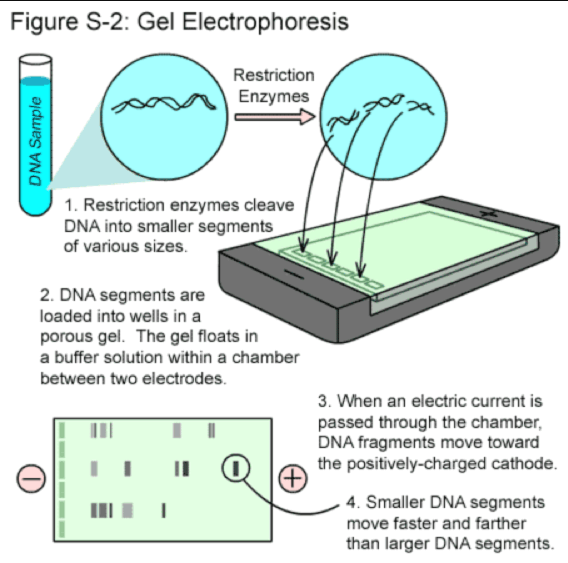
• Gel electrophoresis is a process used to separate the DNA fragments and proteins according to their size using an electric current. The diagram on the left demonstrates how the process is carried out.
• The DNA fragments move through the gel due to their negative charge
Genetic engineering
Restriction enzymes cut DNA at specific base sequences and so are extremely useful in genetic engineering whereby genes from one species can be added to a different species. To carry the DNA into a host cell it must be placed into a vector. Plasmids are the most common vectors but viruses are also used.
Isolated DNA fragments can be placed in plasmids in a following way:
• Plasmid and gene are cut with the same restriction enzyme to create complementary ends. If sticky ends are missing, they can be added
• The fragments are incubated with the plasmids. If a plasmid takes up the insert, base pairing takes place between the complementary ends which are then sealed with the use of DNA ligase which forms phosphodiester linkages
• A recombinant DNA molecule is created
In the formation of transgenic microorganisms, electroporation is used to stimulate bacterial cells to take up plasmids. Electroporation facilitates the process by increasing the permeability of bacterial membranes thus increasing the chance of success. This is achieved via the use of calcium salts and rapid temperature change from 0 to 40 degrees. Bacteria which have successfully taken up a plasmid can be identified with the help of marker genes. For instance, if a plasmid contains an antibiotic resistance gene, the bacteria will be resistant to the antibiotic, and if grown on the media, only the bacteria which have been successfully transformed will survive.
Other types of vectors include bacteriophages, liposomes and yeast artificial chromosome.
Gene therapy
Gene therapy is the insertion of a normal allele into target cells to replace a faulty allele, such as the allele which causes a cystic fibrosis. There are two types of gene therapy: somatic gene therapy where the allele is introduced to the target cells only and germ line gene therapy where the allele is introduced to embryonic cells, thus meaning every cell contains the normal allele. Somatic gene therapy is a short-term solution only and needs to be repeated, whereas germ-line therapy is a permanent solution which will be passed down to the offspring.
There are many ethical considerations regarding genetic engineering. Benefits of genetic engineering include insect resistance in crops such as soya and genetically used animals used to produce pharmaceuticals. Some people object to genetic engineering due to the potential effect it might have on the environment, or because of the idea that genetically modified seeds would not be as easily available to poorer farmers.