Antibiotics
Antibiotics
A substance produced by microorganisms which inhibits or kills the growth of bacteria
It exhibits a specific action against another bacteria (or group of bacteria)
It could be produced by a semisynthetic process, where by antibiotics are chemically altered to improve properties such as stability or spectrum of activity
Bactericidal → kills bacteria
Bacteriostatic → inhibits bacteria
Limits or prevents growth/reproduction
Requires host defences to ‘clean-up’
Susceptibility testing
Susceptibility testing is an attempt to predict the likely in vivo response of a bacterium to a range of antibiotics
It is performed under optimal growth conditions in a laboratory
Does not consider the pharmacokinetics of the antibiotic
The broth macrodilution method is used as a reference method
Serial dilutions of antibiotic made in broth
Suspension of organism added
Tubes visibly inspected for turbidity after overnight incubation
Minimum inhibitory concentration (MIC)
Sterile culture medium
→ Antibiotic (0-40ug/ml)
→ Inoculate with bacteria
→ Incubate overnight
Lower concentrations have more turbidity and visible growth, e.g. at 30ug/ml no visible growth so MIC
However, if you take the 30ug/ml and place it in agar growth media, you may still see growth of bacteria.
Higher concentration like 40ug/ml might show no growth on the agar plate. This is the maximum bactericidal concentration (MBC)
Modes of action
Selective toxicity by targeting the differences between prokaryotic and eukaryotic cells
Cell wall synthesis
e.g. Penicillin V - inhibits cell wall synthesis, generally more effective against G+ve bacteria; Bactericidal
Protein synthesis
e.g. Erythromycin - prevents tRNA shuffling by binding to 5OS subunit; generally more effective against G+ve cocci; bacteriostatic
Nucleic acid synthesis
e.g. Metronidazole - inhibits DNA synthesis by acting on DNA gyrase; effective against anaerobic bacteria; bactericidal
Cell membrane function
e.g. Daptomycin - expands the membrane area and causes an ion leakage; bactericidal
Beta lactam antibiotics include all penicillins and cephalosporins that contain a beta lactam ring.
This is capable of binding to the enzymes that cross-link peptidoglycan.
Beta lactams interfere with crosslinking by binding to transpeptidase and D-alanine carboxypeptidase, preventing cell wall synthesis.
By inhibiting the bacteria cell wall synthesis, the bacteria cell is damaged. G+ve bacteria have a high internal osmotic pressure without a normal rigid cell wall.
Pharmacokinetics
Pharmacokinetics of antibiotics depends on absorption, distribution, metabolism and excretion
Absorption: bioavailability i.e. the percentage of an antibiotic’s dose that reaches the systemic circulation
Better absorbed in the small intestine
Penicillin V is better absorbed in the fasting state
Distribution: the volume of distribution i.e. the volume of body fluid into which a drug dose is dissolved
Metabolism: converting to metabolites (mainly in the liver) or unchanged
Erythromycin is excreted in bile and often undergoes enterohepatic circulation
Metronidazole is metabolised in the liver by oxidation and by glucuronide formation
Excretion: eliminated in faeces or urine by the excretory organs
Mainly the kidneys (e.g. Beta lactams, daptomycin, metronidazole), liver and gut
These factors combined with the dosing regimen, determine the magnitude and time course of antibiotic concentrations in serum and tissues.
Pharmacodynamics
Pharmacodynamics of antibiotics refers to what the antibiotic does to the body and it depends on:
Physiological and biochemical effects of the antibiotic and its mode of action
Time-dependent antibiotic e.g. Beta lactams, erythromycin
Concentration-dependent e.g. Daptomycin, metronidazole
Bacterial susceptibility to the antibiotic
Patient pharmacokinetics
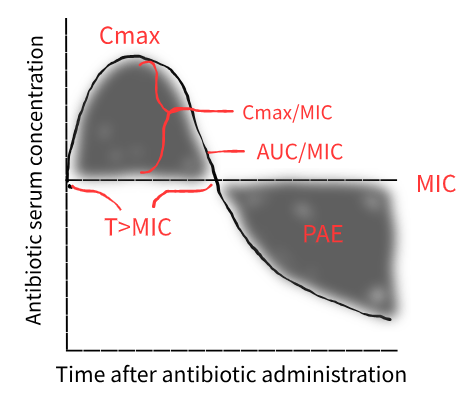
AUC: area under the curve
Cmax: peak antibiotic concentration
MIC: maximum inhibitory concentration for a pathogen
PAE: post antibiotic effect
Main pharmacokinetic and pharmacodynamic parameters used to predict antibiotic efficacy
Mechanisms underlying antibiotic resistance
Can be innate as the organism doesn’t possess the correct target site or is impermeable to the antibiotic; trapping in the cell wall
Antibiotic does not reach the target site in sufficient quantities; altered uptake, overproduction of target site, efflux pump, drug inactivation
Antibiotic is prevented from working at the target site or the target site is bypassed; altered target site
Antibiotics reach through the plasma membrane into the plasmic space and is then immediately pumped out by the efflux pump
→ High level of antibiotic resistance in Streptococci pneumonia
Can be acquired due to the change in genetic make-up through acquisition of resistant genes via plasmids
Bacterial resistance to beta-lactam antibiotics may be acquired by several routes. One of the most important mechanisms is through a process known as transformation
During transformation, chromosomal genes are transferred from one bacterium to another. When a bacterium containing a resistance gene dies, naked DNA is released into the surrounding environment.
If a bacterium of sufficient similarity to the dead one is in the vicinity,it will be able to uptake the naked DNA containing the resistance gene.
Once inside the bacterium, the resistance gene may be transferred from the naked DNA to the chromosome of the host bacteria by a process known as homologous transformation. Over time, the bacterium may acquire enough of these resistance genes to result in a remodelling of the segment of the host DNA. If this remodelled DNA segment codes for crosslinking enzymes (i.e. penicillin binding proteins) the result is the production of altered penicillin binding proteins. These can still crosslink the peptidoglycan layers of the cell wall but have a reduced affinity for beta-lactam antibiotics thus rendering the bacterium resistant to the effects of penicillin and other beta-lactam agents. This transport process has resulted in penicillin-resistant pneumonia through the acquisition of genes from other naturally occurring penicillin-resistant Streptococcus species.
A second important mechanism by which antibiotic resistance occurs is by the production of enzymes capable of inactivating or modifying the drug before it has a chance to exert its effect on the bacteria. Depending on the bacteria species, the genes coding for these enzymes may be found as part of the host DNA or on plasmids, which are small, self-replicating units of genetic material. Bacteria are capable of passing these resistance plasmids to each other by conjugation.
Conjugation
When two bacteria come into close contact with each other, a small channel is created between them which allows one of the bacteria to pass a copy of the resistance plasmid to the other. If the plasmid is transcribed and translated, the bacteria will begin to produce inactivating enzymes. These enzymes are capable of destroying beta-lactam antibiotics, which are known as beta-lactamase
In G+ve bacteria, the beta-lactamase enzyme is generally inducible, resulting in a large amount of enzyme being produced in the presence of the drug. G-ve bacteria, beta-lactam enzymes are produced constitutionally i.e. even when the antibiotic is not present. G+ve bacteria released a beta-lactamase enzyme from the cell into the extracellular environment, where it inactivates the drug before it enters the bacterial cell. In contrast, G-ve bacteria retain the beta-lactamase enzyme within the pair of plasmid space, resulting in a more efficient mechanism in G+ve bacteria. Ultimately, the destruction of the beta-lactam ring of the antibiotic renders it incapable of binding to the penicillin binding protein and thus the bacteria become resistant to that drug or class of drugs.
Causes of antibiotic resistance
Overprescribing of antibiotics
Patients not finishing their treatment
Overuse of antibiotics in livestock and fish farming
Poor infection control in hospitals and clinics
Lack of hygiene and poor sanitation
Lack of new antibiotics being developed
Natural selection: bacteria that are not affected by an antibiotic survive and reproduce more than bacteria that are affected by the antibiotic. The number of strains of antibiotic-resistant bacteria has increased, partly due to the misuse of antibiotics
Horizontal gene transfer is the exchange of genes between two cells of the same generation, as opposed to from the parent to progeny in vertical gene transfer.