Prelim Purposive Communication
Purposive Communication
Communication Process
- Communication – derived from the latin word communis, meaning common.
- In general, communication refers to the reciprocal exchange of information, ideas, facts, opinions, beliefs, feelings and attitudes through verbal or non-verbal means between two people or within a group of people.
- Communication (Webster’s Dictionary) – is a process by which information is exchanged between individuals through a common system of symbols and signs of behavior.
- Communication (Robert Andersion) – is interchange of thoughts, opinions or information by speech, writing or signs.
Meaning of Communication
Communication as
- A process through which individuals mutually exchange their ideas, values, thoughts, feeling and actions with one or more people.
- The transfer of information from the sender to the receiver so that it is understood in the right context
- The process of initiating, transmitting, and receiving information
- The means of making the transfer of information productive and goal oriented
- The process of sharing information, ideas and attitudes between individuals
Process of Communication
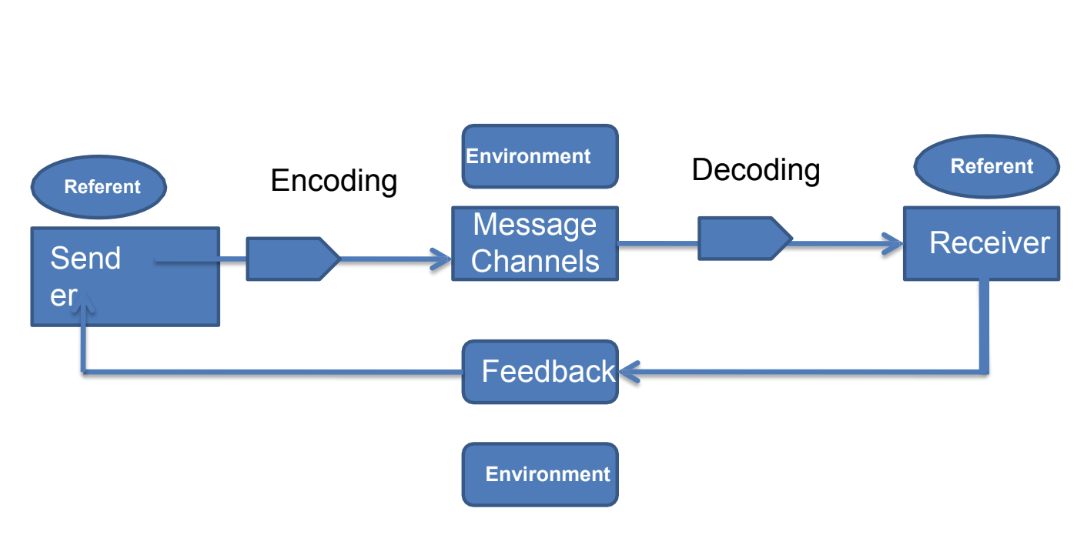
Elements of the communication
- Referent
- A referent motivates the sender (or receiver) to share information (message, object, sounds, sights, time schedule, ideas, perceptions, sensations, emotion, odour, etc.) that may initiate communication.
- For example, a nurse, sighting a patient with difficulty in breathing ma serve as a referent to the nurse promoting her to initiate communication with the patient.
- Sender
- A sender is a person who encodes and sends the message to the expected receiver through an appropriate channel.
- A sender is the source of the message that is generated to be delivered to the receiver after appropriate stimulus from the referent.
- Message
- The message is the content of the communication and may contain verbal, non-verbal or symbolic language.
- Perception and personal factors of the sender and receiver may sometimes distort this element and the intended outcome of communication may not be achieved. For example, the same message may be communicated or perceived differently by two individuals.
- Channel
- A channel is a medium through which a message is sent or received between two or more people.
- Several channels can be used to send or receive the message, i.e seeing, hearing, touching, smelling, and tasting.
- While selecting channels of communication, several factors must be considered: availability of channel(s), purpose, suitability, types of receivers, types of message, preference of sender and receivers, communication skills of the sender, cost, etc.
Classification of channels of communication
- Visual channel: Facial expression, body language, posture, gestures, pictures, and written words, electronic mails, mass media, etc.
- Auditory channel: Spoken words, sounds, telephone or mobile communications, delivering audio content (radio, voicemail), etc.
- Tactile channel: Touch, sensations, therapeutic touch, etc.
- Combined channel: Audiovisual media, consoling a person with touch and spoken words
Elements of the communication
- Receiver
- Is an individual or a group of individuals intended to receive, decode and interpret the message sent by the sender/source of the message.
- A receiver also known as decoder
- He is expected to have the ability and skills to receive, decode and interpret the message.
- Feedback
- It is a return message sent by the receiver to the sender
- It is the most essential element of the communication process as it shows that the receiver has understood the primary message sent by the sender and the communication process is now consider complete
- A successful communication must be a two-way process where the sender sends the message and receives feedback from the receiver.
- These feedback could be verbal and non-verbal
- Cofounding elements
- These elements are not a direct part of the flow of the communication process but influence the communication process significantly undirected.
- These elements are interpersonal variables of the sender and the receiver and the environment where the communication takes place.
- Interpersonal variables such as perception, beliefs, values, sociocultural background, educational and developmental levels, emotion, gender, physical and mental health, may significantly affect the communication process.
Types of communication
- Based on the means of delivering the message
- Verbal communication
- It occurs through the medium of spoken or written.
- A combination of several words is used and each words conveys a specific meaning.
- Some important elements of verbal communication are language, vocabulary, denotative and connotative meaning, pacing, intonation, clarity, consciousness, preciseness, comprehension, brevity, timing and relevance
Subtypes of verbal communication
- Spoken communication
- Written communication
- Telecommunication
- Electronic communication
- Non-verbal communication
- This communication occurs without words; where the five senses and whole range of body movements, posture, gesture, facial expressions and silence are used for sending and receiving the message.
- Non-verbal communication is a more accurate way of communication because it convey the true and intended meaning of the message.
- Based on the purpose of communication
- Formal communication
- Formal communication follows line of authority and is generally used in organization to achieve organizational objectives
- For example, the nursing superintendent of a hospital will communicate with staff through nursing superintendents, supervisors, and ward-in-charge nurses.
- Informal communication
- Informal communication does not follow line of authority
- Examples of informal communication are gossip, chitchat and kitty parties.
- It is very fast and usually takes place in social groups like friends, family, peer, groups, etc.
- Therapeutic communication
- Therapeutic communication takes place between a health care personnel and a patient, with the purpose of modifying the patient behavior.
- This is accomplished with repeated interaction using certain essential attribute such as trust, empathy, tenderness, concern, and non-judgmental attitude.
- Based on the levels of communication
- Intrapersonal communication
- It take place within an individual; we may also say it is self-talk.
- It is crucial because it provides a person with an opportunity to assess self or a situation before acting on it, ultimately affecting the person behavior.
- Interpersonal communication
- It takes place whenever two or more people interact and exchange messages or ideas
- This is also one of the most common forms of communication in our daily lives
- Interpersonal communication may further categories into assertive, non-assertive and aggressive communication
- Transpersonal communication
- It takes place within a person’s spiritual domain
- The purpose of transpersonal communication is to realize selfhood, enhance spirituality and answers questions that are spiritual in nature.
- Small-group communication
- An example of a small-group communication is when a nurse interact with two or more individuals face-to-face or use a medium (like a conference call).
- Patient care conferences, staff meetings and reports are good examples of small-group communication
- Public communication
- Public is generally defined as large group of people
- Communication with such large group of people is known as public communication
- Public communication requires essential skills to influence people at large and media material to reach member of the public clearly and loudly.
- Organizational communication
- It takes place when individuals and groups within an organization communicate with each other to achieve established organizational goals.
- Based on the pattern of communication
- One-way communication
- It takes place when message are delivered to the audience from the communicator only without constant feedback.
- A common example of one-way communication is lecture delivered in a classroom
- Two-way communication
- It takes place when both the communicator and audience take part in the process
- The audience may raise questions and add information, ideas and opinions on the subject
- One-to-one communication
- Communication between one sender and one recipient at one time is termed as one-to-one communication.
- A nurse providing information to a patient is an example of one-to-one communication
- One-to-many communication
- Where one person communicates with many people at the same time, it is termed as one-to-many communication.
- A nurse providing health education to a community is an example of one-to-many communication.
- Many-to-one communication
- Many-to-one communication takes place when several people communicate with one person at the same time.
- A panel of expert taking an interview is an example of many-to-one communication.
Barriers of communication
- Physiological barriers
- Poor retention due to memory problem
- Lack of attention
- Discomfort due to illness
- Poor sensory perception
- Hearing problems
- Poor listening skills
- Information overload
- Gender physiological differences
- Environmental barriers
- Loud background noise
- Poor lighting
- Uncomfortable setting
- Unhygienic surrounding and bad odor
- Very hot or cold room
- Distance
- Psychological barriers
- Misperception and misunderstanding
- Distrust and unhappy emotions
- Emotional disturbances
- Psychotic or neurotic illness
- Worry and emotional disturbances
- Fear, anxiety and confused thinking
- Social barriers
- Diffidence in social norms, values and behavior
- Social taboos
- Different social strata
- Cultural barriers
- Ethnic, religious and cultural differences
- Cultural tradition, values and behavior.
- Semantic barriers
- Language barriers
- Faulty language translation
- Individual differences in expression and perception
- Past experiences of an individual failure to listen
- Organizational Barriers
- Organizational policy, rules and regulation.
- Technical failure
- Time pressure
- Complexity of organization structure due to hierarchy
- Size of the organization
- Communication process-related barriers
- Unclear and conflicting message
- Stereotypical approach
- Inappropriate channels
- Lack of or poor feedback
Methods to overcome barriers
- Methods to overcome physiological barriers
- Keep in each other’s retention and recollection abilities.
- Pay attention during sharing of information
- Ensure each other comfort
- Ensure the intactness of sensory perception
- The limitation of hearing abilities must keep in mind
- Active listening
- Information overload must avoid.
- Methods to overcome environmental barriers
- Good lighting must be ensured to facilitate nonverbal communication
- A comfortable seating arrangement
- A hygienic and odor free environment
- Methods to overcome psychological barriers
- Happy and trustworthy manner
- Should not harbor negative emotions
- Avoid feeling of prejudice, resentment and antagonism
- Free from fear, anxiety and confusion
- Methods to overcome social barriers
- The difference in social norms, values and behavior mist be give consideration.
- Social beliefs must be kept in mind
- Methods to overcome cultural barriers
- Consider cultural differences
- Consider cultural traditions, values and behavior
- Methods to overcome semantic barriers
- Use the same language
- Consider difference in the expression and perception of message
- Methods to overcome organizational barriers
- Consider organizational policy, rules and regulations.
- Organization structure must be simple and non-complex.
- Large organization must be divided into smaller subset.
- Methods to overcome communication process-related barriers
- An appropriate channel must be used.
- A stereotypical approach must be avoided in communication
- The message must be clear and non-conflicting
- Proper feedback must be ensured by the recipient.
Techniques on effective communication
- Conversational skills
- Focusing
- Paraphrasing
- Sharing information
- Providing information
- Asking relevant question
- Clarifying and summarizing
- Sharing humor
- Listening skills
- Active listening
- Using silence
- Listening with purpose
- Acknowledgement of message
- Giving feedback
- Technical Skills
- Using touch
- Using nonverbal cues
- Sharing feeling
- Sharing observations
- Sharing hope
- Presenting reality
- Sharing empathy
Seven C’s of Effective Communication
- Clear
- When writing or speaking to someone, be clear about your goal or message. What is your purpose in communicating with this person? If you are not sure, then your audience won’t be sure either.
- To be clear, try to minimize the number of ideas in each sentence. Make sure it is easy for your reader/audience to understand your meaning/
- People should not have to read between the lines and make assumptions on their own to understand what you are trying to say.
Familiar Words – Pretentious Words
- After – subsequent
- Home – domicile
- Pay – renumeration
- Invoice – statement of payment
- Amplitude – fullness or abundance
- Terminate – finalize or finish
- Delineate – describe or explain
- Facilitate – assist or help
- Moribund – dying or wasting away
- Manifested – established or shown
- To endeavor – to attempt or to try
- Habituated – accustomed or familiar
- Oeuvre – works, outputs
- Ergo – therefore
- Coiffure – hairstyle, hairdo
- Propitious – promising, hopeful
- Haute couture – high fashion
- Per se – really, intrinsically
- Milieu – environment, setting
- Cognizant – aware, mindful
- Splendiferous – great
- Sans – without
- Faux pas – mistake, blunder or error
- Inexorable – determined, unstoppable
- Utilize – use
- Ameliorate – improve
- Denounce – criticize
- Clandestine – secret, hidden
- Comprehend - understand
- Concise
- When you are concise in your communication, you stick and keep it brief. Your audience does not want to read six sentences when you could communicate your message in three.
For example
- Due to the fact – because
- In due course – soon
- At this time – now
- Few in number – few
- On a weekly basis – weekly
- In spite of the fact that – although
- Concrete
- Communicating concretely means being specific, definite, rather than unclear and general. It means your message is practical and useful. You provide the right amount of detail, and stay focused on your main message.
Some vague words
- Slightly
- Small
- Soon
- A few
- Almost
- Several
- Correct
- Your communication is free of errors and mistakes. If it is written, make sure you proofread it
- When your communication is correct, it fits your audience.
- Coherent
- When your communication is coherent, it’s in a logical order
- All points are connected and relevant to the main topic, and the tone and flow of the text is consistent and well-constructed.
- Complete
- In a complete message, the audience has everything they need to be informed and if applicable, take action.
- Courteous
- Courteous communication is friendly, open, and honest. There are no hidden insults or passive-aggressive tones. You keep your reader’s viewpoint in mind, and you are empathetic to their needs
Consideration
- Consideration underlies the other six C’s of good business communication
- You adapt your language and message content to your receiver’s needs when you make your message complete, concise, concrete, clear, and correct.
- Consideration means that you prepare every message with the audience in mind and try to put yourself in his place