Unser Haus
Here you will learn:
to say what belongs to you (or what doesn't)
to say what belongs to whom
VOCABULARY
Danke für die Einladung. - Thanks for having me
NOTES
Good to know: Sometimes, "super" also means "very": superlaut = sehr laut.
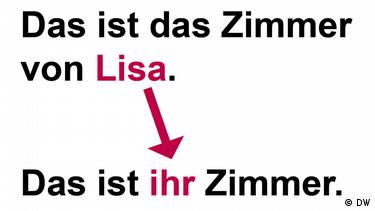
When something belongs to a woman, the possessive determiner is ihr/e.
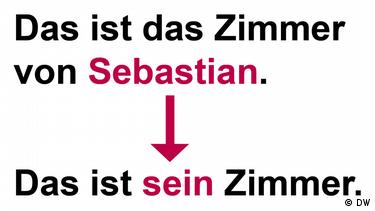
When something belongs to a man, the possessive determiner is sein/e.
Did you notice? The ending "-e" on the indefinite article shows you that the form of the noun is feminine. This is also the case for the possessive determiners: ein-e Küche / mein-e, dein-e, sein-e, ihr-e Küche
Info: masculine: der Spiegel; neutral: das Badezimmer; feminine: die Toilette; plural: die Teppiche
GRAMMAR
Possessive determiners (1)
Ulla: Nawin, ist das deine Unterhose?
Sebastian: Nein, das ist nicht seine Unterhose. Das ist meine Unterhose.

In order to express ownership or belonging, the possessive determiner is used instead of the definite or indefinite article.
When used before a feminine noun or a noun in the plural, the possessive determiner ends in -e in the nominative case:
masculine |
|
(der Föhn) | Das ist mein Föhn. |
feminine |
|
(die Unterhose) | Das ist meine Unterhose. |
neuter |
|
(das Zimmer) | Das ist mein Zimmer. |
plural |
|
(die Bücher) | Das sind meine Bücher. |
| Person | Possessive determiner |
Singular | ich | mein(e) |
| du | dein(e) |
| er/es | sein(e)* |
| sie | ihr(e)* |
Plural | wir | unser(e) |
| ihr | euer/eure |
| sie | ihr(e) |
Formal | Sie | Ihr(e) |
*Note the difference between sein and ihr:
Sebastian is a man:
Lisa is a woman:
Grammatical terms in German: der Possessivartikel: The possessive determiner is an article word that expresses ownership or belonging. |