Student Exploration: Building DNA
Directions: Follow the instructions to go through the simulation. Respond to the questions and prompts in the orange boxes.
Vocabulary: double helix, DNA, enzyme, mutation, nitrogenous base, nucleoside, nucleotide, replication
Prior Knowledge Questions (Do these BEFORE using the Gizmo.)
DNA is an incredible molecule that forms the basis of life on Earth. DNA molecules contain instructions for building every living organism on Earth, from the tiniest bacterium to a massive blue whale. DNA also has the ability to replicate, or make copies of itself. This allows living things to grow and reproduce.
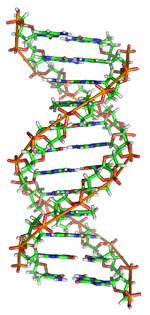
- Look at the DNA molecule shown at right. What does it look like?
| The dna look like Christmas lights strung around each other like a ladder. |
|---|
This shape is called a double helix.
- Based on this picture, how do you think a DNA molecule makes a copy of itself? (Hint: Look at the bottom two “rungs” of the ladder.)
| The ladder will break off and form new DNA molecules. |
|---|
Gizmo Warm-up
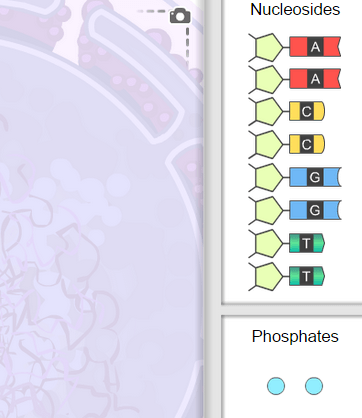
The Building DNA Gizmo allows you to construct a DNA molecule and go through the process of DNA replication. Examine the components that make up a DNA molecule.
- What are the two DNA components shown in the Gizmo?
| Nucleosides and Phosphates |
|---|
- A nucleoside has two parts: a pentagonal sugar (deoxyribose) and a nitrogenous base (in color). When a nucleoside is joined to a phosphate, it is called a nucleotide.
| How many different nitrogenous bases do you see? | 4 |
|---|
Note: The names of these nitrogenous bases are adenine (red), cytosine (yellow), guanine (blue), and thymine (green).
| **Activity A:**Build a DNA molecule | Get the Gizmo ready:If necessary, click Reset to start the building process. | 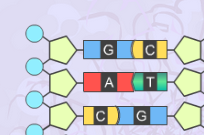 |
|---|
Question: What is the structure of DNA?
- Build: Follow the steps given in the Gizmo to construct a molecule of DNA. (Note: For simplicity, this DNA molecule is shown in two dimensions, without the twist.)
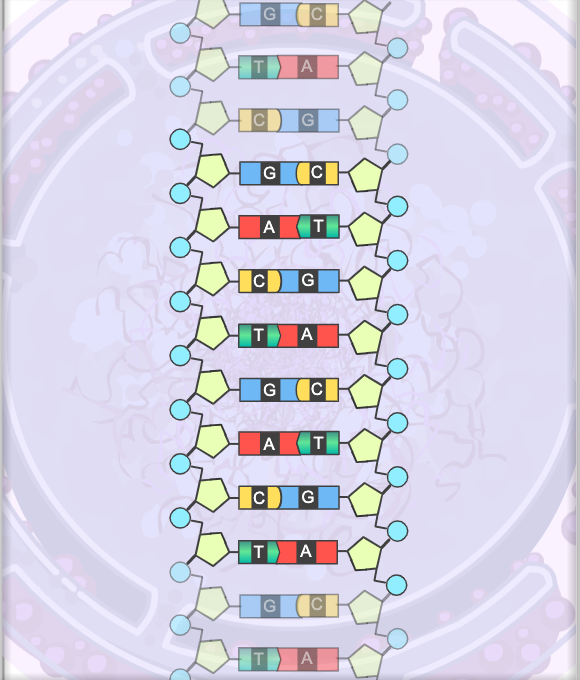
Stop when the hint reads: “The DNA molecule is complete.” In the spaces at right, list the sequence of nitrogenous bases on the left-hand side of the DNA molecule and the right-hand side.
- Take a picture: 📷 Click the camera (
 ) to take a snapshot of your DNA molecule. Right-click the image and select Copy Image. Paste the image below, and label this image “Original DNA molecule.”
Left side Right side
 Original DNA molecule |
|---|
- Explain: Describe the structure of the DNA molecule you made.
| A. | What makes up the sides of the DNA molecule? | Phosphates |
|---|
| B. | What makes up the “rungs” of the DNA molecule? | Nucleosides |
- Fill in: Write the name of the nitrogenous base that joins to each of the bases below:
| Adenine (A) joins to | Thymine (T) | Thymine (T) joins to | Adenine (A) |
|---|
| Cytosine (C) joins to | Guanine (G) | Guanine (G) joins to | Cytosine (C) |

- Practice: The left side of a DNA molecule is shown. \n ✏️ Draw a complementary right side of the molecule.
- Challenge: This DNA strand consists of eight pairs of nitrogenous bases. How many different sequences of eight bases can you make? Explain how you found your answer.
| 65,536 because is Albert is smart at math |
|---|
| **Activity B:**DNA replication | Get the Gizmo ready:Be sure the hint reads: “The DNA molecule is complete.” If not, click Reset and build a new DNA molecule. | 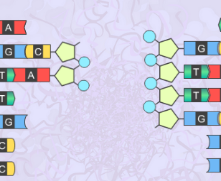 |
|---|
Question: How does DNA make a copy of itself?
- Observe: An enzyme is a protein that facilitates certain cell processes. Click Release enzyme to release DNA helicase. What does this enzyme do to the DNA molecule?
| Splits up bases from pairs |
|---|
Observe: Click Release enzyme to release DNA polymerase.
Notice that two groups of Nucleotides appear on the right. What are the three parts
| of a nucleotide? | Ribose sugar | Phosphate molecule | adenine, guanine, cytosine or uracil |
|---|
- Drag one of the nucleotides to a corresponding nitrogenous base on one of the two strands. What is the role of DNA polymerase in this process?
| DNA polymerase is to make DNA from nucleotides, the building blocks of DNA. |
|---|
- Build: Complete the two molecules of DNA by dragging nucleotides to their corresponding locations. When you have finished, compare the two completed daughter DNA molecules.
| What do you notice about the two molecules? | Both show DNA molecule strands. |
|---|
- Take a picture: 📷 Click the camera to take a snapshot of the DNA molecules, and paste the image below. Label this image “Daughter DNA molecules.”
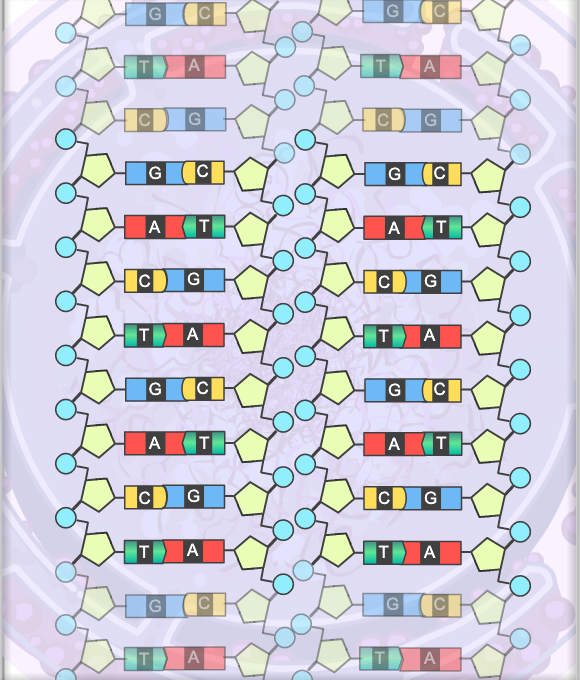 Daughter’s DNA molecules |
|---|
| How do these molecules compare to the original? | They both bond the same enzymes to each other. |
|---|
- Think and discuss: Why is DNA replication such an important process?
| So that DNA can continues exist and grow |
|---|
- Extend your thinking: Sometimes errors called mutations occur during DNA replication. What are some of the possible consequences of mutations?
| A mutation is a permanent change in sequence of DNA. If DNA is mutated it could lead to cancer or other genetic conditions. |
|---|