Week 6: Mercury
PART 1:
Mercury
named after greek god, Mercury (Hermes)
Mercury (the greek god) was the messenger of the gods
was very fast
closest planet to the sun = moves faster
fastest moving planet in the sky
first telescope was observed by Galileo in 1609
diameter: 3/8th Earth’s diameter or 3,000mi
smallest major planet in the Solar System
mass: 1/20th’s Earth’s mass
Axial Tilt: 0 degrees
orbits the sun straight up and down
inclination of orbit: 7 degrees to the plane of the solar system (ecliptic)
most inclined orbit in our solar system
ecliptic: plane of our solar system

average distance from the sun: 0.4 AU
Surface Gravity: 0.38g (g =Earth’s gravity)
= 38% the strength of Earth’s Gravity
Transit of Mercury
Transit: when a smaller body moves in front of a bigger body


Mercury’s size
Mercury is the size of some satellites (moons)
but because it orbits around the sun = its a major planet

Orbit of Mercury
Mercury has the most eccentric (least circular) orbit of all the major planets
most elliptical orbit in our solar system but very hard to tell

Aside: Angular Size
Angular size (angular separation): measurement by apparent size
measured at an angle
measured by comparing imaginary line from eyes to top of planet to imaginary line from eyes to bottom of planet
unit: degrees

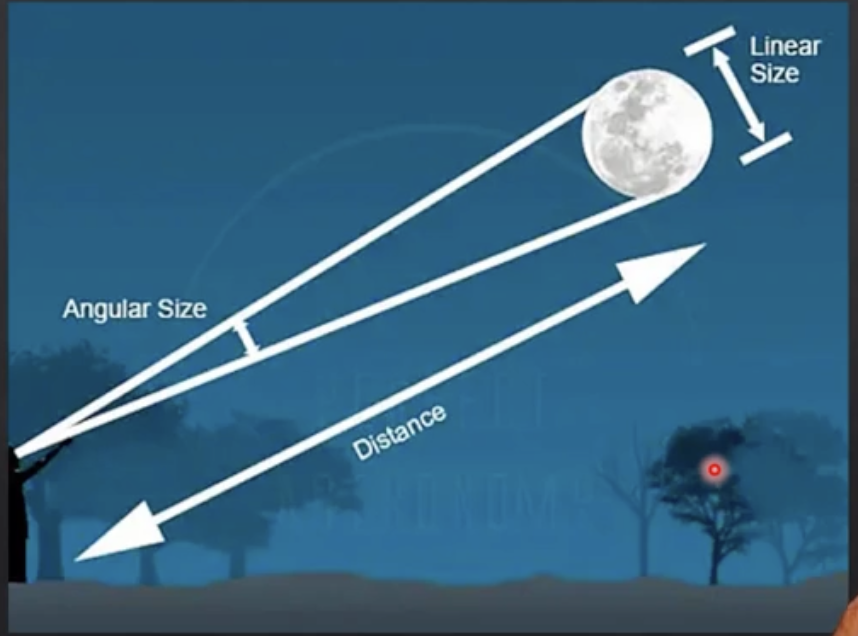
Angular distance: measurement by apparent distance
measured at an angle
measured by comparing imaginary line from eyes to one planet to imaginary line from eyes to another planet
unit: degrees

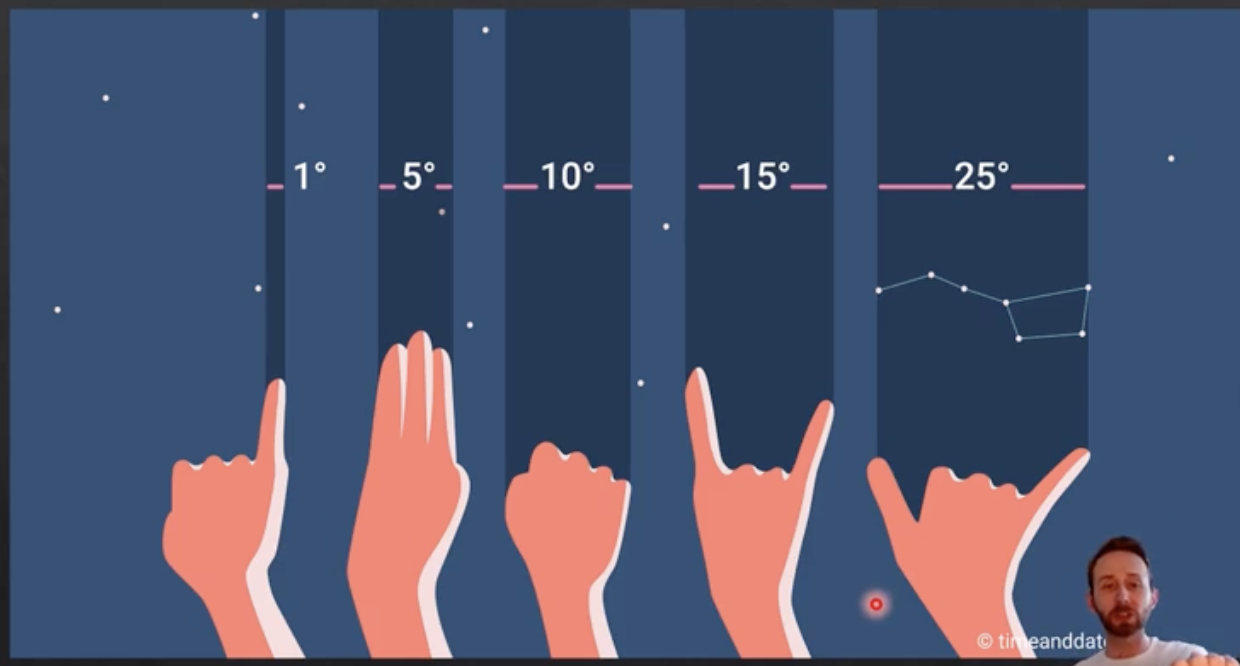
Measuring degrees with hand at arms length:
Enlongation Angle:
Elongation angle: angular distance from a planet to the sun
changes everyday
measures how far a planet appears from the sun

Mercury’s Elongation Angle
Mercury’s greatest elongation angle: 28 degrees
smallest elongation angle because it is closet to the sun and has the smallest orbit
always appearing close to the sun
Best time to observe Mercury: just before sunrise or just after sunset
only about 2 hours to do so

Rotation and Revolution of Mercury
sun over head = noon
Sidereal Day: “with respect to the stars”
for head to be back over sun a day later = 24 hours
measuring from the stars
Solar Day: “with respect to the sun”
for head to be back over sun a day later = 24 hours and 4 minutes
4 minutes longer than sidereal day

period of rotation (Mercurian Day):
sidereal day: 59 days (Mercury turns 360 degrees)
Solar days: 176 days = 3 sidereal days
one solar day is 2 mercury years
Mercury’s solar day is longer than its year
Period of Revolution: (Mercurian Year)
Year: 88 days (Fastest in the Solar System)

Surface Temperature of Mercury
First visited by the Mariner 10 Spacecraft in 1974
didn’t land, just few by and got good data
Surface Temperatures:
Lit side: (daytime) 800 degrees F
Dark side: (nighttime) -300 degrees F
Largest temperature range / swing in the Solar System (1,000 degrees F)
both really hot and really cold
this is due to not having an atmosphere (unlike Earth that has an atmosphere and does not have a large temperature range)
Part 2 Mercury
Density of Mercury
Density: measure of compactness
mass (grams) divided by volume (cm3)
ie: Density of water is 1g/cm3
Density of Iron (Fe) is 7.86 g/cm3
Density of gold (Au) is 19.3g/cm3
Density of Mercury = 5.4 g/cm3
implies a dense core like Earth’s
Surface Composition of Mercury
Rocks mostly made of sulfur, but also silicon, titanium, and iron
water ice on the surface (in craters) near the poles
craters are near the poles of Mercury and does not ever face the sun = results in water ice
very volcanic (molten) up to 3.5 billion years ago


Mercury’s Surface Features: Craters
Craters: impact site of asteroids, comets, meteoroids, etc.
mostly named after famous artists, poets, musicians, and philosophers

Why so many craters? (unlike earth)
no atmosphere to burn up asteroids
no erosion to cover them back up
The Caloris Basin: big impact crater from an asteroid impact a long time ago
800 miles across
impact was about 4 million years ago
basically a big molten pool of lava until it cooled
called “Caloris” Basin because it is the hottest area on the planet
Caloris is “heat” in latin

Surface Features: Scarps
Scarps: wrinkles on the crust and across craters
formed as Mercury’s cooling core shrank, causing the surface to shrink and cool

called “Rupes” (latin for “cliffs”)
named after famous historical ships
Surface Features: “Weird Terrain”
“weird terrain”: hilly region created as a result of shock waves from the Caloris Basin Impact
located on the opposite side of impact (antipodal)

Mercury’s Atmosphere
Mercury has basically no atmosphere
why?
Two main reasons:
Low mass = low gravity
can’t hold onto atmosphere very well
HOT
Gas atoms move so fast that they escape Mercury’s gravity
Another Trip to Mercury
The MESSENGER Spacecraft: last spacecraft to go to Mercury in 2011
MErcury Surface Space ENvironment, GEochemistry and Ranging