Chapter 9: Cell Cycle
Cell cycle: the entire life of a cell from formation to death.
Why do we need the cell cycle?
Repair damage
Make a copy/replicate(unicellular)
Growth Development
Interphase: 90% of the cell’s life.
Three parts—or
Checkpoint
Mitosis: “Spitting of the nucleus
Cytokinesis: Splitting of the cytoplasm
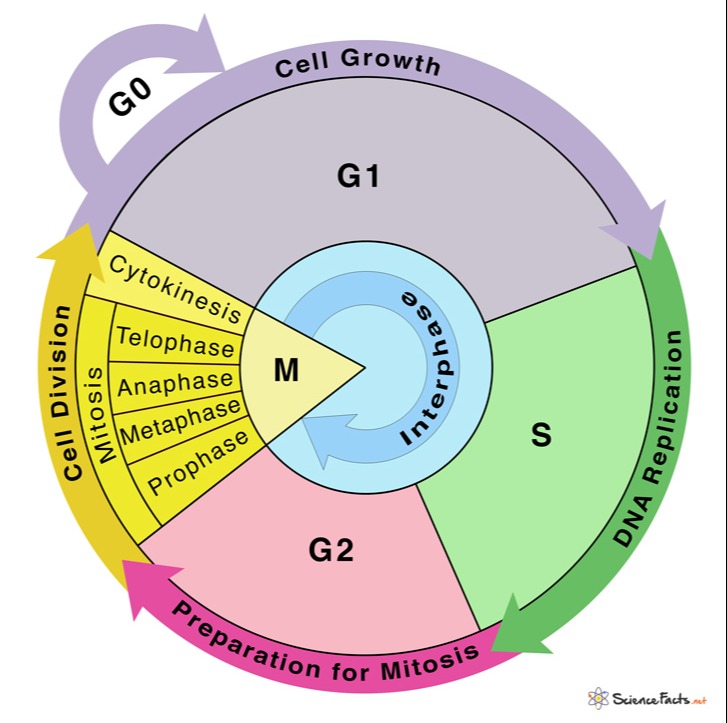
Interphase stages:
Gap1(G1): the first gap comes after the Split. Or Cell to rows, performing regular functions
Synthesis(S): make new DNA. Or DNA replicates itself for future division.
Checkpoint: The cell looks for damaged chromosomes
Gap 2(G2): replicate to organelles and prepare to split the nucleus—or more growth, which reaches twice its size.
Checkpoint: Cell prepares organelles.
Mitosis (M): The cell divides into two identical cells. Ends with cytokinesis (full split)
Gap 0 (G0): leave the cell cycle, and continue t, leave the cell cycle, and continue to routine A stage where the cells stop dividing, leave the cell cycle, and continue to perform normal functions. This does NOT mean that the cell will kill itself.
Checkpoints are to make sure everything ensures proper progression! If a cell develops abnormally, it enables apoptosis (cell death homeostasis, a mechanism that prevents dangerous mutations. *
Mitosis:
Prophase: nuclear membrane disappears, and chromosomes condense, and Sindle: fiber appears.
Metaphase: Chromosomes lines in the middle because of spindle fiber
are attached
Anaphase: chromosomes are pulled apart
Telophase: two new nuclei form.
Cytokinesis: Cytoplasm are dived
Animals: membrane pinches
Plants: build a new cell wall
Chromosome Structure:
leave the cell cycle, and continue t, leave the cell cycle, and continue to routine A stage where the cells stop dividing, leave the cell cycle, and continue
Chromosome (Sister) Chromatid: 1/2 of a Chromosome
Centromere: Region where the sister chromatids attach/ connect
Chromatin: the long, loose state of a chromosome
Diploid (2n): Having 2 sets of chromosomes -Ex: Human somatic cells, which is where mitosis takes place.
*Very important!! The daughter cells will have the exact SAME genetic makeup as the parent cells after mitosis*
Has the cell cycle gone wrong?!
Normal: enzymes control the checkpoint, and the growth signals
Abnormal: mutation in any enzyme may lead to uncontrolled growth (Cancer)
If a cell develops abnormally, it enables apoptosis (cell death homeostasis, a mechanism that prevents dangerous mutations.
DNA structure and replication:
1953, James Waston and Francis Crick published a paper describing the shape of DNA
double helix
Outside (backbone)
Altering sugar (deoxyribose) and phosphate
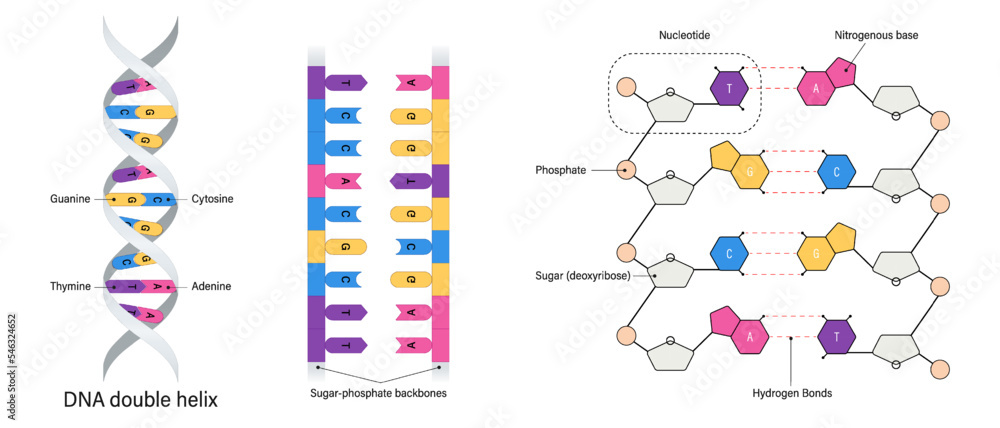
Inside: nitrogenous-based pairs
A: Adenine
T: Thymine
C: Cytosine
G: Guanine
10 base pairs per twist
DNA replication:
Occur in the “s” phase of interphase.
uses many enzymes
occurs in a semi-conservative manner
Steps for DNA replication:
Topoisomerase unwinds and straightens—the DNA strand. (Start at a sequence called the origin of replication)
Helicase “unzips” the double helix by breaking the hydrogen bonds between the base pair.
DNA polymerase adds new nucleotides in one direction (leading stand/lagging)
Ligase fills in any cracks (lagging strands)
Chapter 10: Meiosis
Chromosome: one piece of DNA that carries genetic information
Chromatid: One copy of a duplicated Chromosome
Haploid: one copy of each chromosome
Gametes are haploid
Diploid: Two copies of each chromosome
Body cells are diploid (copy from each parent)
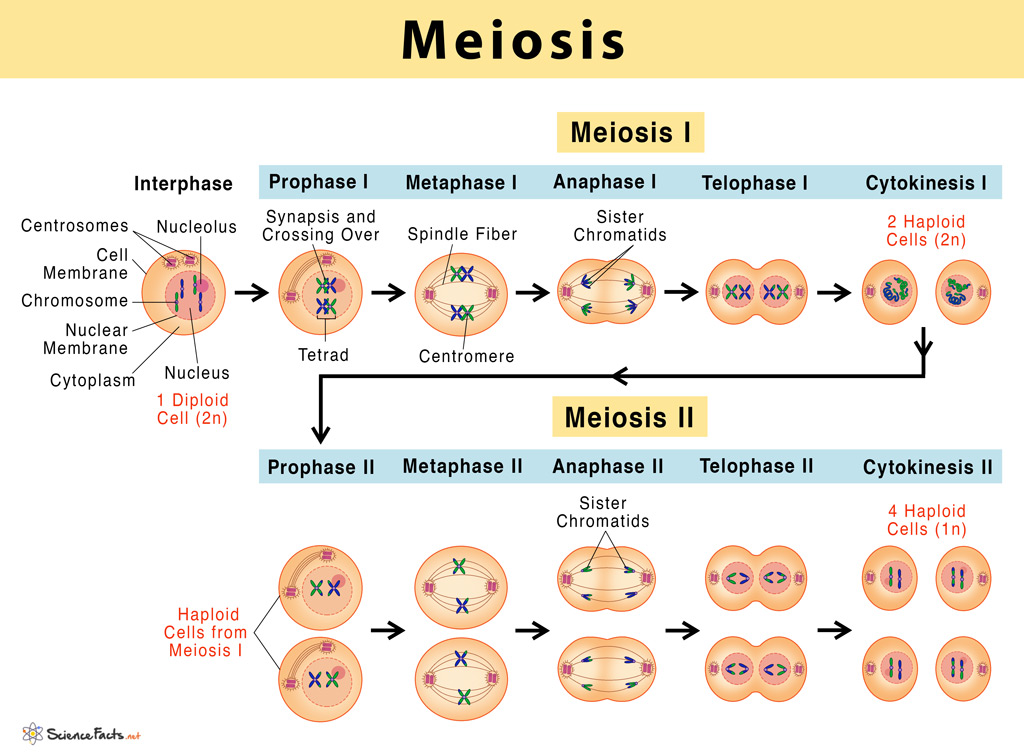
Meiosis is similar to mitosis, except the result is four non-identical cells.
Copied chromosomes are separated and moved into—each new cell.
Meiosis increases genetic diversity by randomly distributing chromosomes into gametes.
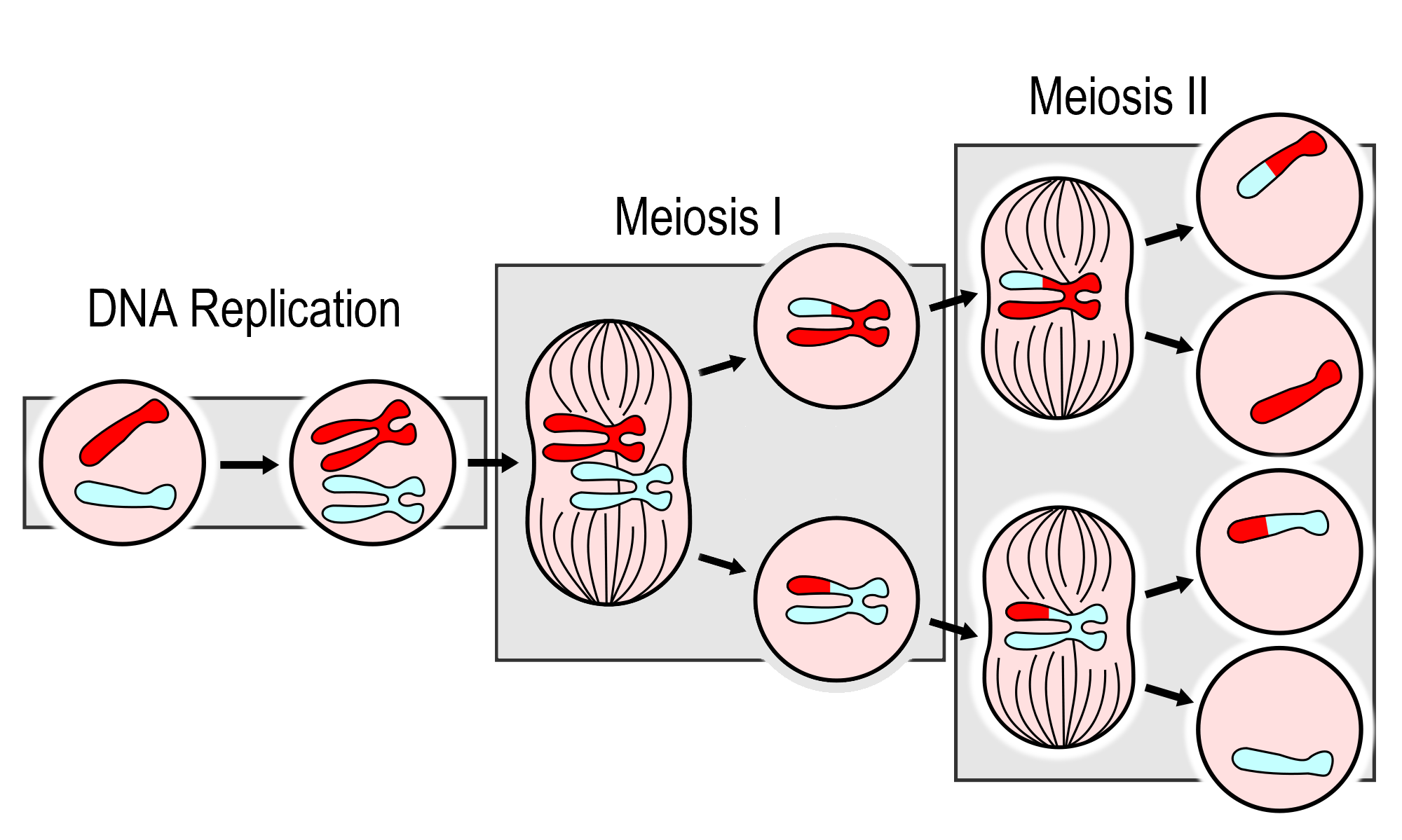
More genetic diversity occurs when “homologous” (the same number) Chromosomes line up and swap portions, a process called crossing over.
If chromosomes don’t separate correctly:
extra copy of chromosomes
Sexual reproduction
Meiosis is a type of a cell division where a diploid cell splits into 4 haploid gametes (sperm/egg cells).
n = number of chromosomes in ONE set (ex: humans have 23, so a diploid cell would have 46)
Gametes only have I set known as haploid
Fertilization: haploid sperm cell fuses with a haploid egg cell, creating a diploid zygote.
That's how we get one set of chromosomes from our father and the other from our mother!
Genetic variation
Why are there variations in offspring?
crossing over Occurs in prophase 1. Creates recombinant chromosomes, with mixed genes from both parents.
Independent Assortment Occurs in metaphase 1 and 2. Random orientations creates many possible combinations of chromosomes in the gametes.
Random Fertilization During sexual reproduction, it is complete random which male gamete will fuse with a female gamete.
Nondisjunction
When homologous pairs or sister chromatids fail to separate properly during anaphase, a gamete may receive any extra copy of a chromosome while the other gamete receives 0.
This can result in genetic conditions such as Trisomy 21 (Down Syndrome), where there is an extra copy of the chromosome 21