Signaling Pathways
LEARNING OBJECTIVES
Understand the concept of signal transduction/cell signaling.
Define the major cell signaling pathways that are involved in carcinogenesis.
Understand the potential use of different signaling molecules as targets for cancer treatments.
Signal Transduction pathways
Process by which a cell converts an extracellular signal into a response.
a.k.a cell signaling in which the transmission of molecular signals form a cell’s exterior to interior.
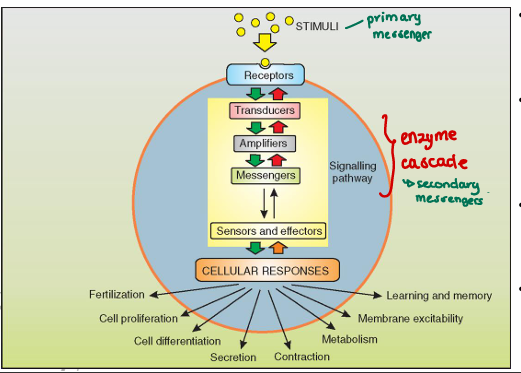
Typical molecular signaling pathways are initiated via receptors which perceive the presence of the activating signal.
Signal passes through a series of intracellular transducers and second messengers which may or may not lead to an amplification of the signal.
Ultimately second messenger sensors are activated, modulate of effector molecules which lead to cellular responses.
Complexity of cellular signaling results from the ‘cross-talk’ between multiple signaling pathways, and among the specific intracellular aspects of the pathways within each cell type.
Signal/Ligand
Ligand is the primary messenger and may be amino acids, peptides, proteins, fatty acids, lipids, nucleosides or nucleotides.
A ligand binds its receptor through specific weak non-covalent bonds by fitting into a specific binding site.
Types of ligands:
Hydrophilic messengers bind to cell membrane receptors.
Cannot penetrate cell membrane and bind to extracellular receptors.
Hydrophobic messengers bind to intracellular receptors which regulate expression of specific genes.
Can penetrate the cell membrane.
Receptor
Extracellular
G-protein-coupled receptors
Receptors with Kinase activity
Integrin receptors.
Toll gate receptors.
Ligand-gated ion channel receptors
Intracellular
Located inside the cell rather than on the cell surface.
Hormonal and steroid receptor.
Transduction Cascade
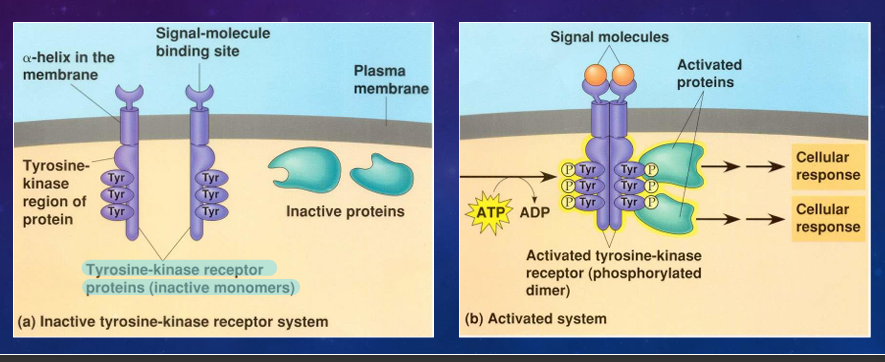
The interaction of the ligand attaches to external domain of receptor.
Leads to up-regulation of enzymatic activity in the intracellular catalytic domain of the receptor.
Leads to tyrosine phosphorylation of intracellular signaling molecules.
e.g epidermal growth factor.
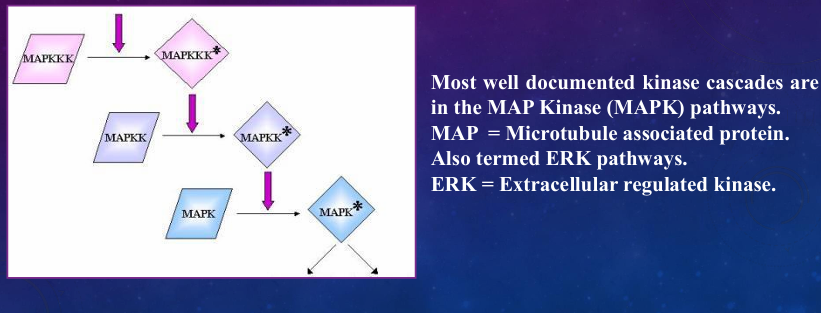
Transfer of phosphate may involve one kinase activating the next kinase → Kinase cascade.
Phosphorylation correlates with protein activity.
Cell receptor characteristics
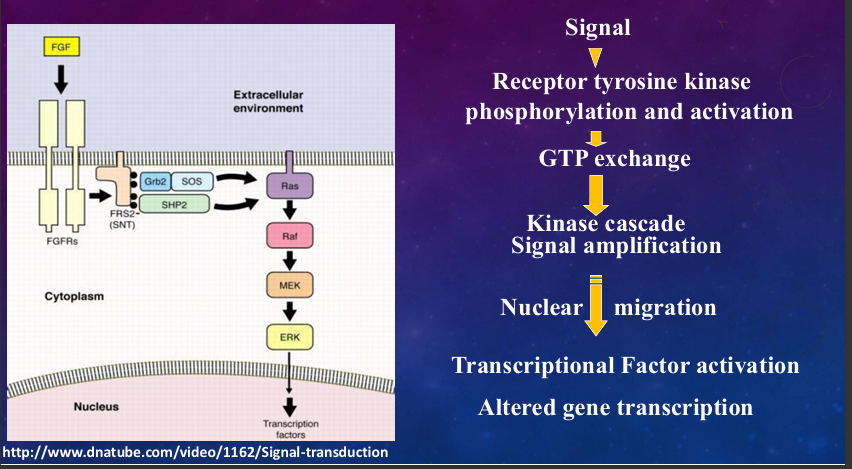
Each receptor may engage with a number of different proteins organized into a signaling network.
Signaling network may result in the triggering of a designed cellular event e.g specific protein synthesis or apoptosis.
Pathways are not isolated form each other but are interconnected to form complex signaling networks.
Aberrant signaling processes associated with uncontrolled growth
Signaling and Cancer
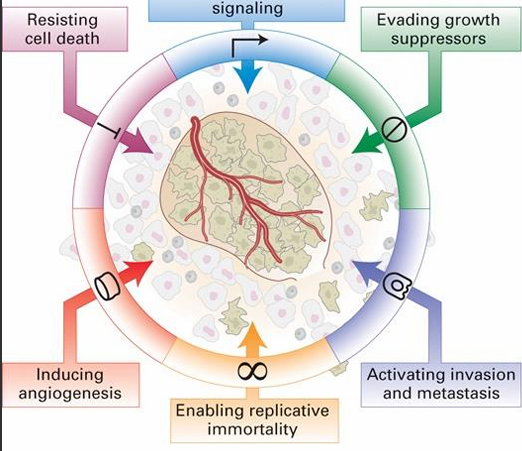
Hallmark of Cancer
Sustained Proliferative Signaling
The ability of cancer cells to sustain chronic proliferation is fundamental.
Allows cancer cells to grow into tumors, metastasize, and invade other regions of the body.
Cancer cells maintain constant growth through sustaining proliferative signaling.
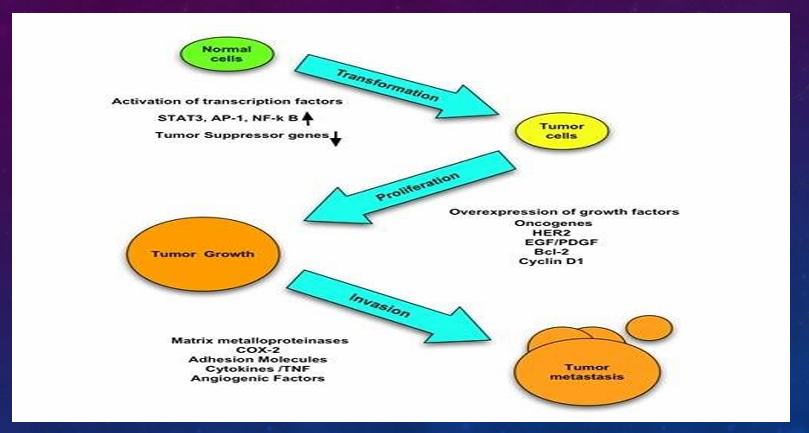
Deregulation of cell signaling pathways allows cancer cells to upregulate growth signals and downregulate antigrowth signals.
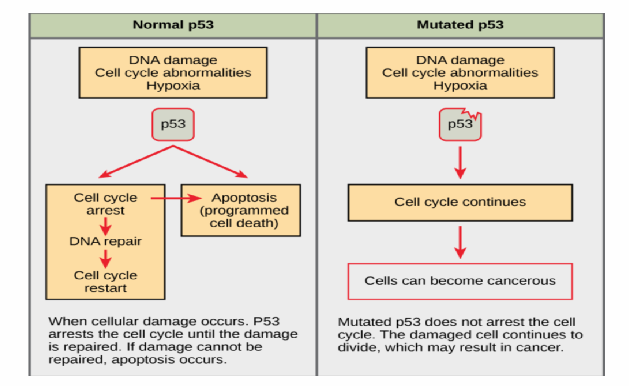
Mutations in components of signaling pathways that control cell growth and division (oncogene) e.g mutations in the Ras-Raf-MAPK pathway and mutation of tumor suppressor proteins such as p53 to limit apoptotic cell death underlie tumor initiation.
30% of cancer cells have a mutation in the RAS gene that leads to uncontrolled growth.
HER2 is a cell-surface receptor that is present in 20% of human breast cancers. Gene duplication led to HER2 overexpression in 25% of breast cancer patients.
Molecular targeting of cancers
Drugs or other substances that block the growth and spread of cancer by interfering with molecular targets involved in the growth, progression and spread of cancer.
They interfere with target molecules needed for tumor growth rather than by simply interfering with all rapidly dividing cells e.g with traditional chemotherapy.
Difference between targeted therapy and chemotherapy
TARGETED THERAPIES | CHEMOTHERAPY |
Act on specific molecular targets that are associated with cancer. | Act on all rapidly dividing normal and cancerous cells. |
Deliberately chosen or designed to interact with their target. | Identified because they can kill cells. |
Often cytostatic
| Cytotoxic |
Target identification for targeted therapies
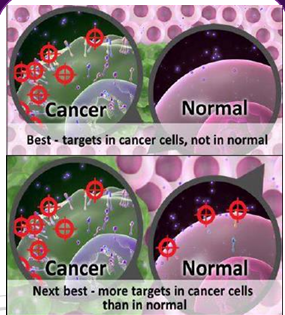
Proteins present in cancer cells but not normal cells or more abundant in cancer cells especially if they are known to be involved in cell growth or survival.
To determine whether cancer cells produce mutant proteins that drive cancer progression.
Development of targeted therapies
Small-molecule compounds are typically developed for targets that are located inside the cell because such agents are able to enter cells relatively easily.
Monoclonal antibodies are relatively large and generally cannot enter cells, so they are used only for targets that are outside cells on the surface.
Herceptin/Trastuzumab
Approved for treatment of early-stage breast cancer that is Human epidermal growth factor Receptor 2-positve (HER2+).
Monoclonal antibody that targets HER2. Herceptin therapy helps to control signaling through HER2. The use of Herceptin in combination with chemotherapy has helped to increase overall survival rate of patients with metastatic breast cancer.
Herceptin may cause heart failure as a side effect of treatment.