2.2.2 International trade
Advantages and disadvantages of free trade
Lower prices and increased choice for consumers – International trade allows consumers to buy from abroad, increasing choice and therefore welfare for consumers. More choice also results in lower prices as there is more competition and foreign firms often have lower costs (see below)
Lower input costs - Through international trade, countries can obtain essential inputs for its industries at a much lower cost. E.g. China has low labour costs. This can reduce prices for consumers. If countries specialise in the production of goods in which they are more efficient, the global economy will benefit. Goods and services all over the world will be produced in locations where costs are minimised. This means that consumers all over the world can buy goods at the lowest possible prices. This will help the world economy to grow and make better use of the world’s resources.
Wider markets for businesses – Businesses can sell to various customers around the world. This helps to reduce the risk of business enterprise. If sales in one country start to decline, a company can rely on sales in other countries to offset the decline.
Foreign competition harming domestic businesses - If countries have open economies, it means that imports from anywhere in the world can flow into the economy. If these imports are good in quality and competitively priced, domestic producers might struggle to compete.
Increasing unemployment - One of the main problems with international trade is the threat to employment levels when domestic industries are threatened by cheap imports. This reduces demand for domestic products, therefore firms close and workers find themselves without a job.
Reasons for protectionism
Protectionism refers to measures taken by the government to protect domestic industries. These include tariffs, quotas and domestic subsidies.
Prevent dumping – dumping is where an overseas firm sells large quantities of a product below cost in the domestic market. Dumping is considered to be unfair competition for domestic producers. If very cheap imports are being sold below cost in a country, domestic producers will find it very difficult to survive in the long term.
Protect employment - Trade barriers may be used if domestic industries need protection from overseas competitors to save jobs. Unemployment is always unwelcome and a government may be criticised if jobs are being lost because of cheap imports.
Protect infant industries – Infant industries are new industries yet to establish themselves. Many argue that infant industries should be protected from strong overseas rivals until they can grow, become established and exploit economies of scale
To gain tariff revenue – A tariff Is a tax on imports. A government can raise revenue if it imposes tariffs on imports. This money can be spent on government services to improve living standards.
Protect consumers from unsafe products - A government might be justified in using protectionism if it is felt that overseas producers are trying to sell goods that are harmful or unwanted. For example, recently, the EU banned all beef from cattle raised using growth hormones because it felt that it was not safe for human consumption.
Reducing current account deficits – A current account deficit occurs when the value of imports is greater than the value of exports. A country has to pay its way in the world and if a current account deficit gets out of control, action may be needed. A government might try to reduce imports and increase exports at the same time to reduce the deficit.
Retaliation – Retaliate is to take action against someone who has done something bad to you. If a foreign business dumps large quantities of goods below cost, a government may feel obliged to retaliate by imposing heavy taxes on those goods when they come into the country. Retaliation may also occur if a country imposes trade barriers on exporters. That country may retaliate by imposing trade barriers on that nation’s imports. This can result in a trade war that will tend to reduce trade between two nations and have a negative impact on both nations.
Methods of protection
Tariffs – A tariff is a tax on imports. One way of restricting trade is to make imports more expensive. This will reduce demand for imports and increase demand for goods produced at home. One of the main advantages of tariffs is that in addition to reducing imports to protect domestic industries and improve the current account, they also raise revenue for the government. However, if tariffs are set too high, imports may cease and government revenue will be zero. Also, consumers will not benefit from tariffs in the short term since they raise prices
Quotas – A quota is a physical limit on the number of imports. By restricting the quantity of imports, domestic producers face less of a threat. They will have more of the market for themselves. However, quotas will raise prices because fewer of the cheaper imports are available. Placing physical limits on the flow of imports means that domestic producers will meet some demand for those goods. This will help to protect employment. One of the main advantages of quotas is that they physically limit the supply of imports. Foreign companies cannot easily get round quotas by adjusting prices. Also, in the short term, the impact on prices might be limited. It may take a while for shortages to force the price up. In the meantime, domestic producers might be able to increase supply to ‘plug the gap’ in the market. One disadvantage is that consumer choice is likely to be restricted and domestic producers might be overprotected and fail to improve efficiency.
Subsidies – A subsidy is a government grant or payment to firms in order to increase production or reduce costs. If subsidies are given to domestic producers, this will lower prices for consumers because subsidies reduce production costs and increase supply. This forces equilibrium prices down. If subsidies are given to exporters, it makes it easier for domestic businesses to break into foreign markets. One of the main advantages of export subsidies is that more domestic firms might be encouraged to enter the market. This will help to boost exports, employment and improve the current account. However, the main disadvantage of subsidies is that it costs the government money. Export subsidies might have a high opportunity cost. The money spent on subsidies might be spent more effectively on alternative government projects such as building new schools and hospitals.
Supply and demand diagrams to show tariffs, quotas and subsidies
All 3 protectionist measures increase affect supply.
A tariff and a quota will reduce supply, shifting it left (see below)
The decrease in supply increases price from P1 to P2 and reduces quantity from q1 to q2.
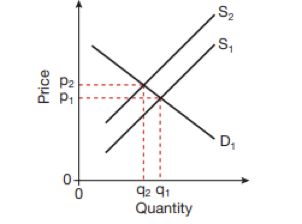
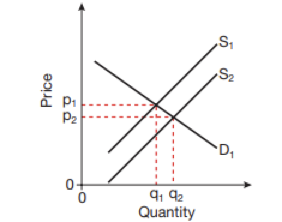
A domestic subsidy will increase supply, shifting it right (see below)
Before a subsidy is granted, the equilibrium price in the market is p1. The effect of a subsidy is to lower production costs, which means that producers will increase supply. This is shown by a shift in the supply curve from S1 to S2. The new equilibrium price is p2, which is lower than p1. The amount traded in the market rises from q1 to q2. Subsidies will lower prices for consumers.
Modern trading blocs
A trading bloc is an agreement between countries to reduce trade barriers and to increase free trade.
There are many different types of trading blocs. E.g. a free trade area removes trade barriers on goods and services. A customs union removes trade barriers between goods and services but also imposes an external tariff on non-member countries. A common or single market (such as the EU) has free trade on goods services and all factors of production.
Impact of trading blocs on member and non-member countries
If members of the bloc abolish all trade barriers, goods will be cheaper, and there will be more consumer choice and faster economic growth. Firms will be able to exploit economies of scale because they have access to larger markets and extra competition will improve the quality of goods and encourage innovation. It is argued that the formation of trading blocs invites FDI. This may be because foreign firms are keen to locate operations within a trading bloc to get access to a larger and barrier-free market. The formation of a trading bloc should result in closer cooperation between members. For example, countries may share resources, help each other out and introduce common standards, laws and customs. Studies have shown that trade blocs can reduce cross-border conflict, promote peace, and achieve substantial social and economic gains.
By their nature, trading blocs encourage regional as opposed to global free trade. However, there is no real agreement as to whether regional trade blocs result in less free trade in the world or encourage further globalisation. One problem with belonging to a trade bloc is the financial cost to the government and therefore the taxpayer.
It is also possible for firms within a trading bloc to merge and become too powerful. This may result in the formation of regional monopolies that might exploit consumers in the bloc. It is also possible that certain countries get far more out of membership than others.
Countries may start to rely too heavily on trade within the bloc. This would make them more vulnerable to changes in prices and demand patterns within the bloc. They may also miss out on opportunities in other world markets. Also, inefficient producers may be protected from competition from businesses outside the trade bloc. As a result, consumers might end up paying more for goods and services in some industries
Role and actions of the World Trade Organisation (WTO)
The WTO is an organisation with 164 member countries. The WTO promotes free trade by persuading countries to abolish tariffs and other trade barriers. It has become closely associated with globalisation. The WTO is the only international agency overseeing the rules of international trade. It polices free trade agreements, settles trade disputes between governments and organises trade negotiations. WTO decisions are final and every member must abide by its rulings.
Trade patterns of developed and developing countries
World trade has increased significantly in the last 50-100 years. E.g. due to better transport and communication and relaxing of trade barriers.
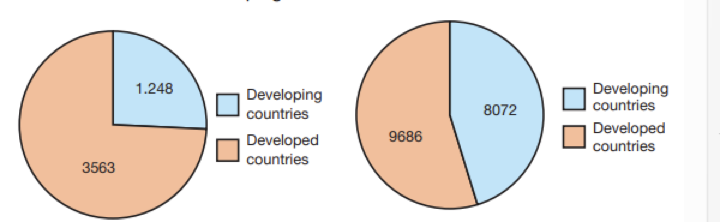
Share of world trade from 1995 (left) and 2024 (right)
Developing countries have increased their share of world trade over time.
There has been an increase in people moving to developed countries to find work
Increased FDI (foreign direct investment) in Africa from China has increased.