JFK Presidency overveiw
Group 1: The Cold War Overview
Quick Overview:
The Cold War (1945–1991) was a tense rivalry between the U.S. and the Soviet Union, affecting JFK’s decisions and everyday American life.
Key Points:
The U.S. and Soviet Union competed for military, political, and technological power.
JFK increased military spending and created the Peace Corps to spread U.S. influence.
The Berlin Wall (1961) symbolized the deep divide between East and West.
Fear of nuclear war was very high during JFK’s presidency.
Guiding Questions (provide clear and concise answers in a different colour):
Guiding Questions (provide clear and concise answers in a different colour):
Why was the Cold War a 'cold' (non-direct fighting) conflict?
The Cold War was a ‘cold’ conflict because no direct military conflict existed. While there was no direct fighting between the two, there were proxy wars (instigated by a major power that didn’t become involved) and a build-up of nuclear weapons. The ‘cold’ states stayed cold because they maintained an understanding that military confrontation could lead to a nuclear exchange.
How did JFK try to show U.S. strength?
John F. Kennedy showed U.S. strength during the Cold War by standing firm during the Cuban Missile Crisis, forcing the Soviet Union to remove its missiles from Cuba. He also boosted military power, supported space exploration, and delivered strong speeches like "Ich bin ein Berliner" to demonstrate America's commitment to fighting communism.
How did events like the formation of the Berlin Wall affect American feelings?
America was angered by the formation of the Berlin Wall and sympathised with the people of East Berlin, although they were allied with West Germany’s government. JFK gave a speech ‘Ich bin ein Berliner’ – ‘I am a Berliner’ – to show himself and his people standing with the oppressed in Berlin.
Find 2-3 iconic pictures from this time and paste them below.
(above: the Berlin Wall) Soviet invasion of Prague
How did this event affect his reputation as president?
The cold war defined his legacy as a president
“Let every nation know, whether it wishes us well or ill, that we shall pay any price, bear any burden... to assure the survival and the success of liberty.”
— John F. Kennedy, Inaugural Address, 1961
Most people respected and admired him
During the bay of pig's invasion people criticized him and blamed him for poor planning by his failed attempts
Group 2: The Cuban Missile Crisis
Quick Overview:
In 1962, U.S. spy planes found Soviet nuclear missiles in Cuba, leading to a dangerous 13-day standoff that almost caused nuclear war.
Key Points:
Soviet missiles were placed in Cuba, only 150km from Florida.
JFK ordered a naval blockade (called a 'quarantine') to stop more missiles.
After tense negotiations, the Soviet Union removed the missiles.
JFK promised not to invade Cuba and secretly agreed to remove U.S. missiles from Turkey.
Guiding Questions:
Why was the Cuban Missile Crisis so dangerous?
It was thought that the world would go into nuclear war, as the United States and the Soviet Union, who were the strongest powers, faced direct confrontation.
How did JFK avoid nuclear war?
On the 22nd of October he ordered a naval blockade to prevent further missiles from reaching Cuba. He demanded the removal of the missiles already there and the destruction of the sites.
What were the results for the U.S. and Soviet Union?
The Soviets agreed to remove their bombers from Cuba and the United State ended its quarantine on 20th of November 1962. After this crisis, the White House and the Kremlin established a direct telephone link between them, which became known as “hotline”.
How did this event affect his reputation as president?
The citizens of America saw him handle the crisis very professionally and swiftly without causing any casualties or nuclear war, so this strengthened his image as president domestically and internationally.
1. This image shows missiles being transported to Cuba via transport ships.
2. An image of a missile launch site in San Cristobal on 1st of November 1962
Group 3: The Civil Rights Movement
Quick Overview:
The early 1960s saw a major push for racial equality. JFK’s response to civil rights challenges became a key part of his legacy.
Key Points:
Civil rights activists fought segregation and discrimination, especially in the South.
JFK sent federal troops to protect Black students at the University of Mississippi (1962).
In 1963, he proposed a Civil Rights Bill to end segregation.
His strong support for civil rights came shortly before his assassination.
Guiding Questions:
What challenges did civil rights activists face?
Physical violence, legal barriers and systemic discrimination. This was due to the old fashioned thinking of the 1950s and 60s. This hatred and mistreatment came from white supremacists, particularly a group called the Klu Klutz Klan, a protestant-led Christian extremist, white supremacist, far-right hate group. They actively committed crimes against black people, ex-slaves and civil rights supporters.
How did JFK's views on civil rights change over time?
JFK originally approached civil rights with a cautionary manner, prioritizing the enforcement of existing laws over new legislation. In 1963, He recognized that civil rights was a moral issue, leading him to propose a Civil rights act.
Why was 1963 important for civil rights?
In 1963, There were multiple significant events for the Civil Rights Movement, including the march on Washington, Martin Luther KIng Jr's "I have a dream" Speech, JFK's proposal of the Civil Rights Act and overall intensified activism.
How did this event affect his reputation as president?
JFK's Support of the Civil Rights movement led to lots of southern democrats negative opinions of him, as they felt "Alienated" as supporters of segregation. Although there was a lot of hatred towards JFK for his Political Actions, activists strongly supported him.
Group 4: The Bay of Pigs Invasion
Quick Overview:
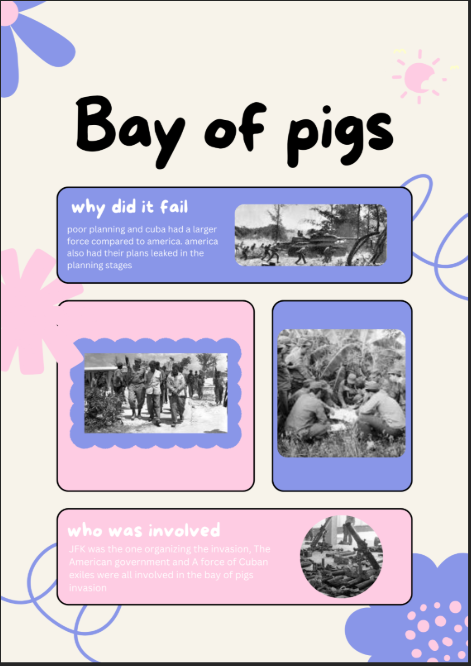
JFK authorized a failed invasion of Cuba by Cuban exiles to remove Fidel Castro, embarrassing the U.S. and worsening Cold War tensions.
Key Points:
CIA trained Cuban exiles to invade Cuba.
The invasion at the Bay of Pigs (April 1961) was a disaster.
JFK publicly accepted responsibility for the failure.
The event made tensions with Cuba and the Soviet Union worse.
Guiding Questions:
Why did the U.S. want to remove Castro?
What went wrong with the invasion?
How did the invasion impact JFK's leadership and Cold War relations?
Find 2-3 iconic pictures from this time and paste them below.
How did this event affect his reputation as president?
Group 5: The Vietnam Conflict and JFK
Quick Overview:
JFK increased U.S. involvement in Vietnam, trying to stop the spread of communism without fully entering a war — setting up future conflicts.
Key Points:
The U.S. wanted to prevent communist North Vietnam from taking over the South.
JFK sent more military advisors, not combat troops.
His administration was divided on how involved America should be.
His actions paved the way for later, much larger U.S. involvement after his death.
Guiding Questions:
Group 6: The Space Race and the Moon Speech
Quick Overview:
The U.S. and Soviet Union competed to dominate space. JFK inspired the nation by challenging Americans to land on the Moon.
Key Points:
The Soviet Union launched the first man into space (1961).
JFK set the goal for the U.S. to land a man on the Moon by the end of the 1960s.
The Space Race became a major part of Cold War competition.
His famous "We choose to go to the Moon" speech motivated Americans.
Guiding Questions
Why was space exploration part of Cold War rivalry?
Space exploration became part of Cold War rivalry mainly because it was seen as a way for the United States and the Soviet Union to prove their, advanced technology, and superiority to the world through the space race. It provided more opportunities to show off, demonstrating technological and political superiority between the United States and the Soviet Union. Public interest in space travel and the achievements of both countries was high, making the Space Race major aspect of the Cold War.
What did JFK promise in his Moon Speech?
JFK said "First, I believe that this nation should commit itself to achieving the goal, before this decade is out, of landing a man on the moon and returning him safely to the earth. “We choose to go to the Moon in this decade and do the other things, not because they are easy, but because they are hard." JFK promised a Moon landing. America would lead the world in space exploration. They would commit the money, resources, and effort it would take, no matter how hard it was. He turned it into a huge national goal, inspiring pride and determination. The proposal did not initially have widespread support; an April 1961 Gallup Poll indicated that 58 percent of Americans were opposed to it. They were negative about this because they thought that the mission would be an outrageous cost as well as the fact they presided.
How did the Space Race impact America’s future?
It established their technological dominance.
How did this event affect his reputation as president?
It boosted JFK’s domestic and international reputation by solidifying his ‘American ingenuity’. This restored the confidence from the country, inspired national unity elevated the American image, made him seem more reliable which therefore helped him as a president.