Cell differentiation/stem cells
As a multicellular organism develops, its cells differentiate to form specialised cells
Specialised cells have structural adaptations which enable them to perform specific functions within the organism
Almost all of the cells in a multicellular organism will contain the same genetic information (the same genes or alleles), but each cell will have a different set of active genes which determine how the cell functions
When the cell differentiates, these active genes cause the development and composition of subcellular structures which enables it to carry out a certain function
e.g. To form a nerve cell the cytoplasm and cell membrane of an undifferentiated cell must elongate to form connections over large distances

In an animal, most cells differentiate at an early stage of its development. Cell division is mainly restricted to repair and replacement in mature animals
Animal cells therefore lose their ability to differentiate after they have become specialised early in the life of the animal
Some cells in various locations throughout the body of an animal retain the ability to differentiate throughout the life of the animal. These cells are called adult stem cells and are mainly involved in replacing and repairing cells (such as blood or skin cells)
Plants differ from animals in that many types of plant cell retain the ability to fully differentiate throughout the life of a plant, not just in the early stages of development
Animal Stem Cells
Stem cells - an undifferentiated cell that’s capable of dividing to produce many more cells of the same type
Stem cells can give rise to other cell types by cell differentiation.
Embryonic stem cells - important as they help to form all different tissues and organs needed during development to form a whole new individual. - cells in the very embryo stage can differentiate to become any other type of body cell.
Adult stem cells , however, are more limited and can only differentiate to produce a few different cell types.
Adult stem cells are predominantly used to replace cells lost through damage or to produce new cells for growth – although the bone marrow has to continually make new blood cells throughout life

Plant stem cells
In plants, stem cells are found in the root/shoot tips, in the meristem tissue.
Meristem cells are unspecialised cells that can differentiate into the cells needed by the plants in regions where growth is occurring
e.g - Meristem cells in the roots can differentiate into root hair cells as well as other cells required in this part of the plant.
Plant stem cells retain the ability to differentiate into any type of plant cell throughout the life of the plant
It’s possible to use plant stem cells to clone plants with desired characteristics e.g. resistance to certain diseases

Stem Cells in Medicine
Adult stem cells can be cultured in the lab and made to differentiate into specialised cells.
Stem cells are already used to replace damaged cells caused by diseases (e.g paralysis & diabetes)
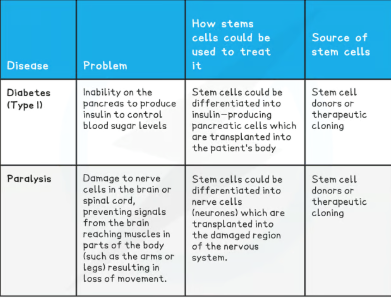
Therapeutic cloning
a process that produces an embryo with the same genes as the patient.
Stem cells taken from this embryo will have the same DNA as the patient. This means that the patient's body will not reject the stem cells or body cells made from the embryo's stem cells.
This is ideal for use in stem cell medical treatments.
Disadvantages of using stem cells for medience
Stem cell transplanting could transfer viral infections.
Ethical beliefs
Introducing stem cells into a patient could cause the patient's immune system to reject and destroy the new cells.