Lac & Trp Operons
Gene expression in prokaryotes is regulated at the point of transcription. A repressor is any protein that binds to DNA, regulating the expression of genes by decreasing the rate of transcription. Operons, specifically, are a unit of genetic material that functions in a coordinated manner using an operator, a promoter, and structural genes that are transcribed together.
Positive control = binding of protein to promoter increases transcription
Negative control = binding of protein to promoter reduces transcription
Prokaryotic operons are classified as either repressible operons or inducible operons.
Lac operon
The lac operon is a catabolic operon that regulates the enzymatic breakdown of lactose (a sugar made up of glucose and galactose). It is an inducible operon with both a negative and positive control system.

The lac repressor is a protein which represses (inhibits) transcription of the lac operon by binding to the opertator. When bound, the lac repressor prevents RNA polymerase from transcribing the operon.
If lactose is not available, the lac repressor binds to the operator (negative control). However, if lactose is present, the lac repressor loses its ability to bind to DNA. This change is caused by an isomer of lactose, allolactose, which causes a confrontational change to the lac repressor.
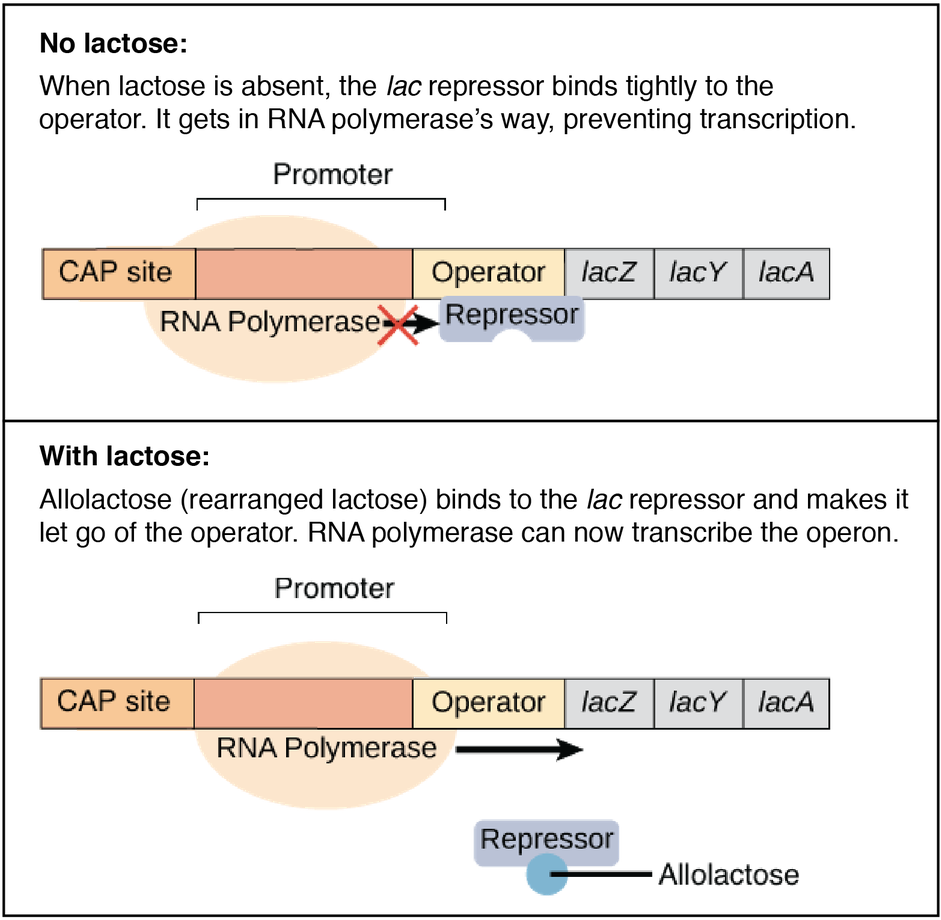
If there are high levels of lactose and low levels of glucose, special proteins called the catabolite activator proteins (CAP) will bind to a region of the DNA using a signaling molecule called cyclic adenosine monophosphate (cAMP). The binding of CAP to the CAP site causes a conformational change, allowing it to encourage the transcri
ption of the gene (positive control).


Trp operon
The Trp operon is an anabolic operon that regulates the production of tryptophan. It is a repressible operon, meaning that its default state is on.

The trp operon is regulated by the trp repressor, which binds to the operator when levels of tryptophan are high. When in contact with tryptophan, the repressor goes through a conformational change which allows it to bind, as tryptophan acts as a corepressor.
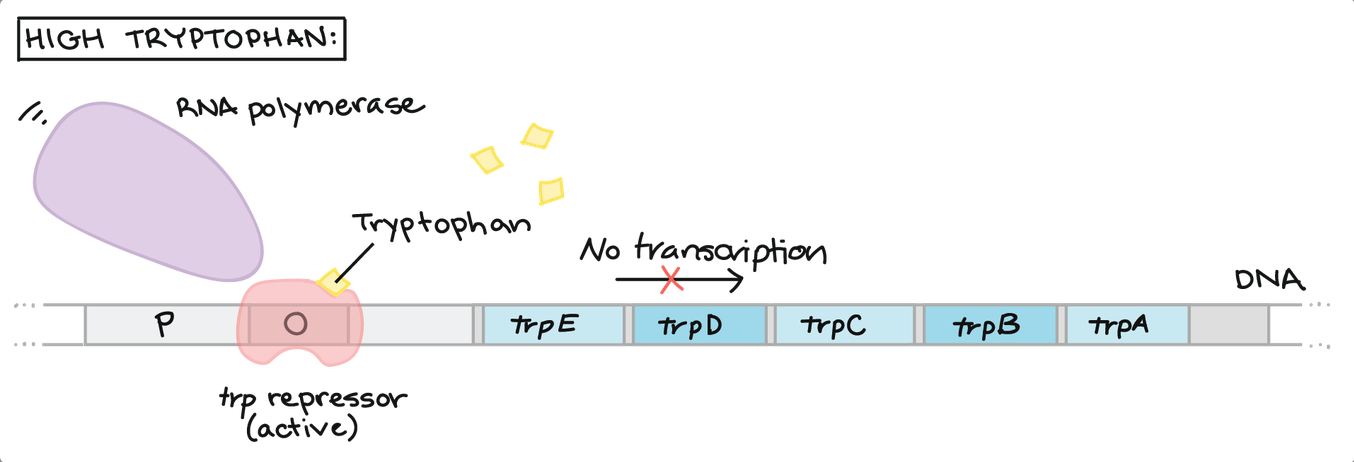
When tryptophan levels are low, however, the trp repressor cannot bind to the operator and the trp operon continues to be transcribed.

Attenuation is a mechanism for reducing expression of the trp operon when levels of tryptophan are high, but rather than preventing initation of transcription, it prevents the completion of it.
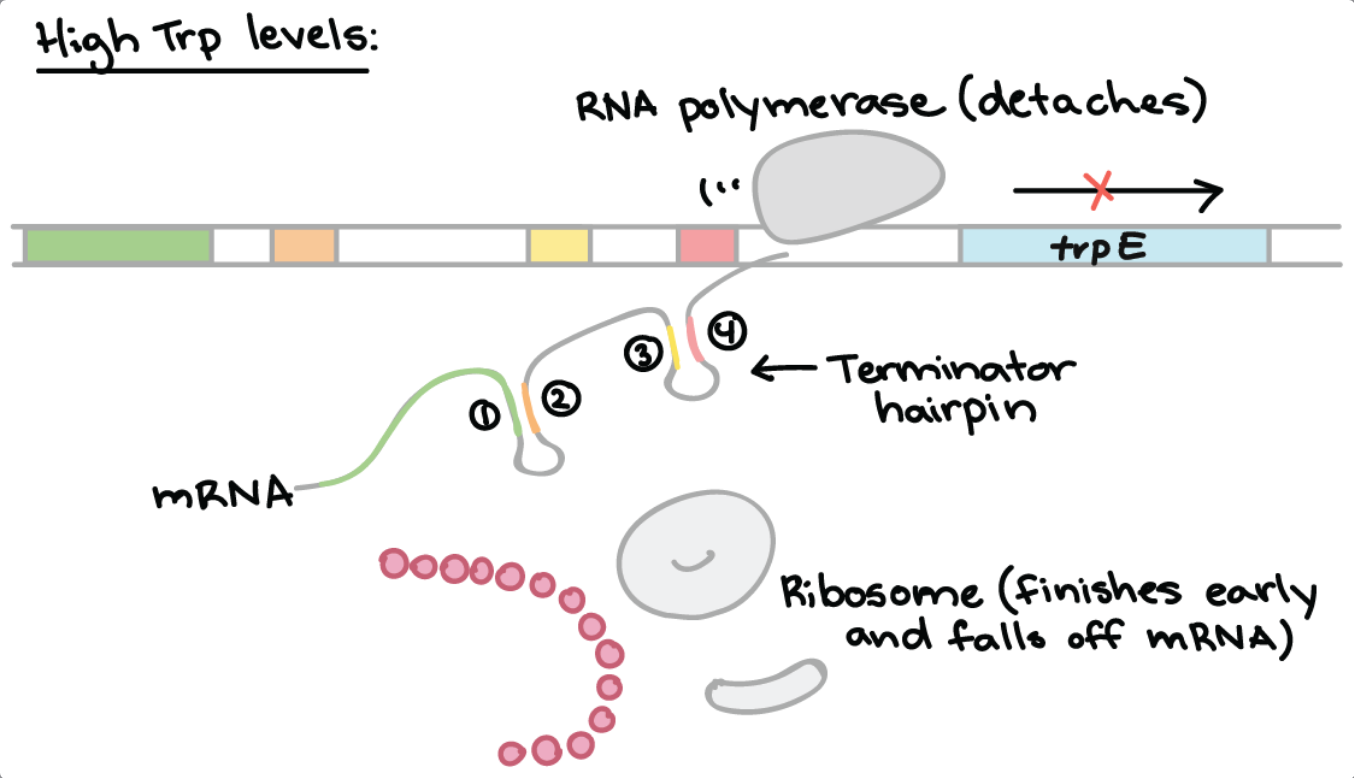
Between the operator and the first gene of the operon is a section called the leader, which encodes a short polypeptide and contains an attenuator sequence. While the attenuator does not code for a polypeptide, when transcribed, it has self-complementary sections which can form hairpin structures

Once RNA polymerase has begun transcribing the operon, a ribosome able to attach to the forming transcript and begin translation of the leader region. The polypeptide encoded by the leader is 14 amino acids long, including two tryptophan residues.
If there is a lot of tryptophan, the ribosome won’t wait for a tRNA carrying tyrtophan and will finish the leader polypeptide
If there is little tryptophan, the ribosome will stall at the trp codons while waiting for the tRNA, and the translation of the leader will be slow
If the ribosome translates slowly, it will pause and cause the formation of the antiterminator (non-terminating hairpin) which prevents the formation of the terminator and allows transcription to continue

However, if the ribosome translates quickly, it will fall off of the mRNA after translation of the leader peptide. This results in the terminator hairpin and an associated hairpin to form, leading to the detachment of RNA polymerase and ending transcription.
Summary (Study Guide Points)
lac operon
Positive vs negative control
positive is binding to promoter INCREASES transcription (+)
negative is binding to promoter DECREASES transcription (-)
What is the purpose of the lac operon?
regulates the catabolism of lactose
Is the lac operon on or off in the presence of lactose?
On in presence of lactose
What determines Lac repressor binding to the operator?
absence of lactose and presence of glucose
What determines if CAP binds to the CAP binding region on the lac operon? (cAMP vs glucose levels)
low glucose = cAMP production, CAP binding
trp operon
What is the purpose of the trp operon?
regulation of anabolism of tryptophan
What determines Trp repressor binding to the operator?
high levels of tryptophan
Is the trp repressor on or off in the presence of tryptophan?
off in presence of tryptophan
trp attenuation
What is the purpose of the leader sequence?
acts as a sensor for transcription
What is the difference between a 2-3 loop vs 3-4 loop?
2-3 loop: tryptophan low, transcription continues
1-2, 3-4 loop: tryptophan high transcription stops
What causes these loops to form? What conditions?
depends on the presence of tryptophan, causing the ribosome to translate either quickly or slowly, determining the hairpins and continuation or termination