Group Dynamics
Virtuality and Teamwork
Hurdles of Virtual Teams
Overcoming distance between team members.
Understanding the impact of geographical dispersion.
Choosing the right technology for communication and collaboration.
Challenges include:
Difficulty in bonding.
Regular teamwork challenges are amplified with fewer opportunities to resolve them.
Teamwork problems are less direct, harder to observe, and easily ignored.
Importance of discussing working styles to ensure compatibility and avoid potential long-term issues.
Virtual Teamwork
Extremely common; over 75% of workers participate in virtual teams.
Virtuality is defined by the degree of geographic dispersion and reliance on technology to mediate interactions.
Similar to basic team processes: decision-making, problem-solving, innovation.
Requires clear roles, goals, communication, and leadership.
Experiences issues with power dynamics, competition, and diversity conflicts.
Benefits
Flexibility and access to diverse teams without travel costs.
Unique Challenges
Higher task conflict.
Less frequent communication.
Reduced cohesion and satisfaction among team members.
Members may feel disconnected and uncertain about tasks.
Information Communication Technologies (ICTs)
ICTs support virtual teams in four ways:
Internal and external communication (e.g., Slack).
Gathering and presenting information (e.g., electronic whiteboards).
Adding structure (e.g., project management tools).
Supporting team information processing.
Mediated Communication
Helps manage relationships within virtual teams.
Two primary goals of communication:
Convey information: status updates, reminders, sharing new ideas.
Converge on a shared meaning: managing conflict, defining problems, exerting influence.
Complex information requires sustained discussion.
Knowing the goal is key to selecting the right technology.
Selecting Communication Tools
Characteristics of ICTs to Consider
Media Richness
Media Synchronicity
Documentation
Media Richness
The amount of verbal and nonverbal information that can be transferred through a medium, ranging from lean to rich.
Rich media has a higher social presence.
Suited for emotional, complex, and personal conversations.
Improves quality, appropriateness, and accuracy of communication.
Text-based technologies are lean.
Filter out social cues and limit immediate feedback.
May decrease bias and foster participation.
Use of "non-standardized textual cues” (emojis).
Conferencing technologies:
Audio-only: participants often multitask.
Video: can feel awkward but is becoming normalized; the visual component strengthens social bonds and provides opportunities for fun.
Media Synchronicity
Refers to speed and interactivity.
Synchronous communication allows for real-time interaction (e.g., Zoom).
Provides immediate opportunities for feedback, questions, and interpreting social cues.
Useful for collaborative teamwork tasks.
Challenging for distributed members across time zones.
Asynchronous communication:
Involves temporal gaps in responses, less immediate feedback (e.g., texting, emailing).
Better suited for conveying information (e.g., meeting agendas).
Benefits of temporal delays: no need to align calendars, allows more processing time for thoughtful responses.
Benefits of Documentation
Documented team discussions can be reviewed to verify agreements and decisions.
Helps absent members stay informed.
Produces a searchable record of discussions.
Meta-analysis shows it improves teamwork via visibility of work.
Example: meeting debrief emails.
Potential drawbacks: may deter open communication due to fear of recording errors.
Types of ICTs
Research on conventional and newer technologies.
Practice has outpaced scholarly research.
Majority of research is on text-based messaging and conferencing tools.
Text-Based Messaging Tools
Email, instant messaging (e.g., Slack).
Can be synchronous or asynchronous.
Effective Email Practices
Include only relevant team members.
Use detailed, searchable subject lines.
Provide clear action items and deadlines for each member.
Request prompt acknowledgement by recipient.
Instant messaging can boost social connections.
Chat rooms or Slack channels stimulate social interaction.
Users often adopt informal communication styles.
Electronic Bulletin Boards and Project Management Apps
Virtual space for interactions, announcements, monitoring progress, visible coordination ‘hub’.
Conferencing Tools
Teleconferencing (voice only): 82% admit to multitasking.
Videoconferencing:
Includes visual cues, facial expressions.
Recording is possible for documentation and asynchronous attendance.
Webcasting:
Attention on speaker, limits interaction between team members.
Virtual presentation of information, screen sharing.
Emerging Technologies
3D virtual environments:
Better shared understandings, consensus, cohesion, satisfaction.
Enterprise social-networking and social media:
Used to share ideas, receive feedback, post milestones.
Can share personal experiences and develop relationships.
Promote teamwork through synchronous and asynchronous communication.
Merits of Social Media
Enhance feeling of being in a group.
Foster spontaneous conversations.
Spontaneous communication is a core driver of team trust, cohesion, information sharing, and performance.
Making Virtual Work More Visible
Develop TMS (Team Mental Models) between distributed team members.
Geographic Dispersion
Presents unique challenges and influences ICTs available.
Three dimensions of dispersion:
Spatial
Temporal
Configurational
Spatial Dispersion
Physical distance between members.
Challenges
Lack of rich face-to-face interactions.
Less frequent and less effective communication.
Challenging to build relationships.
Less recognition of one’s work.
Temporal Dispersion
Degree of overlap in work hours.
Challenges
Different time zones limit overlap of working hours.
Low temporal dispersion in North-South collaborations; high dispersion in East-West.
Barrier to spontaneous communication, reliance on asynchronous methods.
Meetings often occur on the edge of workdays at overlap times.
Configurational Dispersion
Distribution across different locations.
Factors include the number of different sites, people at each site, and isolated members.
Polzer et al. study of 6-person teams:
1-1-1-1-1-1 (each member at a unique location) = lowest conflict and highest trust.
3-3 (two subgroups of three) = highest conflict and lowest trust.
Minority subgroups (e.g., the 2 in a 5-2 split) experience more conflict and poor TMS and coordination.
Subgroup formation leads to distinct norms and assumptions, causing conflict.
Managing Virtuality on Teams
Team size and locations:
Ideal to keep virtual teams small, and fully co-located or fully distributed.
If not possible, have equally sized subgroups.
Virtual team leaders:
Positioned in larger subgroup to maintain power.
Should facilitate shared identity and frequent communication to avoid faultiness.
Short-Term vs. Long-Term Teams
Short-term teams have more conflict and less communication.
Long-term teams experience the same problems but have better performance and satisfaction.
Developing Computer-Mediated Communication Skills
Expressiveness: ability to compensate for the absence of verbal and nonverbal cues.
Communication coordination: ability to initiate, respond to, and conclude a conversation.
Membership
Can be ongoing or temporary.
Benefits of temporary membership:
Focus more efficiently on the completion of tasks.
Less concerned about satisfaction and relationships.
Need communication norms and periodic meetings for role clarity.
Membership in ongoing teams:
Initial and periodic face-to-face meetings.
Focus on building and maintaining social relationships.
Need to familiarize teammates with each other’s work styles, capacities, roles, and tendencies.
Develop Knowledge of communication technologies:
Training in media characteristics (e.g., synchronicity for convergence/conveyance).
Use skillful virtual communication:
Communication problems increase emotional frustration.
Lack of contextual cues adds ambiguity >> barrier to knowledge sharing.
Difficult to relay emotions and social cues via email.
Intercultural Context
Cultural differences in technology use:
Formality, content, promptness.
Typos/grammatical errors in emails:
Conscientiousness, intelligence perceptions.
Etiquette errors (short, no tone) in emails:
Extraversion, trustworthiness perceptions.
Difficult to change perceptions (technical errors are more forgiven, etiquette errors are not).
Effect of Multilingualism on Virtual Teams
Members with less proficiency can be overwhelmed by synchronous communication.
Linguistic ostracism feels isolating.
Vital to adapt to spoken and written communication:
Slow down, avoid slang/jargon, use short sentences.
Develop and sustain trust:
Trust forms when members are reliable, consistent, and responsive.
Fragile; leaders must cultivate it.
Influences communication tech use (any medium acceptable for trustworthy recipients; media richness required otherwise).
Adapting Leadership to Virtuality
More challenging to lead virtual teams.
Begin with lower cohesion and trust, lack norms and shared identity.
High-performing virtual teams display more leadership behaviors (e.g., tracking performance).
Goals of virtual team leaders: take an active role in monitoring and developing social relationships.
Defining Leadership
Goal-oriented social influence process resulting from:
Leader traits and behaviors.
Follower perceptions of the leader.
Situational context.
Consists of actions that transform:
Goals, values, beliefs, emotions of followers.
Leaders are needed in times of change.
Lewin’s Framework (1930s)
Based on how much autonomy is given to employees:
Autocratic: do as I say.
Laissez-faire: do as you say.
Democratic: group decision-making.
Foundation of many models.
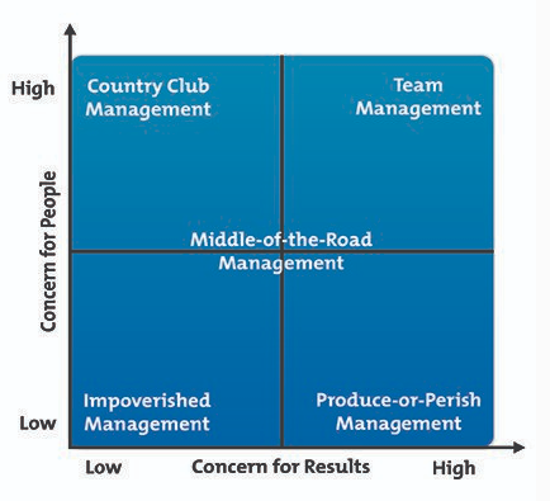
Blake-Mouton Leadership Grid (1960s)
Focuses on:
Concern for people: team member interests, needs, personal development goals.
Concern for results: productivity, efficiency, organizational goals.
Flamholtz & Randle’s Leadership Style Matrix (2007)
Picture of chart
Leadership Broadly
Leading involves:
Determining team objectives.
Motivating shared commitment to achieve them.
Maintaining culture and social relationships.
Transactional vs. transformational leadership.
Transactional Leadership
Premise: people are motivated by rewards and punishment.
Carrot and stick approach.
The ‘transaction’: I give you effort, you give me reward.
More management than leadership.
Reactive to present concerns, short-sighted, no future vision.
Not a good fit for knowledge-based, creative work.
Characteristics
Idealized influence (charisma): admired role models.
Inspirational motivation: provide meaning and challenge via clear communication and commitment to a shared vision.
Intellectual stimulation: solicit ideas and create solutions while emphasizing rationality.
Individualized consideration: personal attention.
Servant Leadership
Leadership must serve and meet the needs of others above all else.
Gain influence in a manner that derives from servanthood itself.
Follower development is the top priority.
Ethical Leadership
Encouraging standards that contribute to trusting and supportive conditions.
Principles: respect, justice, honesty, community, protection, integrity.
Leader Emergence
What contributes to leader emergence?
Personality Traits
In order of importance: Extraversion, Conscientiousness, Openness, Emotional Stability, Agreeableness.
Cognitive Ability
Intelligence, creativity, capacity to think differently.
Leaders can emerge by offering solutions to team problems.
Emotional Intelligence
High EI = understand emotions, greater capacity for empathy, emotional regulation.
May be more predictive than personality and cognitive ability.
Participation Rate
Most frequent communicator (regardless of contributions) contributes to leader emergence.
Quality-of-Communication Hypothesis
Frequent and high-quality leader communication synchronizes neural activities of followers and leaders.
Predicts leader emergence within 30 seconds of an interaction.
Follower Perceptions → Leader Emergence
Implicit leadership theory:
Prototypical notions about what constitutes a good leader (THWAMP).
Research focuses on gender differences:
Men emerge as leaders more frequently.
Women rated as more effective than men.
Gender stereotypes impact leader prototypes:
Communal qualities → typical feminine.
Agentic qualities → typical masculine.
People tend to overemphasize the importance of prototypes.
Effective Leadership
MANY models exist, offering different implications and emphasizing different facets of the leader, followers, and situation.
No single model is complete on its own.
Six Broad Approaches
Trait, behavioral, contingency, relational, charismatic, functional.
Trait Approach
Oldest model of leadership.
Emergence != effectiveness.
Dark triad of personality:
Narcissism, Machiavellianism, psychopathy.
Seek and attain leadership positions.
Problem with the trait approach: leaders are not equally effective across contexts.
Behavioral Approach
Defines effective leadership by actions → what do good leaders do?
Decision-making style (Lewin framework).
Task vs. social components (Blake-Mouton grid).
Key findings: members prefer leaders who maintain supportive social relationships.
Contingency Approach
Effective leadership depends on situational factors.
Effective leaders adapt their style to the situation.
Situational leadership links leaders' behavior to characteristics of followers (e.g., Flamholtz and Randle’s leadership style matrix).
Relational Approach
Leader-member exchange theory (LMX):
Leaders treat each follower differently based on the quality of their relationships.
‘In-group’ followers:
Get more information, attention, support, and resources.
More productive, committed, and satisfied.
Raises important issues of DEI (Diversity, Equity, and Inclusion).
High-Quality LMX Relationships
Dimensions of high-quality LMX communication:
Professional trust.
Professional development.
Verbal communication.
Affective.
Accessibility.
Low-Quality LMX Relationships
Dimensions of low-quality LMX communication
Professional trust
Professional development
Verbal communication
Nonverbal communication
Social
Betrayal
LMX Summary
Leader does not treat everyone alike.
Leader may be performing effectively with some team members but ineffectively with others.
May form higher-quality relationships with members similar to themselves.
Raises important issues with DEI.
Charismatic Approach
Weber: personality and physical characteristics.
Logos, ethos, and pathos:
Use convincing logic, establish credibility, evoke strong emotion.
Communication skills are key:
Storytelling, moral conviction, confidence, animated.
Can be learned and developed.
Gender differences exist.
Leadership in Teams
The leader is not always hierarchically above or external to the team.
No single member is likely to possess all leadership KSAs in all contexts.
Leadership should be thought of as a set of functions.
Functional Approach
The leader’s role is to help the team complete tasks and solve problems to get the job done.
Team problems are ill-structured:
Leaders must determine, gather, and evaluate relevant information across interpretations to devise and implement a solution.
Factors influencing successful navigation through problems:
Problem-solving skills
Social-judgment skills
Knowledge of the task, coworkers, and context.
The best person to carry out a function shifts.
Key Functions
Provide a supportive context for teams:
Focus on direction, structure, and external relations.
Facilitate internal operations:
Problem-solving, coordination, motivation, and affect management.
Provide coaching:
Guiding the team.
Team Coaching
Purpose: to build team capabilities through guidance.
Motivational coaching → commitment.
Consultative coaching → role coordination, strategy, and performance.
Educational coaching → building KSAs.
Need is based on stages of development.
Biggest problem: micromanaging leaders.
Shared Leadership
One person need not perform all leadership functions; it can be shared, distributed, or rotated.
Sharing leadership is empowering:
All members can monitor, diagnose, and provide solutions.
Benefits: improve trust, cohesion, conflict management, collaboration, and performance.
Less Hierarchy = More Self-Management Teams
Adaptation to rapid change and uncertainty:
Transferring power to autonomous units reduces the need for managers.
Better when teams are experienced and familiar.
Levels of self-management:
Responsible for monitoring own work process.
External leader may intervene.
Self-Managed Teams
Effective leaders:
Increase satisfaction.
Prepare teams for change and give support.
Active involvement = dissatisfaction by reducing autonomy.
Unclear goals = need for a strong leader, especially when the task is complex, novel, or non-routine.
Followership
Engaged and proactive followers defend against dysfunctional leaders.
Implicit followership theories:
Good followers: hard-working, enthusiastic, good citizens.
Ineffective followers: incompetent, insubordinate, conforming.
Two-dimensional framework: engagement vs. independence.
Followership Styles
Passive (take little initiative).
Conformist (proactive but servile).
Alienated (bare minimum, critical, cynical).
Pragmatic (adapt as needed for survival).
Effective.
Why Study Leadership
Leadership matters politically, practically, personally, intellectually, and scientifically.
Leadership Myths
Leadership is power (with people rather than over people).
Leaders are born (but leaders are also “made”).
All groups have leaders (large groups tend to require a leader).
People resist their leaders (most groups accept the need for a leader).
Leaders make or break their group (the “romance of leadership”).
Leadership Defined
Guidance, often by organizing, directing, coordinating, supporting, and motivating their efforts.
Reciprocal
Transactional
Transformational
Cooperative
Adaptive
Components of Leadership
Task leadership: focuses on the group’s work and its goals.
Relationship leadership: focuses on interpersonal relationships.
Leadership substitutes theory.
Sex differences in task and relationship leadership tendencies
Early explanations of leadership studied the “traits” of great leaders
“Great man” theories (Gandhi, Lincoln, Napoleon)
Belief that people were born with these traits and only the great people possess them
Other Predictors
Intelligence and emotional intelligence (degree of social skill)
Expertise, skill, and experience
Level of participation in discussion: the “babble effect”
Demographic Background
Height, weight, age
Ethnicity
Sex: Bias against women (even though women possess more of the skills needed to be a successful leader)
Implicit leadership theories (ILT): members' general beliefs about the qualities of leaders
Eagly’s social role theory: ILTs are not consistent with intuitive expectations about men and women: “Think leader, think male”
Personality Variable
Fiedler's contingency theory - High LPC leaders most effective in “moderately” favorable situations, Low LPC leaders most effective in very favorable or very unfavorable situations
Issues with Group Decision Making
Teams are susceptible to influence (normative, informational).
Group stressors can impede Group polarization.
More extreme than position of members.
Risky shift phenomenon: groups make riskier decisions than individuals.
Normative Influence
Compare ideas to teams norm, shift positions to achieve consistency.
Information Influence
Exposure to arguments from dominant position.
Groupthink
Factors Contributing to Groupthink
Structural decision-making flaws:
Ignoring input from outside sources, lack of diversity, poor norms.
Group cohesiveness.
External pressure limits time, critical discussion.
Tactics to Overcome Groupthink
Algorithmic Decision Making
Machine learning - generates and refines algorithm based on new data.
Ex. an algorithm to make hiring decisions.
Mitigates problems of attentionAI/ML Approaches
Full human-to-AI delegation
AI-to-human sequential decision making
Human-to-AI sequential decision making
Aggregated human-AI decision makingAdvantages of AI
Near limitless information
Quickly make accurate decisions/predictions
Limitations of AI
“Black box” (interpretability problem)
Susceptible to human bias → amplifies stereotypes and discrimination
Problem Solving, Innovation, & Creativity
A problem can be many things:
They exist on a continuum,
III Structured (vague beginning, unspecified goals and paths to solution) ←→ Well structured (clear beginning and end, objectively correct solution)
YOU need to know how to problem solve
Important skill for new graduates.
You’ll manage obstacles like technical issues, conflicting viewpoints, interpersonal conflicts
3 Categories of REsearch
Describing how teams solve problems
Prescribing how an ideal problem
Sometimes teams jump to solutions.
This is called a solution orientation
Begins by discussing potential solutions then making a decision.
solution s tend to be inadequate due to unclear understanding of problem
Should be avoided
How should teams solve problems?
Prescriptive approach (recommends an “ideal” process)
Depends on the problem type
More ill-structured/complex → more structured approach
Functional approach (emphasizes quality of team discussions over prescribed order of activities)
Functional approach
Problem analysis** (more important)
Determine solution criteria* (important)
Generate alternative solutions
Evaluate positive consequences of solutions
Evaluate negative consequences of solutions*** (most important)
Problem Recognition
Need to recognize the level of:
Severity
Chronic problems are less visible, often ignored
Familiarity
More familiar = more recognizable
Complexity
Number of connected factors
What factors might impact problem recognition? What can impact problem recognition?
Team norms
Norms for open discussionPerformance
Successful vs unsuccessful teamsEnvironment
Level of uncertainty, change → alert, attentive
Uncertainty makes it difficult to prepare
How to define the problemDefining ill-structured problems
Adding constraints/boundaries brings structure
Balancing oversimplification and overcomplication
Carefully create a shared mental model
Define in several ways before moving forward
Spend some time away (incubation period)Problem Analysis
Seeking information about…
The defined problem.
What is the impact? When/where/why/how does it occur?
Influencing factors.
Root causes, stakeholders, seriousness
How to find this information:
Interviews, obsessions, experience
Threats to Problem AnalysisBeware of:
Information overload = processing challenges
Information underload = waste of time on non-relevant data
Confirmation bias
Establishing Solution Criteria
Define what an acceptable solution must do (not what it is)
Necessary values, needs, functions, constraints
Can come from problem analysis, stakeholders
All criteria are not equally important
Criteria Matrix
Scale for rating alternatives in a structured manner (ex: cost, quality, acceptance)
Generating alternatives and selecting a solution
Good solutions:
balance the needs of team members and stakeholders
Efficiently use time and resources
Foster group harmony
Affected by KSAs and team climate
Techniques used to generate alternatives?Determining the best solution
Foster minority dissent
Assign a rotating role of ‘devil’s advocate’Decision-making and review procedures:
Voting and consensus
A ‘second-chance meeting’ can prevent groupthink, pressure to conformImplementation
A good solution is always feasible to implement.
No use agreeing on a solution that isn’t.
Consider who/what is required to make it happenForce field analysis is a way to understand the barriers and facilitators of change
Driving forces (+1) vs restraining forces (-1)
The implementation stage includes developing the action plan and contingency plans
Action plan: translating the solution into reality
Step-by-step road map with timing, milestones, roles and responsibilities
Break down large action items into stages for monitoring
Establishes evaluation metrics
Evaluation
The most overlooked step in problem solving. A successful solution addresses the goals specified in the problem definition stage
Solutions can come along with new problems
This step provides info for future problem identification and solving.
How can problem-solving teams improve?
Build shared models through process mapping.
Nature of problem, roles and KSAs, mutual awareness
Current vs. ideal map for how a process works
Facilitates team communication vis inclusion
Helps teams make better decisions that everyone is satisfied with
Creativity vs Innovation
What's the difference Creativity → innovationCreativity: process of generating useful ideas
Innovation: builds on creativity by focusing on implementing the idea to make something better
The innovation paradox
Idea generation and idea implementation require conflicting skills
The innovation process is defined by uncertainty
Unclear roles interfere
Cooperation and Competition
Teamwork is a Mixed-Motive situation
Personal and team goals can be incompatible
Social dilemmas
Everyone wants to maximize rewards and minimize costs
Short-term vs long-term benefits
Many choose to be competitive, creating vicious cycle
Factors encouraging cooperation:
Team size: small = more cooperative
Beliefs about whether others will cooperate
Prosocial values
Why are people in teams competitive
Primed by culture
Individualist vs collectivistic
70% of societies are collectivistic
Individualists value task contributors and collectivists value social-maintenance
More collectivists = more cooperation, performance
Culture is relatively stable
Why are people in teams competitive
Personality
Social values orientation:
Prosocial: maximize others' outcomes
Pro-self: maximize personal outcomes
Cooperators: pro-self AND prosocial
Competitors: pro-self
Individualists: pro-self
Organizational rewardsHR practices
Evals based on individual performance
Incentives and punishments
Cooperative rewards help
Cutthroat competition effect
Difficult to shift from competitive to cooperative relationship once established
Competition Erodes Trust
Goal confusion - are we committed to the same goal?
Impedes timely decision making
Conflict between teams
E.g., paramedics vs police
Competition Reduces Learning
Learning from mistakes is essential for teamwork
Competition → defend mistakes and continue misguided actions
Blaming and withholding of information
In a competitive climate, mistake = failure
Intergroup competition
Between members of different groups
Arbitrary group assignments
Enhanced cohesion within group, as well as prejudice and conflict between groups
Self worth is tied to social identity Ingroup bias
Pros and cons of intergroup competition
Increased cohesion Demand for conformity harms teams’ ability to adapt
Negative effects in ‘winners and losers’
Winners attribute success to superiority and ignore their problems
Losers may turn to blaming and scapegoating
Problems with cohesion*
Productive vs Unproductive ConflictsProductive: issues, ideas, tasks
Resolved by cooperative learning approach, communicationUnproductive: emotions, personalities
Resolving conflicts with one side often means the other side is dominated, resulting in competition and less communication
Two Dimensions of conflict managementAssertiveness: concern about own outcomes
Cooperativeness: concern about others outcomes
= 5 outcomes management Competing Conflict Management StylesCompeting approach (assertive, uncooperative)
Used to force an opinion or idea on the team
Cycle of escalation, attempting to outdo each other
Can be appropriate in emergencies when a quick resolution is needed A disruptive team member may need to be forcibly dismissedCompromise approach
Promotes equity, fairness
BUT, consistent compromise is not the goal
Can breed discontentmentCollaborative approach (assertive, cooperative)
Team members search for an alternative solution that allows everyone to win
Conflict emerges from the perception that there are incompatible goals
But this perception is inaccurate
Need to exchange info about interests to find commonalities
Conflict type + Conflict Management Style
How can conflict management styles be applied strategically?Behfar al. (2008) longitudinal study (Process conflict)
Followed teams of MBA students for a semester
Same teams in all 4 classes of first semester
Looked at performance and satisfaction
What is the best approachHigh performance, High satisfaction teams
Process conflict management proactively
Held discussions to forecast issues, clear roles
Task conflict handled via open communication, debates
Consensus, then compromise
Little to no relational conflict, avoided when occurredHigh performance, low satisfaction (rule-based teams)
Process conflict and relational conflict were handled with reactionary rules
Task conflicts managed by compromise and ‘majority rules’ votingLow performance, high satisfaction (passive reams)
Primarily used avoidance and accommodation
Had little process conflict and relational conflict, ignored it when it occurred
Task conflicts managed by superficial debates and premature compromiseLow performance, low satisfaction (unclear roles)
Process conflict ignored, didn’t understand causes
Extreme relational conflict, open communication was unhelpful
Task conflicts addressed with apathetic compromise or accommodating domineering member
Lessons learned from Behfar et al.
Address process conflict proactively
Team characters, clear roles, agree on process
Reactionary rules help at the cost of satisfaction Ignoring process conflict, premature compromising on tasks, directly addressing conflict = a bad time
Collaborative solutions are idealRequire open minded discussions, time, being uncomfortable
Open-Minded Discussions
Goal: to find an integrative agreement via…
Constructive controversy
Integrative negotiation
Impact: teams believe they are in a cooperative relationship, committed to helping each other
View issues as problems to be solved (not win/lose)
Can express interests freely Can argue positions until convinced otherwise
Constructive controversy
Constructive conflict management requires Openly expressing views Listening to understand Integrating opposition
By doing this, disagreements are not interpreted as personal attacks Resolved without creating relational conflict by maintaining trust and psychological safetyOutside mediators
Positive mindset about conflict
conflict is a precursor to positive change
Developing integrative agreements requires focusing away from positions and toward interests Mediators help control courtesy and respectful communication Search for small areas of agreement
AgreementsNegotiation: mutually acceptable agreement Structure for negotiation of a conflict:
Separate the people from the problem
Encourage recognizing and understanding emotions Focus on the shared interests of all parties
Focus on issues rather than positions
What about virtual teams
Communication limitations → misunderstandings Emotional issues escalate Resolutions challenged by less developed social relations, cohesion When conflict escalates, stop emailing and call instead for conflicts
problems so disagreements can be expressed sets aside time to debrief