Community Ecology
What is a Community?
• Community = any group of organisms belonging to a number of different species that coexist in the same habitat or area and interact through trophic and spatial relationships.
• Communities differ in the number of species they contain, species richness and the relative abundance of different species
Community Ecology
• Trophic structure is a key factor in community dynamics
• Trophic = “of or involving the feeding habits or food relationship of different organisms in a food chain”
• Community ecology = “study of species interactions as well as interactions with the abiotic environment”
Contrasting Views of Communities
• The integrated hypothesis of community structure depicts a community as an assemblage of close-linked species locked into association by mandatory biotic interactions
• The community functions as an integrated unit, as a superorganism
Contrasting Views of Communities
• Interactive hypothesis or superorganism concept = all species are closely tied together and locked into associations:
species that make up the community function together as a unit, dependent on each other
• Individualistic hypothesis = chance assemblage of species with similar habitat requirements
Contrasting Views of Communities
• The two hypotheses suggest different priorities in studying biological communities.
The integrated hypothesis emphasises occurrence of species as the essential units for understanding interactions and species distributions.
• The individualistic hypothesis emphasises single species.
Contrasting Views of Communities
• The hypotheses make contrasting predictions about how plant species are distributed along an environmental gradient
• Integrated → predicts species to be clustered into discrete communities with noticeable boundaries
• Individualistic → predicts communities generally lack discrete geographic boundaries because each species has an independent, individualistic distribution along the environmental gradient
Evolution of Communities
• Ecological Niche: combination of an organism’s habitat and its role in that habitat.
• Because of all the different interactions in niches, evolution will always happen even if abiotic change stopped.
Evolution of Communities
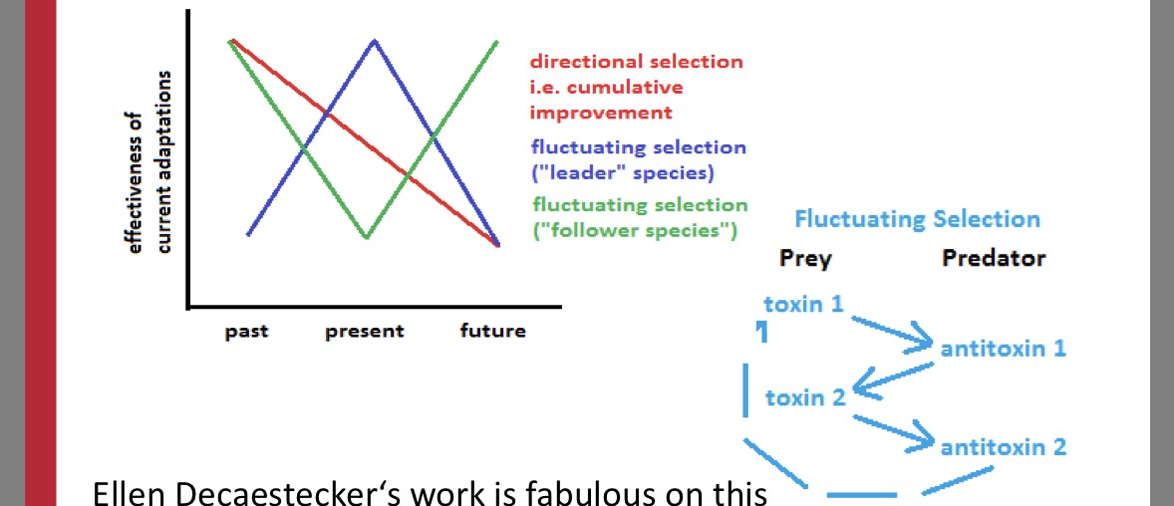
• There will can be two types of selection acting: directional selection and fluctuating selection
Community Structures
• Every niche has its own species and in the simplest terms, an ecological niche is analogous to
“So, what do you do for a living?”
• Of course, what humans do for a living is a far stretch from what our ecological niche is as a species
• What most other species do is a direct result of structural, physiological, and behavioural adaptations, which are inextricably linked to their habitat
Community Structures
• E.g. Downy woodpeckers eat insects, but are adapted to excavate prey from under bark or in dead trees, they are found in forests, not open grasslands
• Woodpecker niches are filled by very different species in different areas e.g. aye-aye in Madagascar
Community Structures:
Evolutionary Effects
• Darwin was told after the Beagle voyage by an expert that many of the species he collected (which Darwin believed to include finches, warblers, grosbeaks etc.) were all in fact finches
(triggering his ideas on evolution and descent from a single common ancestor)
Community Structures:
Evolutionary Effects
• The Grants have done much work on the Galapagos finches (Geospiza fortis) on Daphne Island for >40 years.
• It is a tiny island so has a simpler set of finches, where G. fortis was the major resident finch only until recently.
Community Structures:
Evolutionary Effects
• Why does beak morphology vary so much in Geospiza?
1. Food varies, so they evolved to make better use of each individual food resource
2. Food does really matter, but that competition remains important, so there are still fluctuating changes from generation to generation.
3. Null hypothesis (always remember to include one!) is that there is a random assortment of beak sizes.
Evolutionary Effects
• Recent data shows G. magnirostris can eat large tough tribulus seeds, and G. magnirostris is an intruder to Daphne Major in recent years.
• G. magnirostris easily outcompetes large-beaked medium ground finches when it comes to eating tribulus,
so its arrival on Daphne island has caused a reduction in beak height in G. fortis in recent years
Evolutionary Effects
1977 drought greatly depleted small and medium- sized seeds.
Small finches starved.
Some of large ones survived because their large beaks were good at eating large seeds.
So population born in 1978 averaged 4% larger when adult than population born in 1976: a huge change in one generation.
Community Structures:
Evolutionary Effects
El Nino event in early 1980s selected for small size, instead.
Geospiza magnirostris (name means “large beak”) arrived in 1997, and was common by 2003.
El Niño:
- a natural, temporary climate pattern characterized by warmer-than-average sea surface temperatures in the central and eastern tropical Pacific Ocean
Community Structures:
Evolutionary Effects
A 2004 drought selected for small body size in Geospiza fortis: the opposite selective effect to the effect of the 1977 drought.
Can you think of why there was a difference in the effects of the two droughts?
Character Displacement
The 2004 selective event on G. fortis is an example of “character displacement.
Evolution when a single species is present differs from when competition occurs between species.
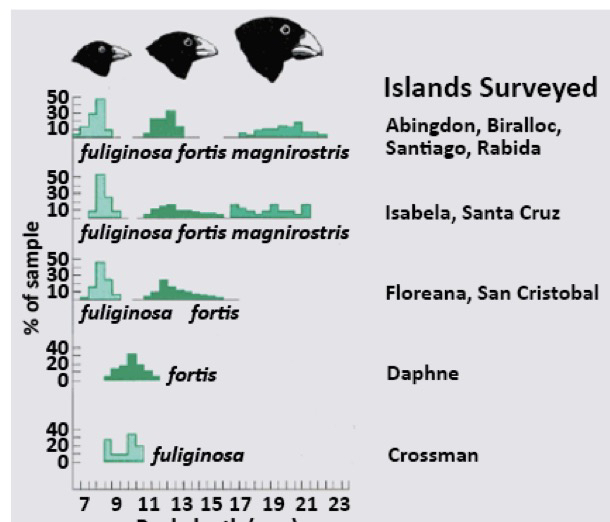
3 species of Geospiza finches: small, medium and large (see up) and several islands with different species combinations.
Natural selection results in character displacement with evolution in morphology, diet and behaviour.
Character Displacement
Character displacement – Species are different when sympatric to avoid competition, but allopatric populations are more similar morphologically.
Allopatry - Occur in separate, non-overlapping geographic areas and often involves populations of related organisms unable to crossbreed because of geographic separation.
Character displacement – Species are different when they are sympatric to avoid competition but allopatric populations are more similar morphologically to each other.
Sympatry - occur in overlapping geographical areas, but without interbreeding.

Types of Interaction
Interspecific interactions between species in a community:
1. Co-evolution: reciprocal interactions between species, mutualistic or not.
2. Arms race between plant/herbivore: Passiflora flowers and Heliconius butterflies: flowers are poisonous as a defence, so butterflies develop resistance.
3. Predator/Prey
4. Interspecific competition - two or more species compete for the same resources.
Examples of Interactions: Resource
Partitioning & Competitive Exclusion
Cocos Finch on Cocos Island (the only one of Darwin's finches not native to the Galápagos) eats a wider variety of food and has greater morphological variation than other Galapagos finches on the Galapagos Islands.
Resource partitioning - where different species have different traits that allow them to use a resource at a different time, in a different way, or in a different place
Competitive exclusion principle – two species competing for the same resources cannot exist.
Examples of Interactions:
Scramble Competition
e.g. no territory defence or dominance hierarchies, and individuals are free to pile in and take as much as they can → free-for-all!
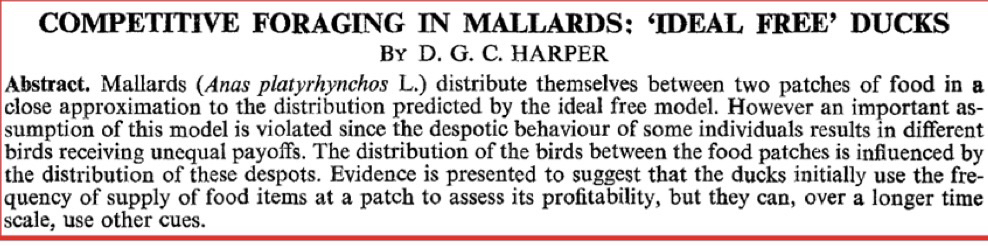
‘Producer vs Scrounger’ game
Two hypotheses:
(1) Scroungers are poorer competitors
(2) Scroungers and producers are of equal competitiveness
Contest competition
2 types:
Dominance Hierarchies
Territory Defence
Examples of Interactions: Passiflora 🌸
A genus of about 550 species of flowering plants:
mostly tendril-bearing vines, with some being shrubs or trees. Has wide range of fascinating interactions with many, many animal species.
Pollination
Pollinators include bumblebees, carpenter bees, wasps, bats, hummingbirds and some are capable of self-pollination.
Passiflora often exhibit high levels of pollinator specificity:
much pollinator-flower coevolution in the genus. -e.g. sword-billed hummingbird: sole pollinator of 37 species of high Andean Passiflora (that’s 7% of the Passiflora genus!)
2. Herbivory
Passiflora fed on by many Lepidoptera species. Famously fed on by many Heliconiini butterfly larvae.
Passiflora defensive adaptations include:
diverse leaf shapes (which help disguise their identity);
coloured nubs (which mimic butterfly eggs);
extrafloral nectaries;
trichomes;
variegation;
chemical defences.
These, combined with adaptations on the part of the butterflies, were important in the foundation of coevolutionary theory.
Heliconius larvae consume and sequester Passiflora leaves’ cardiac glycosides and alkaloids and use them for their own defence: a remarkable evolutionary achievement.
Passiflora has the highest foliar diversity of all plant genera worldwide, presumably to confuse herbivores re. the plant’s identity for oviposition
—
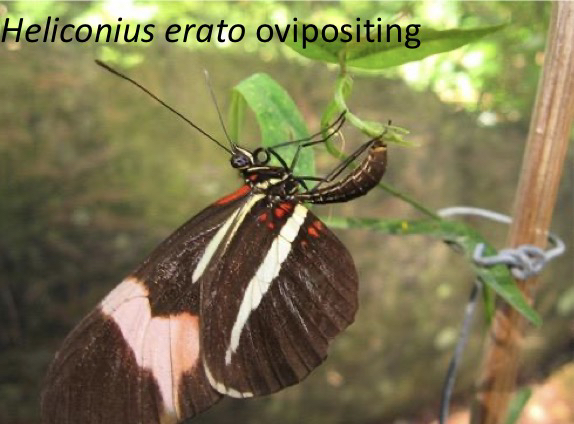
Heliconius responded with very accurate visual & chemosensory systems and expansion of brain structures to process such info:
- so they can memorise shapes and display elaborate pre-oviposition behaviour to defeat visual barriers evolved by Passiflora.
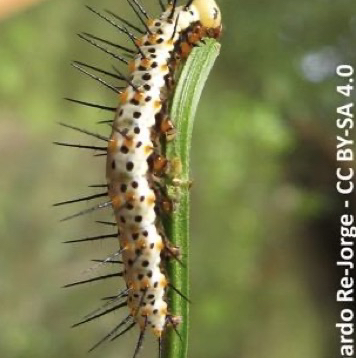
Heliconius erato larva Extra floral nectaries (used to attract ants) are common in Passiflora, and Heliconius have counterattacked by laying their eggs on new shoots, laying on neighbouring plants, long larval spines (see down) and aggressive cooperative larval defence.
Dominance Hierarchies
e.g. black-capped chickadees
• It is better to be at the bottom of a tree where there is more invertebrate prey and less risk from predators
• Females are more often found high up, in poorer sites
• When males were experimentally removed the females moved further down the trees, to the better sites, but were displaced back to the upper sites when the males were reintroduced
Territory Defence
• The bigger the area, the greater the resources BUT you may not need all the resources if they become abundant
• The bigger the territory, the higher the territory defence costs; therefore you want an intermediate size territory where benefits are maximized per unit cost paid
• e.g. in the golden winged sunbird territory defence is useful as it prevents other birds depleting the available nectar per flower
Intraspecific & Interspecific
• Intraspecific interactions between individuals of a species
• Interspecific interactions between different species
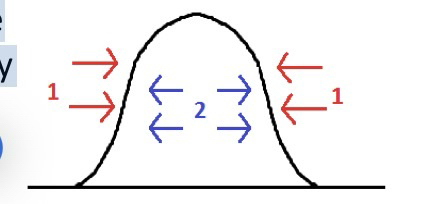
• We expect interspecific competition to shrink the niche (1) and intraspecific competition to expand the niche (2).
• Arrow size, position etc. is not meant to signify the relative strength of the selective effect, and there might only be pressure to the left or the right.
Species Interactions: Symbiosis
Symbiosis (sym – with; bios - life) literally means living together.
It can be:
- Predation & Parasitism
- Competition
- Mutualism
- Commensalism
- Amensalism
Predation – hungry bats and tasty moths!
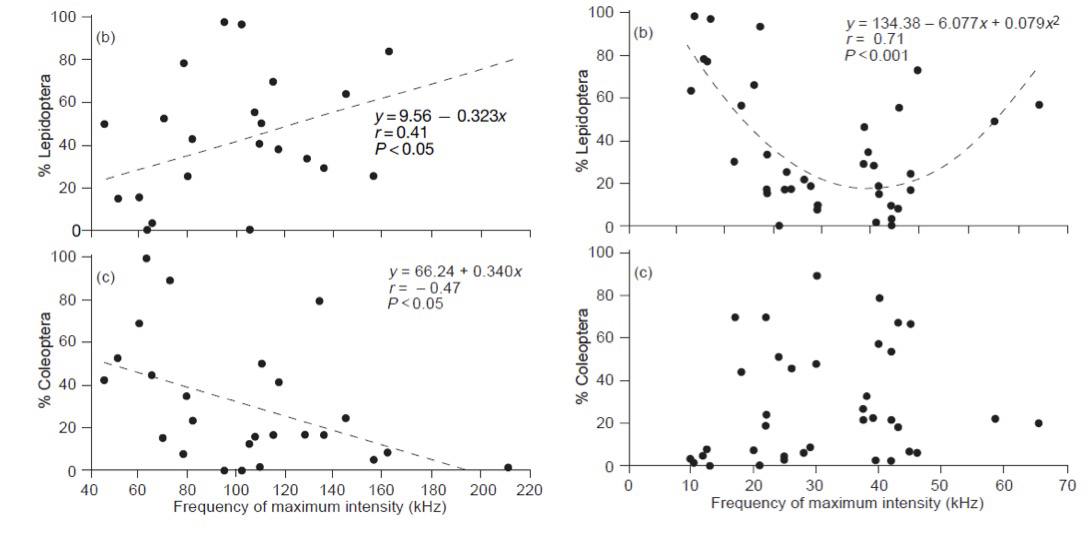
• Although moths evolved ears 10s of millions of years before echolocating bats first appeared (!) there has been a moth-bat arms race for 10s of millions of years up to the present.
• Bats should evolve vocalization frequencies that moths’ simple ears struggle to hear (and high frequencies travel less far than low ones).
• So if moths’ hearing is strongest at intermediate frequencies then bats’ vocalizations should cluster at low and high frequencies if they depend on moths for nourishment.
This is the allotonic frequency hypothesis and there is strong support for it.
Tiger moths fight back!
1. 2. Many unpalatable species squeak back when they hear bat ultrasound, and the bats then choose to avoid eating them.
Some palatable species copy this behaviour: they are tasty but mimic the “I’m not tasty” vocalizations.
3. Other species “jam” bats’ sonar using one
or more of 4 hypothesized methods:
- phantom echo(es),
- interference (reduces accuracy of bats’ target information location),
- masking (vocalizations prevent bats hearing real echoes),
- distraction (bats may struggle to effectively process both real echoes and moths vocalizations simultaneously).
Parasitism
A close association between two living organisms of different species which is beneficial to one (the parasite) and harmful to the other (the host)
• Over half of all known species are parasites
• Parasites are found in all biological kingdom
Parasitism
Parasite obtains food and shelter from the host
– Ectoparasites (e.g. ticks, fleas, leeches) live on the outer surface of the host
– Endoparasites (e.g. Plasmodium, Taenia [pictured]) live within the host
– Obligate – must live parasitically at all times
– Facultative – (e.g. fungi) feed parasitically initially but having killed the host continue to feed saprotrophically on the dead body.
Mutualism
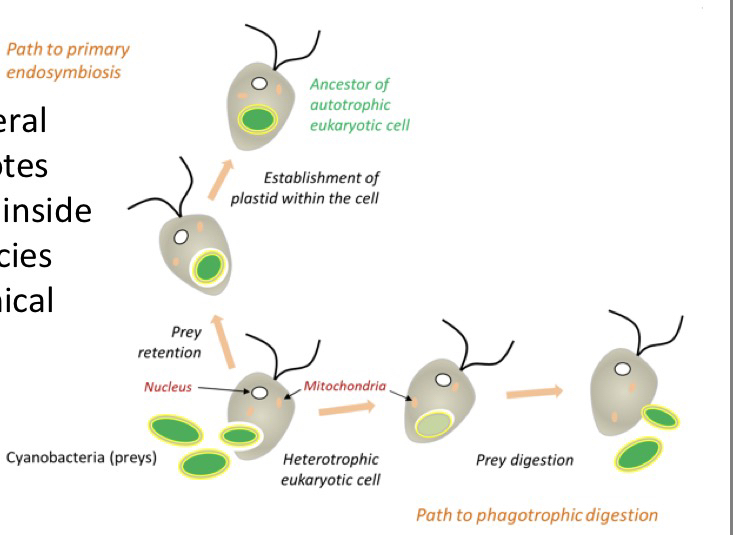
E. coli living in the intestine of humans (human provides shelter, E. coli provides vitamin K to host and assists digestion).
Douglas (1994) – several examples of prokaryotes that invaded and live inside eukaryotes, both species derive some biochemical benefits.
Mutualism
Nilsson et al. (1985) Hawkmoth with a long proboscis is a pollinator for a Madagascar white orchid with a long tubular flower, the moth accessing the nectar at the base of the flower.
Hummingbirds, sunbirds, white-eyes, other avian and mammalian nectarivores, bats and insects that feed on plant nectar and spread plant pollen - most species are tropical and prefer one species of plant, which prevents cross-pollination.
Commensalism
Commensalism (com – together; mensa – table)
A close association between two living organisms of different species which is beneficial to one (the commensal) and does not affect the other (the host).
Examples – an orchid or lichen (the commensal) growing on a tree (the host)
Environmental Adaptation
• Why are some species so rare if they are well-adapted to their environment?
• Non-adaptive species should barely exist at all, so surely all extant species are well-adapted, and therefore common?
Environmental Adaptation & Species Distributions
Two dominating hypotheses:
1. Species may only be common in a few places
2. Species may be rare everywhere
• Sampling effects are crucial:
much of the world we haven’t studied particularly well, especially in the tropics where it is more speciose!
Environmental Adaptation & Species Distributions
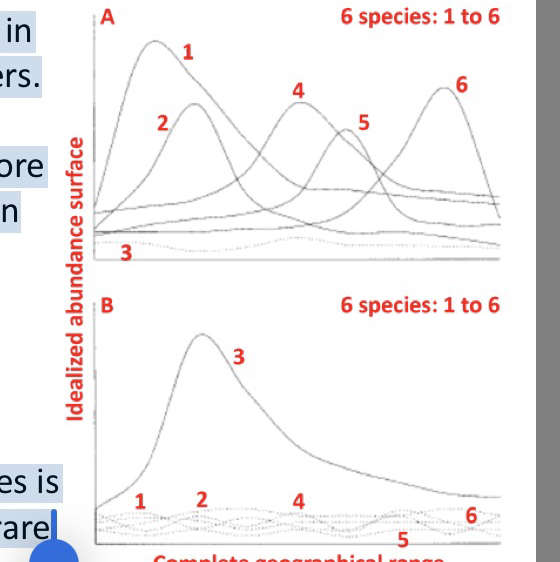
Species 1 to 6 are all common in some habitats but rare in others.
Sampling one part of the geographical range will therefore find one species to be common and all others to be rare.
Species 3 is the only common species throughout the geographical range.
Sampling anywhere will show this species is common and all others to be rare
Environmental Adaptation & Species Distributions
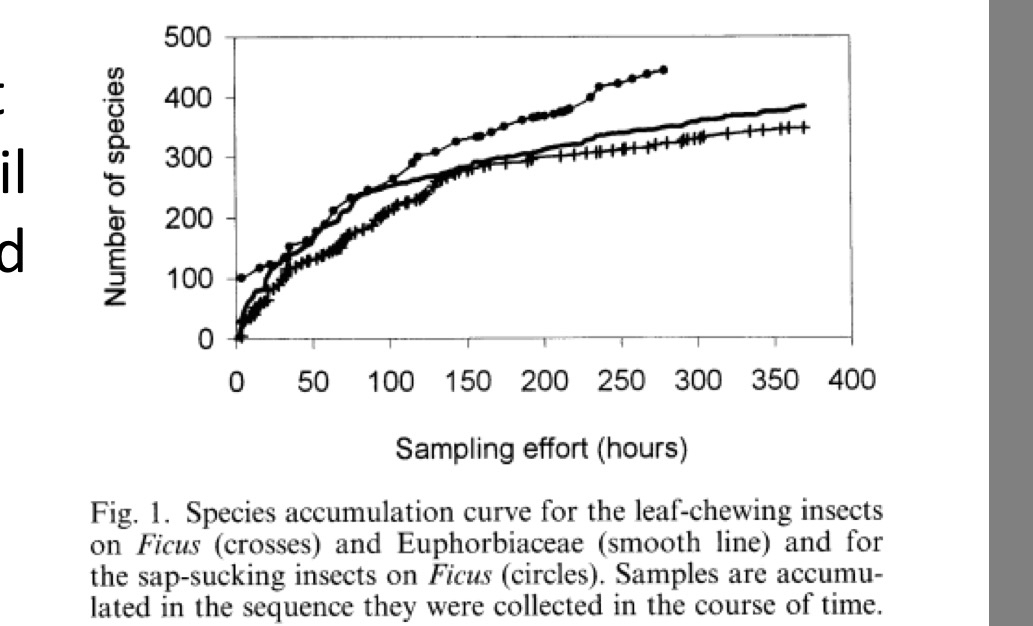
In 2000, researchers identified 80,000 individual specimens to species level, from 30 species of trees and shrubs in New Guinea.
After all this effort, they had not yet seen their sampling curve tail off, and most species were found in a few individuals.
It suggests that many species actually are rare, and the levels of biodiversity are vast.
Environmental Adaptation & Species Distributions
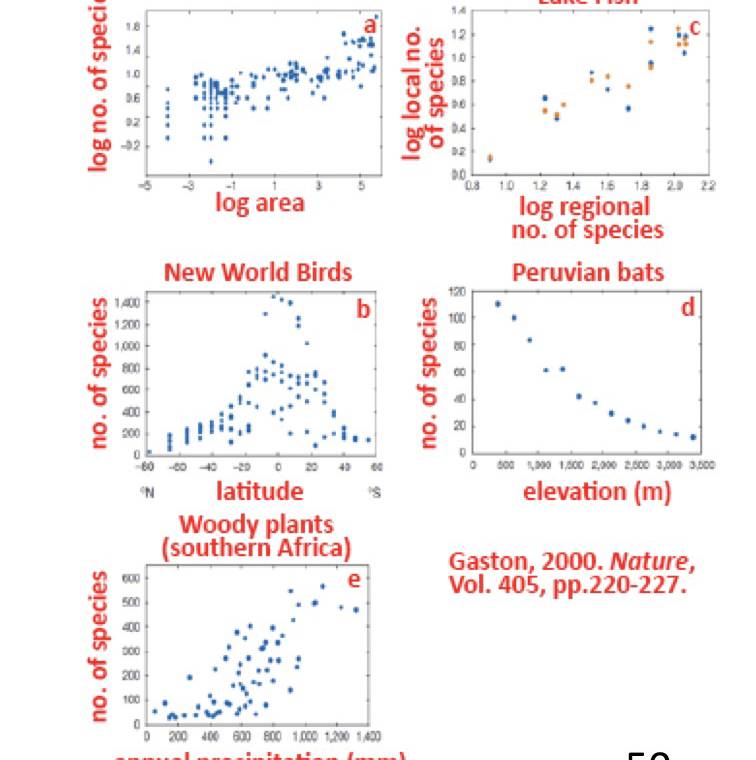
There is a universal pattern of higher distribution in the tropics for most organisms
This pattern is found at a wide range of sampling scales and is long term (it can be seen in fossils).
Why is There High Biodiversity in the Tropics?
Three ultimate explanations:
1. New species evolve faster in the tropics: “cradle” hypothesis
2. Species live for longer in the tropics:
“museum hypothesis
3. Species migrate into the tropics fromelsewhere:
“destination” hypothesis
Defining Biodiversity
• It is hard to define and many people do not know what it is:
– Genetic and biological species diversity
– Abundance and diversity of species
– Diversities of ecosystem
• Biodiversity was formally defined at the Convention on Biological Diversity in Rio (1992):
the variability among living organisms from all sources including, inter alia, terrestrial, marine and other aquatic ecosystems and the ecological complexes of which they are part; this includes diversity within species, between species and of ecosystems”