Chapter 2 Study Guide: Reconstruction - America's "Unfinished Revolution"?
Overview and Academic Benchmarks of Reconstruction
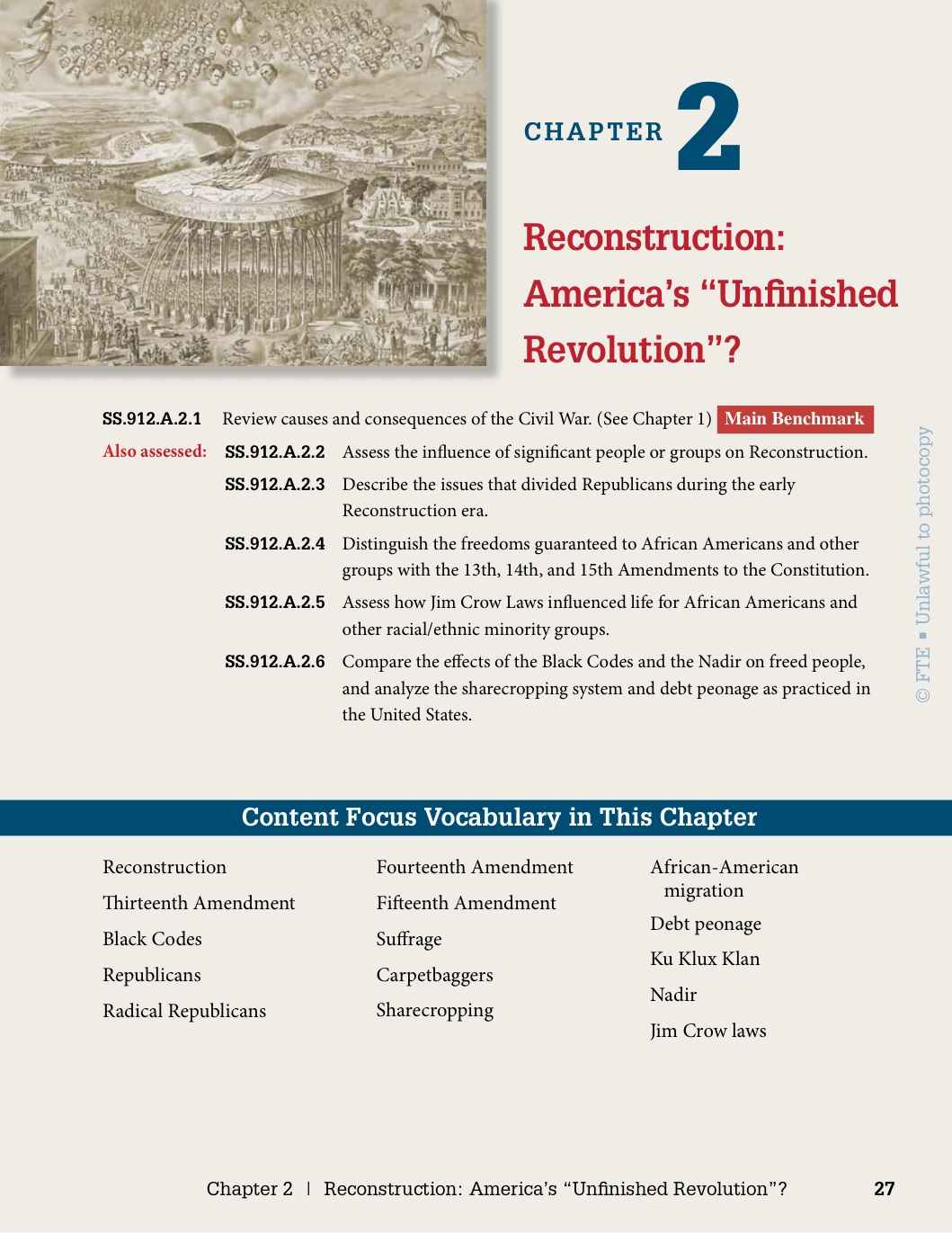
Reconstruction refers to the historical period immediately following the American Civil War during which the United States attempted to readmit Southern states to the Union, integrate millions of emancipated freedmen into public and economic life, and rebuild war-torn Southern economies. Historian Eric Foner highlights that this era represented a moment of immense political promise; however, because national leadership failed to sustain fundamental structural change, Reconstruction stands as America's "Unfinished Revolution."
Main Academic Benchmark:
SS.912.A.2.1: Review causes and consequences of the Civil War.
Assessed Academic Benchmarks:
SS.912.A.2.2: Assess the influence of significant people or groups on Reconstruction.
SS.912.A.2.3: Describe the issues that divided Republicans during the early Reconstruction era.
SS.912.A.2.4: Distinguish the freedoms guaranteed to African Americans and other groups with the 13th, 14th, and 15th Amendments to the Constitution.
SS.912.A.2.5: Assess how Jim Crow Laws influenced life for African Americans and other racial/ethnic minority groups.
SS.912.A.2.6: Compare the effects of the Black Codes and the Nadir on freed people, and analyze the sharecropping system and debt peonage as practiced in the United States.
Content Focus Vocabulary
Reconstruction: The period after the Civil War during which Southern states had to be readmitted into the Union, emancipated freedmen brought into public life, and war-torn Southern economies rebuilt.
Thirteenth Amendment: The constitutional amendment proposed by the U.S. Senate in April 1864, passed by the House in January 1865, and ratified in late 1865 that officially abolished and prohibited slavery throughout the United States.
Fourteenth Amendment: The constitutional amendment that defined United States citizenship and guaranteed all citizens equal protection before the law and crucial civil rights.
Fifteenth Amendment: The constitutional amendment that prohibited the denial of suffrage (the right to vote) to any citizen on the basis of race, color, or previous condition of servitude.
Black Codes: Severe legal statutes passed by Southern state legislatures immediately following the Civil War, modeled on older antebellum slave codes, designed to restrict the civil rights and freedom of movement of freedmen.
Republicans: The political party of President Abraham Lincoln during the Civil War, which became divided over Reconstruction policies regarding how leniently or strictly to treat former Confederate states.
Radical Republicans: A faction of Republicans in Congress who advocated for complete political rights and civil equality for African Americans, military occupation of the South, and strict consequences for former Confederate leaders.
Suffrage: The legal and constitutional right to vote in public elections.
Carpetbaggers: A term used to describe Northerners who moved to the South during the Reconstruction era to hold political office, participate in government, or engage in economic and social projects.
Scalawags: A derogatory term for Southern whites who supported Reconstruction and collaborated with Northern Republicans and freedmen in Southern governments.
Sharecropping: An economic arrangement developed during Reconstruction where landowners provided land to freedmen in exchange for a portion or share of the harvested crops.
Debt Peonage: A state of involuntary servitude in which a debtor is forced to work for a landlord or creditor until accumulated financial debts are paid off.
African-American Migration: The demographic movement of newly emancipated African Americans moving out of the rural South to other areas of the United States.
Ku Klux Klan (KKK): A white supremacist terrorist organization that utilized violence, intimidation, and brutal attacks to prevent African Americans from exercising their civil and voting rights.
Jim Crow Laws: Systemic racial segregation laws passed by Southern states after Reconstruction that required the separation of "white" and "colored" individuals in public places.
Nadir: The historical period following Reconstruction representing the worst low point in American race relations, marked by racial segregation, violence, and disenfranchisement.
Core Challenges of the Reconstruction Era
By the end of the Civil War in April 1865, much of the Southern region was completely devastated:
Physical Destruction: Southern towns, farms, and plantations were in total ruins, and advancing Union armies had torn up primary railway transportation lines.
Economic Collapse: Confederate paper currency had lost all value, leaving Southern citizens destitute.
Social Upheaval: The collapse of the Confederacy eliminated the antebellum social order, making it impossible for Southerners to return to pre-war ways of life.
To rebuild the South, Americans were forced to overcome five primary political, economic, and social hurdles:
Readmission Conditions: How Southern states should be readmitted to the Union.
Constitutional Power: Whether the President or Congress possessed the constitutional power to set readmission conditions.
Treatment of Confederate Leadership: Whether former Confederate leaders should be permitted to participate in public life or be excluded and punished.
Status of Freedmen: Determining the civil, social, and economic position of the four million newly emancipated former slaves (freedmen or freedpeople) in Southern society. Historians regard this as the single greatest challenge of Reconstruction.
Economic Reconstruction: Rebuilding the broken economy of the Southern states.
Early Plans and Political Conflicts for Reconstruction
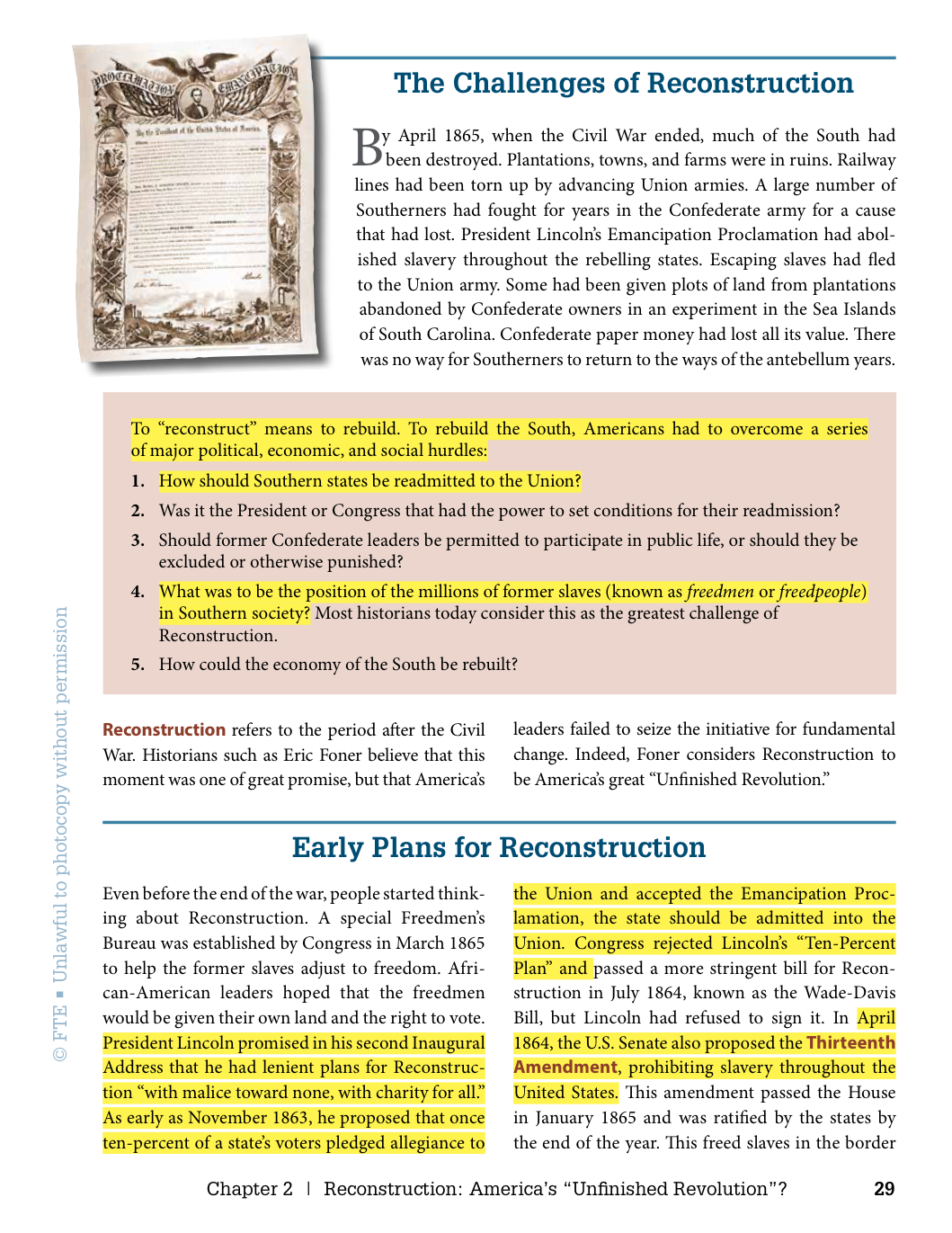
Political conflicts over Reconstruction emerged prior to the end of the war as leaders debated how to re-integrate the South and support emancipated individuals.
Establishment of the Freedmen's Bureau: In March 1865, Congress established a special federal agency called the Freedmen's Bureau. The bureau set up local offices across the South to help former slaves adjust to freedom and established schools for their education.
Land and Voting Aspirations: African-American leaders hoped freedmen would receive voting rights and land ownership. During the war, escaping slaves were granted land plots from abandoned plantations on the Sea Islands of South Carolina. However, despite wartime experiments and promises, freedmen overall were not granted land.
Lincoln's Reconstruction Plan: President Abraham Lincoln advocated for a lenient policy toward the South, stating in his Second Inaugural Address his commitment to act "with malice toward none, with charity for all."
The Ten-Percent Plan (November 1863): Lincoln proposed that once ten percent () of a Southern state's voters from the 1860 election took an oath of allegiance to the Union and accepted the Emancipation Proclamation, the state could form a government and be readmitted.
Congressional Opposition and Presidential Succession:
Congress rejected Lincoln's Ten-Percent Plan as overly lenient. In July 1864, Congress passed the Wade-Davis Bill, establishing stricter readmission criteria, but Lincoln refused to sign it.
Following Lincoln's assassination in April 1865, Vice President Andrew Johnson assumed the presidency. Though initially appearing stern toward former Confederates, Johnson soon pardoned almost all former Confederate leaders.
Radical Reconstruction and Congressional Action
The leniency of Andrew Johnson and the rapid re-emergence of Confederate elites led to direct conflict with Northern Republicans in Congress.
Passage of Black Codes: Southern state legislatures accepted the end of slavery but passed Black Codes to strictly limit freedmen's civil rights and movement.
Congressional Backlash: Outraged by Black Codes and the election of former Confederate officials to Congress, Northern Republicans passed the Civil Rights Act, granting freedmen civil rights. This statute formed the direct basis for the Fourteenth Amendment.
Radical Republican Control: Radical Republicans gained veto-proof control of Congress and implemented their own Reconstruction plan:
Military Districts: The South was divided into five () military districts, each occupied and governed by the Union army.
Disenfranchisement and Voting: Former Confederate leaders lost political rights, whereas freedmen were granted suffrage.
Impeachment of Andrew Johnson: Republicans in Congress impeached President Andrew Johnson in the House of Representatives due to his opposition to Reconstruction measures; however, the Senate fell one vote short of removing him from office.
Constitutional Amendments (13th, 14th, and 15th)
Three foundational amendments were added to the United States Constitution during Reconstruction:
Thirteenth Amendment:
Timeline: Proposed by the U.S. Senate in April 1864, passed by the House of Representatives in January 1865, and ratified by the states by late 1865.
Provision: Completely abolished slavery and involuntary servitude throughout the entire United States, freeing slaves in all states, including loyal border states.
Fourteenth Amendment:
Provision: Defined national U.S. citizenship and guaranteed all citizens equal protection under the law and vital civil rights.
Fifteenth Amendment:
Provision: Prohibited any state or federal government from denying a citizen suffrage (the right to vote) based on race, color, or previous condition of servitude.
Political and Social Dynamics in the Reconstruction South
Governance: Freedmen, carpetbaggers (Northerners who moved south), and scalawags held political power in Southern state governments.
African-American Officeholding: For the first time, African Americans were elected to public office, including seats in state legislatures and the United States Congress.
Achievements: Reconstruction governments built public schools, constructed roads, and enacted social legislation promoting racial equality.
Troop Withdrawal: In the late 1870s, Northern troops were withdrawn from the South, enabling Southern state governments to regain control and enact segregation laws.
Economic Realities: Sharecropping, Debt Peonage, and Migration
Reconstruction forced the South to develop a new agricultural labor system due to capital and land shortages:
Sharecropping System: Former slave owners lacked cash to pay wage laborers, while emancipated slaves lacked land. Under sharecropping, freedmen farmed land owned by a landlord in exchange for providing the owner a share of the harvested crops.
Tenant Farming and Debt Peonage: Many freedmen rented land as tenants and borrowed money for seed and tools. Falling crop yields or high merchant interest rates trapped farmers in debt peonage, keeping them in servitude to pay off debts they could not afford.
African-American Migration: Facing economic hardship and rising violence, increased numbers of African Americans began migrating out of the South.
The Post-Reconstruction Era: Jim Crow, Plessy v. Ferguson, and the Nadir
After federal troop withdrawal concluded Reconstruction, Southern states instituted legal and physical systems of racial control.
Jim Crow Laws: Southern legislatures enacted state and local Jim Crow laws requiring racial segregation (separation of "white" and "colored" individuals) in public facilities.
Plessy v. Ferguson (1896): The U.S. Supreme Court reviewed segregation laws in Plessy v. Ferguson (1896) and formally upheld Jim Crow laws under the "separate but equal" legal doctrine.
Racial Violence: The Ku Klux Klan and similar white supremacist terror groups committed violent acts and lynching against African Americans to suppress political rights.
The Nadir: This era represented the Nadir, or the historical low point in race relations across the United States.