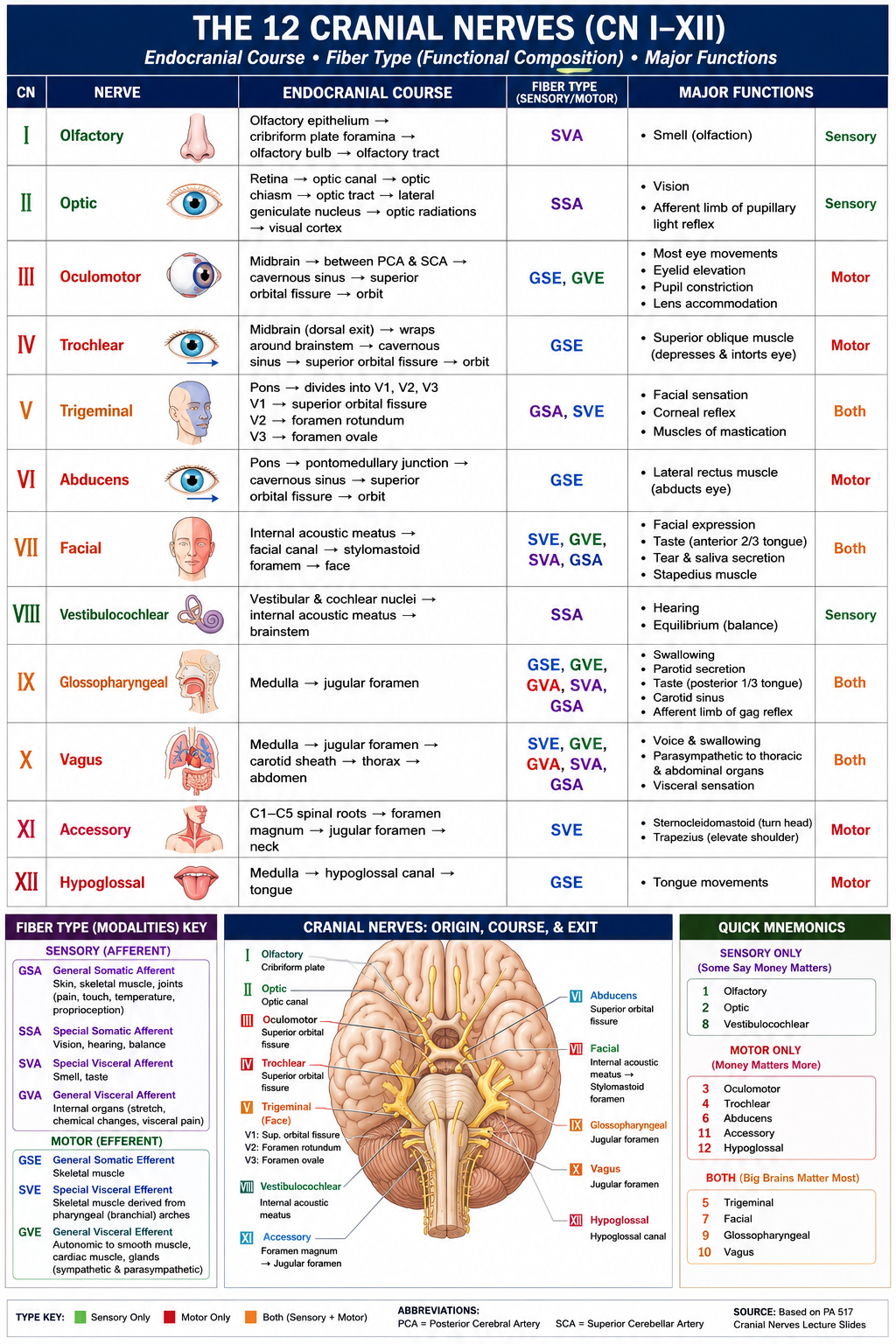
Cranial nerve
Identify the 12 pairs of cranial nerves and describe the endocranial course, functional composition (sensory/motor), and major functions of each nerve:
Optic
Olfactory
Oculomotor
Trochlear
Trigeminal
Abducens
Facial
Vestibulocochlear
Glossopharyngeal
Vagus
Accessory
Hypoglossal
Cranial Nerves Summary:
CN | Nerve | Endocranial Course (Slides) | Fiber Type(s) | Major Function(s) | Type |
|---|---|---|---|---|---|
CN I | Olfactory | Olfactory epithelium → cribriform plate foramina → olfactory bulb → olfactory tract | SVA | Smell (olfaction) Olfactory sensation to cerebral cortex | Sensory |
CN II | Optic | Retina → optic canal → optic chiasm → optic tract → lateral geniculate nucleus → optic radiations → visual cortex | SSA | Vision; afferent limb of pupillary light reflex | Sensory |
CN III | Oculomotor | Midbrain → between PCA & SCA → cavernous sinus → superior orbital fissure→ orbit | GSE, GVE | Eye movement, eyelid elevation, pupil constriction, lens accommodation | Motor |
CN IV | Trochlear | Midbrain → exits dorsally → wraps around brainstem → cavernous sinus → superior orbital fissure | GSE | Superior oblique muscle (depresses and intorts eye) | Motor |
CN V | Trigeminal | Pons → divides into V1, V2, V3 | GSA, SVE | Facial sensation, corneal reflex, mastication | Both |
CN VI | Abducens | Pons → pontomedullary junction → cavernous sinus → superior orbital fissure | GSE | Lateral rectus muscle (abducts eye) | Motor |
CN VII | Facial | Brainstem → internal acoustic meatus → facial canal → stylomastoid foramen | SVE, GVE, SVA, GSA | Facial expression, taste (anterior 2/3), tear & saliva secretion, stapedius | Both |
CN VIII | Vestibulocochlear | Vestibular & cochlear nuclei → internal acoustic meatus → brainstem | SSA | Hearing and equilibrium | Sensory |
CN IX | Glossopharyngeal | Medulla → jugular foramen | GSE, GVE, GVA, SVA, GSA | Swallowing, parotid secretion, taste (posterior 1/3), carotid sinus, gag reflex | Both |
CN X | Vagus | Medulla → jugular foramen → carotid sheath → thorax → abdomen | SVE, GVE, GVA, SVA, GSA | Voice, swallowing, autonomic control, visceral sensation | Both |
CN XI | Accessory | C1–C5 spinal roots → foramen magnum→ jugular foramen | SVE | Sternocleidomastoid & trapezius (head rotation, shoulder elevation) | Motor |
CN XII | Hypoglossal | Medulla → hypoglossal canal | GSE | Tongue movement | Motor |
Fiber Type | Sensory or Motor? | What It Does | Examples |
|---|---|---|---|
GSA | Sensory | General body sensation | Pain, touch, temperature |
SSA | Sensory | Vision, hearing, balance | Eyes and ears |
SVA | Sensory | Smell and taste | Nose, tongue |
GVA | Sensory | Internal organ sensation | Blood pressure, stretch |
GSE | Motor | Skeletal muscle movement | Eye and tongue muscles |
SVE | Motor | Branchial arch muscles | Facial expression, chewing, swallowing |
GVE | Motor | Parasympathetic output | Glands, smooth muscle, heart |