Week 12 Collaborate Session Study Notes
Concise Version
Week 12 Collaborate Session Overview
Session Introduction
Recording in progress, microphone confirmed working.
Welcome everyone to week 12 collaborate session; it is the final week of the teaching period.
Instructor present with Beck, acknowledges participation from the group.
Reflection on the Teaching Period
Instructor's perception: teaching period has felt both quick and slow.
Break for the holiday season creates a disruption in continuity, but necessary.
Revision Focus for the Session
Emphasizes the focus is solely on revision.
No new content will be delivered this week; preparation for final exam is emphasized.
The final exam is scheduled in a week.
Acknowledgment of Traditional Land Owners
Statement acknowledging traditional owners of land across Australia and respect for elders, ancestors, cultures, and heritage.
General Guidelines for Exam Preparation
Importance of utilizing OLAs (Online Learning Assistants) for guidance and questions during the final week.
Examples of other support available include student coaches and advisers.
Advises contacting student advisers regarding exam arrangements as exams are managed centrally.
Confidence in Exam Preparation
Instructor polls students on their confidence levels regarding the exam on a scale of 1-10.
Most students report confidence levels under 5 due to the uncertainties associated with the exam format and content.
Exam Details
Assignment two part two results will release on Sunday or Monday and will be available before the exam.
Final exam holds significant weight: 40% of the unit grade.
Students may enter the exam with up to 60% of the unit already earned, potentially easing exam-related stress.
Exam Structure
Exam duration: 3 hours with 10 minutes for perusal (total of 190 minutes for completing the exam).
Explanation of the exam originally structured as supervised; now held unsupervised but has retained the longer duration.
Unsupervised exam details: open book, students may bring materials to aid them in answering questions.
Exam format includes:
Multiple choice questions (9 questions with 4 options).
Short answer and report writing components mirroring previous assignments.
Exam content spans from weeks one through eleven, excluding the current revision week.
No practical component, no requirement to use SPSS.
Preparation Recommendations
Students should make use of available materials, highlighting the need to be familiar with SPSS outputs.
Encouragement to prepare materials for quick referencing during the exam, allowing for effective time management.
Instructor notes it is acceptable to bring pen and paper for calculations despite restrictions on other forms of note-taking.
Key Exam Prep Topics
Students should ensure they can identify appropriate statistical tests for given scenarios based on research designs and types of variables involved.
Examples of scenarios: correlational designs (regression analyses), comparison of means (t-tests).
Need to interpret SPSS outputs including graphs correctly and efficiently.
Understanding essential statistical concepts such as means, relative risk, significance, p-values, sampling theory, and types of variables.
Practice Exams
Availability of two trial exams located in Canvas modules 12.2 and 12.7.
Encouraged to practice under typical exam conditions to enhance preparedness.
Important to check answers post-practice and address any learning gaps identified during that exercise.
Content Review By Week
Week One
Populations vs Samples:
Populations are the broader group, samples are subsets from populations used to make inferences.
Importance of understanding and recognizing sources of bias in sampling.
Rounding statistics: use 2 decimal places for general stats, 3 for p-values.
Week Two
Metric vs Categorical Variables:
Identifying variable types and their implications for analysis outcomes.
Data displays for summarizing data.
Week Three
Central Tendency Measures:
Understanding mean, median, mode, and when to use each.
Discussion of hypotheses: null and alternative hypotheses.
Week Four
Z Scores & Normal Distribution:
Understanding the normal distribution and related z scores.
Relationship between z scores and normal curves.
Z score calculation formula:
Z = \frac{(X - \mu)}{\sigma}
where X is the raw score, \mu is the mean, and \sigma is the standard deviation.
Week Five
Hypothesis Testing with Sample Means:
Introduction to dependent and independent variables.
Identification of nuisance and confounding variables.
Week Six
T-tests:
Exploring one sample, independent samples, and paired samples t-tests.
Importance of understanding homogeneity of variance and using Levene's test effectively.
Week Nine
Correlational Designs:
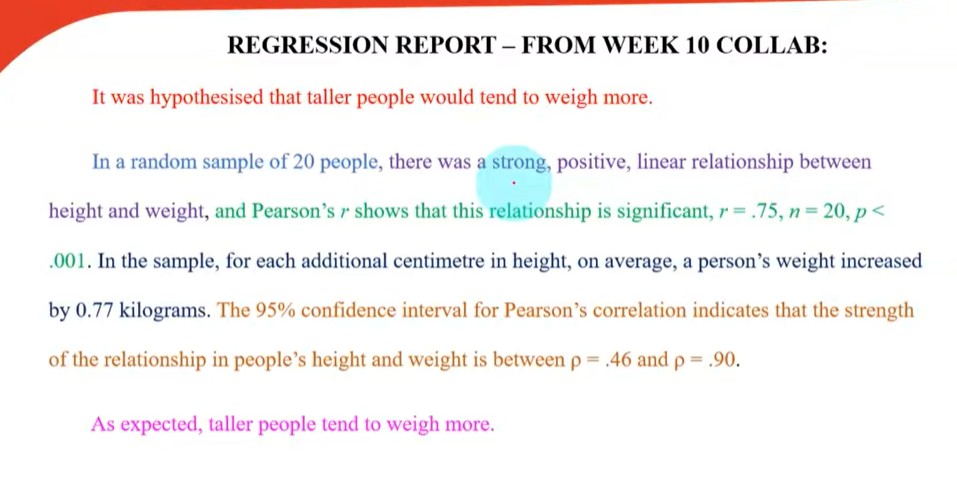
Description of relationships (direction, form, strength) using metrics like Pearson's r and data visualizations (scatter plots).
Definition and significance of the coefficient of determination:
R^2
(explained variance).
Final Reminders
Importance of careful interpretation of outputs and clarity in reporting results.
Structured responses in relation to hypothesis testing, and proper conclusion formulation.
Closing Remarks
Last reminders about preparation and support availability prior to the exam.
Information about trial exams, attendance at optional drop-in sessions, and different resources for revision.
Appreciation for class engagement and open invitation for additional questions post-session.
Discussion about unit feedback survey for continuous improvement.
Apologies for running overtime, expressed gratitude towards Beck for ongoing support during the session.
Instructor encourages students to review materials thoroughly, apply learning to practice questions, and reach out for any assistance needed before the exam.
Detailed Version
Week 12 Collaborate Session Overview
Session Introduction
Recording in progress, microphone confirmed working to ensure everyone can participate fully.
Welcome everyone to week 12 collaborate session; it marks the conclusion of the teaching period and an important milestone in the course.
Instructor present with Beck, acknowledges participation from the group, emphasizing the value of collective input and collaboration during the final week of study.
Reflection on the Teaching Period
Instructor's perception: the teaching period has seemed both quick and slow, highlighting the contrasting experiences students may have felt as they navigated through the course content.
The break for the holiday season creates a disruption in continuity but is considered necessary for student well-being and rest.
Revision Focus for the Session
Emphasizes the session's focus is solely on revision to consolidate knowledge ahead of the final exam.
No new content will be delivered this week; the primary goal is to prepare effectively for the upcoming final exam, ensuring students feel equipped and confident.
The final exam is scheduled for one week from now, emphasizing the urgency and importance of maximizing this revision opportunity.
Acknowledgment of Traditional Land Owners
Acknowledgment of traditional owners of the land across Australia, expressing respect for elders, ancestors, cultures, and heritage. This reflects a commitment to recognizing the diverse histories and contributions of Indigenous peoples in Australia.
General Guidelines for Exam Preparation
Importance of utilizing OLAs (Online Learning Assistants) for guidance and questions during the final week, ensuring that all students can access support as needed without hesitation.
Examples of other support available include student coaches and advisers who provide additional help.
Advises contacting student advisers regarding exam arrangements as exams are managed centrally, which includes scheduling and necessary accommodations.
Confidence in Exam Preparation
Instructor polls students on their confidence levels regarding the exam on a scale of 1-10, aiming to gauge overall readiness and provide reassurance.
Most students report confidence levels under 5, due to uncertainties associated with the exam format and content; this feedback is crucial for the instructor to address any widespread concerns.
Exam Details
Assignment two part two results will be released on Sunday or Monday and will be available before the exam, providing students with essential feedback that can inform their revision strategies.
The final exam holds significant weight: 40% of the unit grade, underscoring the importance of preparation and understanding of all course material.
Students may enter the exam with up to 60% of the unit already earned, potentially easing exam-related stress as prior achievements can help enhance confidence.
Exam Structure
Exam duration: 3 hours with an additional 10 minutes for perusal (total of 190 minutes for completing the exam), allowing students to read and formulate their approach to the questions.
Explanation of the exam originally structured as supervised; now held unsupervised but has retained the longer duration, allowing for a more flexible exam experience.
Unsupervised exam details: open book, enabling students to bring materials to aid in answering questions, thus promoting effective resource utilization.
Exam format includes:
Multiple choice questions (9 questions with 4 options), testing knowledge breadth and recall ability.
Short answer and report writing components mirroring previous assignments, reinforcing the practical application of knowledge gained.
Exam content spans from weeks one through eleven, excluding the current revision week, ensuring comprehensive assessment of covered material.
No practical component nor requirement to use SPSS, streamlining focus on theoretical understanding and application.
Preparation Recommendations
Students should make use of available materials, highlighting the need to be familiar with SPSS outputs, which are critical for interpreting statistical data.
Encouragement to prepare materials for quick referencing during the exam, allowing for effective time management and minimizing stress during the test.
Instructor notes it is acceptable to bring pen and paper for calculations despite restrictions on other forms of note-taking; this emphasizes practical math skills and aids clarity in problem-solving.
Key Exam Prep Topics
Students should ensure they can identify appropriate statistical tests for given scenarios based on research designs and types of variables involved.
Examples of scenarios include correlational designs (involving regression analyses) and comparison of means (t-tests), which form the backbone of much statistical analysis.
Need to interpret SPSS outputs including graphs correctly and efficiently, as these skills are fundamental for both assignments and real-world applications.
Understanding essential statistical concepts such as means, relative risk, significance, p-values, sampling theory, and types of variables; grasping these concepts is vital for success in evaluating research findings critically.
Practice Exams
Availability of two trial exams located in Canvas modules 12.2 and 12.7, providing students with practical experience in exam conditions.
Encouraged to practice under typical exam conditions to enhance preparedness and simulate the pressure of the actual exam.
Important to check answers post-practice and address any learning gaps identified during that exercise, which is crucial for reinforcing learning and ensuring comprehension.
Content Review By Week
Week One
Populations vs Samples:
Populations are the broader group, while samples are subsets from populations used to make inferences; understanding this distinction is crucial for designing research.
Importance of understanding and recognizing sources of bias in sampling, which can significantly affect results.
Rounding statistics: use 2 decimal places for general stats, 3 for p-values, promoting consistency in reporting.
Week Two
Metric vs Categorical Variables:
Identifying variable types and their implications for analysis outcomes is necessary for selecting appropriate statistical tests.
Data displays for summarizing data effectively highlight the importance of visual communication in statistics.
Week Three
Central Tendency Measures:
Understanding mean, median, mode, and when to use each is essential for accurately summarizing data distributions.
Discussion of hypotheses: null and alternative hypotheses reflects critical thinking in the research process.
Week Four
Z Scores & Normal Distribution:
Understanding the normal distribution and related z scores is crucial for statistical analysis in varied fields.
Relationship between z scores and normal curves aids in interpreting standardized scores.
Z score calculation formula:
Z = \frac{(X - \mu)}{\sigma}
where X is the raw score, \mu is the mean, and \sigma is the standard deviation; mastering this formula is key to statistical assessment.
Week Five
Hypothesis Testing with Sample Means:
Introduction to dependent and independent variables assists in laying the foundation for complex analyses.
Identification of nuisance and confounding variables is vital for ensuring valid research conclusions.
Week Six
T-tests:
Exploring one sample, independent samples, and paired samples t-tests deepens understanding of comparative analyses.
Importance of understanding homogeneity of variance and using Levene's test effectively to check assumptions in t-tests cannot be overstated.
Week Nine
Correlational Designs:
Description of relationships (direction, form, strength) using metrics like Pearson's r and data visualizations (scatter plots) supports accurate data interpretation.
Definition and significance of the coefficient of determination:
R^2
(explained variance) is crucial in assessing the strength of relationships.
Final Reminders
Importance of careful interpretation of outputs and clarity in reporting results to uphold integrity in academic work and discussions.
Structured responses in relation to hypothesis testing, and proper conclusion formulation should always be prioritized during exams.
Closing Remarks
Last reminders about preparation and support availability prior to the exam, reinforcing the encouragement to reach out for help as needed.
Information about trial exams, attendance at optional drop-in sessions, and different resources for revision to ensure comprehensive readiness for the final exam.
Appreciation for class engagement and an open invitation for additional questions post-session fosters a supportive learning environment.
Discussion about unit feedback survey for continuous improvement emphasizes the value of student voice in courses.
Apologies for running overtime, expressed gratitude towards Beck for ongoing support during the session amidst the closing.
Instructor encourages students to review materials thoroughly, apply learning to practice questions, and reach out for any assistance needed before the exam, aiming to boost readiness and confidence.