Research Methods
IGCSE Psychology Revision 🤍 Research Methods
Aims and Hypotheses
Aims
Aim - A general statement of what the researcher intends to study. It highlights the purpose of the study.
Example: “To investigate the effects of temperature on participants learning a list of words”
Hypothesis
Hypotheses - A precise, testable statement about the expected outcome of a piece of research. It is an educated guess. It states the relationship between the variables being tested.
Example: “Participants who will learn a list of words in a cold room will recall more words than those who learn them in a hot room”
Types of Hypothesis
Example hypothesis
“To investigate whether people work just as well with the TV on, or wether their work will suffer as a result.
Alternate Hypothesis
There is a difference between the variables being tested.
Directional hypothesis
Same as alternate hypothesis
Predicts an outcome/difference between the two variables.
“Levels of concentration will be low in high noise conditions”
Null Hypothesis
No difference between the 2 variables being tested
“There is no difference in concentration levels bewteen high and low conditions”
Non - Directional Hypothesis
Does not state the direction of the outcome of the variables being studied.
Psychologists tend to use this when there is no previous research to determine the outcome of the study.
“Levels of concentration will be different in high and low noise conditions”
Variables
There are two types of variable: Independant and Dependant
Independant variable - The variable we change.
It is the variable that is manipulated to see the effect on the other variable.
Dependant variable - The variable we measure.
The IV will always affect the DV.
Example:
“Does caffiene improve our memory?”
IV: Caffeine
DV: Number of words recalled
Extraneous Variables
Extraneous Variable - A variable you do not intend to investigate but may skew the results of the experiment.
For example: A researcher does an experiment to test which study methods are most affected. Some of the students did not get enough sleep last night, and were less efficient than others. This is an extraneous variable.
There are two types of extraneous variable.
These are:
Situational variables
Present in the enviroment of the experiment. These include noise, distractions, light levels and temperature.
Example: temperature of the room where the research is conducted.
Participant variables
Associated with the participants involved. Participants have various abilities and potetial moods that could affect the reliability of the experiment.
Example: Age of participants taking part in the study.
Sampling techniques
A sampling technique is a method used to select individuals from a population to participate in a study.
But first, what is a population?
Target population - a target population refers to the entire group of individuals or cases that a researcher is interested in studying.
eg - riverside students
Sample - A selection of the target population being directly studied in an investigation.
eg - 10 riverside students from each year group
Difference: The target population is everyone you want to learn about, while the sample is just a smaller group you actually study.
You are carrying out an investigation looking at attitudes to homework.
How might you recruit your partcipants.
There are several ways to recruit participants.
They are:
Random sampling
Every member of the target population is assigned a number and they are drawn out of a hat (like lottery)
Every member of the target population has an equal chance of getting selected.
Stratified sampling
The population is divided into different groups showing the same charectaristics (strata) and a random sample is taken from each group.
This makes it representative for the whole population.
Volounteer sampling
Involves gathering a sample of participants who are willing to volounteer themselves to take part in a study.
The experiment must be advertised.
Opportunity sampling
Carefull!! this is confusingly similar to volounteer sampling.
This method recruits participants who are ready and willing to take part in a study at a certain time.
For example, you are doing interviews in the street and you ask someone (on the spot) some questions.
Experimental Designs
Example Investigation: A researcher wants to study the effects of caffeine on memory.
Repeated Measures
All particpants take part in all conditions
Example: The participants are tested twice. Once before consuming the beverage and once after consuming the caffinated drink. This is an example of RP.
Independant Groups
Participants are placed in seperate groups and each take part in one condition
Example: The participants are split up into two groups. The researcher uses one half to drink the caffinated drink and recall a list of word, and the other does the same but does not consume the drink.
Matched Pairs
Each participant is paired with another participant sharing similar charectaristics. One member is assigned to one condition of the experiment and the other to the differnet one.
Helps control confound variables (participant differences) for more accurate results.
Example: The experimenter assigns each participant of the same IQ. He then splits them up, each doing 1 condition.
Acronymn to remeber these methods:
I Get Really Mad Matching Penguins
Independant Groups
Repeated Measures
Matched Pairs
Types of Experiment
Laboratory Experiment
Investigation that takes place in a controlled enviroment.
Has an IV and DV, and they aim to control any other extraneous variables.
The settings of laboratory experiments are ussually very unnatural.
Field Experiment
Conducted in a natural enviroment
There is still an IV and a DV that is measured and manipulated by the researcher.
Participants may/may not be aware that they are taking part in an experiment.
Natural Experiment
Also occurs in a natural setting
Has an IV and DV - Researches cannot manipulate the IV as it occurs naturally.
They make use of natural and unique situations.
Ethical Issues
Overarching term: Protection from harm
Participants should be no worse when they leave an experiment as to when they arrived
Risk is considered acceptable if it is no greater than what would be experienced in everyday life
Informed Consent
Revealing the true aims of the study, or at least making the participant aware of what is going to happen in the study. Participants must be aware of what they have to do in order to take part in the study.
Deception
Decieving participants must be kept to a minimum.
Witholding details of the study is acceptable, describing the study differently/lying about what is going to happen is not.
Privacy
A person’s right to control the information about themselves.
Confidentiality
The communication of personal information from one person to another and the trust that this will be protected.
Investigators need to be sure that the participant information that is released is not identifiable to the participant.
Right to Withdraw
Even after giving consent, participants still have the right to leave at any time.
Debrief
If consent cannot be obtained (like in a field experiment) the participant must be debriefed after the experiment.
This involves revealing the true aims if the experiment to the participant and giving them the option to release their information or not. It is basically done to ensure the participant leaves the experiment feeling the same way as when they came.
Non - Experimental Methods
Different methods can be used to investigate behaviour
The non - experimental method is still a scientific method as it can still be measured.
Questionare
Good way to get large amounts of data
Set of questions that are designed to investigate a specific topic
Can ask open and close questions
Open: Give respondants an opportunity to provide a lot of opportunity to provide a lot of information
Closed: yes/no answers
Interviews
Structured
Series of fixed questions
Limited range of answers
Fast to complete
Provides easy data
Semi - Structured
Open ended questions
Respondants can speak freely (may be irrelevant?)
More depth
Answers can be difficult to analyse
Unstructured
No prepared questions
Has an aim but no rules/structure
Correlation
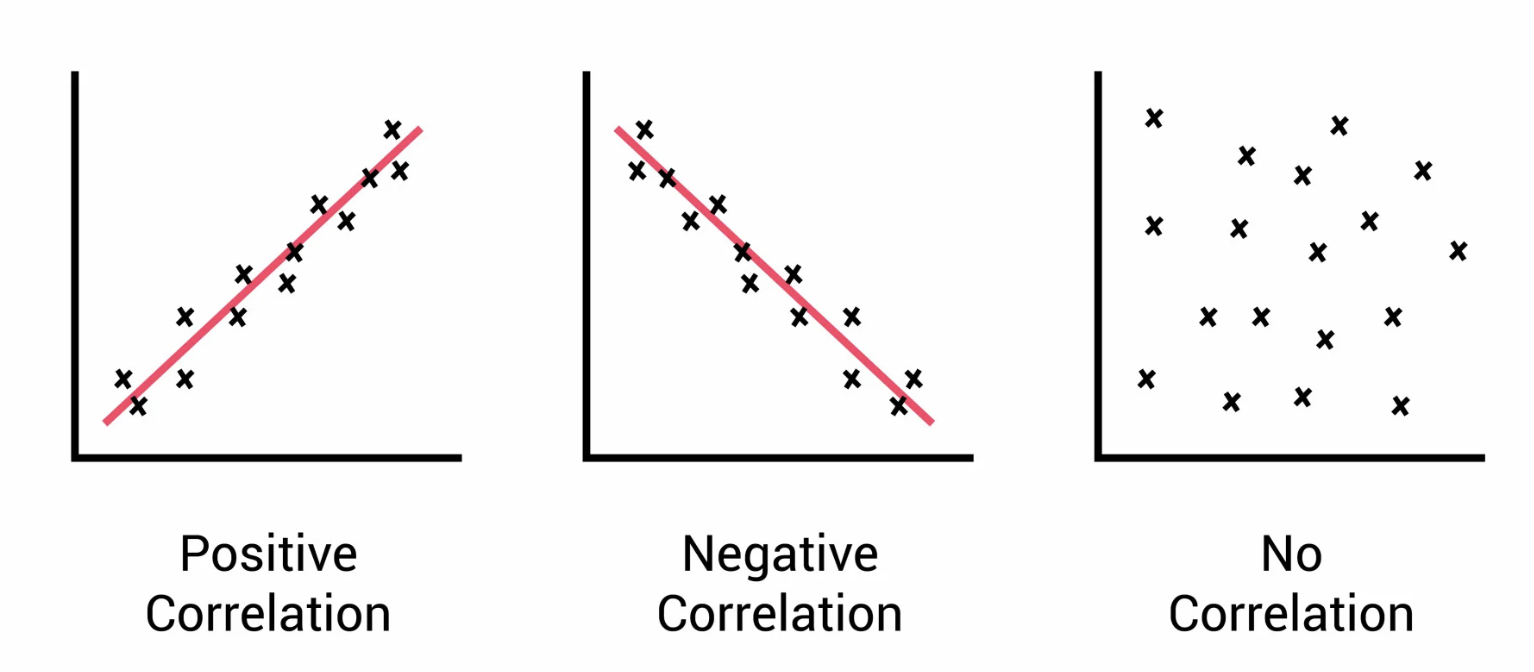
This technique is used to compare the connection between 2 variables.
You can use an interview/questionarre to gather information. Then, you can write out your information and and look for a connection between the variables. Then, you can check your hypotheses by plotting the information on a scatter graph and looking at the correlations.
Positive Correlation
Each variables (x,y) increase together
Example: Happiness increases with age
Negative Correlation
As one increases, another decreases
Example: Productivity lowers with lack of sleep.
No Correlation
No connection between IV and DV
The shoe size of a sample of individuals does not correlate with their IQ
Observations
Psychologists observe people and measure their behaviour in the most precise way possible.
Here are the types of observations:
Naturalistic
Conducted in an everyday enviroment where participants can behave normally.
Controlled/Lab
Conducted in a lab
Overt vs Covert
Overt - Participants know that they are being studied
Covert - Participants are not aware that they are being studied
Participant
Observer becomes part of the group they are studying
Non - participant
Observer takes a step back from the group.
Case Studies
Case studies are a specific research study on 1 person
Example - Kitty Genovese
Other Information:
May include open - ended information
Secondary information can be collected.
Very detailed