Lesson 2: Cardiac Action Potential: Myocyte
Cardiac Action Potential Overview
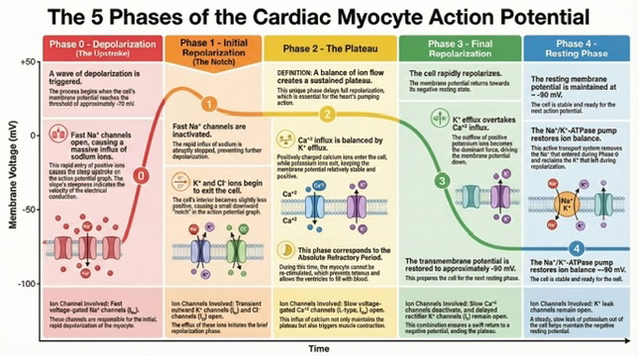
Unique to cardiac myocytes: plateau phase prolongs depolarization, enabling effective heart contraction.
Phases of Myocyte Action Potential
Phase 0 - Depolarization: Na+ influx. Threshold potential at -70 mV activates fast voltage-gated Na+ channels.
Phase 1 - Initial Repolarization: K+ efflux and Cl- influx. Inactivation of Na+ channels.
Phase 2 - Plateau: Ca2+ influx counters K+ efflux, maintaining depolarization; prolongs absolute refractory period.
Phase 3 - Final Repolarization: K+ efflux dominates; repolarization restores transmembrane potential to -90 mV.
Phase 4 - Resting Phase: Maintenance of resting potential at -90 mV via K+ leak channels and Na/K-ATPase function (removes Na+, replaces lost K+).
Ionic Movements Summary
Phase 0: Na+ in.
Phase 1: Cl- in & K+ out.
Phase 2: Ca2+ in & K+ out.
Phase 3: K+ out.
Phase 4: K+ out & Na/K-ATPase function.