Physics - 12 Wave Properties - Required Practical 8: Investigating Plane Waves in a Ripple Tank and Waves in a Solid
Activity 1: Investigating Plane Waves in a Ripple Tank
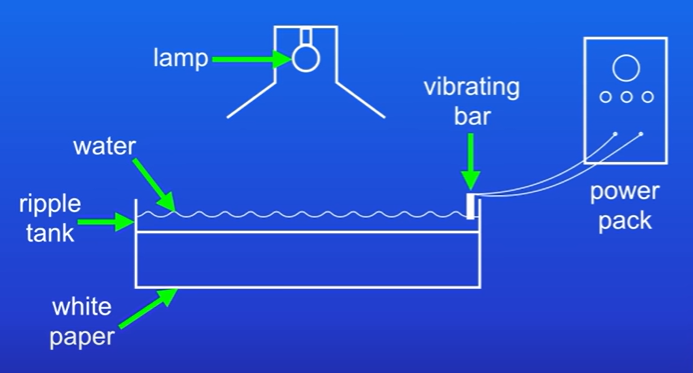
Aims:
use a ripple tank to measure the wavelength, frequency and speed of water waves
Risk Assessment:
Safety:
Equipment:
ripple tank and accessories (lamp, bar)
low-voltage supply
metre rule/ruler
white paper
video camera (with video editing software)
stopwatch
Control variables:
distance of lamp from ripple tank
distance of ripple tank from paper
Independent variable:
Dependent variable:
Method:
For the wavelength:
Lay a ruler perpendicular to the shadows of the wavefronts on the white paper
Using a video camera, record the waves moving past the ruler. Screenshot a still image from the video
Find the wavelength of one wave by dividing the length of 10 wavelengths by 10
For the frequency:
Place the stopwatch next to the setup of ruler and ripple tank. Draw an arrow on the white paper at a fixed point
Start to record a video of the setup. Start the stopwatch and let it run for 10 seconds, then stop filming
Put the video in slow motion and count the number of waves that pass the arrow in the 10 seconds. Find the frequency of the waves by dividing this by 10
Calculations & graphing:
calculate the speed of the waves using v = fλ (multiplying together the two values recorded)
Activity 2: Investigating Waves in a Solid
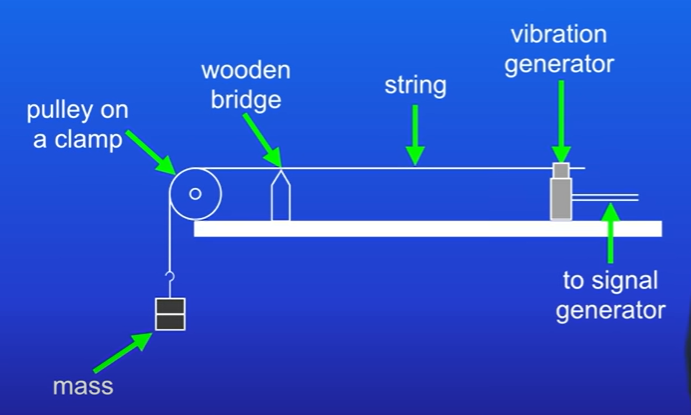
Aims:
measure the wavelength, frequency and speed of waves in a solid
Risk Assessment:
Safety:
Equipment:
vibration generator
power signal generator
string/elasticated cord
wooden bridge
pulley on a clamp
masses and hanger
metre rule
Control variables:
Independent variable:
Dependent variable:
Method:
Turn on the signal generator to cause the string to vibrate. Adjust the frequency until you reach a standing wave of one wavelength. Record this frequency
Using the metre rule, measure the distance from the wooden bridge to the vibration generator. This is the wavelength of the wave
Calculations & graphing:
calculate the speed of the waves using v = fλ (multiplying together the two values recorded)